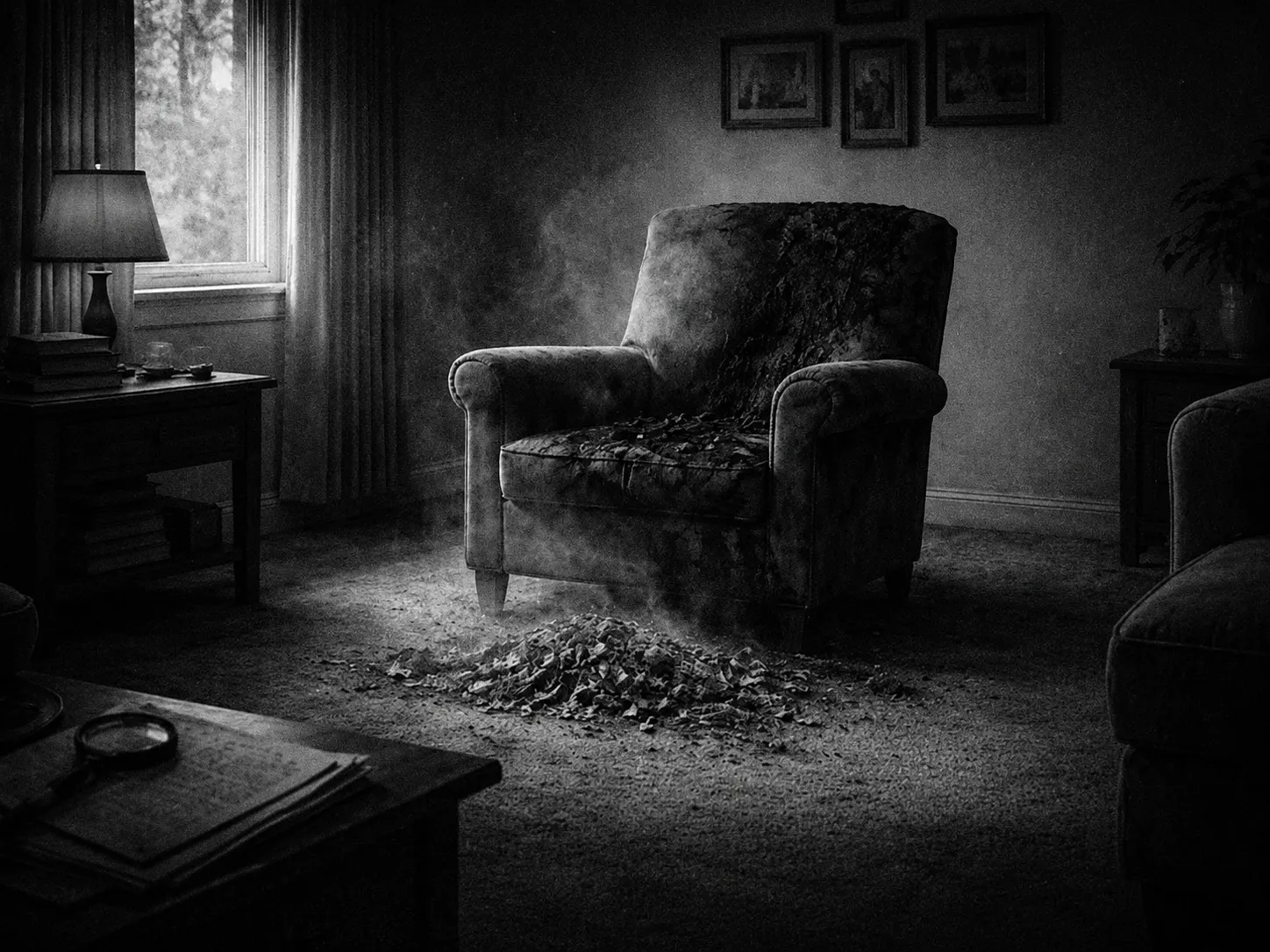
For almost three centuries, the strange phenomenon of Spontaneous Human Combustion was mentioned in medical journals, courtrooms, and campfire stories. It describes a death so unusual that even experts have struggled to explain it: a person is reduced almost entirely to ash in their own home, while the chair, carpet, and nearby walls show little sign of fire.
But how can a body burn hot enough to destroy bone while a nearby newspaper remains untouched? This question still puzzles people today. For answers, it’s important to look at what the phenomenon is, where it started, and what investigators have discovered after examining these cases closely.
Summary
What Is the Spontaneous Human Combustion Phenomenon?
Spontaneous Human Combustion (often shortened to SHC) describes cases in which a human body is reported to have caught fire and burned severely without any identifiable external source of ignition — no dropped match, no faulty wiring, no nearby flame that investigators could point to.
The body is typically destroyed almost completely, sometimes reduced to ash and bone fragments, while the surrounding room, furniture, and nearby flammable materials show little or no fire damage.
Across the few hundred cases recorded since the early 1700s, investigators and writers have noted a frequent set of features:
- Intense, localized destruction. The torso and head are usually consumed almost entirely, sometimes leaving only a small pile of ash.
- Spared extremities. Hands, feet, and lower legs are often found mostly intact, even when the rest of the body is gone. This detail appears in several of the most well-known cases.
- Minimal damage to the immediate environment. Walls, ceilings, and even nearby fabric or paper often stay untouched, even though it takes a lot of heat to destroy human bone.
- A greasy soot or residue sometimes coats nearby surfaces, generally attributed to rendered body fat.
- A lone victim. Almost every alleged case involves someone found alone, frequently elderly, infirm, or otherwise unable to move quickly.
The term itself dates back to the mid-1740s, when Paul Rolli, a fellow of London’s Royal Society, translated and published an Italian case for the Royal Society’s Philosophical Transactions.
Today, the scientific community treats Spontaneous Human Combustion as a pseudoscientific label rather than a real, independent biological process.
Most forensic experts believe that every closely examined case involves some outside source of ignition that was missed or not recorded at the time, such as a cigarette, a fireplace ember, or a candle. This, combined with a slow-burning process called the “wick effect” (explained later), is thought to explain these events. Still, the cases and the real mystery investigators faced are worth looking at on their own.
A History of Spontaneous Human Combustion: Three Centuries of Documented Cases
The earliest references to people apparently bursting into flame are difficult to verify and are generally treated by historians as folklore. One frequently repeated account describes an Italian knight, sometimes named Polonus Vorstius, said to have burst into flame after a night of heavy drinking.
The story was recorded in the mid-1600s by the Danish anatomist Thomas Bartholin in his collection of anatomical curiosities. Still, the date of the supposed original event, along with most of its details, varies between retellings, and it should be read as a legend rather than a documented case.
Countess Cornelia Bandi (1731)
The case most historians point to as the true starting point of the Spontaneous Human Combustion debate is that of Countess Cornelia Zangari Bandi of Cesena, Italy.
In March 1731, the 62-year-old noblewoman was found by her maid reduced to a pile of ash and greasy soot in her bedroom. Her lower legs, still in their stockings, were untouched, along with three blackened fingers and part of her skull. A thick, foul-smelling residue coated the walls and ceiling, yet the bedding itself was barely disturbed. A small oil lamp in the room was found empty but intact.
The clergyman Giuseppe Bianchini investigated and published an account of the case, ruling out the supernatural and a lightning strike, and proposing instead that excessive internal heat combined with the countess’s habit of rubbing alcohol-based remedies on her skin had ignited her from within.
When Paul Rolli translated Bianchini’s account for the Royal Society in the mid-1740s, the case entered the English-speaking scientific world and gave the phenomenon its name. It would go on to influence one of literature’s most famous fictional depictions of the phenomenon more than a century later.
You may also enjoy:
9 Haunted Houses in Arizona That Hold Terrifying Secrets
October 7, 2025
Who Is Cimejes, the Twentieth Demon in the Ars Goetia?
November 13, 2025
Dajjal, the One-Eyed Antichrist Who Deceives the World
October 3, 2025
Complete Guide to Vermont Bigfoot Sightings (1861–2025)
August 8, 2025
Top 11 Most Haunted Houses in Delaware
December 1, 2025
The Victorian Era and Charles Dickens’s Bleak House
By the 19th century, dozens of similar deaths had been reported in Europe and North America, and the phenomenon became closely linked to ideas about morality and alcohol.
Victims were often described as elderly, overweight, and “habitually drunken,” with more cases involving women than men. At the time, people believed that a body full of alcohol should be flammable, and a fiery death was seen as a fitting punishment for a life considered immoral, even though this idea was not scientific.
This idea found its most famous expression in Charles Dickens’s 1853 novel Bleak House, in which the alcoholic rag-and-bottle dealer Krook dies by spontaneous combustion, leaving behind little more than a sooty residue and a small pile of ash.
Critics accused Dickens of lending credibility to something with no real scientific basis, but he defended the scene by pointing to historical research describing roughly 30 known cases. The controversy helped cement Spontaneous Human Combustion in the public imagination for generations, well past the point where most scientists had begun dismissing it.
Mary Reeser (1951)
One of the most thoroughly investigated cases of the 20th century involved Mary Hardy Reeser, a 67-year-old widow living in St. Petersburg, Florida.
On the morning of July 2, 1951, her landlady, Pansy Carpenter, arrived with a telegram and found the metal doorknob to Reeser’s apartment uncomfortably hot. Inside, firefighters discovered that Reeser had been almost completely incinerated in her armchair.
Her estimated 175-pound body had been reduced to less than 10 pounds of remains, including a shrunken skull, part of her spine, and one foot still inside its slipper. The chair she sat in and a side table were destroyed, but the rest of the small apartment showed only light soot on the upper walls; nearby, the curtains, the bed, and most of the furniture were untouched.
The case drew national attention, and St. Petersburg’s police chief, J. R. Reichert, sent evidence, including glass fragments, fabric, and what were thought to be teeth to the FBI for analysis.
In August 1951, the Bureau reported that there were no chemical accelerants. They concluded that Reeser, who had taken sleeping pills and smoked, probably fell asleep with a lit cigarette. Her body fat then fueled a slow, smoldering fire, which is now known as the wick effect.
Wilton M. Krogman, a physical anthropologist, consulted on the case and was reportedly troubled by the fact that Reeser’s skull had survived in shrunken form rather than exploding, as is typical in fires hot enough to cremate a body, and was not fully convinced by the conventional explanation.
No criminal cause was ever established, and the case file was eventually closed without a definitive resolution.
Dr. John Irving Bentley (1966)
On the morning of December 5, 1966, a gas meter reader named Don Gosnell entered the Coudersport, Pennsylvania, home of 92-year-old retired physician John Irving Bentley. In the basement, Gosnell found a small pile of ash on the floor and noticed a hole burned through the ceiling above him.
Following the smoke upstairs, he found a hole roughly two feet by four feet burned through the bathroom floor. All that remained identifiable of Dr. Bentley was a lower leg and foot near the hole; his aluminum walker leaned against the bathtub, and a partially burned bathrobe lay inside it.
Bentley was known to smoke a pipe and had a history of accidentally scorching his clothing. Investigators theorized that he had fallen asleep smoking, then walked to the bathroom after his robe caught fire, collapsing before he could extinguish the flames. The flammable linoleum floor and the open structure of the house beneath it were thought to have helped sustain a smoldering fire long enough to burn through the floorboards.
A local fire marshal officially listed the death as Spontaneous Human Combustion, and the case is still one of the most discussed examples in SHC literature.
For decades, researchers have debated it: some support the wick-effect explanation, while others, like SHC researcher Larry Arnold, argue that the amount of destruction is difficult to explain with such a slow-burning process.
Jeannie Saffin (1982)
Most alleged SHC cases are reconstructed after the fact from a burned scene, but the death of Jeannie Saffin is unusual because it was witnessed as it happened. On the evening of September 15, 1982, the 61-year-old, who had intellectual disabilities, was sitting in the kitchen of her family’s home in Edmonton, North London, with her elderly father, Jack Saffin.
He reported seeing a flash of light and turning to find his daughter engulfed in flames around her face, hands, and torso. His son-in-law, Donald Carroll, ran in and described flames roaring from her midsection and mouth. The two men extinguished the fire with water, and Saffin was taken to the hospital, where she died eight days later from burn-related complications.
Witnesses noted that the kitchen and even most of Saffin’s clothing showed little damage, and the wooden chair she sat in was untouched. The coroner, Dr. John Burton, gave an open verdict and clearly stated that Spontaneous Human Combustion does not exist.
A police investigation found no clear ignition source. However, later analysis suggested that hospital records showed Saffin’s mouth was undamaged — contradicting claims that flames had come from inside her — and that the most likely explanation was an ember from her father’s pipe igniting her synthetic cardigan, which would have burned and melted quickly enough to create the appearance of flames erupting from her body.
You may also enjoy:
Lilith: First Wife of Adam, Queen of Hell
August 22, 2025
Why the Kitsune Is the Most Dangerous Yokai in Japanese Folklore
September 10, 2025
Who Is Pazuzu? The Terrifying Demon of Mesopotamia
August 26, 2025
Who Is Vapula? The Lion-Winged Demon of Hell
August 28, 2025
Michael Faherty (2010)
The most recent widely reported case took place in Ballybane, Galway, Ireland. In the early hours of December 22, 2010, a neighbor’s fire alarm led to the discovery of smoke pouring from the home of 76-year-old Michael Faherty.
Firefighters found his body in the sitting room, almost completely burned, with his head positioned near an open fireplace that had been lit earlier that night. Fire damage was confined almost entirely to the floor beneath him and the ceiling directly above; the rest of the room, including nearby furniture, was untouched, and no trace of an accelerant was found.
Pathologist Grace Callagy, who noted that Faherty had Type 2 diabetes and high blood pressure, was unable to determine an exact cause of death given the extent of the burns.
At the September 2011 inquest, West Galway coroner Dr. Ciarán McLoughlin said he had researched the matter extensively and consulted forensic pathology literature, noting that many alleged SHC cases happened near open fireplaces or chimneys.
After a thorough investigation, he concluded that he had no explanation except to classify it as Spontaneous Human Combustion. This was the first time an Irish coroner gave such a verdict, and one of the few times anywhere that a government official has formally listed the phenomenon as a cause of death.
The Wick Effect
The most widely accepted forensic explanation for these cases is called the wick effect, a theory usually credited to British pathologist Gavin Thurston in the early 1960s. The idea is that a clothed human body acts like an inside-out candle. An external flame, such as a cigarette ember, a spark from a fireplace, or a dropped match, ignites a person’s clothing.
As the fire smolders, it melts the body’s subcutaneous fat, which is absorbed by nearby fabric (clothing, upholstery, or carpet) the same way melted wax is drawn up a candle’s wick. That fat-soaked fabric then burns slowly and steadily, generating intense, sustained heat focused tightly on the body itself rather than spreading outward, since the flame stays low and the available fuel is concentrated in one place.
This process would explain several common features in reported SHC cases. The destruction of bone, which usually requires much higher temperatures than a normal house fire, can occur if a smoldering fire lasts for hours rather than minutes.
Extremities like hands and feet, which have less fat, are more likely to survive. Also, because the fire does not become large enough to ignite the entire room, nearby furniture and walls often remain largely undamaged.
The theory was tested directly in 1998, when forensic scientist John DeHaan experimented with the BBC science series QED. Researchers wrapped a pig carcass of roughly 95 kilograms in a cotton blanket, placed it in a furnished mock living room, and ignited the blanket with a small amount of petrol. The carcass burned for several hours, eventually destroying most of the torso and bones, while the legs — proportionally less fatty — were comparatively spared.
The fire generated enough sustained heat to melt a nearby television, yet caused only modest damage to the rest of the room. The results offered the strongest experimental support to date for the idea that a slow, self-sustaining, fat-fueled fire could replicate the central mystery of SHC cases: severe bodily destruction paired with minimal surrounding damage.
Not all researchers agree that the wick effect explains everything. Critics, such as independent SHC researcher Larry Arnold, point to cases like Dr. Bentley’s, in which the destruction seemed to occur very quickly or in which no clear ignition source was found. They argue that lab experiments do not fully match the speed and pattern seen in some real cases.
Other Proposed Explanations
Beyond the wick effect, several other theories have been put forward over the years to explain what might trigger or sustain these fires.
In 2012, British research biologist Brian J. Ford proposed that a metabolic state called ketosis — in which the body burns fat instead of carbohydrates for energy — could be a contributing factor. Ketosis, which can be brought on by alcoholism, diabetes, very low-carbohydrate diets, or even teething in infants, produces acetone, the same flammable compound found in nail polish remover.
Ford soaked pork tissue in acetone and built small-scale model bodies from it, finding that the tissue ignited readily from a small spark and burned intensely enough to reduce simulated bone to ash, while leaving leaner extremities, which would have absorbed less acetone, relatively intact. Ford has been careful to describe this as a plausible contributing mechanism rather than a proven cause, and it has not been independently replicated in peer-reviewed research at the same scale.
In the nineteenth century, writers often blamed alcohol, thinking that a body full of spirits would become flammable. Modern toxicology does not support this, since blood alcohol levels never get high enough to keep a fire going.
Other historical and fringe theories have included static electricity, internal bacterial or gas buildup, and, in the case of researcher Larry Arnold, fluctuations in the Earth’s geomagnetic field. None of these has gained meaningful support within mainstream forensic science.
In a small number of cases, severe burn-like skin damage with no clear fire source may be linked to rare medical conditions rather than fire at all. Stevens-Johnson syndrome, a serious skin reaction sometimes triggered by medications, can cause blistering and tissue damage that superficially resembles burns, and some researchers have suggested it may account for a handful of historical reports mistaken for combustion.
You may also enjoy:
Forneus: The Terrifying Sea Demon of the Ars Goetia
August 21, 2025
Hillbilly Beast of Kentucky: What Boone Really Saw
June 30, 2025
Stanley Hotel Haunting: What Really Inspired The Shining?
October 21, 2025
Why Most Forensic Scientists Reject Spontaneous Human Combustion as a Real Phenomenon
The current scientific consensus has that every closely examined case attributed to Spontaneous Human Combustion involved an external ignition source that was simply overlooked, undocumented, or impossible to identify after the fact, rather than a body igniting through some unknown internal process. Several patterns support this conclusion.
Forensic investigators, including skeptic Joe Nickell, have noticed that alleged victims often share similar traits: most are elderly, in poor health, or have limited mobility, and are found alone, usually near something that could start a fire, like a fireplace, cigarette, or candle.
This combination—being less able to react quickly and having a nearby flame—is exactly what the wick effect needs. It also explains why no one has ever been recorded or filmed starting to burn without first being near a source of fire.
It is also important to note that there are no verified videos, photos, or surveillance footage showing the actual start of an unexplained ignition, even though billions of people now have access to recording devices. Every known case has been reconstructed after the fact, using physical evidence and witness accounts of a fire already in progress. There has never been a documented instance of spontaneous ignition without an external cause.
Spontaneous Human Combustion in Literature and Popular Culture
Long before forensic science weighed in, Spontaneous Human Combustion had already secured a place in fiction. Beyond Dickens’s Bleak House, the device appears in the work of Mark Twain, Herman Melville, and Washington Irving, among others.
There are close to a dozen references to characters bursting into flame in fiction written before 1900, reflecting just how widely the idea had taken hold of the public imagination during the Victorian era.
The phenomenon never really left popular culture. It has shown up as a plot device in television series such as The X-Files, and inspired comic-book characters like Johnny Storm, the Human Torch, whose fictional power is a more heroic, controllable version of the same basic idea.
Crime procedurals have also used it as a teaching moment for the wick effect itself, with shows built around forensic investigation occasionally dramatizing a version of DeHaan’s pig experiment to walk characters — and viewers — through how a body could burn so completely without an obvious cause.
Frequently Asked Questions
Is Spontaneous Human Combustion real?
The scientific consensus is that it is not a real, independent biological process. Every case that has been closely investigated by forensic scientists points to an external ignition source combined with the wick effect, even when that source wasn’t immediately obvious at the scene.
How many cases of Spontaneous Human Combustion have been recorded?
Estimates vary depending on how strictly a case must be documented to count. Still, researchers generally cite a range of roughly 200 to a few hundred reported cases across Europe and North America over the past three centuries.
What is the most famous case of Spontaneous Human Combustion?
Mary Reeser’s 1951 death in St. Petersburg, Florida, is probably the most widely cited case, both because of how thoroughly it was investigated at the time — including direct involvement from the FBI — and because of how often it has been retold in books, documentaries, and online discussions since.
Has anyone ever survived an alleged case of Spontaneous Human Combustion?
Yes. A small number of people have survived being burned in incidents attributed to SHC, generally because bystanders were able to extinguish the flames quickly, limiting the damage to a much smaller portion of the body than in fatal cases.
What is the wick effect?
The wick effect is the forensic theory that a clothed human body can act like an inside-out candle once ignited: melted body fat soaks into nearby fabric, which burns slowly and sustains intense, localized heat for an extended period, while producing little damage to the surrounding area.
You may also enjoy:
Who Is Samael? The Angel of Death in Demonology
August 27, 2025
Is My Home Haunted or Just Old? How to Tell the Difference
September 5, 2025
January 14, 2026
New Mokele-Mbembe Sightings, Theories & Evidence
June 3, 2025
Sources
- Dickens, Charles. Bleak House. Bradbury and Evans, 1853.
- Bartholin, Thomas. Historiarum Anatomicarum Rariorum. Copenhagen, 1654.
- Arnold, Larry E. Ablaze!: The Mysterious Fires of Spontaneous Human Combustion. M. Evans, 1995.
- Heymer, John E. The Entrancing Flame: Facts of Spontaneous Human Combustion. Little, Brown, 1996.
- Nickell, Joe. Real-Life X-Files: Investigating the Paranormal. University Press of Kentucky, 2001.
- Pérez Pérez, Antonio & Vallejo, José Ramón. (2025). The Phenomenon of Spontaneous Human Combustion in Eighteenth and Nineteenth-Century Spain. Histories. 5. 39. 10.3390/histories5030039.