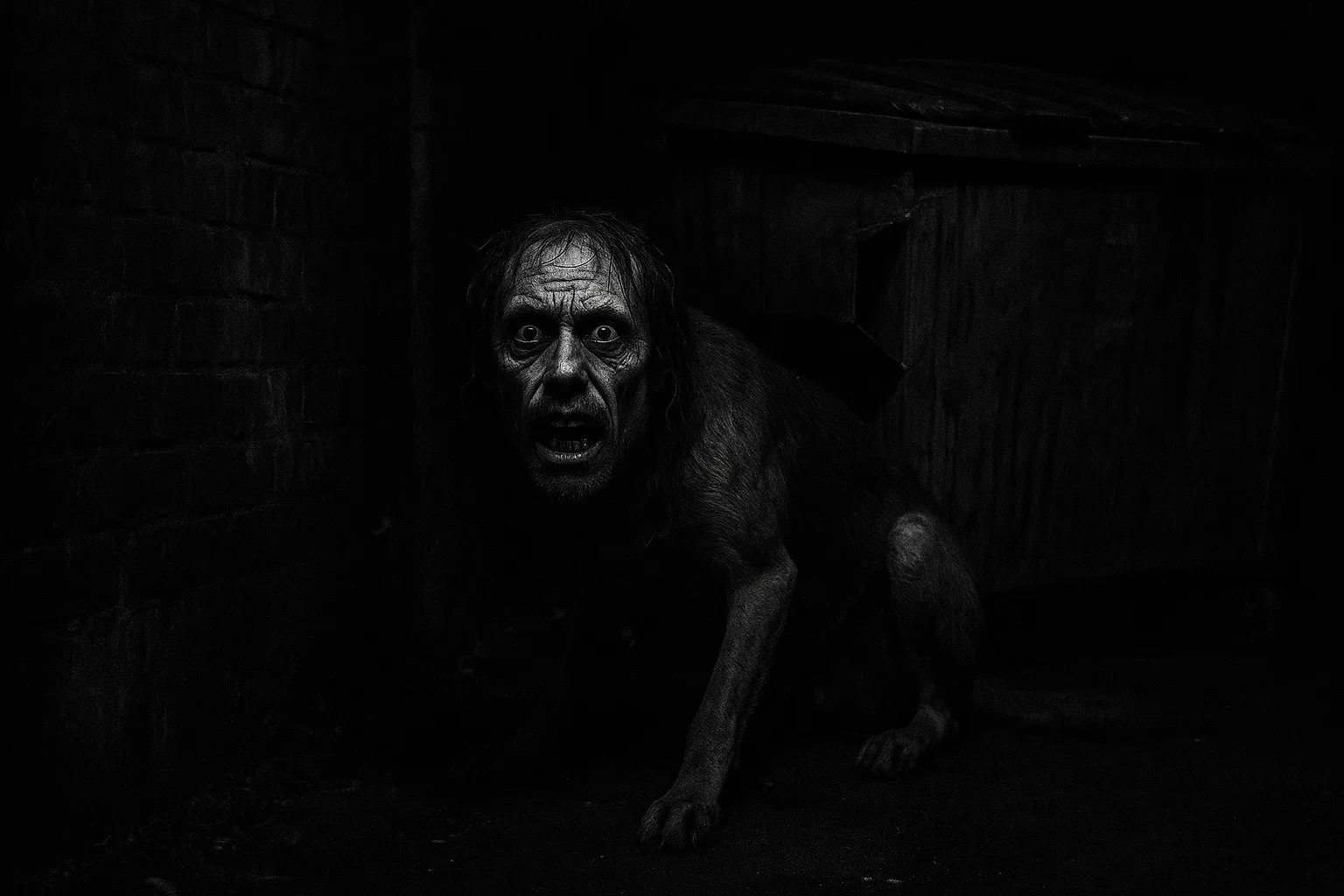
The Jinmenken is a Japanese creature — part dog, part human — whose face defies every law of natural biology. Unlike most yokai born from ancient mythology, the Jinmenken straddles two worlds: it has documented roots in Edo-period texts dating to 1810, yet its most explosive spike of sightings happened in 1989, the height of Japan’s economic bubble, when it terrorized highway drivers and alley workers across Tokyo.
The monster does not attack. It does not hunt. Instead, it speaks — and what it says is profoundly, almost tragically human: “Leave me alone.” That one phrase is what makes the Jinmenken unforgettable.
Summary
Overview
| Attribute | Details |
|---|---|
| Names & Etymology | Jinmenken (人面犬); no widely established alternative names; literally “human-faced dog” — jin (人) = human, men (面) = face/mask, ken (犬) = dog |
| Classification | Yōkai / Urban Legend (toshi densetsu); straddles both traditional supernatural folklore and modern urban legend categories |
| Species | Beast / Hybrid |
| Origin | In Edo-period lore, Jinmenken were said to be born from transgressions of the natural order — most commonly from human-animal contact, resulting in a puppy bearing a human face as a visible sign of karmic or biological corruption. A Buddhist interpretation holds that deeply immoral people are reincarnated in animal bodies, their human face the only remnant of what they once were. |
| Earliest Record | 1810 CE; documented in Gaidan Bunbun Shūyō by 19th-century historian Ishizuka Hokaishi, which records the birth of a human-faced puppy in the Tado-chō district of Edo (modern Tokyo), subsequently exhibited at a misemono sideshow |
| Habitat | Urban environments across Japan, particularly Tokyo and surrounding prefectures; found near alleyways, garbage bins, city parks, graveyards, and major expressways and highways at night |
| Diet | Omnivorous; primarily scavenges human food waste from trash bins and dumpsters, behaving like a common stray dog |
| Physical Details | Medium-sized canine body, roughly the proportions of a Shiba Inu; matted, unkempt fur; tail tucked submissively between the legs; face unmistakably human — most commonly resembling a weary, middle-aged or elderly man; eyes hollow and expressionless, lacking the reactive quality of an animal’s gaze; some accounts describe primate-like rather than fully human features, and rarer accounts note human hands in place of front paws |
| Strengths | Capable of human speech; extraordinary running speed (reported up to 100–130 km/h in modern accounts, allowing it to pace or overtake highway vehicles); induces severe psychological shock through its uncanny appearance; can blend in as a normal stray dog until approached at close range |
| Weaknesses | No known combat vulnerabilities; the creature’s defining behavioral weakness is its desire to be left alone — it actively flees human contact and will not pursue a person who withdraws. It holds no predatory intent, making avoidance the only reliable “countermeasure.” No specific ritual, amulet, or material is documented as effective against it in the original lore. |
| Warning | Do not approach stray dogs alone on Japanese urban highways or in city alleyways at night — if a dog turns to face you and its eyes carry no animal expression, do not engage, do not startle it, and do not make prolonged eye contact if you are behind the wheel of a vehicle |
| Threat Level | Level 1 (Nuisance) [See the Threat Level Guide] |
| Survival Odds | 99% (You will almost certainly survive the encounter — the Jinmenken wants nothing to do with you and will likely just tell you to leave it alone) |
Who or What Is the Jinmenken?
The Jinmenken (人面犬) is a creature from Japanese folklore and urban legend described as a dog in every physical respect — four legs, fur, canine body — except for one detail that makes witnesses freeze: its face is unmistakably human.
Most accounts describe the face as belonging to an older man, weary and expressionless, with eyes that carry the hollow sadness of something that doesn’t belong in either the human or animal world.
What sets the Jinmenken apart from most yokai is its temperament. Japan’s supernatural catalog is full of predatory, malevolent beings — the fox-spirit that deceives, the river-child that drowns its victims, the mountain wolf that devours travelers who stumble.
The Jinmenken does none of these things. It rummages through trash. It haunts the margins of cities. It runs along highways in the dead of night. And when confronted, it asks to be left alone.
The profound non-violence is not a minor footnote. It is the core of the creature’s cultural weight. The Jinmenken is classified both as a yokai — a supernatural entity in the traditional Japanese sense — and as an urban legend (toshi densetsu), making it one of the rare creatures in Japanese folklore to have successfully migrated from premodern scroll culture into the brightly lit anxiety of late 20th-century city life.
It is also considered a class of creature rather than a single individual: multiple Jinmenken are believed to exist simultaneously, roaming different city settings across Japan.
You may also enjoy:
Who Is Kimaris, the 66th Demon in Ars Goetia?
August 29, 2025
Bryce Hospital Haunting: Alabama’s Most Haunted Asylum
September 19, 2025
The True Horror Behind Medusa: Greece’s Most Terrifying Monster
October 30, 2025
Who Was Moloch, the Child-Devouring God?
August 26, 2025
Origin & Lineage
The Jinmenken’s documented history begins in the city of Edo — modern-day Tokyo — in the early 19th century. The most concrete early record comes from the Gaidan Bunbun Shūyō, a text compiled by the 19th-century historian Ishizuka Hokaishi, which describes the birth and following exhibition of a human-faced dog in the city.
According to this account, a litter of puppies was born in 1810 in the Tado-chō district of Edo, and one of the pups displayed a face described as strikingly human. The birth created an immediate public spectacle — the pup was acquired for display in a misemono, the Edo-period equivalent of a carnival sideshow, where exotic animals, biological curiosities, and fabricated monstrosities were exhibited to paying crowds hungry for the strange and sensational. The Jinmenken proved enormously popular.
A second Edo-period text, Waga Koromo, adds a darker origin story to the legend. It records a tale of a man suffering from syphilis who, having heard a folk rumor that intercourse with a dog could cure the disease, acted on it. The dog he encountered later gave birth to a litter, and one of the puppies bore a human face.
These origin accounts are geographically anchored in the Kantō region, particularly the Edo urban center. This matters because the Kantō region was, during the Edo period, the most densely populated and commercially active area in Japan — a place where misemono sideshows flourished, where tabloid-style woodblock print newspapers (kawaraban) circulated sensational stories, and where the border between spectacle and belief was deliberately blurred by showmen and storytellers alike.
The Jinmenken shares its conceptual neighborhood with several Kantō and broader Japanese canine yokai. The Inugami — a dog spirit deliberately created through ritual torture and starvation of a living dog — reflects the same cultural anxiety about corrupted dogs and transgressed spiritual boundaries, and is prominent in western Japan’s Kyushu and Shikoku regions.
The Okuri-inu, a predatory dog-yokai that stalks lone mountain travelers at night, occupies the same nocturnal, liminal territory as the Jinmenken but belongs to mountain pass folklore rather than urban space. What distinguishes the Jinmenken from both is its human face — the visible, undeniable marker of a soul trapped in the wrong body.
Buddhist philosophical threads run through the origin lore as well. Some Edo-era interpretations held that a Jinmenken was a human being reincarnated into an animal form as karmic punishment for moral failures in a previous life — a person so wicked, so impure, that they were born back into the world inside a dog’s body, their human face the only residue of what they once were.
Etymology
The name Jinmenken is composed of three kanji characters: 人 (jin), 面 (men), and 犬 (ken). Broken down literally, 人 means “person” or “human being”; 面 means “face,” “surface,” or “mask”; and 犬 means “dog.”
The compound, all things considered, translates with clean directness as “human-faced dog” — a descriptive name rather than a mythological one, which itself tells us something about the creature’s cultural status. It was not named after a deity, a legend, or a location. It was named after what it looked like.
The character 面 (men/omo) carries a richness worth dwelling on. In classical Japanese, men doesn’t just mean face in the physical sense — it is the same character used for noh theater masks, those carved wooden faces worn to embody spirits, gods, demons, and the dead.
A noh mask (men) is a face that is not your own, a surface that conceals the real self while projecting something supernatural outward. The Jinmenken’s name, viewed through this lens, doesn’t merely describe a dog with a human face — it describes a dog wearing the mask of a human, which gives rise to a greatly unnerving ambiguity: which face is the real one?
The character 犬 (ken/inu) shifts pronunciation depending on its position in a compound word, which is why the creature is called Jinmenken rather than Jinmeninu. In standalone usage, the Japanese word for dog is inu. Still, in compounds — particularly those with Chinese-derived (on’yomi) readings — ken is used. This gives the name a formal, nearly clinical register, as though it belongs in a taxonomic catalog rather than a ghost story.
Interestingly, several older texts and informal accounts use the hybrid pronunciation jinmeninu, grounding the creature in more native Japanese speech patterns and giving it a warmer, more colloquial feel — closer to a neighborhood stray than a classified specimen.
There is no meaningful dialectal variation in the name throughout regions of Japan. The creature’s name remained remarkably stable across its documented history, implying it was never profoundly regionalized — it was always, conceptually, an urban creature belonging to no single prefecture.
What Does the Jinmenken Look Like?
The baseline description, consistent throughout both the Edo-period records and modern urban legend accounts, is deliberately understated: from a distance, a Jinmenken looks like an ordinary stray dog.
The body is canine — medium-sized, roughly the proportions of a Shiba Inu, with fur that tends toward the matted and unkempt. The tail is typically described as placed between the legs, a posture of submission or cowering. Nothing about the silhouette would register as abnormal.
The horror is entirely in the face.
Up close, the face is unmistakably human — most commonly described as resembling a middle-aged or elderly man, with sunken, sorrowful eyes that seem to look through the observer rather than at them. The expression is almost uniformly described as exhausted.
One Edo-era account, preserved in later compilations, describes a man encountering a Jinmenken at a misemono exhibition: the animal seated in the corner of its enclosure, and when it looked up, the witness noted that the eyes were not the bright, reactive eyes of an animal — they had the empty, inward gaze of someone who had stopped expecting anything from the world.
Some accounts — particularly the older Edo-period ones — describe the face as resembling a monkey more than a pure human, with primate-like features. This detail is significant, as it opens the possibility that some Edo-period Jinmenken sightings were simply misidentified primates such as Japanese macaques (Macaca fuscata), which bear hard to ignore facial resemblances to humans and were sometimes displayed in misemono shows.
A little-known physical detail from deeper folkloric accounts: certain Jinmenken are described as having human hands in place of their front paws. Not paws that resemble hands — actual, articulated human hands emerging from the dog’s forelegs.
Modern media — particularly the Yo-kai Watch franchise, where the Jinmenken appears as the comedic character Manjimutt — depicts the creature as pudgy, cartoonish, and expressive.
The eyes are large and warm. The earliest lore gives the opposite: a thin, wretched animal whose eyes are the most disturbing thing about it precisely because they don’t react the way an animal’s eyes should. No warmth. No curiosity. Just the dull stare of something that has seen too much of the world from the wrong side of it.
You may also enjoy:
Complete Guide to Oregon Bigfoot Sightings (1904–2025)
August 6, 2025
What Is the Agogwe? The Mysterious Hairy Dwarf of East Africa
November 10, 2025
The Lernaean Hydra: Greek Myth’s Deadliest Creature
October 28, 2025
Who Is the Demon Caim in the Ars Goetia?
August 20, 2025
Fenrir: The Bound Beast Waiting for Ragnarök
September 12, 2025
Myths, Legends, and Stories
The stories surrounding the Jinmenken are preserved across two distinct yet linked traditions: the Edo-period documentary and tabloid accounts recorded in texts such as Gaidan Bunbun Shūyō, and the modern urban legend cycle that exploded across Japan between 1989 and 1992, spread through radio broadcasts, schoolyard whispers, and television variety programs.
The 1810 Sideshow Birth
The earliest documented narrative involving a Jinmenken centers on its 1810 appearance in the Tado-chō district of Edo. According to Ishizuka Hokaishi’s account, a female dog gave birth to a litter of puppies, one of which bore a human face. A misemono operator acquired the creature and put it on public display, where it became a celebrated attraction.
The creature was exhibited not simply as a freak but as a portent — the Edo period was rife with the belief that abnormal births signaled a cosmological disturbance.
A human-faced dog fit neatly into a centuries-old tradition of interpreting biological aberrations as messages from the unseen world. The historical record does not tell us what eventually became of the creature.
The 1989 Highway Panic
The most widely known modern incarnation of the Jinmenken legend began circulating in Japan in late 1989, reaching critical mass after it was featured on the popular Fuji TV variety program Paradise GoGo!! in September of that year. The form this version took was built for the speed of an industrialized society: not a sideshow curiosity, but a highway predator.
The story runs as follows. A driver on one of Tokyo’s expressways — typically the Tokyo Metropolitan Expressway — notices a dog in the emergency lane late at night. Unnerved, they accelerate. The dog accelerates too.
They push the car to 100 km/h. So does the dog. The driver floors it, managing to pull ahead — and then, in the rearview mirror or directly alongside the car, the dog turns its head and looks back. The face is human. In many versions of the story, the creature’s eyes meet the driver’s eyes, and the driver loses control of the vehicle.
This version of the legend — the highway runner — carried real menace. It wasn’t asking to be left alone. It was chasing.
The Trash-Eating Encounter
The second major narrative form is almost darkly comedic in contrast. In this version, a restaurant worker, delivery driver, or late-night-time passerby encounters what appears to be a stray dog rooting through a garbage bin or dumpster in an alleyway. They approach it to shoo it away — or simply get closer out of curiosity. The dog turns around. Human face. And then it speaks, in a flat, irritated human voice: “Hottoite kure.” Leave me alone.
This version became so widespread that it entered a kind of folklore shorthand — the image of the Jinmenken interrupted at its trash dinner and responding with the weary aggression of someone who just wants to eat in peace became, paradoxically, both frightening and absurd. It is one of the only creatures in Japanese urban legend history that functions simultaneously as a horror icon and a dark-comedy punchline.
The Deliberate Social Experiment
What makes the 1989 explosion of Jinmenken sightings undeniably remarkable in the history of folklore is the documented evidence of deliberate human engineering behind it. Japanese writer Motoaki Ishimaru has spoken openly about his role in spreading the rumor to study how misinformation propagates through society.
What’s more, members of a university urban legend club are documented as having approached schoolchildren while dressed in white lab coats, asking: “Have you seen a dog with a human face? It escaped from our research facility.”
A year later, the rumor had become national news. The iconic phrase “Leave me alone” was itself reportedly an ad-lib, added to give the story what its architects called “surreal realism.” The Jinmenken, in other words, is one of the rare folklore creatures where we can actually trace the deliberate hand of myth-creation — which makes it, if anything, a more fascinating specimen of cultural psychology, not a less credible one.
The Syphilis Origin Tale
The Edo-period text Gaidan Bunbun Shūyō preserves what is arguably the most disturbing origin narrative in the Jinmenken canon. A man afflicted with syphilis, having heard a folk remedy that claimed intercourse with a dog could cure the disease, acted on it. The dog later gave birth to a puppy bearing a human face — the visible consequence of a violated boundary between species.
This story isn’t merely grotesque for shock value; it expresses a specific Edo-period logic about how the natural order can be corrupted. In this system, the Jinmenken is not a supernatural visitation or a damned spirit — it is a biological punishment, a creature that exists because a human being did something that made it exist.
You may also enjoy:
Is My Home Haunted or Just Old? How to Tell the Difference
September 5, 2025
The Lobizon Legend: Werewolf, Curse, or Cryptid?
May 17, 2025
Is the Bragg-Mitchell Mansion in Alabama Really Haunted?
September 3, 2025
Agares: The Duke of Hell Who Commands Earthquakes
April 22, 2025
The Winchester Mystery House Haunting: The Real Story
October 23, 2025
Can You Defeat a Jinmenken? Powers & Weaknesses
The short answer, according to every strand of Jinmenken lore across all periods, is: there is no meaningful framework for defeating a Jinmenken, because the creature does not operate on the logic of a threat.
This is what makes the Jinmenken genuinely unusual in the sphere of Japanese supernatural creatures. The Inugami is created to harm and must be ritually managed. The Okuri-inu stalks and kills and must be neutralized through certain protocols of courtesy and food offering. The Kappa has documented pressure-based vulnerabilities.
But the Jinmenken has no hunting mechanism to defeat, no magical engine to disrupt, because it is not fundamentally hunting anything. Its power, such as it is, operates entirely through the mechanism of witnessing — through being seen and seeing back.
The highway variant of the legend hints at something more ominous. The Jinmenken running alongside a car doesn’t physically attack the vehicle; the crashes that occur happen when the driver, after seeing the human face, loses control.
The creature’s “weapon” is the uncanny itself — the cognitive disruption of encountering something that should not biologically exist, looking at you with the eyes of a person. It is, in a sense, a creature that can only harm those who are unprepared for the philosophical shock of its face.
Some accounts from the 1980s urban legend cycle elaborated more dangerous properties onto the Jinmenken during the height of the sighting panic. Rumors circulated that the creatures could run faster than 130 km/h. That they could leap over six meters. That their excrement was green and toxic.
Most dramatically, certain schoolyard versions held that if a Jinmenken bit a person’s arm or leg, that limb would need to be amputated — or worse, that the bitten person would themselves begin to transform, slowly developing the human-faced dog’s features. These exaggerated attributes should be understood as the organic escalation of legend under social pressure, not as established folkloric properties.
The one consistent “weakness” registered across both the Edo-period and modern accounts is the Jinmenken’s pathological desire to be left alone. It doesn’t want engagement. It actively flees human contact.
Every documented narrative in which the creature speaks involves it communicating some version of rejection — go away, don’t look at me, leave me alone. If this constitutes a vulnerability, it is the vulnerability of any creature that has already surrendered: you cannot threaten something that has already given up on being seen as anything other than wrong.
In the Buddhist karmic reading of the creature, there is no “defeating” it at all. The Jinmenken is not an enemy — it is a consequence. A soul paying off a debt it accumulated in a prior lifetime, trapped in a dog’s body with a human face as the mark of what it once was. The appropriate response, in this system, is not hostility but pity — possibly even prayer.
Jinmenken vs Other Monsters
| Creature & Lore | Danger Level | Details |
|---|---|---|
| Inugami (Japan) | Severe. A deliberately created dog spirit, summoned through ritual starvation and decapitation of a living dog, bound to a family line and weaponized to curse enemies, cause illness, or destroy rivals. | The Inugami’s true form is a desiccated, mummified dog head kept hidden in a secret shrine inside the owner’s home — what appears in public is just the spirit’s projection, not its actual body. |
| Okuri-inu (Japan) | High. Stalks lone travelers silently along mountain roads at night, waiting for a single stumble or fall as the trigger to attack and devour its victim on the spot. | The Okuri-inu can be neutralized by a specific act of social grace: upon arriving home safely, leaving out a dish of food for it as thanks effectively transforms the predator into a reluctant escort. |
| Psoglav (Serbia / Balkans) | Severe. Digs open graves to feed on human corpses, and will attack and cannibalize living people it encounters in or near burial sites and caves. | The Psoglav possesses iron teeth — a detail that inverts Balkan protective folklore, since iron was considered a warding material against evil spirits, making this creature’s jaws built from the very thing meant to repel it. |
| Cynocephali (Medieval Europe / Ancient Greece) | High. Described in medieval travel accounts as tribal races of dog-headed men who communicated through barking and were reported to consume human flesh on the fringes of the known world. | Saint Christopher was depicted in certain Eastern Orthodox icons and apocryphal texts as a dog-headed man before his conversion to Christianity — a tradition the Western Church rejected but which persisted in Cappadocian iconography well into the 17th century. |
| Wulver (Scotland — Shetland) | Low. Does not molest humans who do not molest it, and has been documented in Shetland tradition as actively leaving fish on the windowsills of impoverished local families. | The Wulver is one of the few wolf- or dog-headed creatures in European folklore classified as genuinely benevolent — folklorist Jessie Saxby recorded it in the 19th century as a distinct entity from werewolves, with no transformative cycle. |
| Black Shuck (England — East Anglia) | Medium. Appears as a massive black dog with burning eyes near churchyards and coastal roads, and sighting it is traditionally understood as a death omen for the witness or someone close to them. | The name “Shuck” derives from the Old English word scucca, meaning “demon,” and the creature’s most famous documented appearance — at St. Mary’s Church in Bungay, Suffolk, in 1577 — was recorded in a contemporary pamphlet as having killed two parishioners and left scorch marks on the church door. |
| Barghest (England — Yorkshire) | High. A shape-shifting phantom dog with saucer-like eyes that materializes in Yorkshire’s darkest lanes and crossroads specifically to foreshadow imminent death for those who encounter it. | Unlike Black Shuck, which is primarily a passive omen, the Barghest is recorded in Yorkshire folklore as an active shape-shifter capable of taking non-canine forms — including that of a bear or a headless figure — to disorient its victims before revealing its true form. |
| Cŵn Annwn (Wales) | Severe. A pack of spectral white hunting hounds with red-tipped ears that rides across the sky with the Wild Hunt, pursuing the souls of the dead and sometimes claiming the living who cross their path. | In Welsh tradition, the Cŵn Annwn’s sound is counterintuitive: the closer the pack, the quieter it becomes — the loudest howling means they are distant and you are safe, while terrifying silence means they are directly overhead. |
| Xolotl (Aztec Mexico) | Medium. Not a predator but a psychopomp deity: a dog-headed god who escorted the souls of the dead through the nine dangerous layers of Mictlán, the underworld, and whose failure would leave a soul permanently lost. | Xolotl wept so desperately to avoid the gods’ self-sacrifice that, according to Aztec mythology, his eyes fell out of their sockets — which is why he is depicted with empty eye sockets in codices, and why his earthly form, the xoloitzcuintli dog, is hairless and considered physically “deformed.” |
| Adlet (Inuit — Arctic North America) | Extreme. A race of violent hybrid beings said to be the offspring of a woman and a red dog, born fully predatory and described as slaughtering entire hunting groups they encounter in the wilderness. | The Adlet origin myth — in which the woman Niviarsiang marries a red dog, and her hybrid offspring are sent across the sea, founding both the Adlet and the European peoples — is one of the oldest recorded explanations in Inuit cosmology for the perceived hostility of outsiders. |
| Manananggal (Philippines) | Extreme. A self-segmenting female creature that detaches its upper body at the waist at night, grows bat wings, and uses a proboscis tongue to feed on sleeping, pregnant women, and unborn fetuses. | Though not a canine creature, the Manananggal belongs in this comparison because, like the Jinmenken, it is a hybrid being defined by a severed identity between its two halves — but where the Jinmenken is passive and sad, the Manananggal is entirely lethal, making them almost perfect thematic opposites. |
My Take
The Jinmenken is the only creature in Japan’s vast folklore catalog that seems genuinely embarrassed to exist.
That matters. Most supernatural creatures in world mythology are defined by appetites — for souls, for blood, for worship, for dominance. The Jinmenken’s defining characteristic is the opposite: it wants to eat garbage in peace and not be looked at. Its horror doesn’t come due to malice; it comes from the uncanny valley made flesh, the wrongness of a face in a place where a face should not be.
But here’s what I find most compelling about the Jinmenken, and what most articles miss by focusing on the spectacle of a talking dog: this creature was partially invented on purpose, and it worked anyway.
Motoaki Ishimaru and a group of university students essentially stress-tested Japan’s folklore machine in 1989. They confirmed something that anthropologists of religion have long suspected — that a story doesn’t need to be old to become believed. It doesn’t need to be spontaneous to become culturally real. The Jinmenken was seeded like a crop and grew like a weed, which suggests that the conditions for believing in it were already in place. The story was available because the anxiety was available.
What was that anxiety? Late-1980s Japan was at the peak of its economic bubble — a society of ceaseless productivity, highway infrastructure expansion, late-night work culture, and an urban sprawl that had absorbed the traditional landscapes where yokai were supposed to live.
The old supernatural beings belonged to forests, mountains, and rivers. The Jinmenken belongs to expressways and dumpsters. It is, in the most literal sense, a yokai that evolved to survive in an industrialized environment.
There is also something worth examining in the specific face the Jinmenken wears: most commonly, that of an old man. Not a young face. Not a woman’s face. An elderly man’s face — the face of someone who has been discarded, who no longer fits neatly into a society oriented around productivity and economic output. Japan was, and remains, a society with profound tensions around aging, social utility, and what happens to people who fall outside the productive center of the social order.
The Jinmenken — scraping for food in alleyways, running from human contact, telling anyone who approaches to go away — reads less like a monster and more like a metaphor for a specific kind of social invisibility.
The Edo-period origin story in Gaidan Bunbun Shūyō adds one more layer that I don’t think gets enough attention. The Jinmenken in that account is the product of a sick man acting on dangerous misinformation in desperation.
He wasn’t malevolent; he was suffering and credulous. The being born from that act — bearing the mark of a human face but condemned to live as an animal — is, in that reading, not so much a punishment as a tragedy. An unintended life. A being that exists because someone was desperate enough to believe something terrible was true.
That, I think, is the Jinmenken’s most durable meaning across all its incarnations: the creature that results when the boundary between the human and the non-human gets violated — not through evil, but through desperation, grief, carelessness, or the unrelenting burden of living in a world that moves faster than any one person can process. It wears a human face because it used to be — or was caused by — something human. And it runs from you because it knows what it looks like.
You may also enjoy:
Naamah: The Seductive Demon Queen of Infernal Desires
September 30, 2025
The Japanese Kappa Monster: A Dark Obsession With Humans
September 9, 2025
97 Best Jokes and Puns About Ghosts
June 18, 2026
The Demon Ammit: Crocodile-Headed Devourer of the Dead
October 2, 2025
Bear Creek Swamp Haunting: The Darkest Ghost Story in Alabama
September 23, 2025
Who Is the Red Lady of Huntingdon College?
May 14, 2025
Sources
- Davisson, Zack. (2026). The Persistence of Yōkai. Education About Asia. 29. 10.65959/eaa.1847. ResearchGate.
- Bradt, Aaron. The Role of Yokai in Japanese Myth. 2016. Academia.edu.
- Foster, Michael Dylan. The Book of Yokai: Mysterious Creatures of Japanese Folklore. University of California Press, 2015. Internet Archive.
- Shores, Matthew W. Interlude Misemono and Rakugo : Sideshows and Storytelling. A History of Japanese Theatre. Ed. Jonah Salz. Cambridge: Cambridge University Press, 2016. 184–189. Print.
- McCormick, James P. Japan: The Mask and the Mask-Like Face. The Journal of Aesthetics and Art Criticism, vol. 15, no. 2, 1956, pp. 198–204. JSTOR, https://doi.org/10.2307/427875. Accessed 10 June 2026.
- Foster, Michael Dylan. Pandemonium and Parade: Japanese Monsters and the Culture of Yōkai. University of California Press, 2009. Internet Archive.
- White, David Gordon. Myths of the Dog-Man. University of Chicago Press, 1991. Internet Archive.
- Saxby, Jessie M. E. Shetland Traditional Lore. Grant and Murray, 1932. Internet Archive.
- Thompson, Christopher S., and John W. Traphagan, editors. Wearing Cultural Styles in Japan: Concepts of Tradition and Modernity in Practice. State University of New York Press, 2006.