The Alabama Metal Man is one of the most unusual and well-documented cryptid encounters in American paranormal history. It all began with a single, dramatic event on the night of October 17, 1973, in the small town of Falkville, Alabama.
Unlike the typical shadowy, fur-covered creatures often discussed in cryptozoology, the entity was described as a humanoid in a shiny, metallic suit that gleamed like liquid mercury when hit by a flashlight.
The case is remarkable not just for its strange details, but also because the only witness was a police officer who suffered greatly after sharing his story. He lost his job, his marriage, and eventually his home because of what happened.
Summary
Infobox
| Attribute | Details |
|---|---|
| Name | Alabama Metal Man |
| Aliases | Falkville Metal Man, Tin Foil Man, Metal Man of Falkville |
| Ancestry | Modern American UFO lore / 1973 UFO Flap / Southern paranormal folklore |
| Species | Humanoid — unknown (extraterrestrial entity or robotic construct, disputed) |
| CCI Score | 3/10 (Highly doubtful) [See the Cryptid Credibility Index] |
| Threat Level | 🟢 Harmless — no attack or threatening behavior reported; entity fled on sight |
| Height / Weight | Approx. 5–6 ft (1.5–1.8 m) / Weight unknown |
| Physical Traits | Fully reflective metallic suit resembling aluminum foil; fused head-and-neck structure; single head-mounted antenna; no visible facial features; jerky, mechanical movement; bipedal |
| Habitat | Open agricultural fields and dirt road corridors on the rural outskirts of Falkville, Alabama; Appalachian foothill terrain at ~600 ft elevation; humid subtropical climate |
| Core Sighting Corridor | Falkville, Morgan County, northern Alabama (single documented location) |
| Time Active | Nocturnal — sole encounter occurred just after 10:00 PM |
| Diet | Unknown; no feeding behavior observed or documented |
| Movement | Bipedal; extraordinary running speed (~35+ mph); spring-like bounding gait covering ~3 meters per stride |
| First Sighting | October 17, 1973 |
| Last Notable Sighting | October 17, 1973 (sole documented encounter) |
| Sighting Frequency | Isolated Incident (1 documented sighting) |
| Evidence | Four Polaroid photographs (originals stolen in 1983; copies survive); eyewitness testimony of a sworn law enforcement officer; anonymous corroborating phone call |
| Rational Explanations | Person in aluminized asbestos fire-proximity suit; staged hoax inspired by the Pascagoula Abduction (October 11, 1973); mass suggestion driven by the 1973 UFO Flap |
| Status | Unresolved — not debunked, not confirmed; photographs unrecovered; no secondary sightings |
Who or What Is the Alabama Metal Man?
The Alabama Metal Man, also known as the Falkville Metal Man, is a unique cryptid linked to just one documented encounter in Morgan County, northern Alabama. In the world of the paranormal, it is often classified as a close encounter of the third kind by UFO researchers. This means it involves meeting a being connected to an unidentified flying object.
Still, because the creature’s existence is unconfirmed and it appeared only in one story that reads like folklore, many cryptozoologists consider it part of their field.
The entity is not a legendary creature with a long history. Before 1973, there were no stories about a metal-suited monster in Morgan County. Its story began on just one autumn night, which is part of what makes it so interesting. The case relies almost completely on the account of Jeff Greenhaw, who was 26 and the chief of police in Falkville when it happened.
Importantly, Greenhaw was able to take four Polaroid photos of the creature before it ran away. This makes the Alabama Metal Man one of the rare cryptids with any photographic evidence. The story has since become part of popular culture and even showed up in the trading card game MetaZoo: Cryptid Nation, securing its place in American cryptozoology.
You may also enjoy:
Who Is the Demon Caim in the Ars Goetia?
August 20, 2025
Inside the Lizzie Borden House Haunting: Real Ghost Encounters?
October 22, 2025
Eliza Battle Haunting: Alabama’s Most Infamous River Ghost Story
September 18, 2025
Alabama Metal Man Mythology
Unlike the deep-rooted folkloric traditions that underpin creatures such as the Wendigo or the Wampus Cat, the Alabama Metal Man carries no ancient mythological lineage.
There are no Native American oral traditions from the region specifically describing a metallic, humanoid being striding across the Morgan County fields, nor do early European settler accounts from the Tennessee Valley region document anything resembling the entity.
Instead, the creature’s story appeared almost overnight during one of the most active periods of UFO sightings in American history. The fall of 1973 was a tense time in the country. The Watergate scandal had damaged trust in the government, and the Vietnam War was still ongoing. During this period, reports of UFOs across the United States reached record highs.
The 1973 UFO Flap, as it became known, produced a cascade of reports from credible witnesses — most notably the Pascagoula Abduction Incident on October 11, 1973, just six days before the Falkville encounter, in which two Mississippi shipyard workers, Charles Hickson and Calvin Parker, claimed to have been seized by robotic-looking, metallic alien beings along the banks of the Pascagoula River.
The time and place are key to understanding the Alabama Metal Man’s story. The creature didn’t come from old legends or stories passed down over generations. Instead, it appeared suddenly when a small-town police chief reported his experience during a period when people were especially open to unusual events.
Within days, Greenhaw’s story and photos were shared nationwide by news outlets and TV stations. The legend grew as people learned about the serious consequences he faced, including losing his job, his marriage, and his home. These hardships made the story even more mysterious. They turned it into a lesson about the risks of sharing uncomfortable truths.
Over the years, the case has become a key part of Alabama’s paranormal history. It now stands with other famous local legends like the White Thang of Winfield, the Wolf Woman of Mobile, and Huggin’ Molly of Abbeville. People in the region still talk about and debate these stories today.
What Does the Alabama Metal Man Look Like?
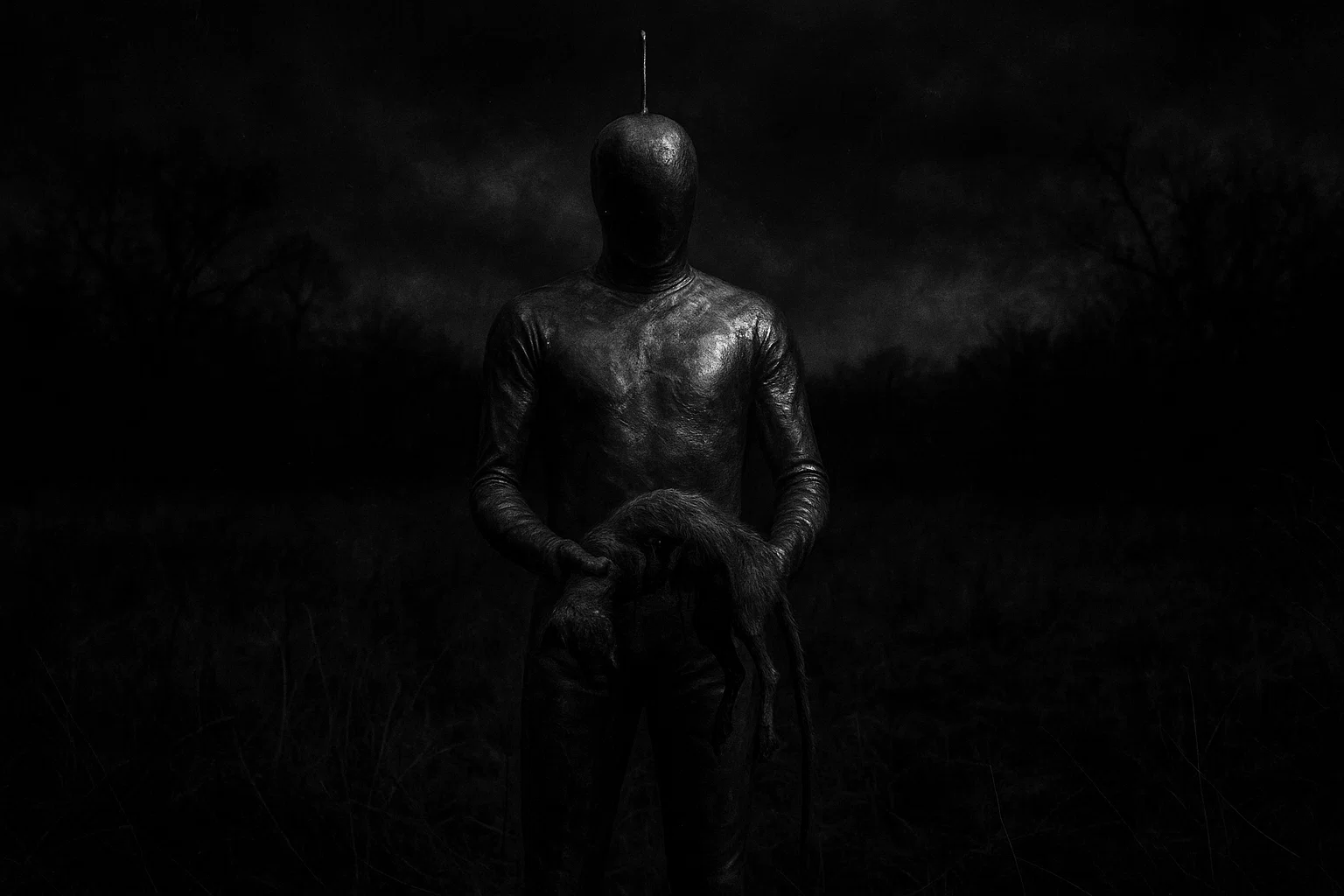
The Alabama Metal Man was described as a human-shaped creature about five to six feet tall, walking on two legs, and covered head to toe in a shiny suit resembling thick aluminum foil or an asbestos fire suit.
Greenhaw said the suit was “smooth as glass” and very bright, reflecting light in different ways depending on the angle, “something like rubbing mercury on nickel.” The suit was wrinkled and seemed to fit tightly over the body.
One of the most unusual features was that its head and neck seemed to blend, with no clear line between them, making it look as if it were wearing a sealed suit.
There was a single antenna sticking up from the top, similar to what Hickson described in the Pascagoula case. Its movements were both jerky and mechanical, yet surprisingly agile—“childlike or even monkey-like” in how it moved, with legs that seemed spring-loaded and could jump about three meters at a time.
One detail that is rarely mentioned is that Greenhaw noticed the figure made no sound at all—not even footsteps, mechanical noises, or breathing—even though it ran across rough ground at over 35 miles per hour, fast enough to outrun a car.
Habitat
The Alabama Metal Man’s alleged territory centers on the rural farmland and dirt road network on the outskirts of Falkville, Alabama, a small town of roughly 1,200 residents situated in Morgan County in the northern part of the state. The encounter took place in a field approximately four miles outside of town near Highway 31, on property owned at the time by a local farmer named Bobby Summerford.
The environment of this part of northern Alabama is defined by its position in the Appalachian foothills, sitting at an elevation of approximately 600 feet above sea level. The terrain is a mosaic of open agricultural fields, creek bottomlands, and dense stands of mixed hardwood and pine.
The region experiences a humid subtropical climate, with long, hot summers, mild winters, and abundant rainfall distributed across the year — conditions that produce lush, dense ground cover and limited long-distance sightlines at night, particularly in autumn when low-lying mist can obscure fields.
The area lies within the Tennessee Valley, whose river systems and lowland corridors historically supported significant biodiversity. Native fauna includes white-tailed deer, red fox, coyote, wild turkey, several owl species, including the barn owl (Tyto alba) and great horned owl (Bubo virginianus), and black bears (Ursus americanus) in the more forested hilly sections further east toward the base of the Appalachians. The Wheeler National Wildlife Refuge, a major waterfowl sanctuary, lies just miles to the west along the Tennessee River.
Looking at the environment, the Alabama Metal Man’s supposed habitat is unusual. Most cryptids, like Bigfoot, are believed to live in remote wilderness areas. In contrast, the Falkville entity was seen on a dirt road next to an open field. In this place, people like farmers, hunters, and night fishermen are often present. It seems unlikely that a strange creature could live there without being seen again.
However, the mix of open farmland and dense woods creates dark areas between towns, especially at night. These edge zones between fields and forests are places where people often mistake animals or objects for something unusual.
For example, barn owls hunting near fields, deer caught in headlights, or a coyote with reflective eyes could easily be mistaken for something else in the right lighting or mindset. However, none of these explanations accounts for the photographs.
Alabama Metal Man Sightings
Many cryptids have had numerous reported sightings over the years, such as Bigfoot and the Loch Ness Monster.
The Alabama Metal Man is different because there is only one well-documented account, backed by photos from a credible witness. No other sightings have been reported in the Falkville area before or after 1973. The whole story is based on that single night and one set of Polaroid pictures.
You may also enjoy:
The Leshy: Shape-Shifting Monster of Slavic Mythology
September 10, 2025
Who Is Xezbeth, the Demon of Lies and Fraud?
August 29, 2025
Jeff Greenhaw (Falkville, Alabama — October 17, 1973)
The foundational encounter began just after 10:00 PM on October 17, 1973, when Jeff Greenhaw, then 26 years old and serving as the chief of police of Falkville, Alabama, received an emergency telephone call at his home.
Despite being off-duty and having just settled in for the evening, Greenhaw responded as a matter of professional duty. The caller was an anonymous woman, described as nearly hysterical, who claimed to have witnessed a UFO land in an open field just outside the town limits on property belonging to a farmer named Bobby Summerford.
Greenhaw suited up, notified the duty officer of his destination, and drove out to investigate. He spent between fifteen and twenty minutes patrolling the field in his vehicle without finding any sign of unusual activity. He concluded he was likely the victim of a prank. As he exited the field and turned onto a narrow gravel road, his headlights swept across a creature standing motionless in the road ahead.
At a distance of approximately 75 feet, the entity appeared essentially human. Greenhaw slowed and approached, assuming the creature might be a person in need of assistance.
As he closed to within roughly 15 feet, the full strangeness of the entity became apparent. The being was encased head to toe in a brilliantly reflective metallic suit — “smooth as glass” and blazing with reflected light from the truck’s high beams. Its head and neck formed an unbroken column, topped by a single antenna. It stood silently, without movement or vocalization.
Greenhaw stopped the vehicle and exited, addressing the entity directly and asking whether it was a foreigner. There was no response. He then reached back into the truck and retrieved his Polaroid camera, which he had brought almost as an afterthought, and began taking photographs.
The first image captured only darkness and a flash of silver. The next three photographs successfully captured the entity standing in the road in discernible detail — a wrinkled, fully reflective humanoid entity with its antenna visible.
As soon as the camera’s flash went off, the creature reacted. It seemed to think the flash was a threat and quickly ran away into the darkness at a speed Greenhaw said was much faster than any human could run. He chased it in his truck, driving up to 35 miles per hour over rough ground, but still couldn’t catch up.
The monster moved in big, bouncing steps, “like it had springs on its feet,” jumping about three meters at a time. Greenhaw followed it toward Lacon, a town about three miles from Falkville, but lost control of his truck on the rough ground and got stuck. He watched as the silver figure vanished into the night.
By October 19, 1973, only two days after the event, the story of the Falkville Metal Man was being reported across the country. News agencies and TV stations shared the photos, and Greenhaw spoke with investigators. Sadly, his community reacted harshly. Instead of treating it as a serious police matter, people mocked and ridiculed him.
Within a few months, things got much worse for Greenhaw. The Falkville town council fired him as police chief. His marriage ended in divorce because of the stress. Then, in the most painful event, his house burned down. The cause of the fire was never fully explained, and some investigators thought it might have been arson related to the encounter. Greenhaw was photographed standing outside the remains of his home.
He told reporters decades later: “People who were supposed to be my friends, the only thing I found out is that I really couldn’t trust anyone. I withdrew, I ran and I went places to try to get away from it.” He described coming close to losing his sanity, crediting his wife and his faith with keeping him grounded.
In 1983, Greenhaw filed a police report documenting that the original Polaroid photographs had been stolen from his home in a break-in that also resulted in the loss of his service revolver and a shotgun. The incident added yet another layer of unresolved mystery to an already extraordinary case.
Through all of these hardships, Greenhaw never changed his story, never exaggerated, and, importantly, never made any money from telling it.
Evidence & Investigations
The physical evidence for the Alabama Metal Man is unusually detailed for a cryptid case. It centers on four Polaroid photos that Greenhaw took during the encounter.
The first photo didn’t show much—just darkness and a silver streak. The other three, though, clearly showed a human-like creature in a wrinkled, metallic suit standing on the road, with the suit shining brightly in the camera flash. No one claimed the photos were fake; they were real pictures of something.
In the weeks following the incident, the photographs were collected and submitted for formal analysis to Walt Andrus, then serving as a director of the Mutual UFO Network (MUFON), one of the United States’ oldest and most prominent civilian UFO investigation organizations.
The conclusion drawn by MUFON’s analysts was measured but skeptical: the encounter was assessed as “most likely a fabrication,” probably inspired — consciously or unconsciously — by the intense media coverage surrounding the Pascagoula Abduction Incident just days earlier. Analysts suggested that aluminum foil or an asbestos fire suit could have been used to produce the unusual appearance of the entity in the photographs.
However, the analysis did not fully debunk the case. The photos were never proven to be fake. No accomplice was found, and no costume or prop was ever discovered. Some details, like the speed Greenhaw described, would mean a person in a costume would have to outrun a car at 35 mph over rough ground in the dark, which is hard to believe.
Later, in 1983, the original Polaroid negatives were stolen. This meant experts could no longer use modern technology to analyze them in detail. Some see this as a major loss of evidence, while others think it might have been a deliberate attempt to hide the truth.
Theories
The 1973 UFO Flap and Mass Suggestion
One possible explanation for the Alabama Metal Man is the intense cultural atmosphere during the 1973 UFO wave. That fall, there were more UFO reports than ever before in the United States, which led to lots of media coverage, public interest, and people being more likely to notice strange things.
The Pascagoula Abduction, which took place just six days before the Falkville encounter, had generated nationwide headlines describing robotic, metallic entities — descriptions strikingly similar to what Greenhaw would report days later.
Given this atmosphere, it’s possible that Greenhaw saw something ordinary—like a person in reflective clothing, a mannequin, or a scarecrow—and his mind filled in the rest, making it seem like an alien. MUFON’s analysts suggested this idea. Still, the theory doesn’t fully explain the photos, which show enough detail to make simple explanations unlikely.
You may also enjoy:
Is the Lake Iliamna Monster Alaska’s Real-Life Sea Cryptid?
November 5, 2025
Who Is Seere? The 70th Demon of the Ars Goetia
May 29, 2025
What Is a Banshee and Why Does It Scream Before Death?
December 9, 2025
Who Was the Wolf Woman of Mobile? The Full Case File
April 17, 2025
The Hoax-and-Accomplice Hypothesis
The most straightforward skeptical explanation has that the Alabama Metal Man was a staged hoax perpetrated by Greenhaw and an unknown accomplice wearing a suit of aluminum foil or a reflective asbestos fire garment. Under this theory, the anonymous woman’s phone call was manufactured to lure investigators to a prearranged location, and the “entity” was a confederate in costume who fled when Greenhaw began photographing.
This theory has a major problem: Greenhaw had nothing to gain and lost almost everything as a result of the encounter. He lost his job, his marriage, and his home. He stayed out of the spotlight for years and never made money from the story. If it was a hoax, it was one of the most damaging pranks in American cryptozoology.
Also, the speed at which the entity ran—fast enough to outrun a car going 35 mph over rough ground—makes it hard to believe it was just someone in a costume, unless Greenhaw made up that part.
A Reflective Material Misidentification
A more technically grounded skeptical hypothesis focuses on the specific optical properties of the entity’s suit. Aluminized proximity suits — firefighting gear designed to reflect radiant heat — were in routine use in industrial and hazardous materials contexts by the early 1970s.
These suits are extremely shiny under direct light, matching the “smooth as glass” and “rubbing mercury on nickel” look that Greenhaw described. If someone wearing one of these suits was on the road—maybe an industrial worker, a trespasser, or a Halloween prankster—they could have looked just like what Greenhaw saw.
The antenna is the hardest part to explain with this theory. Proximity suits don’t have antennas, so either Greenhaw imagined it, someone added it to a homemade costume, or it was truly something unusual.
Correspondence with the Pascagoula Entities
Some UFO researchers have seriously considered the similarities between the Falkville Metal Man and the beings described in the Pascagoula Abduction. Charles Hickson and Calvin Parker said their abductors looked robotic, had wrinkled, pale metallic skin, fused head and necks, and moved mechanically. These details are not the usual “grey alien” features—they are specific and closely match Greenhaw’s story.
Because Pascagoula, Mississippi, and Falkville, Alabama, are close together and the events happened just six days apart, some researchers think both encounters might have involved the same kind of being, or even the same individuals. Still, it’s unclear whether this is a real pattern or just a coincidence amplified by media attention, since the evidence doesn’t provide a clear answer.
The Deliberate Concealment Hypothesis
The original Polaroid negatives disappeared in 1983 during a break-in that also took Greenhaw’s guns, which has led some people to believe that someone with power wanted to hide the evidence. Supporters of the idea point to everything that happened to Greenhaw—losing his job, his family, his home, and the theft. In this view, the Alabama Metal Man was a real, unexplained event, and the photos were deliberately taken away.
This theory assumes a level of organized cover-up for which there has no direct proof. Still, it’s important to note that what happened to Greenhaw discouraged others from coming forward. He himself said that his experience shows why many people with strange stories choose to stay quiet.
Comparative Analysis: Similar Cryptids Worldwide
| Cryptid | Danger level | Details |
|---|---|---|
| Flatwoods Monster | ⚠️ MEDIUM — Emits a noxious mist that causes temporary illness in witnesses but makes no direct physical attack. | The 1952 Flatwoods, West Virginia encounter predates the Alabama Metal Man by 21 years and also involved a hovering object, a metallic or robotic-looking entity, and a pungent chemical odor — yet the two cases are rarely analyzed together despite their structural near-identity. |
| Pascagoula Creatures | 💥 HIGH — Paralyzed and physically abducted two adult men from a riverbank in Mississippi. | The Pascagoula entities described by Charles Hickson and Calvin Parker — robotic, with wrinkled metallic skin and fused head-and-neck structures — were reported just six days before the Falkville encounter, making them the closest temporal and descriptive parallel in the entire UFO contact record. |
| Hopkinsville Goblins | ⚠️ MEDIUM — Besieged a farmhouse for hours, terrorizing a family of 11, but caused no physical injury beyond extreme psychological distress. | The 1955 Kelly-Hopkinsville encounter in Kentucky involved small, silvery, large-eyed humanoids that proved impervious to shotgun blasts — the case is one of the most heavily investigated close-encounter reports in American history and shares the Alabama Metal Man’s quality of involving rural law enforcement. |
| Dover Demon | 🕊️ LOW — Observed passively on multiple occasions over two nights; showed no aggressive or threatening behavior toward witnesses. | Despite being reported by four independent witnesses in Dover, Massachusetts, over consecutive nights in April 1977, the Dover Demon was never satisfactorily explained — and unlike most cryptids, the witnesses were teenagers whose accounts were corroborated rather than dismissed. |
| Mothman | ⚠️ MEDIUM — Associated with the collapse of the Silver Bridge in Point Pleasant (49 deaths), though it made no documented physical attacks on individuals. | Mothman sightings in Point Pleasant, West Virginia, clustered between November 1966 and December 1967 — always preceding disasters — leading folklorist John Keel to theorize it was not a creature but a harbinger entity operating outside normal causal time. |
| Spring-Heeled Jack | 💥 HIGH — Scratched and terrorized victims across Victorian England, with reported blue flame expulsion from its mouth causing temporary blindness. | Spring-Heeled Jack’s defining physical trait — the ability to leap extraordinary distances with apparent spring-loaded propulsion — is strikingly parallel to the Alabama Metal Man’s documented bounding gait, yet the two cases are separated by nearly a century and an ocean. |
| Greys | 💥 HIGH — Associated across hundreds of abduction accounts with involuntary paralysis, medical experimentation, and psychological trauma in victims. | Despite being the dominant archetype of alien-entity encounters from the 1960s onward, the classic Grey — large-headed, smooth-skinned, dark-eyed — bears almost no physical resemblance to the metallic, robotic entity Greenhaw described, suggesting either a genuinely different type of entity or a pre-Grey-archetype encounter uninfluenced by pop culture. |
| Men in Black | ⚠️ MEDIUM — Intimidate and psychologically coerce UFO witnesses into silence through veiled threats, surveillance, and bizarre behavior; no documented physical attacks. | The disappearance of Greenhaw’s original Polaroid negatives in a targeted burglary a decade after the encounter aligns suspiciously with the documented pattern of evidence suppression associated with Men in Black cases reported by other UFO witnesses throughout the 1970s. |
| Flatwoods Monster (Braxton County) | ⚠️ MEDIUM — The entity’s sulfurous mist caused vomiting and swollen throats in multiple witnesses for weeks after the encounter. | The Braxton County Monster’s suit-like appearance — a wide, pleated skirt-like lower body, a large spherical head, and glowing eyes — was later reinterpreted by investigators as a barn owl perched in a tree seen through a misidentified landing craft glow; the same misidentification dynamic may apply to the Falkville entity. |
| Skinwalker | 🩸 SEVERE — Associated in Navajo tradition with deliberate malevolent acts, including disease-sending, mind control, and lethal spiritual attacks on targeted victims. | Unlike virtually every other entity on this list, the Skinwalker is not a cryptid but a practitioner — a human witch who has achieved transformation by violating a sacred tribal taboo, making it philosophically distinct as the only anthropogenic “creature” in comparative cryptozoology. |
| Kecksburg Acorn | 🕊️ LOW — No entity or being reported; an apparently piloted craft landed and was immediately seized by military personnel, with the area cordoned off within hours. | The December 1965 Kecksburg, Pennsylvania incident — in which a large acorn-shaped metallic object with inscribed hieroglyphic-like markings landed in woods before being transported away on an Army flatbed truck — represents the closest documented case of physical metallic craft recovery in the American northeast. |
Is the Alabama Metal Man Real?
What sets the Alabama Metal Man case apart from most other cryptid stories is that the witness had nothing to gain and everything to lose. Greenhaw wasn’t looking for attention, fame, or money.
He was a 26-year-old police chief in a small town, off duty on a Tuesday night, who responded to a call because it was his job. The years that followed—marked by social isolation, losing his career, and personal hardship—don’t fit the pattern of someone who pulled off a successful hoax. Instead, it looks like the story of someone who told the truth but wasn’t believed.
At the same time, the evidence is limited. There was only one witness and four photos, which have since been stolen, leaving only copies. There were no physical traces, such as footprints or other material left behind, and no other witnesses. MUFON’s review suggested the story might be made up, though they couldn’t prove it.
What is most remarkable to me is what’s missing in this case: there’s no clear reason for Greenhaw to make it up, no costume or prop was ever found, and no one has come forward in over fifty years to say they helped with a hoax—even though it could have been profitable to do so.
The Alabama Metal Man might not be an alien or a traditional cryptid. Still, after looking closely at the facts, it seems less likely that Jeff Greenhaw made up the whole story than most people think.
You may also enjoy:
Complete Guide to Michigan Bigfoot Sightings (1962–2025)
August 1, 2025
Inkanyamba: Real Beast or Local Legend?
May 22, 2025
July 24, 2026
Abalam: Demon of Sorrow and Knowledge
August 13, 2025
Sources
- Chief of Police Jeff Greenhaw’s interview about his 1973 encounter with the Falkville Metal Man.
- Ballester Olmos, V. Ic En Te-J. UA N. Pictures Of Aliens In USA. October 1973. Academia.edu.
- Jamaludin, Ahmad. UFOs, Earthquakes and the Straight Line Mystery The Answer to the UFO Enigma. Flying Disk Press, UK, 2021. Academia.edu.
- Spencer, John. UFOs: The Definitive Casebook. Hamlyn, 1991.
- NFPA 1971 Standard on Protective Ensembles for Structural Fire Fighting and Proximity Fire Fighting (2018 ed.). Quincy, MA: National Fire Protection Association. August 21, 2017. p. 18. ISBN 978-145591728-0.
- Pas men ‘forced’ aboard UFO. The Mississippi Press. October 12, 1973. p. 1.