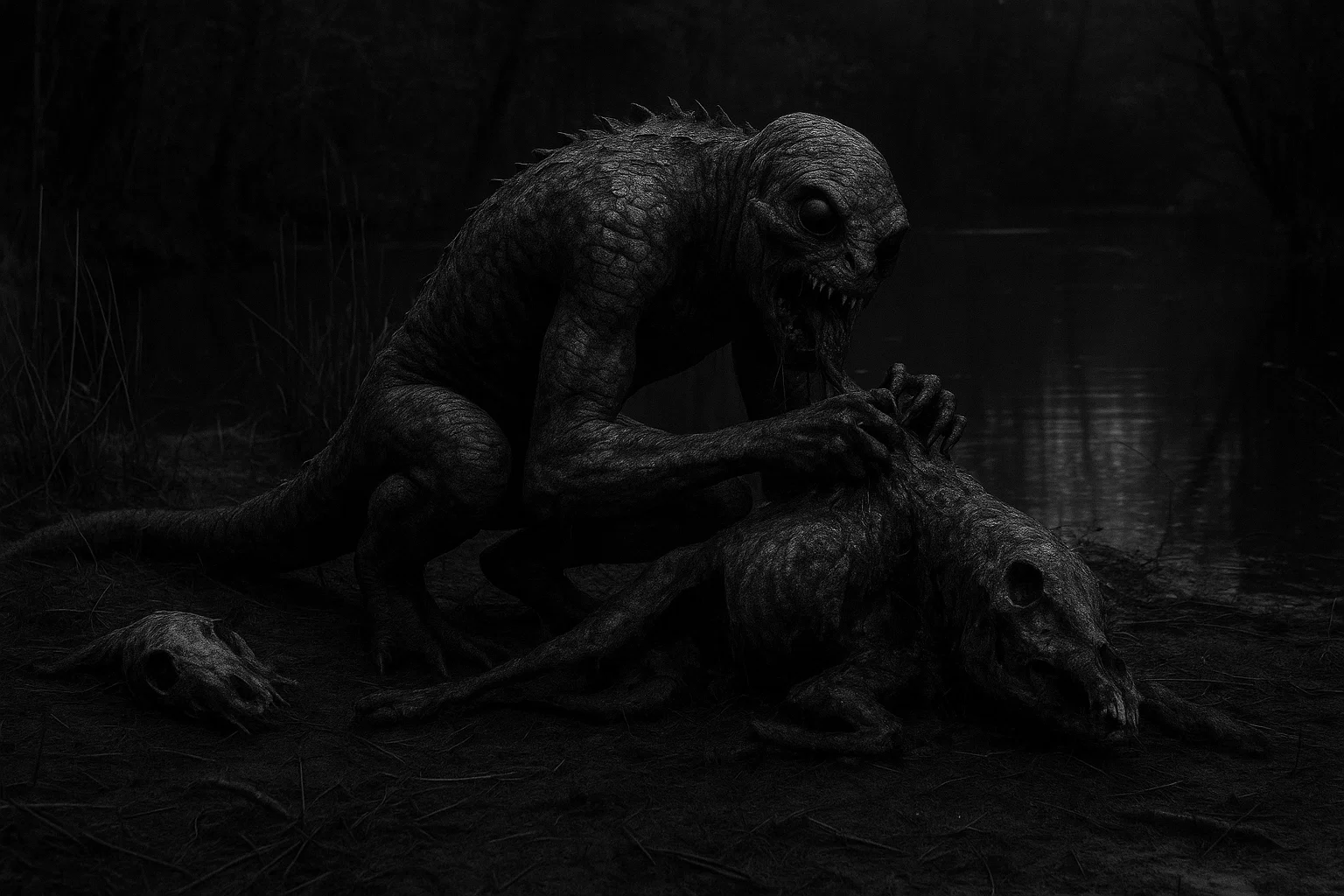
The Lizard Man of Lee County is the reptilian, seven-foot-tall creature believed to stalk the swamps of rural South Carolina — and its 1988 debut turned a sleepy cotton-farming county into national headline news almost overnight.
What began as a single teenager’s frantic report to a local sheriff snowballed into a $1 million bounty, a Washington Post headline, a live cut-in on Good Morning America, and a legend that a small Southern town still builds festivals around nearly four decades later. But how much of the story holds up, and what was actually found in Scape Ore Swamp that summer?
Summary
Lizard Man of Lee County Infobox
| Attribute | Details |
|---|---|
| Name | Lizard Man of Lee County |
| Aliases | Lizard Man of Scape Ore Swamp, Bishopville Monster |
| Ancestry | Late 20th-Century American Cryptid Folklore / Southern U.S. Local Legend (originated 1988; not tied to older regional mythology) |
| Species | Reptilian humanoid |
| CCI Score | 2/10 (Almost certainly misidentification) [See the Cryptid Credibility Index] |
| Threat Level | 🟢 Harmless (Safe to track; essentially a ghost story) |
| Height / Weight | Approximately 7 ft (2.1 m) tall; weight not documented in any eyewitness report |
| Physical Traits | Bipedal; greenish, wet-looking scaly skin; glowing red eyes; three long fingers per hand; strength described as sufficient to scratch and dent car bodies |
| Habitat | Freshwater swampland and adjoining rural woodland, centered on the Scape Ore Swamp watershed |
| Core Sighting Corridor | Lee County, South Carolina (Pee Dee region), centered on Bishopville and Browntown |
| Time Active | Nocturnal; nearly all reports occurred late at night, around 2 a.m. |
| Diet | Unconfirmed; folklore attributes pet and livestock disappearances to it, though later cases were traced to coyotes and domestic dogs |
| Movement | Bipedal; described in the original 1988 account as fast enough to leap onto a car moving at roughly 40 mph |
| First Sighting | June 29, 1988 (Christopher Davis’s encounter; first reported to police on July 14, 1988) |
| Last Notable Sighting | August 2015 (photos and video aired by South Carolina TV station WCIV, attributed to witness Jim Wilson) |
| Sighting Frequency | Rare (an estimated 20–30 reported incidents since 1988) |
| Evidence | Eyewitness testimony, scratched and damaged vehicles, tooth marks, hair and muddy footprints, a polygraph test, unverified photos and video, blood traces later identified as canine |
| Rational Explanations | Black bear, a barred owl misidentified in poor light, a startled human bystander, coyote or dog activity, low-hanging tree branches, and one admitted hoax (Kenneth Orr, 1988) |
| Status | Unproven / largely debunked by skeptical investigators; remains an active piece of local folklore celebrated through festivals and museum exhibits |
Who or What Is the Lizard Man of Lee County?
The Lizard Man of Lee County — also called the Lizard Man of Scape Ore Swamp or the Bishopville Monster — is an American cryptid: a bipedal, reptilian humanoid said to inhabit the swampland surrounding Scape Ore Swamp near Bishopville, in Lee County, South Carolina.
According to the original eyewitness description, the creature stood roughly seven feet tall, had greenish, wet-looking, scaly skin, glowing red eyes, and three long fingers on each hand. Some later retellings added details such as a spiked tail, webbed three-toed feet, and enough physical strength to dent and claw through automobile sheet metal.
The creature belongs to folklore rather than confirmed zoology. There is no photograph, video, physical remains, or scientific specimen that has ever been used to verify its existence. What does exist is a well-documented paper trail: police reports, newspaper archives, a polygraph test, a criminal case for filing a false report, and decades of skeptical investigation.
That combination — a dramatic first sighting, heavy media coverage, a wave of copycat reports, and a total lack of hard evidence — is what folklorists point to when they classify the Lizard Man alongside other modern American “monster” legends rather than as an undiscovered animal.
The name “Lizard Man of Lee County” specifically ties the creature to its home territory: Lee County is a small, largely rural county in the Pee Dee region of central South Carolina, and Bishopville is its county seat. Scape Ore Swamp runs along the county’s edge near a community called Browntown, which is where the story’s central events took place.
The Night It Began: July 14, 1988
The legend’s official starting point is precise. On the evening of July 14, 1988, the Lee County sheriff’s office, led by Sheriff Liston Truesdale, investigated a report of a car damaged overnight at a home near Browntown, on the edge of Scape Ore Swamp. The vehicle had deep scratches, tooth marks, hair, and muddy footprints around it. A local newspaper reporter riding along with the sheriff that night sensed a good story and wrote it up.
That article is what brought the case’s most famous witness forward. Seventeen-year-old Christopher Davis, a Bishopville teen who worked the night shift at a local fast-food restaurant, went to the sheriff’s department after reading about the Browntown car damage and admitted that something similar — and far more frightening — had happened to him roughly two weeks earlier, and that his father had told him to stay quiet about it.
Davis said that while driving home from work around 2 a.m., he got a flat tire near Scape Ore Swamp. After changing it, he saw a creature approaching him from the tree line: green, wet-looking, about seven feet tall, with three fingers, red eyes, and lizard-like scaly skin.
He got back in his car and sped off, and — in what became the legend’s signature detail — the creature allegedly landed on the roof of his moving car before rolling off as he braked at roughly 40 mph. Davis reported scratches on his vehicle as evidence.
Spawning a Media Frenzy
Once Davis’s account reached the press, the story exploded far beyond Lee County.
The Washington Post ran a piece in August 1988 headlined “‘Lizard Man’ Claims a Casualty,” and Britain’s Sunday Times covered it as well. Coverage ran in more than 100 newspapers across the country. Good Morning America did a live interview segment from the swamp itself. Local radio station WCOS in Columbia, South Carolina, offered a $1 million reward to anyone who could capture the creature alive, which only intensified public interest and drew monster hunters into the area.
Davis was given a polygraph test that August, and the results — reported to indicate he was truthful — were shared publicly, adding a veneer of credibility to the story. Researcher Ben Radford later noted that the test appears to have been arranged by a marketing company that was also booking Davis for paid personal appearances, raising questions about how independent the exam really was. Local businesses capitalized quickly too, selling Lizard Man T-shirts, and the Lee County Chamber of Commerce openly welcomed the publicity as good for the community’s economy.
Fueled by the coverage, new sighting reports poured in from around the county: near the Scape Ore bridge, along McDuffy Road and Springdale Road, and even across a local airstrip runway.
The frenzy produced its own confirmed hoax within weeks. On August 5, 1988, Kenneth Orr, an airman stationed at nearby Shaw Air Force Base, filed a police report claiming he had encountered the Lizard Man on Highway 15 and shot it, presenting scales and a small amount of blood as physical proof.
Two days later, at his own arraignment on charges of unlawfully carrying a pistol and filing a false police report, Orr admitted he had staged the entire encounter — by his own account, specifically to keep the Lizard Man story circulating in the news. The episode is one of the few pieces of the legend with a fully documented, confirmed resolution: a real name, a real court case, and an admitted fabrication.
By the end of the summer of 1988, sightings tapered off, and local law enforcement floated a mundane explanation for the original vehicle damage reports: a bear.
What I Found Digging Into Ben Radford’s Case File
The deeper I dug into the primary sources on the case, the less the Lizard Man of Lee County looked like a monster mystery and more like a case study in how a small-town news story can snowball into a national sensation, almost entirely on the strength of one retelling.
The most thorough breakdown I found comes from Benjamin Radford, deputy editor of Skeptical Inquirer and a scientific paranormal investigator, who examined the case first in Fortean Times and then in a dedicated 2023 Skeptical Inquirer article titled “The Curious Case of the Carolina Lizard Man.” Reading his research alongside the original 1988 newspaper coverage, a few things stood out to me as genuinely damaging to the story’s credibility — and a few others that I think get glossed over in most retellings.
The first is how much Chris Davis’s account actually changed over time. Radford’s review of contemporaneous reporting shows the details were not stable: whether the creature had visible scales or simply looked caked in mud, how far away it was when Davis first spotted it, and whether it truly launched itself onto the roof of his car all shifted between one telling and the next.
That kind of drift is common in eyewitness testimony generally. Still, it’s worth noting because Sheriff Liston Truesdale publicly maintained that Davis’s story “never wavered” — a claim Radford’s side-by-side comparison of the period newspaper quotes directly contradicts.
The second thing I find hard to get past is the lighting. Davis says the encounter happened around 2 a.m. in a heavily wooded, unlit swamp — the kind of place where you’d expect near-total darkness. Radford actually checked an astronomical almanac for that date and found the moon was nearly full that night, which cuts both ways: it means there was more ambient light available than a “totally dark swamp” story implies, but Radford still argues that with tree canopy and possible cloud cover overhead, it’s a stretch to think Davis could make out fine details like distinct red eyes and individual scales at a glance, in a moment of panic, at that hour.
Then there’s the timeline problem, which I think is the account’s weakest link. By Davis’s own telling, he was still crouched near his trunk finishing the tire change when he first noticed the creature in the shadows. He then had to get back in the car, start it, and accelerate away — and yet the creature was somehow already fast enough to land on the roof while the car was doing roughly 40 mph. Radford doesn’t buy that a swamp-dwelling biped could close that gap in the time it takes to start a car and pull onto the road, and neither do I; it’s the single detail in the entire case that asks the most of a reader’s credulity.
The physical “evidence” doesn’t hold up much better under a close read. No photographs of the car’s alleged claw-and-bite damage were ever published in 1988, despite the intense media interest, and one contemporaneous newspaper quote actually has Davis describing the damage as no worse than “a scratch on his fender” — a very different picture than the deep gouges described in later retellings of the story.
Radford has floated a mundane explanation for whatever damage did exist. If Davis really was swerving in a panic through a swampy, wooded area in the dark, it’s entirely plausible the car picked up scratches from low-hanging tree branches rather than claws.
One detail I hadn’t seen highlighted much before is the eye color. Davis’s red-eye description is actually one of the most common features in cryptid and paranormal eyewitness reports generally — the same “glowing red eyes” motif shows up in Chupacabra sightings and Mothman accounts, and by at least one retelling, Davis’s own first impression in the moment wasn’t “monster” at all — he reportedly thought he might be looking at the Devil.
Radford’s broader research on nocturnal eyeshine suggests a simpler culprit: many nocturnal animals reflect available light back through their eyes with a reddish or orange tint (a phenomenon called eyeshine), which can look genuinely unnatural to a frightened person glimpsing it for a split second in near-darkness.
That brings me to the most concrete alternative explanation I found for what Davis may have actually seen. In a follow-up piece published in Skeptical Inquirer later in 2023, “Revealing the Real Carolina Lizard Man,” investigator Joe Nickell proposed a specific culprit: a barred owl (Strix varia) — a large, stocky, “earless” owl with heavily streaked and mottled brown, buff, and white plumage.
Nickell’s argument is that this kind of plumage pattern can genuinely look scaled, spotted, or mud-caked at a glance in poor light, which lines up with Davis’s own description of the creature’s texture. It’s not a definitive answer, and it doesn’t explain every detail of the story. Still, of all the “mundane explanation” theories I came across, it’s the one that best accounts for both the lighting conditions and Davis’s specific choice of words.
Separately from Radford and Nickell’s work, investigator Alicia Lutz has proposed a much more human explanation for the encounter itself: a local butterbean farmer named Lucious Elmore, who was reportedly guarding his shed that night after a string of thefts in the area. In this account, Elmore heard Davis’s tire blow out nearby and walked toward the road to confront who he assumed were the thieves — and a startled Davis, seeing a creature appear from the tree line at 2 a.m., panicked and fled.
Taken together, none of these theories require anyone involved to have been lying outright. A dark swamp, a genuinely frightened teenager, a large owl or a startled neighbor, a media apparatus hungry for a monster story, and a summer’s worth of repeated retelling is, in my reading of the record, a far more plausible chain of events than an undiscovered reptilian biped — even if it’s a much less exciting one.
Discover More Cryptids:
Complete Guide to Texas Bigfoot Sightings (1837–2025)
August 8, 2025
Who or What Is the Owlman of Mawnan Church?
November 5, 2025
Koolakamba: History, Sightings, and Scientific Explanations
February 4, 2026
Is Cadborosaurus the Real Sea Serpent of the Pacific Northwest?
November 6, 2025
The 2008 “Return” of the Lizard Man
The legend resurfaced two decades later. In early 2008, a Bishopville couple, Bob and Dixie Rawson, reported finding their vehicle damaged overnight, along with blood traces and the disappearance of some of their cats — details that immediately drew comparisons to 1988 and enough attention that CNN covered the story.
The blood samples were sent to a veterinary lab in California for analysis. They were identified as belonging to a domestic dog. Lee County Sheriff E.J. Melvin offered his own theory that a coyote or wolf was responsible. Shortly afterward, his office found a dead cow and a dead coyote in a field next to the Rawsons’ property — evidence that pointed toward ordinary wildlife activity rather than a cryptid’s return.
A separate wave of alleged photos and video, aired by a local South Carolina TV station in 2015 and attributed to a witness named Jim Wilson, added another chapter to the legend without producing any verifiable evidence.
How the Lizard Man Compares to Other American Cryptids
| Cryptid | Danger Level | Details |
|---|---|---|
| Loveland Frogman | ⚠️ MEDIUM. Witnesses along Ohio’s Little Miami River describe it lunging toward them or brandishing a wand-like object, but no confirmed injury has ever been tied to it. | Two Loveland, Ohio, police officers independently reported encounters with a bipedal, frog-faced creature along the riverbank in March 1972, more than 15 years after an earlier 1955 sighting had first given the legend its name. |
| Dover Demon | 🕊️ LOW. Witnesses describe it merely staring back at them from roadside rocks and tree branches, with no aggressive behavior ever reported. | The entire legend rests on sightings made by a small group of teenagers over roughly 48 hours in Dover, Massachusetts, in April 1977; witness William Bartlett’s on-the-spot sketch remains the primary visual reference used to this day. |
| Fresno Nightcrawler | 🕊️ LOW. It has only ever been recorded walking silently across open ground at a distance, with no direct human contact reported. | The creature owes its fame almost entirely to grainy 2007 security-camera footage from Yosemite National Park, showing what appears to be two pant-like legs walking with no visible torso, head, or arms. |
| Thetis Lake Monster | ⚠️ MEDIUM. It allegedly chased two teenagers from a lakeshore in 1972 and cut one boy’s hand with the sharp spines on its head. | Investigators in Victoria, British Columbia, ultimately proposed that witnesses may have encountered an escaped pet tegu lizard, a South American reptile capable of growing several feet long. |
| Kappa | 💀 EXTREME. Lurks in rivers to drag down swimmers and extracts the shirikodama, a mythical jewel said to contain the soul, directly from its victims. | Traditional Japanese folklore holds that a kappa can be disarmed by bowing to it, since etiquette compels the creature to bow back — spilling the water stored in the dish-shaped depression on its head and draining its power. |
| Chupacabra | 💥 HIGH. Kills goats and other livestock by draining their blood through small puncture wounds, though no verified attack on a human has ever been documented. | The modern legend began in Puerto Rico in 1995 after witness Madelyne Tolentino described the creature; researcher Benjamin Radford later traced her description closely to the alien creature featured in the science-fiction film “Species,” released just months earlier. |
| Skunk Ape | 🕊️ LOW. Known almost entirely for its overpowering smell and its habit of fleeing into the brush, with no attacks on people ever documented. | Some Florida investigators have linked sightings to methane and hydrogen sulfide gas naturally released by the state’s swamps and wetlands, arguing the creature’s signature odor may be environmental rather than biological. |
| Honey Island Swamp Monster | ⚠️ MEDIUM. Hunters have reported it growling and briefly charging toward them when cornered, though no physical injuries have ever been documented. | Skeptic Joe Nickell examined the original 1963 plaster-cast tracks made by witness Harlan Ford and concluded they were most likely produced with a carved wooden or rubber foot, noting the near-total absence of any accompanying human or animal tracks. |
| Mothman | 🩸 SEVERE. Never directly attacked anyone, but its sightings became permanently linked to the deaths of 46 people in the 1967 collapse of the Silver Bridge in Point Pleasant, West Virginia. | Author John Keel’s 1975 book “The Mothman Prophecies” popularized the theory tying the creature’s 1966–1967 sightings to a string of otherwise unrelated strange events in the same small town, cementing its reputation as an omen rather than a simple animal. |
| Goatman | 💥 HIGH. Regional legend credits it with axe attacks on parked cars and the killing of pets, particularly in versions of the story told in Maryland and Texas. | Prince George’s County, Maryland, and several Texas communities maintain competing versions of the Goatman legend, with some Maryland tellings tracing its origin to a scientist whose animal experiments allegedly went wrong. |
Radford has pointed out that the Lizard Man legend follows a pattern common to several famous North American cryptids: a single, highly dramatic “reference sighting” becomes the permanent centerpiece of the entire legend, regardless of how many other, vaguer reports accumulate around it. Bigfoot has the 1967 Patterson–Gimlin film. The lake monster known as Champ, said to live in Lake Champlain, has the 1977 photograph taken by Sandra Mansi. The Lizard Man has Chris Davis’s rooftop encounter.
The nature of the “evidence” also tends to follow a pattern across cryptid folklore. Bigfoot reports are dominated by footprints; Chupacabra reports are typically not sightings of the creature itself but discoveries of livestock carcasses that appear to have been drained of blood, with witnesses inferring a monster’s involvement after the fact. In the Lizard Man’s case, the regular “evidence” has almost always been damaged vehicles rather than the creature itself — a pattern that held true in both 1988 and 2008.
Reptilian humanoids as a broader folkloric category stretch back much further than 1988. Serpent-bodied and part-reptilian deities appear in Mesopotamian and ancient Egyptian mythology, and the Nagas of South Asian tradition are semi-divine beings that shift between human and serpent forms.
In 20th-century paleontology, researcher Dale Russell proposed the “dinosauroid” — a speculative, upright, humanlike descendant that certain small theropod dinosaurs might have evolved into had they survived the Cretaceous extinction — a thought experiment sometimes cited by cryptozoology writers discussing the Lizard Man’s plausibility.
Among modern American cryptids specifically, the Lizard Man sits in the same broad “humanoid cryptid” category as the Loveland Frogman of Ohio, the Dover Demon of Massachusetts, the Fresno Nightcrawlers, and the Thetis Lake Monster reported near Victoria, British Columbia, in 1972 — all bipedal, non-human figures reported by ordinary eyewitnesses rather than tied to any established indigenous tradition.
A separate and unrelated “Lizard People” legend, involving a supposed underground city beneath Los Angeles, traces back to a 1934 hoax by mining engineer G. Warren Shufelt and has no connection to the Bishopville sightings beyond the shared reptilian theme.
The Legend Today
The Lizard Man never became a Bigfoot- or Loch Ness-level cultural phenomenon, largely because, as author Lyle Blackburn has observed, no breakout film or major franchise carried the story beyond its original news cycle. But it never disappeared from Lee County either.
The South Carolina Cotton Museum in Bishopville hosts a permanent Lizard Man exhibit featuring original newspaper clippings and period merchandise. Museum director Eddie Grant has described visitors coming from as far as Texas, Oklahoma, and New Jersey, as well as a documentary film crew from Japan.
In 2018, the museum launched the first annual Lizard Man Festival and Comic Con to mark the 30th anniversary of the original sightings. This event ran through 2020 and drew costumed attendees, reptile displays, and panel discussions on the creature’s origins.
Bishopville also hosts the annual Lizard Man Stomp, and the town’s local restaurant, Harry and Harry Too, serves a “Lizard Man burger” and a Scape Ore-themed hoagie alongside Lizard Man memorabilia on its walls. Lyle Blackburn’s 2013 book, Lizard Man: The True Story of the Bishopville Monster, remains the most complete single account of the case, and the creature has since appeared on television programs including Destination Truth and Fact or Faked.
Chris Davis’s original account from that July night in 1988 has never been definitively explained, retracted, or proven — it remains, in Radford’s words, a mystery “frozen in time.” What is certain is that it produced one of South Carolina’s most long-lasting pieces of homegrown folklore, built almost entirely on a single dramatic night, a media machine eager for a monster story, and a small town that decided to embrace its scaly reputation rather than live it down.
Frequently Asked Questions
Is the Lizard Man of Lee County the same creature as the Lizard Man of Scape Ore Swamp?
Yes. “Lizard Man of Lee County,” “Lizard Man of Scape Ore Swamp,” and “Bishopville Monster” are three names for the same cryptid legend, tied respectively to the county, the specific swamp, and the nearest town. Newspaper coverage in 1988 used all three interchangeably, and modern sources still do.
When and where did the first Lizard Man sighting happen?
The first publicized incident was a damaged car discovered near Browntown, South Carolina, on the edge of Scape Ore Swamp, investigated by the Lee County sheriff’s office on July 14, 1988. Chris Davis then came forward to report his own encounter, which he said had happened roughly two weeks earlier, placing his sighting around the end of June 1988.
Did anyone ever produce physical evidence of the Lizard Man?
No confirmed physical evidence has ever been recovered. The one piece of purported physical evidence — scales and blood presented by airman Kenneth Orr in August 1988 — was admitted to be a hoax within days. Blood samples collected from a damaged vehicle during the creature’s alleged 2008 “return” were lab-tested and identified as belonging to a domestic dog.
Was Chris Davis’s story ever proven false?
Not definitively, in either direction. Davis passed a polygraph test in August 1988, and Sheriff Truesdale publicly backed his credibility. However, researcher Ben Radford’s review of the newspaper record found that key details of the story changed a lot over repeated retellings, and Radford has raised doubts about how independently the polygraph test was arranged. No court ever ruled on the truthfulness of Davis’s account, unlike Kenneth Orr’s, which was legally established as a hoax.
What is the leading scientific explanation for the sightings?
There isn’t a single agreed-upon explanation, but the leading theories include a bear (the explanation favored by local law enforcement in 1988), a barred owl misidentified in poor light (proposed by investigator Joe Nickell in 2023), and a startled human bystander, specifically a local farmer guarding his property (the theory proposed by investigator Alicia Lutz). Vehicle damage reports have separately been attributed to coyotes, a wolf, and low-hanging tree branches.
Is the $1 million reward for capturing the Lizard Man still available?
No. The $1 million bounty was offered by Columbia, South Carolina radio station WCOS in the summer of 1988 as a publicity promotion tied to the original media frenzy, and there is no evidence the offer has remained active in the decades since.
Has the Lizard Man been reported more recently than the 1980s and 2000s?
Sporadic reports have surfaced since then, including a widely circulated set of photos and a video aired by a South Carolina TV station in 2015. Still, none carry the documentation or media scrutiny of the 1988 case or the 2008 Rawson incident. No sighting since 1988 has produced a named, on-the-record primary witness comparable to Chris Davis.
Is there a book about the Lizard Man of Lee County?
Yes. Cryptozoology researcher Lyle Blackburn published “Lizard Man: The True Story of the Bishopville Monster” through Anomalist Books in 2013, drawing on interviews and period reporting to reconstruct the case in detail. The creature also has a chapter in Linda Godfrey’s 2014 book “American Monsters.”
Where can visitors see Lizard Man memorabilia today?
The South Carolina Cotton Museum in Bishopville hosts a permanent exhibit with original newspaper clippings and period merchandise related to the case. The local restaurant Harry and Harry Too also displays Lizard Man memorabilia and serves Lizard Man–themed menu items.
Does Lee County still celebrate the Lizard Man legend?
Yes. Bishopville has an annual event known as the Lizard Man Stomp, and the South Carolina Cotton Museum ran a Lizard Man Festival and Comic Con from 2018 through 2020 to mark the 30th anniversary of the original sightings.
Discover More Cryptids:
Complete Guide to Wyoming Bigfoot Sightings (1967–2025)
August 10, 2025
Flatwoods Monster: What Really Happened in 1952?
June 30, 2025
Eloko: The Tiny Forest Cryptids That Kill Without Warning
February 3, 2026
Complete Guide to Montana Bigfoot Sightings (1971–2025)
August 4, 2025
Sources
- Blackburn, Lyle. Lizard Man: The True Story of the Bishopville Monster. Anomalist Books, 2013.
- Godfrey, Linda S. American Monsters: A History of Monster Lore, Legends, and Sightings in America. TarcherPerigee, 2014.
- Cox, Barbara, and Scott Forbes. Maniacal Monsters and Bizarre Beasts. Rosen Publishing Group, 2014.
- Radford, Benjamin. The Curious Case of the Carolina Lizard Man. Skeptical Inquirer, vol. 47, no. 3, May/June 2023, pp. 58–61.
- Radford, Ben. The Lizard Man of Scape Ore Swamp. Fortean Times, no. 331, Nov. 2015.
- Helmer, Jodi. The Mysteries of Lizard Man of Lee County. MPD Electric Cooperative, 11 Oct. 2023.
- United Press International. Stories of the ‘Lizardman,’ a 7-foot tall monster with… UPI Archives, July 22, 1988.
- Clark, Jerome. Cryptozoology A to Z: The Encyclopedia of Loch Monsters, Sasquatch, Chupacabras, and Other Authentic Mysteries of Nature. Simon & Schuster, 1999. Internet Archive.
- Puglia, D. J. (2024). The (Mostly) Unseen World of Cryptids: Legendary Monsters in North America. Humanities, 13(1), 1.
- Rossi, Lorenzo. (2015). A Review of Cryptozoology: Towards a Scientific Approach to the Study of “Hidden Animals”. 10.1007/978-3-319-22246-2_26.
- Alicia Lutz. Off to See the Lizard. The College Today, September 7, 2011.