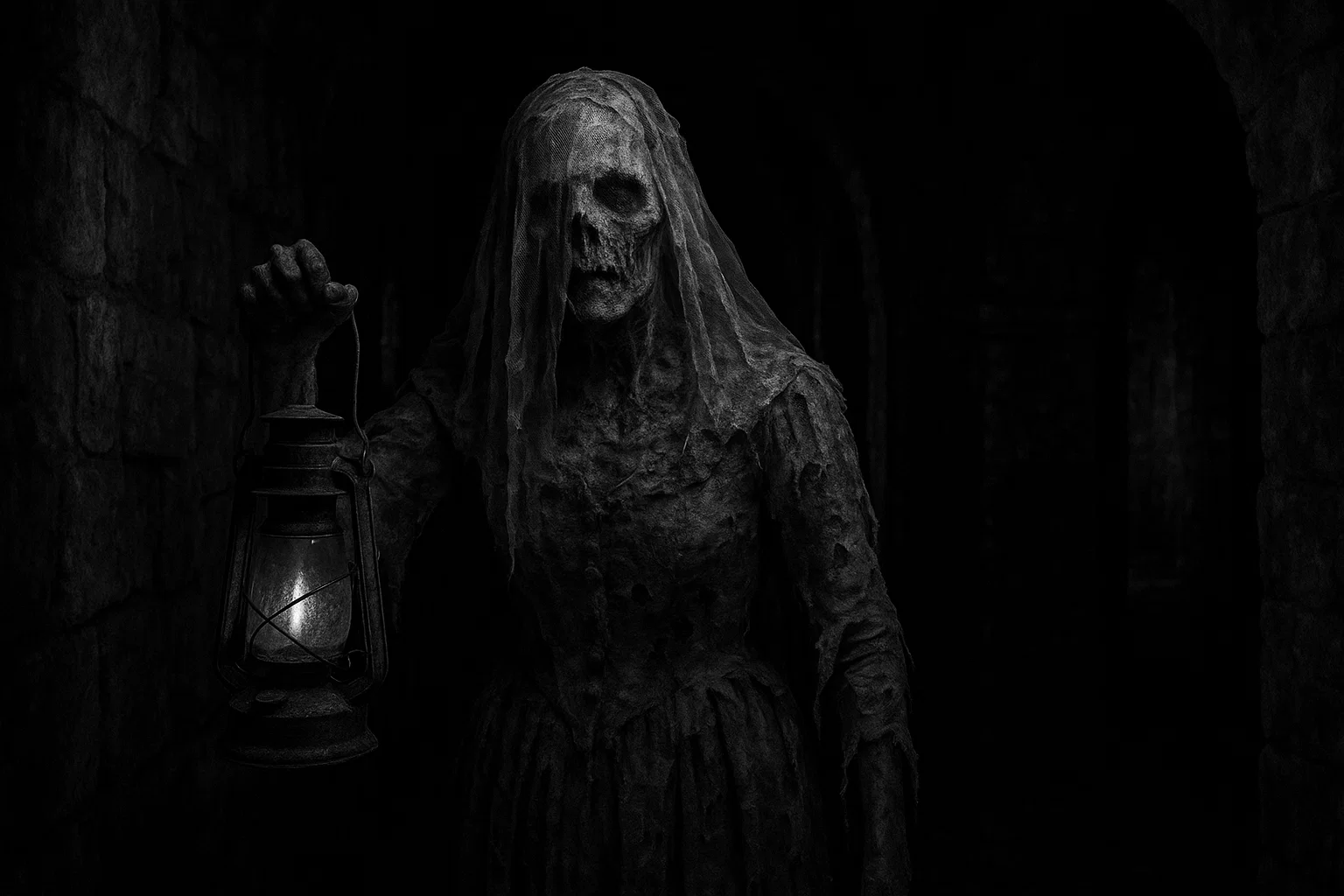
The White Lady of Hohenzollern (also known as the Weiße Frau or Witte Wiwer) is a classic example of a crisis apparition—a spirit that shows up to warn of an approaching death or major change in the family. Unlike most hauntings, this White Lady is tied to the family itself, not just one place, and has appeared at several Hohenzollern homes, including the Plassenburg Castle, the Bayreuth Residence, and the Berlin City Palace.
A detail that is often missed is that the White Lady of Hohenzollern is usually seen not just as a woman in white, but as someone wearing a large ring of heavy iron keys at her waist, which may point to her past role as the household’s mistress.
Summary
Key Takeaways
| Attribute | Details |
| Name | The White Lady (Die Weiße Frau), Kunigunde von Orlamünde |
| THC Scale | L-4 [See the THC Scale Explanation] |
| Location / Origin | Plassenburg Castle, Kulmbach, Bavaria (Historical Origin); Berlin Palace (Primary Manifestation) |
| Classification | Crisis Apparition, Thoughtform |
| History | The tragic death of two children in the mid-14th century (circa 1340-1351) allegedly at the hands of their mother. |
| Casualties & Deaths | 2 primary historical victims (the children) + dozens of royal deaths heralded by the entity. |
| Lunar / Seasonal Cycle | None documented; manifestations correlate with dynastic transitions rather than celestial cycles. |
| Manifestations | Visual (full apparition), Auditory (jingling keys), Physical (touch/shoving). |
| First reported sighting | 1486 (Plassenburg Castle) |
| Recent reported sighting | 1940 (Reported by palace guards in Berlin prior to WWII escalations). |
| Threat Level | 5/10 (potentially aggressive) [See the Threat Level Explanation] |
| HCR | 3/10 (probably authentic) [See the Hoax Confidence Rating Explanation] |
Who or What is the White Lady of Hohenzollern?
The White Lady of Hohenzollern is an ominous ancestral apparition linked to the fate of the ruling Hohenzollern house (which governed Brandenburg-Prussia and eventually the German Empire).
Unlike most “localized” spirits (ghosts that haunt a specific location), this entity manifests across several family-owned properties over the years. It’s a highly unusual behavior.
The haunting itself usually involves brief sightings of a woman in white, whose visage is typically sorrowful or veiled. According to legends, the White Lady can be seen in the days or hours before a death or a major tragedy impacts the dynasty.
The Weiße Frau is not known primarily for aggressive actions but rather for her silent, spectral presence, which instills fear and foreknowledge of imminent doom in those who witness it. Her role is strictly prophetic, linking historical tragedies to the downfall or hardship of the noble line.
White Lady of Hohenzollern Haunted History
The story behind the infamous White Lady of Hohenzollern begins with a tragedy in the mid-1300s involving Countess Kunigunde von Orlamünde, who was born around 1303.
After her husband, Count Otto VI of Orlamünde, died in 1340, Kunigunde was left a widow with a young son and daughter. She became obsessed with Albrecht the Handsome, a younger Hohenzollern and the son of the Burgrave of Nuremberg, which led to one of Germany’s most famous dark legends.
The heart of the legend is a tragic misunderstanding. According to old stories, Albrecht wanted to avoid marrying the older widow without causing trouble, so he said he would marry her if not for ‘four eyes’ standing in the way. He meant his parents, who had to approve any marriage and did not want him to marry her. But Kunigunde, profoundly infatuated, thought he was talking about her two children.
Desperate to join the Hohenzollern family, Kunigunde did something terrible. Local legends from Kulmbach say she killed her children using a golden needle or hairpin, pushing it through the soft parts of their skulls to hide what she had done. These deaths are believed to have happened between 1341 and 1351. When Albrecht learned what she had done, he was horrified and ended all contact with her.
Afterward, Kunigunde devoted herself to a life of penance. Overcome with guilt and hoping for forgiveness, she traveled to Rome, with some stories saying she even walked parts of the way on her knees. When she came back, she gave her wealth to the church and founded the Himmelkron Monastery, a Cistercian convent near Bayreuth. She lived there as a nun until she died around 1351.
As someone who studies historical hauntings, I see this ghost story as the result of trauma that has built up over time. The haunting is tied to the Hohenzollern family because Kunigunde’s children were killed in an attempt to join their bloodline. This act created a lasting connection, making the ghost an unwanted but permanent part of the family’s history.
When the Hohenzollerns became powerful rulers, sightings of the woman in white—sometimes dressed as a Cistercian nun—became a regular part of their story. The keys she carries might be from the Himmelkron Monastery or could symbolize the role she lost by committing her crime.
You may also enjoy:
What Is a Ghost Orb? The Paranormal Phenomenon Explained
January 5, 2026
Complete Guide to Nevada Bigfoot Sightings (1970–2025)
August 4, 2025
Ittan-momen: The Flying Cloth Yokai That Strangles Victims
September 10, 2025
The Curse of the White Lady and the Nibelungen Treasure
The Nibelungen Treasure (Nibelungenhort) is central to the 13th-century German epic, the Nibelungenlied. The immense treasure was originally amassed by the hero Siegfried. It was later cursed after Hagen of Tronje seized it.
The hoard, comprising vast quantities of gold, precious stones, and powerful magical artifacts such as the Tarnkappe (cloak of invisibility), was famously sunk in the Rhine River. However, several German legends suggest that parts of the treasure were hidden by following possessors in secure, well-fortified locations (including the castles of powerful regional houses).
In Hohenzollern lore, the White Lady is specifically associated with the existence of the treasure within the dynasty’s ancestral seats, such as Hohenzollern Castle and Plassenburg Castle.
According to several documented sightings, the ghost was “carrying” a large ring of antique keys. This description is one reason she is often regarded as the Schlüsselträgerin (key bearer). These keys are believed to open up secret chambers, hidden walls, or subterranean vaults where the Nibelungen gold lies concealed.
The terrifying conjunction of the two curses—the dynastic curse of the White Lady and the inherent curse of the Nibelungen treasure—amplifies the perceived danger. So, the White Lady’s appearance not only foretells a death in the family but may also serve as a spectral temptation or warning against the avarice inspired by the treasure.
According to a 17th-century court story, a Hohenzollern noble allegedly witnessed the White Lady glide through a stone wall. Despite being terrified by the sighting, the man glimpsed a glittering hoard of gold and jewels within the revealed passage. Driven by greed, the noble sought to locate the treasure in the following days, only to meet his end in a bizarre accident shortly thereafter.
The story suggests that any attempt to claim the infamous treasure is met with immediate, lethal misfortune.
White Lady of Hohenzollern Sightings
The historical reports regarding the appearance of the White Lady are numerous, spanning over three centuries and occurring across several castles connected to the Hohenzollern dynasty in Germany:
| Date | Location | Description of Event/Sighting |
| 1486 | Plassenburg Castle, Bavaria | Reported sighting as a harbinger of misfortune during a period of dynastic tension. |
| 1540 | Plassenburg Castle, Bavaria | Sighting reported preceding a period of misfortune within the Hohenzollern family branch associated with the castle. |
| 1554 | Plassenburg Castle, Bavaria | Sighting reported preceding a period of misfortune within the Hohenzollern family branch associated with the castle. |
| 1598 | Berliner Schloss (City Palace), Berlin | Reported in the castle chambers shortly before the death of Elector Johann Georg of Brandenburg. |
| 1618 | Berliner Schloss, Berlin | Sighting reported before the death of a member of the Hohenzollern family. |
| 1619 | Berliner Schloss / Kurfürstenhaus, Berlin | Sighted by Elector Johann Sigismund, causing him to flee the palace. He died shortly after her reported appearance. |
| 1625 | Berliner Schloss, Berlin | Sighting reported before the death of a member of the Hohenzollern family. |
| 1628 | Undocumented Hohenzollern residence | Allegedly witnessed by a man of the cloth, who reported the apparition uttered the Latin phrase: “Veni, Judica vivos et mortuos!” |
| Mid-17th Century | Undocumented Hohenzollern residence | Witnessed by courtier Kurt von Burgsdorf, an initial skeptic. She is reported to have thrown him down the stairs in response to his challenge. |
| 1667 | Berliner Schloss, Berlin | Electress Louise Henrietta of Nassau, wife of Friedrich Wilhelm, saw the figure sitting in a chair and writing in her bedchamber shortly before her death. |
| 1677 | Plassenburg Castle, Bavaria | Sighting reported as a harbinger of misfortune. |
| 1678 | Bayreuth Residence | Margrave Erdmann Philip of Brandenburg saw the White Lady sitting in an armchair in his bedchamber shortly before his fatal injury on a race course. |
| 1688 | Berliner Schloss, Berlin | Seen multiple times, including by the court chaplain at the exact hour of the death of the Great Elector, Friedrich Wilhelm. |
| 1857 | Pillnitz Castle, Saxony | A sentry witnessed the apparition leading a procession of four headless men carrying a headless corpse in a casket, preceding King Frederick William IV’s debilitating stroke. |
| 20th Century | Hohenzollern Castle, Baden-Württemberg | Reported by soldiers stationed in the castle who saw a veiled white figure moving through the hallways, preceding the mysterious death of a high-ranking officer. |
Elector Johann Georg (1598)
One of the earliest documented and most commonly referenced appearances of the Weiße Frau happened in 1598 at the Berliner Schloss. Servants and staff reported seeing the specter moving through the palace’s private quarters.
This appearance was immediately followed by the death of Elector Johann Georg of Brandenburg. The bizarre coincidence strengthened the legend that the entity served as a direct, visible omen of the ruling family’s demise.
You may also enjoy:
Lilith: First Wife of Adam, Queen of Hell
August 22, 2025
Fenrir: The Bound Beast Waiting for Ragnarök
September 12, 2025
The Rocky Hill Castle Haunting: Ghosts, Chains, and Curses
September 18, 2025
The Complete List of All Haunted Places in California
November 19, 2025
Elector Johann Sigismund (1619)
Perhaps the most dramatic event associated with the apparition took place in 1619, concerning Elector Johann Sigismund. The Elector, already suffering from severe illness and fearing the well-established family legend, reportedly saw the White Lady gliding silently through the walls of the palace.
Horrified, he attempted to escape the omen of death by relocating from the palatial residence to the much smaller and simpler Kurfürstenhaus in the Nikolaiviertel. Despite his efforts to distance himself from the traditional site of the haunting, he died in his new refuge on December 23, 1619.
The Headless Procession (1857)
A detailed and particularly unsettling report originate from 1857, while King Frederick William IV of Prussia was staying at Pillnitz Castle in Saxony. A sentry on duty claimed to have witnessed a procession led by the White Lady. The apparition was followed by four headless men who were carrying a long, heavy object.
After the procession’s second appearance, the sentry identified the object as an open casket containing a headless corpse of a man in royal regalia, a crown placed where the head should have been. Three months after this sighting, King Frederick William IV suffered a debilitating stroke that left him incapacitated, necessitating a regency and leading to his death three years later.
The White Lady of Hohenzollern Case File
The White Lady of Hohenzollern (Weiße Frau) presents a unique case file because the entity’s primary function is not to haunt a specific site, but to serve as a trans-locational, prophetic omen tied directly to the fate and bloodline of a major European dynasty. The analysis must, all things considered, focus on her systemic role and the mythological weight she carries.
Analysis of Trans-Locational Prophecy
Unlike most documented ghosts, the White Lady is not confined to a single “haunted” location. The records document her appearances across multiple Hohenzollern strongholds, including the Berliner Schloss, Plassenburg Castle, and Hohenzollern Castle, spanning over five centuries.
Evidence classifies this phenomenon as a crisis apparition, meaning the apparition is triggered not by residual energy or a physical landmark, but by an imminent event (usually the death of a dynastic leader or a major political crisis).
Her ability to manifest hundreds of miles apart, often appearing only moments before a significant death, suggests a powerful non-mortal origin, or a collective psychic construct bound to the family’s unconscious expectation of doom.
The Schlüsselträgerin (Key Bearer) Paradox
A common element in the White Lady’s manifestation is her appearance as the Schlüsselträgerin (Key Bearer), often carrying a large ring of antique keys. This detail is analytically linked to the local Hohenzollern legend of the Nibelungen Treasure.
The appearance of the White Lady, as a result, carries a dual meaning: she is the Harbinger of Death and the Guardian of Hidden Wealth. This paradox suggests a spiritual warning: the death foretold might be linked to the sin of avarice, tempting a family member to reveal the location of the concealed, cursed treasure.
This conjunction of two separate curses—the dynastic omen and the treasure’s curse—amplifies her significance beyond a simple ghost sighting.
Historical Documentation and Omen Severity
The White Lady’s appearances are cataloged extensively in court chronicles and private diaries dating back to the late 16th century, providing one of the most reliable long-term historical records of a periodic paranormal entity.
Her classification is consistently a non-aggressive, Level 1 (Harmless) entity because she serves only as the messenger. However, the severity of the crises she announces varies dramatically, from the death of an Elector to the 1857 sighting of a Headless Procession that directly preceded King Frederick William IV’s debilitating stroke.
This variation suggests the entity’s manifestation intensity scales with the severity of the incoming dynastic catastrophe, cementing her unique role as the House of Hohenzollern’s spectral thermometer.
Theories
The legend of the White Lady of Hohenzollern has prompted numerous theories regarding her identity and nature.
The Sin of Child Murder
The dominant and historically favored theory claims that the White Lady is the restless soul of Countess Kunigunde von Orlamünde. This theory provides a clear motive for her eternal torment: the severe sin of child murder based on a misinterpretation, combined with the later penance in a convent where white robes were mandatory.
According on this theory, the White Lady is a form of residual haunting embedded on profound, unresolved guilt and suffering. Her frequent appearance at Plassenburg, which Kunigunde was also associated with, supports this explanation.
Vengeance of Anna Sydow
A later, more politically charged theory identifies the ghost as Anna Sydow (the former mistress of Elector Joachim II). Sydow’s life ended in state-sanctioned imprisonment following the Elector’s death, making her a victim of dynastic betrayal.
In this context, the ghost is an intelligent haunting driven by vengeance, focused on warning or punishing following Hohenzollern leaders by announcing their deaths. This explanation strongly links the ghost to the Prussian branch of the Hohenzollerns, who ruled Berlin, and aligns with numerous sightings at the Berliner Schloss.
Omen and Banshee
A broader mythological explanation suggests that the Weiße Frau is less a specific, individual ghost and more a Germanic regional manifestation of an archetypal omen entity. This figure parallels the Celtic Banshee or similar warning spirits tied to noble families across Europe (such as the Habsburgs and Bourbons).
The ghost’s function as a consistent harbinger of death, rather than as a vengeful spirit tied to a specific room or object, suggests a non-mortal origin or that the spirit has transcended individual identity to become a pure Crisis Apparition, bound to the collective destiny of the Hohenzollern bloodline.
The Egregore / Thoughtform Hypothesis
One strong theory is that the ghost is not actually Kunigunde’s soul, but an Egregore—a being created by the shared thoughts and fears of a group. For centuries, the Hohenzollern family was so afraid of this legend that whenever a monarch got sick, everyone expected to see the woman in white.
I believe that generations of royal anxiety about the woman with keys may have left a mark on places like the Berlin Palace, which could be why the ghost only appears to family members or those close to them. In this view, the ghost is really a reflection of the family’s fear of death.
The Stone Tape Theory (Residual Energy)
The Stone Tape Theory says that the minerals in old buildings, such as the limestone and granite in German castles, can ‘record’ strong emotions and replay them later. The trauma of the Orlamünde infanticide, which was a profoundly distressing event, might have been imprinted on the walls of Plassenburg.
When I review the reports, many sightings are repetitive, like the ghost walking the same halls. But this theory does not explain why the White Lady of Hohenzollern appears only during times of crisis. If it were just a recording, she would show up at random times, not only when a king is dying.
Infrasound and Structural Vibration
Many of the palaces where the ghost appears are large, drafty stone buildings with complicated ventilation systems. Scientists have found that infrasound—sound waves below 20Hz—can make the human eye vibrate, causing people to see gray shapes at the edge of their vision and feel a strong sense of fear.
Since many sightings occur during storms or other weather changes, wind moving through the halls of the Berlin Palace may produce a sound around 19Hz, which could explain why people feel watched or see strange things. But it does not explain the repeated reports of hearing ‘clinking keys,’ which is a much higher sound.
Tectonic Strain and Piezoelectricity
Bavaria and the old Prussian lands lie on several fault lines and areas of shifting ground. The Tectonic Strain Theory suggests that stress in the Earth’s crust generates electric currents, which can produce strange lights or even trigger visions in the human brain.
If the Hohenzollern castles are built on these geological ‘hot spots,’ the buildings might act like giant batteries. However, while this idea is interesting, there is not much evidence that Hohenzollern deaths happened during earthquakes or other seismic events.
The Genetic/Bloodline Resonance Theory
Another, more unusual theory I’ve thought about is that the haunting could be a kind of genetic memory or a special sensitivity in Hohenzollern DNA. Maybe the ‘ghost’ is really a visual sign of a biological warning—an instinct that shows up as a lady in white when the family senses something is seriously wrong.
This could explain why the White Lady of Hohenzollern seems to follow the family wherever they go. The sound of ‘clinking keys’ might actually be a stress-induced hallucination within the family.
White Lady of Hohenzollern vs Other Ghosts
The legend of the White Lady of Hohenzollern aligns with a pan-European spectral archetype often involving a noblewoman linked to misfortune or a curse. The following table compares the characteristics of this German dynastic ghost with those of other prominent “White Ladies” and similar female apparitions from around the world.
| Name | Location | Type of Haunting | Activity Level |
| The Brown Lady of Raynham Hall | Norfolk, England | Residual | 4 (occasional) |
| The Red Lady of Huntington Library | San Marino, USA | Intelligent | 3 (dormant) |
| The Grey Lady of Glamis Castle | Angus, Scotland | Residual | 6 (occasional) |
| The White Lady of Avenel | Scotland | Crisis Apparition | 2 (dormant) |
| Banshee of the O’Neills | Ireland | Crisis Apparition | 5 (occasional) |
| The Bell Witch | Tennessee, USA | Poltergeist | 8 (very active) |
| The Blue Lady of Moss Beach | California, USA | Residual | 5 (occasional) |
| The Black Lady of Bradley Woods | Lincolnshire, England | Shadow Figure | 4 (occasional) |
| The White Lady of Kinsale | Cork, Ireland | Residual | 6 (occasional) |
| The Lady in White of Balete Drive | Quezon City, Philippines | Intelligent | 7 (very active) |
Is the White Lady of Hohenzollern Real?
After studying this case, I believe we are not dealing with a trapped soul, but with a rare dynastic tulpa. The evidence, especially the 1667 event with Margrave Erdmann August, suggests that the legend became real because so many people believed in it for so long.
What is most remarkable in my research is how consistent the details are. From the 1400s to the 1900s, people who could not have shared their stories all reported hearing the same thing: the sound of clinking keys.
This points to a ghostly identity that is profoundly ingrained in the family’s story. I think Kunigunde’s original trauma set the pattern, but the Hohenzollern family’s importance and shared fears kept it alive.
The haunting became a self-fulfilling prophecy and faded away after the family lost power in 1918. When the family’s role ended, the White Lady of Hohenzollern’s appearances mostly stopped, showing that the entity was truly part of the royal house.
You may also enjoy:
The Complete List of All Haunted Places in Arizona
November 18, 2025
January 14, 2026
Is the Richards DAR House Haunting Evidence of Intelligent Spirits?
September 22, 2025
Sources
- Sharon A. Hill. The ‘Stone Tape Theory’ of Hauntings: A Geological Perspective. SharonAHill.com, 2017. Academia.edu.
- Tony Cornell. (2002). Investigating the Paranormal. New York: Helix Press.
- Carroll, Robert Todd. Psychometry. The Skeptic’s Dictionary, 24 Nov. 2015.
- Scheife, Richard. (2009). A Ghost in the Machine. Pharmacotherapy. 29. 363-4. 10.1592/phco.29.4.363. ResearchGate.
- Mühlhans, Jörg H. Low Frequency and Infrasound: A Critical Review of the Myths, Misbeliefs and Their Relevance to Music Perception Research. Musicae Scientiae, vol. 21, no. 3, 2017, pp. 267-286. Sage Journals.
- Fischer, Henry W. Behind the Scenes with the Kaiser (1888-1892): The True Story of the Kaiser as He Lived, Loved, Played and Warred. Hertag Publishing Corp., 1922. Wikimedia Commons.
- Fischer, Henry W. The Private Lives of William II. and His Consort: A Secret History of the Court of Berlin. William Heinemann, 1904. Internet Archive.
- Geheimes Staatsarchiv Preußischer Kulturbesitz. Digital Archive of the Prussian State Cultural Heritage. Berlin, Germany.
- University of Freiburg: Institut für Grenzgebiete der Psychologie und Psychohygiene (IGPP). Specialized Archive for Parapsychology and Psychology. Freiburg im Breisgau, Germany.