Some horror doesn’t need a monster with a face — just a wild, indifferent place that knows you’re there. “The Third Bend” is an original cosmic horror and nature horror story about a bayou backwater that has spent generations quietly tallying the people who pass through it, for reasons no one who’s encountered it has ever lived long enough to fully explain. It’s a slow-building horror story of isolation and ancient, inherited fear, in the tradition of wilderness horror, where the true threat isn’t a creature you can name but a presence so vast that naming it would almost be beside the point.
Story File
| 👁️ Title | The Third Bend |
| 🪶 Author | Razvan Radu |
| 🪦 Genre | Cosmic Horror / Nature Horror / Short Horror Story |
| 🏷️ Themes | Wilderness, Isolation, Ancient Presence, Inherited Fear, Folklore, Indifferent Entities |
| ⏳ Read Time | 9 minutes |
| ☠️ Warnings | Intense dread, themes of generational trauma, body horror (implied), no graphic violence |
| 📜 The Lore | A bayou backwater keeps a count of everyone who lingers past its third bend — and never explains what the number is for. |
| 🎬 The Scoop | A city visitor talks a local fisherman into camping past a stretch of marsh the man has avoided his whole life, and learns by morning exactly why. |
Decklan Foss had fished the Atchafalaya backwater his whole life and never once gone past the third bend after dark, and he told Ren that twice before they’d even loaded the canoe — once at the dock, once at the truck, as if repetition might do the convincing that reason hadn’t.
Ren laughed it off both times. He was visiting from the city, three days into a trip meant to clear his head after a year that had taken more out of him than he liked to admit, and the idea of a backwater too haunted for a local fisherman to enter sounded less like a warning and more like the best possible way to spend an afternoon.
“It’s not haunted,” Decklan said, paddling with the unhurried economy of a man who’d done this ten thousand times. “Haunted I could live with. Haunted’s got a story to it. This is just a place that doesn’t want company, and it lets you know.”
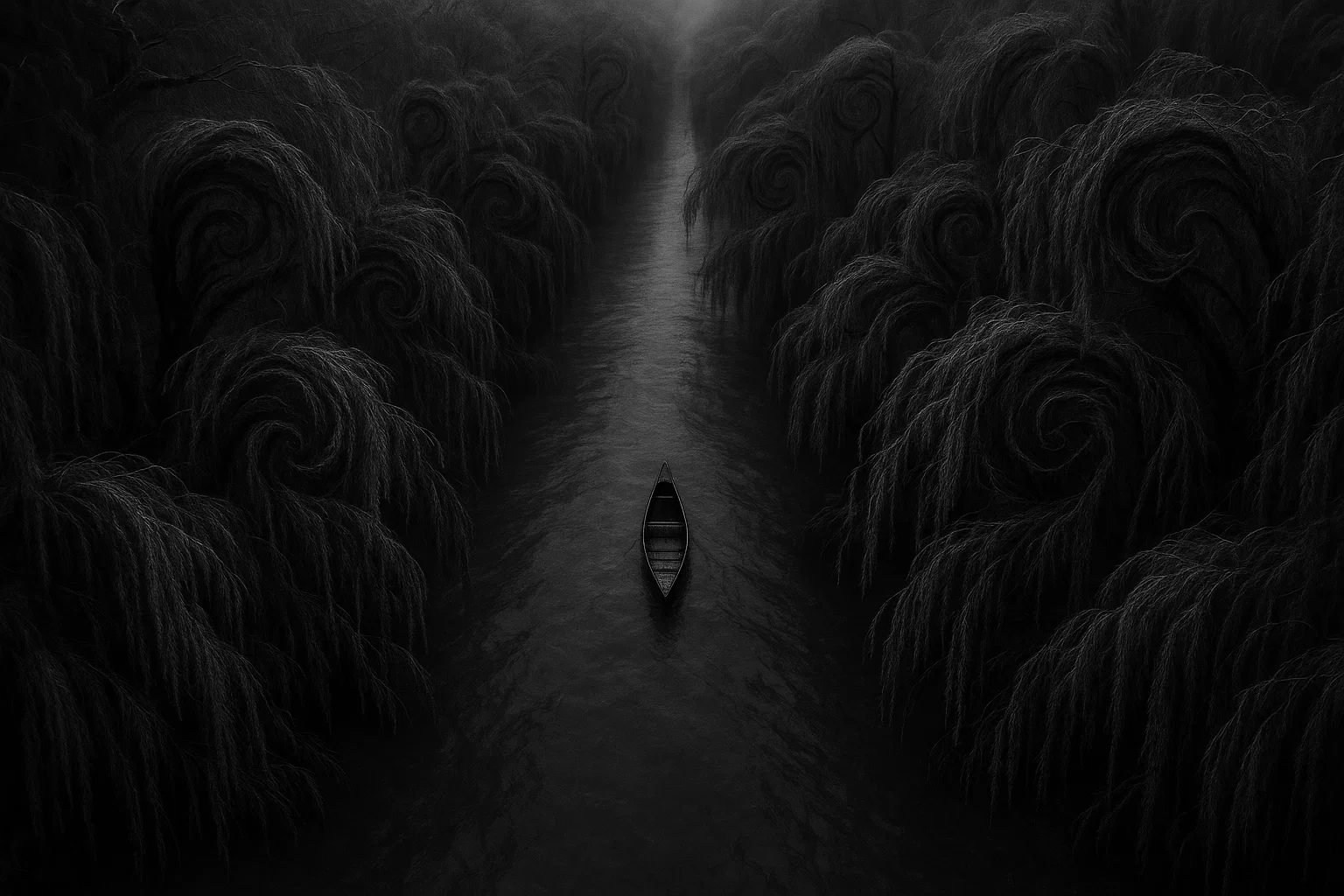
The water past the third bend changed color first — not dramatically, just a few shades darker, as if something had settled into it that didn’t reflect light the way water should. The cypress trees grew closer together here, their knees breaking the surface in crooked rows like a congregation kneeling at the wrong angle, and the reeds along the banks stood taller than any reeds Ren had seen elsewhere on the bayou, pale and dry despite the humidity, rattling faintly though there was no wind to move them.
They made camp on a low hummock of solid ground an hour before dusk, Decklan working with the brisk, slightly too-fast efficiency of a man who wanted the tent up and the fire lit before the light went entirely. Ren noticed, but didn’t say anything. He was busy noticing something else — the reeds at the hummock’s edge, which seemed, in the corner of his vision, to be leaning inward, very slightly, toward the camp, the way grass leans toward a draft from an open window.
Dinner was canned beans and bad coffee, eaten quickly, the conversation thinning as the dark thickened around the firelight’s small circle. Decklan told Ren, finally, why he didn’t come past the third bend — not a ghost story exactly, more a habit passed down without explanation, the way you might inherit a fear of a particular intersection because your grandfather once lost a friend there and never said how.
His own father had come back from this stretch of water forty years ago a different man, quieter, prone to standing at windows facing the marsh for long stretches with an expression Decklan’s mother never asked him to explain. He’d died with that same look on his face, years later, in a hospital bed three counties away from any water at all.
“He used to say the reeds count,” Decklan said, feeding a stick to the fire. “I never knew what he meant by it. Count what, I’d ask him. He’d just say, you, mostly. They’re counting you.”
Ren laughed, because it was easier than not laughing, but the sound came out thin in the heavy air, and the reeds — he would have sworn to this later, though he knew how it sounded — rattled in response, a dry, papery rustle that moved down the bank in a wave too even to be wind, almost like something running a hand along their length to make them speak.
He woke twice in the night. The first time, he convinced himself it was nothing — a shift in Decklan’s breathing, the canoe knocking gently against the hummock. The second time, near what must have been three or four in the morning, he woke because the silence had become total in a way that felt deliberate, the way a held breath is different from an empty room.
He unzipped the tent flap an inch and looked out at the reeds, and for one long, suspended moment, every single one of them was bent at the same precise angle, all pointing toward the tent, motionless, as if they had only just stopped moving the instant before he looked.
Morning brought fog thick enough to swallow the canoe at ten feet, and Decklan’s voice, when Ren found him kneeling at the water’s edge, had a flatness to it that hadn’t been there the night before. He was looking at the mud, where something had written itself overnight in long, raked lines too deliberate to be animal tracks and too alien to be anything Ren had words for — rows of marks, evenly spaced, like a tally kept by something that had never seen a tally mark before but had been told, somehow, that this was how the keeping of counts was done.
“My father used to talk about a census,” Decklan said, not looking up. “I thought it was just a word he liked. Something from his time in the war, maybe, some habit of bookkeeping that stuck with him wrong.” He traced one of the lines with a finger, not quite touching the mud. “I think this is what he meant. I think something out here keeps a list, and I think we got ourselves added to it sometime last night.”
They broke camp in a hurry that neither of them dressed up as anything but fear, and the marsh seemed to cooperate with their urgency in a way that felt worse than resistance would have — the current ran faster than it should have on the way out, carrying them back toward the third bend at a pace that suggested less an escape than a release, the feeling of being let go rather than getting away.
Ren looked back once, against every instinct telling him not to, and saw the reeds along the whole stretch they’d camped on bending in a long, slow ripple toward the water, toward the canoe, toward them, a motion with no wind behind it at all, patient and unbroken, like a held note finally allowed to land.
Decklan didn’t fish that backwater again, and as far as Ren knows, he kept his own promise about the third bend more firmly than ever. But four years later, back in the city, Ren found himself unable to walk past a stand of ornamental reeds outside a downtown office building without the same prickling certainty that something behind the rustling was paying him a very specific, very patient kind of attention — counting, the way Decklan’s father had said, though counting toward what, neither of them had ever wanted to ask aloud.
He called Decklan once, on the fourth anniversary of the trip, mostly to hear another voice say it wasn’t just him. Decklan answered on the second ring, his voice careful in a way Ren had heard once before, at the campfire, when a man chooses his words around an absence rather than through it.
“My boy started asking about the marsh road last week,” Decklan said. “Wanted to know why we never fish past the third bend. I told him the truth — that it’s not haunted, it just doesn’t want company.” A pause, long enough that Ren could hear the wind moving through something on Decklan’s end of the line, dry and rattling and entirely too rhythmic to be anything but reeds. “He asked me how it lets you know it’s counting. I didn’t have an answer for him that wouldn’t scare him worse than not knowing.”
Ren didn’t have one either. He still doesn’t. But some nights, when the wind moves just wrong through whatever greenery happens to be nearest his window, he finds himself going very still, the way you go still when you suspect, without proof, that you are being tallied by something that has all the patience in the world and has not yet decided what the final number is for.