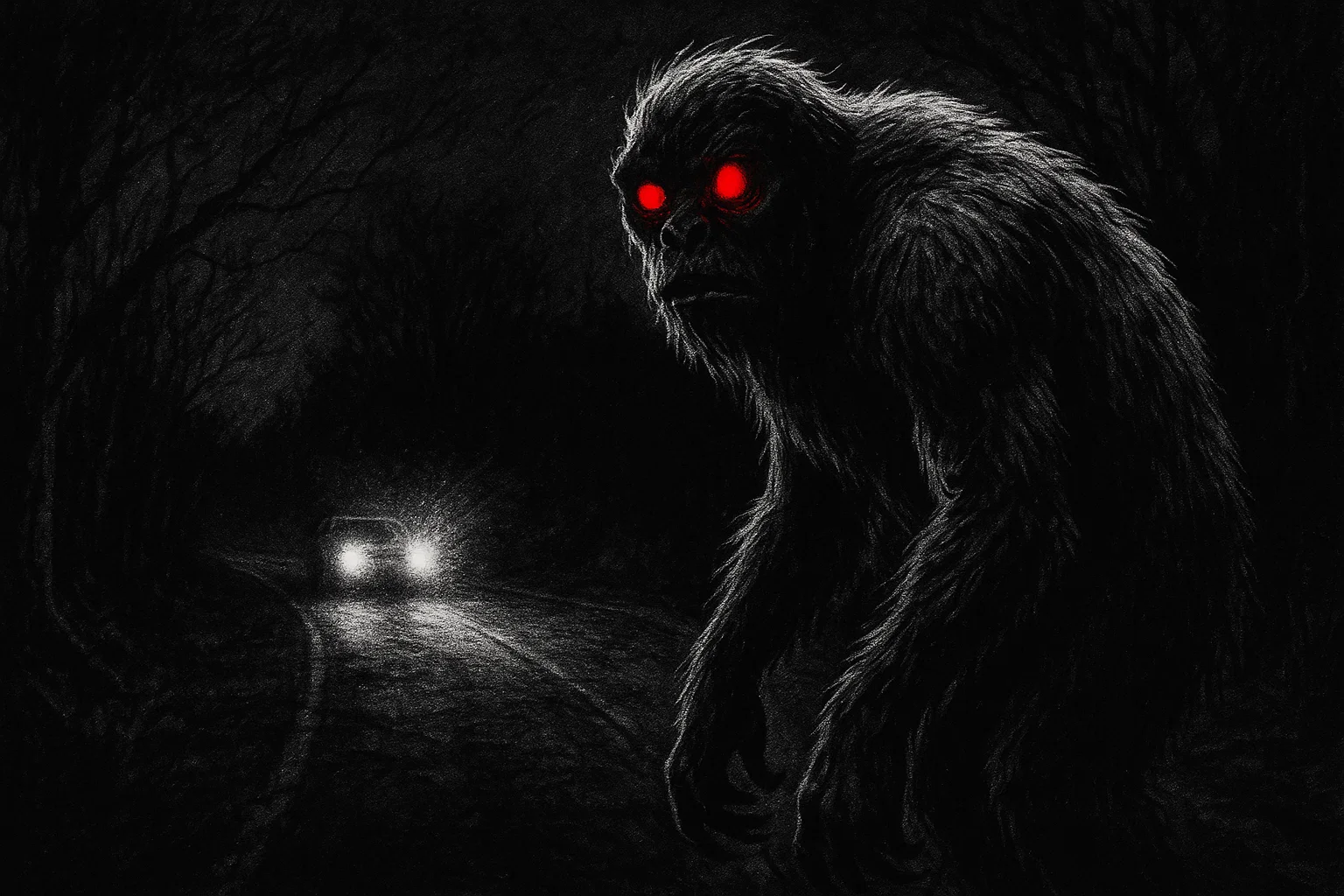
The Choccolocco Monster is a bipedal cryptid from Calhoun County, Alabama, said to have frightened rural drivers on the back roads of Choccolocco Valley in the late 1960s.
Witnesses described it as a large, shaggy, hump-backed creature with a strange, cow-like head. The creature quickly became one of northeastern Alabama’s most talked-about mysteries, leading to newspaper headlines, armed patrols, and even a segment on The Daily Show years later.
The legend is fascinating from other Southern American cryptid stories because it has a named, living confessor—a local teenager who eventually admitted he was the monster. Still, even with that confession, the story turns out to be more interesting than just a prank.
Summary
Infobox
| Attribute | Details |
|---|---|
| Name | Choccolocco Monster |
| Aliases | The Choccolocco Booger; The Calhoun County Monster |
| Ancestry | 20th-Century American Rural Folklore / Southern Appalachian Roadside Tradition |
| CCI Score | 1/10 (Proven hoax) [See the Cryptid Credibility Index] |
| Threat Level | ⚫ N/A (Proven hoax) |
| Height / Weight | Perceived height 6–7 ft (1.8–2.1 m); actual costume wearer of average teenage build |
| Physical Traits | Bipedal; shaggy, dark, matted hair; pronounced dorsal hump; pale bovine skull head; reported foul odor; glowing eyes in some accounts |
| Habitat | Rural roadside margins bordering dense mixed hardwood-pine woodland; creek-adjacent lowland corridors in a humid subtropical climate |
| Core Sighting Corridor | Iron City Cutoff, Calhoun County, northeastern Alabama |
| Time Active | Exclusively nocturnal; primarily dusk to midnight |
| Movement | Bipedal; burst sprinting from the tree line toward the road, then rapid retreat into the woodland |
| First Sighting | Spring 1969 |
| Last Notable Sighting | Summer 1969 (active period ended after shots were fired at the perpetrator) |
| Sighting Frequency | Isolated Incident (estimated 8–15 witnesses during the active window) |
| Evidence | Eyewitness testimony only; no photographs, no physical evidence, no audio recordings |
| Rational Explanations | Confirmed teenage prank (Neal Williamson wearing a cow skull and sheet); secondary reports likely fueled by mass suggestion and media coverage |
| Status | Debunked |
Who or What Is the Choccolocco Monster?
The Choccolocco Monster is a legendary monster tied to the unincorporated community of Choccolocco in Calhoun County, northeastern Alabama. Like many Southern roadside monsters, it appeared suddenly at the edge of rural roads after dark, rather than stalking or attacking people over time.
Unlike the Skunk Ape or the Fouke Monster, which have decades of disputed evidence and ongoing sightings, the Choccolocco Monster was seen mostly in the spring and summer of 1969. Later reports were mainly driven by public excitement and fear.
What sets this monster apart is the detailed record around it. The Anniston Star published the original story on June 8, 1969, making it one of the few cryptid scares from that time documented by a local newspaper. Thirty-two years later, in October 2001, the same paper published the confession that solved the mystery.
The community has embraced the legend. When Oxford, Alabama, started a summer baseball team at Choccolocco Park, they named it the Choccolocco Monster. Neal Williamson, the original prankster, was even invited to throw the first pitch at the team’s first game.
Choccolocco Monster Mythology
To see the Choccolocco Monster as more than just a hoax, it helps to know the area where the story began. Choccolocco is part of the larger Choccolocco Valley, a place closely tied to the history of the Muscogee (Creek) Nation.
The name Choccolocco comes from Muskogean words. Some sources say it means chahko lago, or “big shoals,” while others say choko rakko, or “big house.” By the 1700s, “big house” referred to the Creek ceremonial square, a sacred place with wooden bleachers and awnings. The area where the monster was seen carries the memory of this important gathering place.
The nearby Choccolocco Creek Archaeological Complex has remains of at least one temple mound and three burial mounds, showing people lived there as far back as 8,000 BC. This includes the Mound Builders and Mississippian cultures. Creek Chief Selocta Chinnabby’s village was also along the creek. The valley has long been seen as a place where people and the spiritual world meet.
The creature that appeared in 1969 was not based on any specific Indigenous legend. Instead, the Choccolocco Monster fits into a Southern American tradition known as the roadside booger. Locals used the word “booger” in early reports to describe any scary, shapeless monster seen in the dark. These stories often served as warnings, marking the line between the safety of town and the dangers of the dark countryside.
The time period is important. In 1969, rural Calhoun County faced major challenges such as racial tension, the Vietnam War, and rapid social transition. The sudden appearance of a strange creature on local roads gave people a way to focus their fears.
You may also enjoy:
Is the Brown Lady of Raynham Hall’s Real?
May 5, 2025
Pope Lick Monster: Louisville’s Most Haunted Cryptid
September 26, 2025
Mastema: The Angel of Hostility Who Tested the Faithful
September 29, 2025
What Does the Choccolocco Monster Look Like?
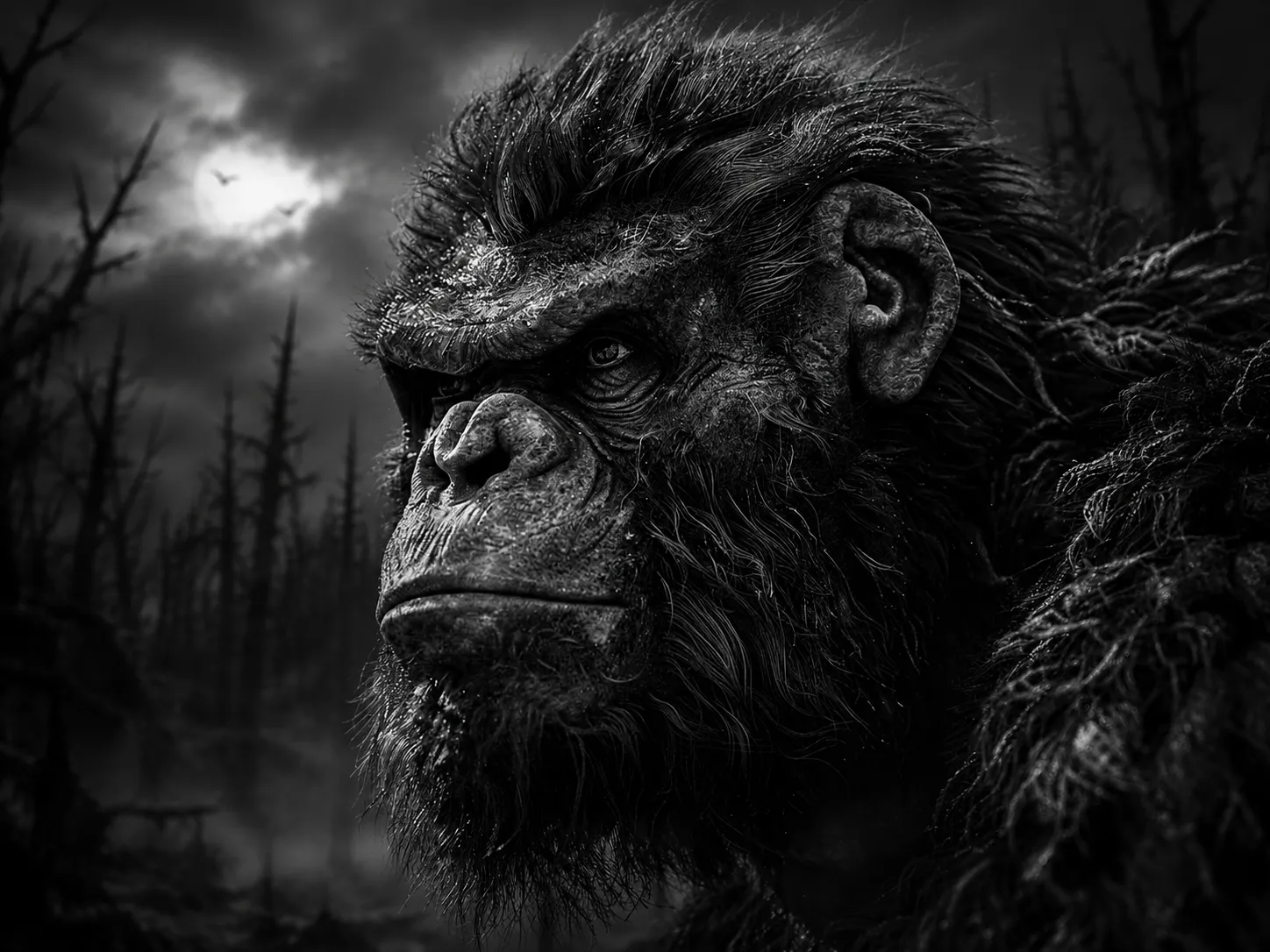
Most witnesses described the creature in similar ways. However, some differences suggest people were reacting to the same thing rather than making up a story together. The monster was usually said to walk on two legs, stand 6 to 7 feet tall, and be covered in long, dark, tangled hair. Some people thought it looked lean, while others thought it was bulkier.
The monster’s most unusual feature was its head, which witnesses described as resembling a cow’s skull or that of a large, bony animal. This pale skull stood out against its dark body. It made it very different from typical Bigfoot stories, which usually mention ape-like faces. The skull gave the creature a spooky, almost death-like appearance, rather than just looking like a wild man.
Many witnesses also reported a strong, bad smell when the creature appeared, similar to reports of the Skunk Ape and the Fouke Monster.
One detail that is often missed is that early reports in 1969 described the monster as having a hump on its back, making it look more like a large animal standing up than a typical human-shaped monster. The hump was part of the original newspaper stories and might explain why some people thought the creature was the size of a cow before it stood up.
Habitat
The Choccolocco Monster’s alleged territory centers on the rural roads and wooded margins of Choccolocco Valley in Calhoun County, northeastern Alabama, with sightings concentrated along the Iron City Cutoff — a rural highway corridor running between the communities of Choccolocco and Iron City.
The broader landscape is defined by proximity to two major ecological features: the Choccolocco Creek (a primary tributary of the Coosa River, draining approximately 246,000 acres across Calhoun, Talladega, and Cleburne counties) and the Talladega National Forest, which forms one of the largest continuous expanses of Southern Appalachian woodland in Alabama.
The area is about 712 feet above sea level. It has a humid, subtropical climate, with hot, wet summers and mild winters. The forests are a mix of loblolly and shortleaf pine, oaks, hickory, and river birch near the creeks, with thick undergrowth of mountain laurel and wild azalea. The dense forest makes it easy for something to move around at night near roads, but hard for people to confirm what they saw.
Ecologically, the area could support a large, secretive animal if one existed. The Talladega National Forest and nearby woods are home to black bears, white-tailed deer, coyotes, and wild turkeys. Black bears are especially important to mention because they can walk on two legs, grow over 6 feet tall, and are most active at dawn and dusk—the same times the Choccolocco Monster was seen. The creek area is also used by coyotes and bobcats, which can make strange noises at night.
Choccolocco Creek is one of the most important waterways in Alabama, supporting over 70 fish species, including endangered species such as the pygmy sculpin, holiday darter, and blue shiner. In 2011, a freshwater snail thought to be extinct, the wicker ancylid, was found there again.
Sightings happened along the roadside, where farmland meets thick woods—an area known as the “edge zone” where people and wild animals cross paths, which is common in monster stories.
Choccolocco Monster Sightings
Most sightings of the Choccolocco Monster happened in the spring and early summer of 1969, all along a certain stretch of rural road in Calhoun County.
We don’t know the exact number of people who saw the monster. Still, the Anniston Star reported in June 1969 that at least eight drivers and local residents claimed to have seen it in a short time. The actual number was probably higher, since many rural residents at the time were hesitant to talk about such things.
The sightings had a lot in common. The creature always showed up at dusk or after dark, near the edge of the woods by the road. It would rush or jump toward passing cars, then quickly disappear back into the trees. It never chased anyone, attacked, or appeared during the day.
Multiple Drivers (Iron City Cutoff, Calhoun County, Spring 1969)
The most significant cluster of sightings took place along the Iron City Cutoff, the rural highway running between Choccolocco and the community of Iron City in Calhoun County. At least eight separate drivers reported encountering the creature along this corridor.
Witnesses consistently described a large creature — some saying it was the size of a cow before rising onto its hind legs — with a prominent, bony head and covered in shaggy fur or dark material. The creature was described as a “booger” by some local witnesses, drawing on the traditional Appalachian vernacular for a terrifying nocturnal entity.
These encounters followed a clear pattern. A car would spot a shape in its headlights near the trees, and before the driver could react, the monster would rush toward the road and then retreat. Each encounter lasted just a few seconds. No one was hurt, but some drivers stopped suddenly or sped away. The number of reports in such a short time made many locals anxious.
The Anniston Star published its initial reporting on these events on June 8, 1969, bringing the creature to the attention of a wider northeastern Alabama audience and, crucially, escalating the public response far beyond what a few whispered rural stories might have produced.
Armed Vigilante Patrols (Spring–Summer 1969)
One of the most important but rarely discussed parts of the Choccolocco Monster story is what happened after the news broke. When people heard about a monster in Calhoun County, some locals didn’t just doubt the story—they formed armed patrols. Groups of residents drove around the country roads at night, carrying rifles and watching the tree lines for the creature.
This quickly turned a teenager’s prank into a real public safety problem. Later, Neal Williamson said he was shot at at least once or twice while pretending to be the monster. The shots were close enough to be clear. It was this danger—not guilt or fear of being caught—that made Williamson stop.
The monster disappeared from Choccolocco roads as suddenly as it had arrived, and many locals thought this meant the creature had left or been scared away. Williamson would not speak publicly about any of it for thirty-two years.
You may also enjoy:
Children Vanished: The Werewolf of Eschenbach Case
June 18, 2025
Top 11 Most Haunted Houses in Delaware
December 1, 2025
Balberith: The Infernal Scribe Who Tempts Humanity
August 16, 2025
Neal Williamson’s Confession (October 2001)
In October 2001, the Anniston Star ran a story where Neal Williamson admitted he was the Choccolocco Monster. He explained how it worked: as a teenager, he had two friends who drove him to different roadside spots while he acted as the monster. His costume was a real cow skull and a sheet or long robe that covered his body. Seen in car headlights for just a moment, the disguise was very convincing.
Williamson’s confession wasn’t about feeling guilty. Instead, it was more of a dry, late admission. He kept the secret for thirty years, watched the legend grow, and finally decided to tell the truth.
The Daily Show later featured the story, sharing the legend and its real origins with a national audience. When the Choccolocco Monsters baseball team played its first game, Williamson was there to throw the first pitch as the community celebrated its famous local legend.
Evidence & Investigations
There is very little real evidence for the Choccolocco Monster as a true cryptid, and this is even clearer since the case was solved by a confession. The only evidence from the 1969 sightings was eyewitness accounts. No one took photos of the creature, and no footprints, hair, scratches, or other physical evidence were collected. There were also no audio recordings.
The lack of evidence is partly because, in 1969, people in rural Alabama didn’t usually carry cameras, and the sightings were brief and surprising. Still, the total lack of physical proof is remarkable, even compared to other cryptid stories from that time.
There was never a formal scientific or cryptozoological investigation into the Choccolocco Monster. No university, wildlife agency, or cryptozoology group sent a team to Calhoun County. The story stayed local, kept alive by word of mouth and one newspaper article, until the person behind it finally came forward.
The Anniston Star article from October 2001 acted as both the final investigation and the last piece of evidence. Williamson’s story was consistent and detailed, matching the old newspaper reports from 1969. No one in the cryptozoology field seriously argues that the Choccolocco Monster is still an unsolved mystery.
The evidence tells us more about how people react to monster sightings than about the monster itself. Several independent witnesses, honestly reporting what they saw, were fooled by a teenager in a sheet and a cow skull, who was seen for just a couple of seconds in the headlights of on car on a dark road.
Theories
The Adolescent Prank in a Climate of Fear
The confirmed explanation—a teenage prank—is true, but it’s worth asking why it worked so well. Williamson’s plan succeeded not just because a cow skull is scary, but because the community was already on edge.
In the late 1960s, rural northeastern Alabama was under a lot of stress. Civil rights struggles, Vietnam War losses, and fast economic changes all created a general sense of anxiety. The monster gave people a clear, outside focus for their worries.
Studies show that communities under a lot of stress are more likely to believe in monster scares than those that feel calm. The creature became a symbol for everyone’s shared fears.
Misidentification of an American Black Bear
Before the confession, the most likely scientific explanation was that people mistook a black bear for the monster.
Black bears live in the Talladega National Forest and nearby areas, and they can stand on their hind legs, reaching 5 to 7 feet tall. If someone saw a bear standing by the road in their headlights for a couple of seconds, it could easily look like a big, dark, two-legged creature.
However, the black bear theory doesn’t explain the monster’s most distinctive feature: its cow-skull head. No bear, no matter how it stands or how dark it is, looks like it has a cow’s skull. The fact that many witnesses mentioned this detail shows it wasn’t just a case of mistaken identity, and it aligns with what we now know about Williamson’s costume.
Comparative Analysis: Other Similar Cryptids
| Cryptid | Danger Level | Details |
|---|---|---|
| Fouke Monster | ⚠️ Medium — Reported to charge at and knock down humans, though no confirmed fatalities are on record. | The 1972 film “The Legend of Boggy Creek” dramatized the Fouke Monster sightings, making it one of the first cryptids to generate a regional box-office hit. |
| Lake Worth Monster | ⚠️ Medium — Threw a spare tire at a group of bystanders and reportedly scratched a car, though no serious injuries were documented. | Like the Choccolocco Monster, the Lake Worth Monster of Fort Worth, Texas, emerged in the summer of 1969 and was later attributed to teenagers in costumes — making them near-simultaneous Southern hoaxes. |
| Skunk Ape | 🕊️ Low — Observers consistently report it retreating from humans rather than engaging them. | The Florida Fish and Wildlife Conservation Commission received an anonymous package in 2000 containing photographs of what the sender claimed was the Skunk Ape, which remains one of the few cryptid photo submissions ever forwarded to a state wildlife agency. |
| Beast of Busco | 🕊️ Low — No aggressive behavior ever reported; the cryptid is a purported giant snapping turtle and has attracted crowds rather than caused panic. | The 1948 sighting in Churubusco, Indiana, drew so many spectators and press crews that it effectively became a media circus, and the town now hosts an annual “Turtle Days” festival in its honor. |
| Goatman (Maryland) | ⚠️ Medium — Primarily associated with property damage, roadside aggression toward vehicles, and the alleged killing of pets. | The Maryland Goatman legend is geographically anchored to the area around the U.S. Department of Agriculture’s Beltsville Agricultural Research Center, which spawned a popular rumor that the creature was the result of a failed genetic experiment. |
| Boggy Creek Monster | 🕊️ Low — Primarily a lurker; most reports describe it observing humans from tree lines or creek banks without direct confrontation. | The Boggy Creek area in Miller County, Arkansas, has produced sighting reports spanning more than a century, making it one of the longest-running localized cryptid traditions in the American South. |
| Knobby (North Carolina) | 🕊️ Low — No aggressive behavior reported; witnesses describe it as a passive, shy figure observed briefly before retreating. | Knobby, the Bigfoot-type cryptid of Cleveland County, North Carolina, generated a concentrated wave of sightings in 1978 that attracted national press coverage and a brief investigation by the Cleveland County Sheriff’s Department. |
| Wampus Cat | ⚠️ Medium — Folklore describes it as an ambush predator capable of driving men to madness simply through its terrifying cry. | The Wampus Cat originates in Cherokee mythology, where it was associated with a woman transformed into a half-cat, half-human being as punishment for spying on sacred male rituals — making it one of the few American cryptids with a fully articulated Indigenous mythological origin story. |
| Pope Lick Monster | 💥 High — Indirectly lethal; the creature’s legend has drawn trespassers onto an active rail trestle in Louisville, Kentucky, where at least two people have been struck and killed by trains. | The Pope Lick Monster is arguably the only American cryptid whose legend has a documented, confirmed body count — not through the creature’s own actions, but through the dangerous site its mythology draws people toward. |
| White Thang (Alabama) | 🕊️ Low — Described as a passive glowing entity that vanishes when approached; no aggressive behavior reported. | The White Thang of Morgan County, Alabama, is a regionally beloved cryptid that predates the Choccolocco Monster by decades and shares its home state, suggesting northeastern Alabama has a particularly fertile tradition of roadside monster encounters. |
| Old Stinker (England) | ⚠️ Medium — Alleged to stalk individuals at night near the Beverley and Barmston Drain; no documented attacks, but multiple witnesses report a sense of being hunted. | Old Stinker, the werewolf-type cryptid of Hull, East Yorkshire, saw a notable resurgence of sightings in 2016, prompting a local historian to connect the reports to a medieval legend about a “dog-headed man” recorded in the area centuries earlier. |
| Beast of Bladenboro | 💥 High — Documented series of animal kills in 1954, including livestock and domestic animals drained of blood, that prompted an organized armed hunting party of over 1,000 people. | The Beast of Bladenboro panic in North Carolina was intense enough that the mayor of Bladenboro deputized hunters and the event drew national wire-service coverage — one of the largest organized cryptid hunts in recorded American history. |
Is the Choccolocco Monster Real?
The Choccolocco Monster is not a real, undiscovered animal. This is one of the few cryptid stories where we can say that with real certainty. The confession is clear, the person who did it is known and alive, the details match the historical record, and the lack of physical evidence fits the explanation.
What is real, and worth studying, is how the community reacted. Eight or more people were truly scared by a teenager in a sheet. In just a few weeks, fear led to armed patrols. Williamson stayed silent for thirty-two years, not because he was afraid of getting in trouble, but because he watched his prank become a local legend. These are fascinating things to consider.
In this way, the Choccolocco Monster story isn’t a failure in cryptozoology but rather a well-documented case. It has a clear human origin, a real effect on the community, and a record that goes from a 1969 newspaper to a baseball team’s first season.
The creature was just a boy wearing a cow skull. The legend that grew from it is completely and unmistakably human.
You may also enjoy:
Chimera: The Three-Headed Beast That Even Gods Feared
October 28, 2025
Sources
- Rossi, Lorenzo. (2015). A Review of Cryptozoology: Towards a Scientific Approach to the Study of “Hidden Animals”. 10.1007/978-3-319-22246-2_26.
- Schembri, Elise. Cryptozoology as a pseudoscience: beasts in transition. Studies by Undergraduate Researchers at Guelph Vol. 5, No. 1, Fall 2011, 5-10.
- Budd, Deena West. The Weiser Field Guide to Cryptozoology: Werewolves, Dragons, Skyfish, Lizard Men, and Other Fascinating Creatures Real and Mysterious. San Francisco: Weiser, 2010. Print.
- Eberhart, George M. Mysterious Creatures: A Guide to Cryptozoology. Santa Barbara: ABC-Clio, 2002. Print.