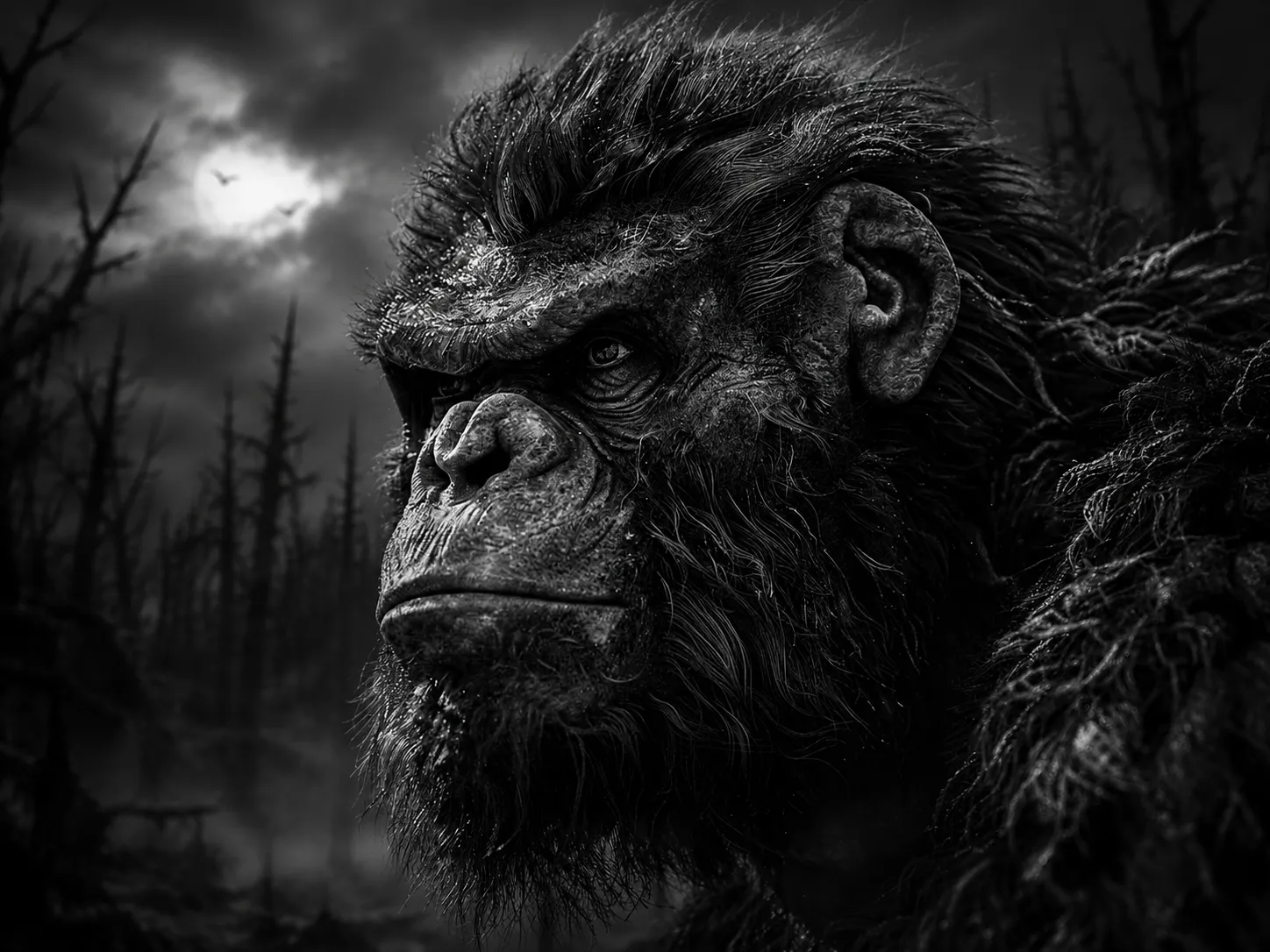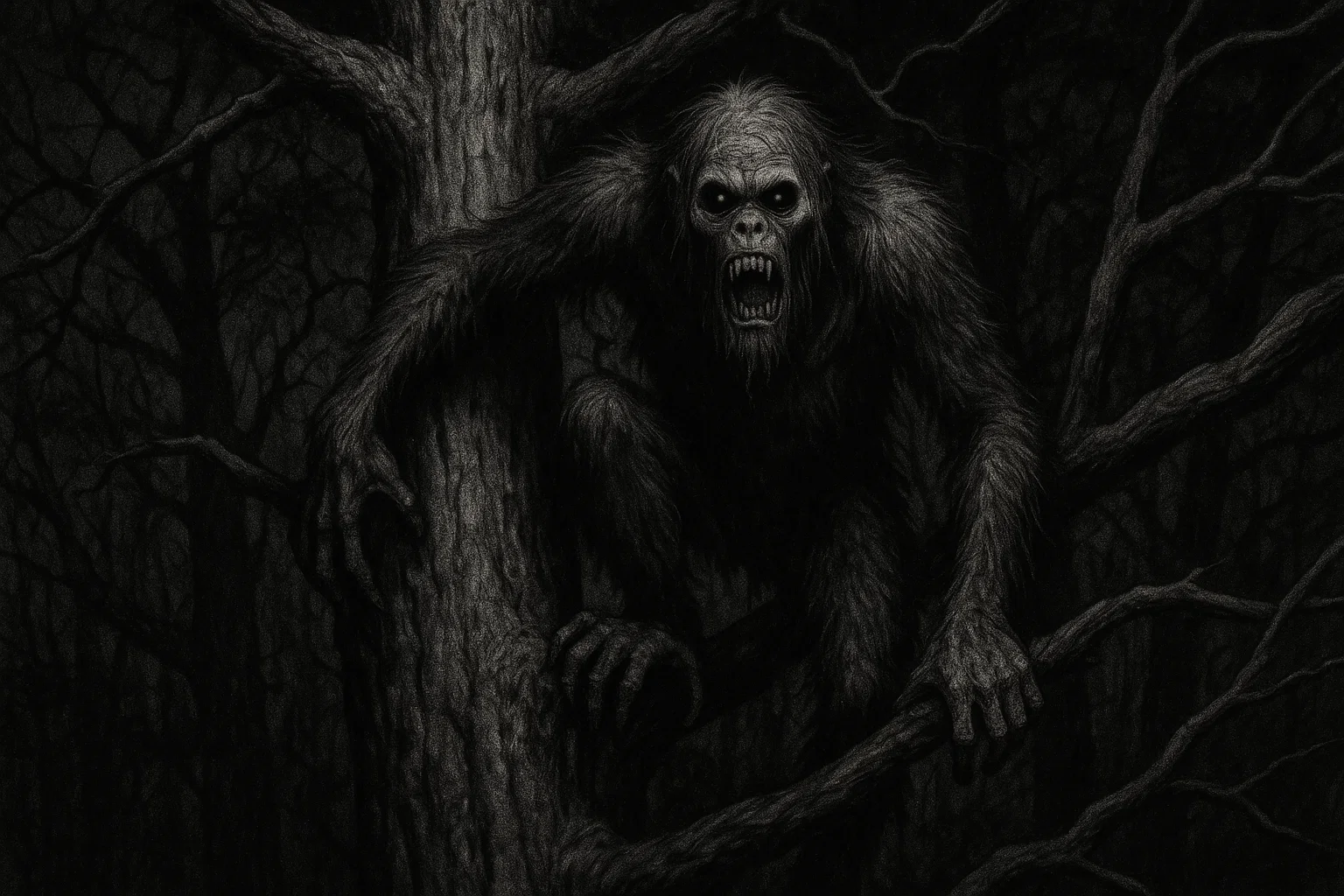
The Alabama Sasquatch is the name given to a towering, hair-covered, ape-like creature that hundreds of hunters, drivers, and rural residents claim to have encountered in the state’s national forests, river bottoms, and backroads.
Unlike the Pacific Northwest’s version of Bigfoot, Alabama’s creature has its own regional identity, its own local names, and a documented paper trail of sightings, festivals, and even a town that has officially branded itself around the legend.
Summary
Infobox
| Attribute | Details |
|---|---|
| Name | Alabama Sasquatch |
| Aliases | Alabama White Thang, Slough Thing, Red Eyed Devil, Southern Sasquatch |
| Ancestry | Choctaw and Cherokee wild-man oral tradition blended with the 20th-century North American Bigfoot/Sasquatch legend |
| Species | Hominid |
| CCI Score | 3/10 (Highly doubtful) [See the Cryptid Credibility Index] |
| Threat Level | 🟢 Harmless (Safe to track; essentially a ghost story) |
| Height / Weight | 6–10 ft tall (1.8–3 m); an estimated 500–800 lbs (225–360 kg) |
| Physical Traits | Bipedal; thick black, brown, reddish, or white hair; no visible neck; broad shoulders; foul odor; witnesses have reported yellow or glowing eyes |
| Habitat | Dense hardwood-pine forest, river bottomland, and swamp corridors within Alabama’s national forests and wildlife refuges |
| Core Sighting Corridor | North-central Alabama (Bankhead National Forest) and southwest Alabama (Conecuh National Forest / Evergreen area) |
| Time Active | Dusk, dawn, and full nighttime hours |
| Diet | Presumed omnivorous — deer, feral hogs, and forest mast/berries (speculative) |
| Movement | Primarily bipedal; some White Thang accounts describe the creature moving on all fours |
| First Sighting | Pre-1830s (Native American oral tradition, predating written record); 1940s (first documented modern sightings) |
| Last Notable Sighting | February 2023 (Heflin, Cleburne County) |
| Sighting Frequency | Widespread (101 total reports filed with the BFRO) |
| Evidence | Eyewitness accounts, footprint casts, claw marks, audio recordings of howls and screams |
| Rational Explanations | Misidentified American black bear, feral hog, white-tailed deer, or barred owl call; cultural pattern transmission among witnesses |
| Status | Actively reported; unconfirmed |
Who or What Is the Alabama Sasquatch?
The Alabama Sasquatch is a regional variant of the North American Bigfoot legend: a large, bipedal, hair-covered hominid said to inhabit the state’s forests, swamps, and river corridors. It is not a single, uniform creature. Instead, it is an umbrella term covering several overlapping local traditions — including the “Alabama White Thang” of the Bankhead Forest region, the “Red Eyed Devil” and general “Bigfoot” reports of south Alabama, and older Native American wild-man legends tied to the Choctaw, Chickasaw, and Cherokee peoples who lived across the state before removal in the 1830s.
Modern sightings are tracked most systematically by the Bigfoot Field Researchers Organization (BFRO), a nationwide volunteer network that logs and investigates witness reports.
Alabama has generated a total of 101 reports filed with the BFRO over the years, with the most recent coming from near Heflin in Cleburne County in February 2023, where a witness reported seeing what appeared to be Bigfoot peeking around a tree. Tuscaloosa County is tied with Morgan County for the highest number of BFRO-filed reports in the state, with five sightings or odd occurrences reported to the organization between July 1999 and April 2014.
Rather than a single confirmed animal, the Alabama Sasquatch is best understood as a persistent regional folklore tradition — one reinforced by consistent physical descriptions across unrelated witnesses, an environment genuinely suited to large, mysterious wildlife, and a cultural appetite (fed by local media, festivals, and word of mouth) for keeping the legend alive.
What Witnesses Describe: Height, Fur, and Behavior
Across dozens of independent Alabama reports, certain physical details repeat with unusual consistency.
Pine Orchard resident Carl Pugh described the creature he saw as 8 to 10 feet tall, with a head as large as a cow’s, a brownish-black body, and shoulders as wide as a Volkswagen. He said it could sound like a bulldozer walking through brush, or at other times as quiet as a cricket. Pastor and Bigfoot hunter Wesley Acreman, who founded the Southwest Alabama Bigfoot Hunters Organization, said the creature he and members of his group observed had yellow eyes.
Two traits show up again and again in independent accounts: a lack of visible neck, with the head seeming to sit directly on massive shoulders, and a powerful, unpleasant odor that witnesses often mention before they describe anything else about the creature’s appearance.
Coloration varies by report — black, dark brown, reddish, and grayish fur are all described, which is one reason researchers treat the “White Thang” sightings (see below) as a distinct color-morph tradition rather than a separate species.
Reported behavior tends to be defensive rather than predatory. Most Alabama accounts describe the creature freezing in place, staring, and then retreating into cover once it registers that it has been seen, rather than approaching a witness.
Vocalizations described across multiple unrelated reports include low moans, a bulldozer-like grumbling sound moving through brush, and — particularly in the White Thang tradition — a scream witnesses compare to a woman in distress.
Sightings are also reported disproportionately at dusk, dawn, or full dark, near water sources such as creeks, sloughs, and the freshly cut lines used by utility and gas companies, which several witnesses describe as travel corridors the creature appears to use like a game trail.
Discover More Cryptids:
Impundulu: The Strange Bird That Drinks Blood
May 21, 2025
Complete Guide to Utah Bigfoot Sightings (1970–2025)
August 8, 2025
Native American Legends of the Wild Man
Long before Bigfoot became a national pop-culture phenomenon, the peoples indigenous to what is now Alabama had their own oral traditions about large, hairy, man-like beings living in the deep forest. Choctaw folklore describes the Shampe, a malevolent, ogre-like monster sometimes depicted as a giant and other times as a large, hairy man.
In some versions, he attempts to abduct Choctaw women; in others, he is portrayed as a man-eater. His most distinctive trait is an overpowering smell so strong that it makes him difficult to approach or fight. Related figures appear in neighboring nations, including the Lofa of the Chickasaw. Both the Choctaw and Chickasaw homelands historically extended into what is now western and central Alabama before the forced removals of the 1830s.
Farther north, in the region that includes the Bankhead National Forest, Cherokee land once stretched across the area before the same removal era. Cherokee oral tradition includes the Tsul’ Kalu, described as a powerful, ape-like being that was both feared and revered among Cherokee communities.
Local historians and folklore researchers in north Alabama have traced references to a wild, hairy man in the Bankhead region back through Cherokee storytelling and later Scots-Irish settler tradition, arguing that the “White Thang” legend did not spring up overnight in the twentieth century but grew out of a much older layer of regional folklore.
The Choctaw tradition also includes a second, related creature worth distinguishing from the Shampe: the Nalusa Falaya, a frightening shadow-like being described in Choctaw folklore as thin and dark rather than bulky and hair-covered. The two are sometimes conflated by modern retellers. Nonetheless, traditionally they represent different kinds of forest danger — the Shampe a physical, smell-driven predator, the Nalusa Falaya something closer to a malevolent spirit. Keeping them distinct matters for anyone tracing the actual folkloric record rather than a flattened modern version of it.
These older traditions matter because they establish that “hairy wild man” stories were circulating in Alabama’s forests generations before the word “Sasquatch” entered the American vocabulary in the 1920s (borrowed from a Halkomelem word used by the Sts’ailes people of British Columbia) or “Bigfoot” became popularized nationally in 1958.
It is also worth noting that the modern BFRO classification system explicitly carves out an exception for this kind of pre-1958 material: reports from before Bigfoot entered the American vocabulary, and sightings documented in non-tabloid newspapers or magazines, are treated differently from ordinary secondhand stories precisely because they predate the modern cultural template for what such a creature is “supposed” to look like.
The Alabama White Thang: A Distinct Regional Variant
The best-documented and longest-running of Alabama’s local traditions is the “White Thang” (sometimes called the “Slough Thing” around Courtland, in Lawrence County), centered on the Bankhead National Forest in north Alabama.
Stories of the Alabama White Thang have circulated since the 1940s, describing a white, furry, tall, Bigfoot-like creature that has eluded definitive evidence. Accounts vary on its exact form: some witnesses say it stands 7 to 10 feet tall and walks upright on two legs, while others insist it moves on all fours and looks more like a large animal with the head of a cat.
Beyond stature, older regional descriptions add further detail: a scream reported to sound almost human — specifically like a woman screaming — along with a powerful, foul odor — both details that echo the Shampe legend’s emphasis on smell as a defining trait.
Reported sighting areas historically associated with the White Thang include Happy Hollow, Walnut Grove, Moody’s Chapel, and the Wheeler National Wildlife Refuge, plus the Bankhead Forest itself. Most witness accounts describe the creature as shy and non-threatening rather than aggressive, a detail that distinguishes it from the more overtly menacing Shampe of Choctaw tradition.
Alabama’s Bigfoot Hotspots
Alabama’s sighting reports are not evenly distributed. They cluster heavily around a handful of large, densely forested public lands, which makes geographic sense: these are among the largest unbroken tracts of wilderness left in the state, with limited human traffic, dense tree cover, and reliable water and food sources for wildlife.
- Bankhead National Forest (Winston County and surrounding areas) — the traditional home of the White Thang legend, with reports and expeditions continuing into recent decades.
- Conecuh National Forest and the Evergreen area (Conecuh and Monroe Counties) — the modern epicenter of south Alabama’s Bigfoot culture.
- Talladega National Forest (spanning Cleburne and Clay Counties) — a regular source of reports in east-central Alabama.
- Tuscaloosa and Morgan Counties — tied for the highest volume of formally filed BFRO reports in the state.
- Additional frequent reports come from Limestone, Chilton, Colbert, and Tallapoosa Counties, as well as the Wheeler National Wildlife Refuge in the Tennessee Valley.
Wheeler and Bankhead in particular sit along river systems and hardwood bottomland that provide the kind of dense cover and food resources — deer, feral hogs, and abundant mast crops from oaks — that would, in theory, support a large omnivorous animal moving largely undetected.
Alabama’s terrain provides this pattern with real ecological support. The state contains roughly 23 million acres of forestland, covering about 69 to 70 percent of its total land area — enough to rank Alabama third among the lower 48 states in total timberland acreage, behind only Georgia and Oregon.
Of that forestland, more than 90 percent is privately owned, meaning the publicly accessible national forests where most organized Bigfoot expeditions take place — Bankhead, Conecuh, and Talladega — represent only a fraction of the total wooded terrain in the state.
Alabama White Thang Sightings Map
This is a complete, 100% interactive map of all alleged Alabama White Thang sightings. Click on the “Play” button to start interacting with the map. The sightings are color-coded by decade. You can click or tap on each marker for additional details.
The Self-Declared Bigfoot Capital of Alabama
No single event has done more to put the Alabama Sasquatch on the map than what happened in the small city of Evergreen, the county seat of Conecuh County, in early 2017.
Bigfoot hunters Donald McDonald of Mississippi and Michael Humphreys of Oklahoma, from the television series “Killing Bigfoot,” visited Conecuh County in January 2017 and put on a program about Bigfoot during Evergreen’s annual Collard Green Festival. Based on a large set of claw marks they found in Pine Orchard, they publicly declared that there were “monsters” in the woods around Conecuh County.
The story went worldwide through outlets including AL.com and nationally syndicated radio programs such as Rick & Bubba and Coast to Coast AM. Around the same time, local enthusiasts formed the Southwest Alabama Bigfoot Hunters organization. In February 2017, the Evergreen city council approved a resolution declaring the city the Bigfoot Capital of Alabama, reasoning that Evergreen sat at the geographic center of the reported activity.
The Southwest Alabama Bigfoot Hunters Organization grew to more than 50 members in the years following its founding, collecting and comparing witness accounts from across the surrounding counties. The town’s association with the legend has since been the subject of a 2020 documentary, “The Town That Loved Bigfoot,” and the Collard Green Festival now regularly folds Bigfoot-themed programming into its annual schedule.
Discover More Cryptids:
What Is the Snallygaster Monster and Why Does It Terrify Maryland?
September 26, 2025
What Is the Mazomba—Africa’s Lost Dinosaur or an Unknown Rhino?
November 11, 2025
What the Data Actually Shows
When I set aside the individual anecdotes and just look at the aggregated numbers, I get a more sober picture than the local folklore alone suggests.
Of the 101 Alabama reports filed with the BFRO, Tuscaloosa and Morgan Counties account for the largest concentrations, each with five logged sightings over roughly a 15-year cover. That’s a modest number in absolute terms, especially spread over more than a decade — and it tells me something the festivals and campfire stories don’t: even in a state with an organized, active Bigfoot-research community, formally documented, investigated encounters remain rare rather than routine.
I think it’s worth explaining how that data is actually vetted, because most casual readers assume every “Bigfoot sighting” carries equal weight, and it doesn’t. The BFRO sorts every report it receives into one of three tiers:
- Class A — clear, direct sightings under conditions where misidentifying another animal is unlikely, including well-documented footprint finds.
- Class B — a possible sighting at a distance, in poor light, or without a clear view of the subject; still considered credible, just harder to verify.
- Class C — secondhand or thirdhand stories with an untraceable source, which the organization keeps in its archives but rarely publishes, except for pre-1958 accounts documented in legitimate newspapers.
I find that classification system useful precisely because it undercuts the more sensational retellings of Alabama’s Bigfoot culture. A number like “101 reports” sounds impressive until you realize it is a mix of all three tiers, collected over roughly three decades, across a state of five million people.
When I compare that to national BFRO research, which has found that sighting reports overall have been trending downward over time even as public interest in the topic has grown, and that reports cluster disproportionately in summer and autumn months, the Alabama pattern looks less like an anomaly and more like a small regional sample of a much larger, well-studied reporting phenomenon.
To me, the gap between how often the Alabama Sasquatch comes up in conversation, tourism branding, and local media, versus how rarely it shows up as a rigorously investigated Class A case, is one of the most telling data points in the entire subject.
Discover More Cryptids:
Proctor Valley Monster: Is the San Diego Bigfoot a Minotaur?
September 24, 2025
What Is a Pukwudgie? Spirit, Cryptid, or Something Worse?
November 5, 2025
The Strange Hodag Monster: Wisconsin’s Fearsome Cryptid
September 26, 2025
Skeptical and Scientific Explanations
When I look past the eyewitness accounts and toward what’s actually been tested in a lab, the strongest physical-evidence case against a literal flesh-and-blood Alabama Sasquatch comes from a 2014 study led by Oxford University geneticist Bryan Sykes, published in the peer-reviewed journal Proceedings of the Royal Society B. Sykes and his team put out an open call to museums, scientists, and Bigfoot and Yeti enthusiasts worldwide, asking for hair samples believed to come from “anomalous primates.”
They ran DNA sequencing on 30 usable samples from Bhutan, India, Indonesia, Nepal, Russia, and the United States.
Every single one matched a known species — mostly black bears, but also horses, wolves or dogs, cows, a porcupine, a raccoon, deer, and one human hair. None matched an unknown or unclassified primate. It remains, to my knowledge, the only systematic, peer-reviewed genetic survey ever conducted on physical evidence attributed to Bigfoot-type creatures anywhere in the world, and no Alabama-specific hair or tissue sample has ever produced a different result.
What I find more interesting than the negative result is a statistical detail buried in the same research: a follow-up analysis of the Sykes data found that Sasquatch sighting reports across North America are statistically correlated with black bear population density — for every increase of 1,000 bears in a regional population, researchers found an associated 4 percent increase in Sasquatch sightings in that area.
That correlation gives me a genuinely useful lens for reading Alabama’s own hotspot map. The state’s confirmed black bear populations are concentrated in two places: an estimated 30 bears centered on Little River Canyon near Fort Payne, in the same DeKalb-Cherokee-Talladega corridor where Bigfoot reports also cluster, and a separate, geographically isolated population of roughly 85 to as many as 165 bears in Mobile and Washington Counties, just south of the Conecuh National Forest where the Evergreen “Bigfoot Capital” sightings are concentrated.
That overlap doesn’t prove every Alabama report is a misidentified bear, but it’s a stronger and more specific piece of circumstantial evidence than the generic “it was probably a bear” explanation usually offers.
Beyond bears, I’d also point to more mundane sources of misidentification: white-tailed deer and feral hogs moving through dense brush at dusk, and the calls of barred owls, which produce a distinctive scream that has fooled experienced outdoorsmen into reporting something far stranger than a bird.
I also think the consistency of details like “no visible neck” and “overpowering odor” across otherwise unconnected witnesses is explainable by cultural transmission rather than a shared biological reality — once a description becomes part of local folklore, later witnesses describing an ambiguous, poorly lit encounter tend to unconsciously fit what they saw to the pattern they already know.
What none of this changes is the plain fact that, despite decades of searches, trail-camera deployments, and organized expeditions in the Bankhead and Conecuh forests, no bone, body, or verified DNA sample unique to an unknown hominid has ever been produced in Alabama or anywhere else.
Alabama Sasquatch vs Other Similar Cryptids
| Cryptid | Danger Level | Details |
|---|---|---|
| Fouke Monster (Boggy Creek Monster) | 💥 HIGH. Blamed for killing livestock and pets across rural Arkansas, and tied to a documented 1971 home invasion in which it reportedly reached through a window and grabbed a sleeping woman. | The 1972 docudrama it inspired, The Legend of Boggy Creek, was made on a shoestring budget yet became the 11th highest-grossing film of that year in the United States. |
| Momo (Missouri Monster) | ⚠️ MEDIUM. Associated with mutilated pets and a foul, rotting-meat odor during its 1972 flap, though no confirmed human injuries were ever reported. | An investigator who visited the town during the panic said the sightings matched nearly 300 similar “giant hairy biped” reports his organization had already logged nationwide since 1957. |
| Ohio Grassman | 🕊️ LOW. Overwhelmingly described as shy and reclusive, with only scattered older accounts of aggression toward livestock or property. | Its name comes from the flattened nests of tall grass it allegedly builds for shelter, and Ohio’s Salt Fork State Park now hosts an annual Bigfoot conference built entirely around local sightings. |
| Skunk Ape | 🕊️ LOW. Almost universally described as shy and non-confrontational, known mainly for its overpowering smell rather than any aggression toward people. | A Florida state representative tried twice in the late 1970s to pass a bill making it illegal to hunt or harm a skunk ape; both attempts failed in the legislature. |
| Yeti (Himalayas) | 🕊️ LOW. Traditional Sherpa and Tibetan accounts describe an elusive creature that avoids direct human contact rather than one that hunts people. | The most famous piece of physical “evidence,” a giant footprint photographed by mountaineer Eric Shipton during a 1951 Everest reconnaissance expedition, remains one of the most reproduced cryptid images in history. |
| Yeren (China) | ⚠️ MEDIUM. Chinese folklore historically describes it descending from mountain caves to raid villages for food, livestock, or women. | Reports of hairy wild men in what is now Hubei Province’s Shennongjia region date as far back as the Warring States period, roughly 340 BCE, giving the Yeren one of the longest continuously recorded wild-man traditions on Earth. |
| Yowie (Australia) | ⚠️ MEDIUM. Witnesses commonly describe aggressive territorial displays such as charging, rock-throwing, or piercing screams rather than direct physical attacks. | Skeptics point out that Australia’s native fauna includes no large omnivorous primates or great apes of any kind, making the Yowie harder to explain zoologically than its Northern Hemisphere counterparts. |
| Almas (Central Asia) | 🕊️ LOW. Most accounts describe a shy, primitive human-like being that avoids contact rather than one that threatens people or livestock. | A 1925 report describes a Red Army cavalry unit encountering what soldiers described as a naked, human-like being inside a mountain cave in the region, which reportedly died after being fired upon. |
| Orang Pendek (Sumatra) | 🕊️ LOW. Almost exclusively described as shy and elusive, occasionally raiding crops like potatoes but never attacking people. | At only 3 to 5 feet tall, it is one of the smallest hominid-type cryptids on record, leading some researchers to compare it to Homo floresiensis, the extinct dwarf hominin discovered on the nearby island of Flores. |
| Mapinguari (Amazon) | 🩸 SEVERE. Amazonian folklore describes it devouring entire cattle herds and punishing hunters who violate forest taboos, using an overwhelming stench as its first weapon. | The leading scientific hypothesis links it to the extinct giant ground sloth Megatherium, whose inward-curling claws would have produced footprints that looked eerily like backward-facing feet. |
My Take
After working through the folklore, the witness accounts, and the actual data, my own take is that the Alabama Sasquatch says as much about the state’s landscape and cultural memory as it does about any single animal. Alabama is, by any measure, still a genuinely wild state — nearly 23 million acres of forest, covering roughly seven-tenths of its total land area, ranking it third in the contiguous United States behind only Georgia and Oregon.
That’s not folklore; that’s US Forest Service inventory data. When I picture how much of that acreage is private timberland that almost nobody walks through regularly, rather than the handful of public forests where organized Bigfoot expeditions concentrate, it doesn’t surprise me at all that a mystery like this has room to breathe. Most of the state simply isn’t being watched closely enough for anyone to say with confidence what does or doesn’t move through it.
What genuinely impresses me, though, isn’t the physical plausibility — it’s the depth of the cultural layering. I don’t think it’s a coincidence that a wild-man tradition shows up independently in Choctaw stories of the Shampe, in Cherokee accounts of the Tsul’ Kalu, and then again in twentieth-century Scots-Irish settler tales that fed directly into the Bankhead White Thang legend.
Three unrelated storytelling traditions, occupying the same forests across different centuries, converged on a remarkably similar creature: something large, hairy, foul-smelling, and shy of direct contact. To me, that convergence is the most compelling part of the whole subject, regardless of whether a single physical creature is ever found.
And I think that’s why Evergreen’s decision to lean into the legend rather than laugh it off makes sense as more than just a tourism gimmick. A town built where multiple independent lines of folklore, geography, and modern eyewitness reporting all happen to intersect isn’t manufacturing a myth out of nothing — it’s sitting at a genuine convergence point in a story that predates the United States itself.
Whether or not I believe an undiscovered hominid is walking through the Conecuh or Bankhead forests tonight, I don’t think the Alabama Sasquatch is going anywhere. It’s too well ingrained in the actual wilderness and the actual history of the state that carries its name.
Discover More Cryptids:
Complete Guide to Ohio Bigfoot Sightings (1860–2025)
August 5, 2025
Complete Guide to Michigan Bigfoot Sightings (1962–2025)
August 1, 2025
Sources
- Evergreen. Encyclopedia of Alabama, Alabama Humanities Alliance.
- Blackburn, Lyle. Beyond Boggy Creek: In Search of the Southern Sasquatch. Anomalist Books, 2017.
- Blackburn, Lyle. The Beast of Boggy Creek: The True Story of the Fouke Monster. Anomalist Books, 2012.
- Sykes, Bryan C., et al. Genetic Analysis of Hair Samples Attributed to Yeti, Bigfoot and Other Anomalous Primates. Proceedings of the Royal Society B: Biological Sciences, vol. 281, no. 1789, 2014.
- Alabama Forestry Commission. Encyclopedia of Alabama, Alabama Humanities Alliance.
- BFRO Database History and Report Classification System. Bigfoot Field Researchers Organization.
- Shampe, Man-Eating Monster of the Choctaw. Native Languages of the Americas.
- Fouke Monster. Encyclopedia of Arkansas, Central Arkansas Library System.
- Draper JP, Waits LP, Adams JR, Seals CL, Steury TD (2017). Genetic health and population monitoring of two small black bear (Ursus americanus) populations in Alabama, with a regional perspective of genetic diversity and exchange. PLOS ONE 12(11): e0186701.
- Photograph of an alleged yeti footprint found by Michael Ward. The photograph was taken at Menlung Glacier on the Everest expedition by Eric Shipton in 1951. Wikipedia Commons.