In Norfolk, there is a mystery that has puzzled researchers for generations. Unlike many ghost stories dismissed as legend or tricks of the eye, the Brown Lady of Raynham Hall case is remarkable because of a famous photograph that experts still struggle to explain, even with today’s technology.
Unlike most hauntings that focus on a single room, this ghost is linked to the manor’s grand oak staircase. Sightings have persisted for over 300 years, possibly linked to the sad story of an 18th-century noblewoman who lived in isolation.
Summary
Key Takeaways
| Attribute | Details |
| Name | Brown Lady of Raynham Hall; Dorothy Walpole |
| THC Scale | L-4 [See the THC Scale Explanation] |
| Location / Origin | Raynham Hall, Norfolk, England (52.7944° N, 0.7911° E) |
| Classification | Residual; Crisis Apparition |
| History | Imprisonment and the suspicious death of Lady Dorothy Walpole in 1726. |
| Casualties & Deaths | 1 confirmed historical death (Dorothy Walpole) + 0 attributed deaths. |
| Associated Entities | The Duke of Monmouth; The Ghostly Cocker Spaniel |
| Manifestations | Visual (full apparition), Auditory (rustling silk), Environmental (temperature drops). |
| First reported sighting | 1835 (Christmas gathering) |
| Recent reported sighting | 1936 (Photographic capture) |
| Threat Level | 2/10 (harmless) [See the Threat Level Explanation] |
| HCR | 3/10 (probably authentic) [See the Hoax Confidence Rating Explanation] |
| Access Status | Private. The estate is a private residence and not open to the general public. |
What Is the Raynham Hall Haunting?
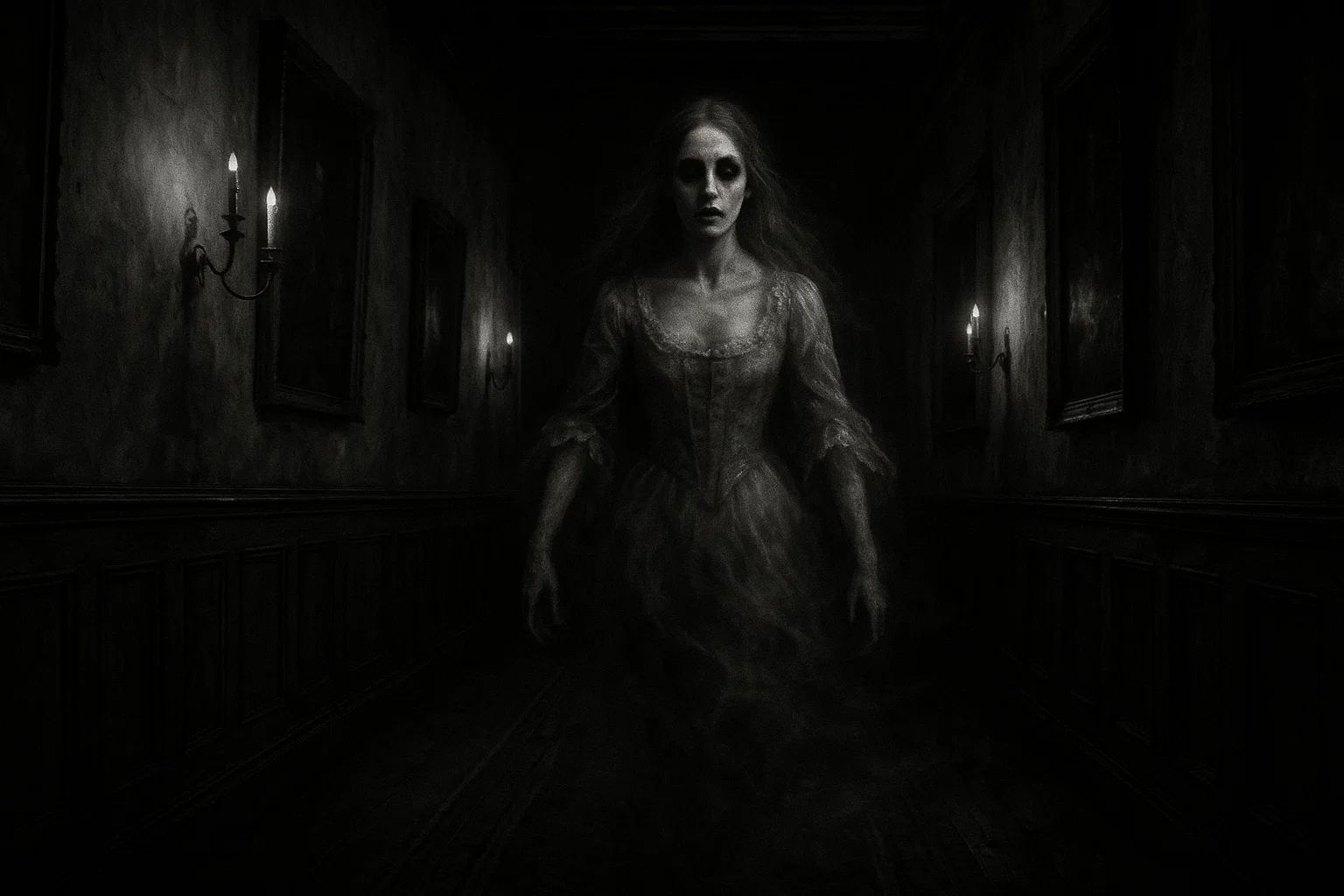
Most experts consider the Brown Lady of Raynham Hall to be a residual haunting, though some sightings happened during times of crisis. Witnesses describe her as a dignified woman in a brown brocade dress and a unique headdress.
One detail that unsettles many witnesses, even those who saw her up close, is that she has no eyes—just dark, empty sockets where her eyes should be.
As an investigator, I see this haunting as a kind of loop. The ghost is almost always seen on the grand staircase or in the halls near the State Bedroom. It seems the manor holds onto the woman’s strong emotions, the woman who was kept there in isolation by her husband, Viscount Townsend.
The Brown Lady of Raynham Hall haunting doesn’t seem to involve a spirit that interacts with people. Instead, it’s more like a replay of past events. Still, the 1936 photograph adds a twist, as the misty entity in the image suggests something more than a mere trick of the mind.
The Haunted History of Raynham Hall
Raynham Hall’s architecture tells the story of the Townshend family, who have lived there since the 12th century. The current mansion, built in the style of Charles I, was started in 1619 by Sir Roger Townshend.
But the ghost story at Raynham Hall mainly comes from the early 1700s, during the sad life of Lady Dorothy Walpole. She was the second wife of Charles Townshend and the sister of Britain’s first Prime Minister. Her life took a tragic turn after her 1713 marriage.
The haunting’s origin is tied to scandal and Dorothy’s confinement. Charles Townshend, known for his temper, reportedly learned that Dorothy had a past relationship—and possibly a child—with Lord Wharton.
Local stories and family records say that instead of divorcing her, Townshend locked Dorothy in her rooms, took away her status, and kept her from seeing her children.
Parish records say Dorothy died of smallpox on March 29, 1726, but her quick burial and her husband’s jealousy led to rumors. Some think smallpox was just an excuse, and that she may have died from a fall or from neglect.
During this time, the house was remodeled. From 1725 to 1732, architect William Kent redesigned the inside, including the Grand Staircase, where the ghost is often seen. This happened right around the time Dorothy died, which is important for investigators.
Some believe that remodeling the house during a time of strong emotions helped “record” Dorothy’s distress. The heavy marble and oak used in the hall and stairs may have created a ‘Stone Tape’ effect, capturing her repeated, desperate walks.
Unlike many ghost stories that appear long after the events, Raynham Hall’s own records support the legend. Family documents and guest books from the 1800s mention an uneasy feeling in the State Bedroom and the Belisarius Room, both part of the area where Dorothy was said to be kept.
Records from 1835 show that during a Christmas party at the hall, several guests—who didn’t know the story—described seeing a woman in old-fashioned brown silk. They also noticed a strange smell and a sudden chill, suggesting the haunting was already well known before ghost tourism became popular, and it ties the legend to real events in the family’s history.
You may also enjoy:
Complete Guide to Wyoming Bigfoot Sightings (1967–2025)
August 10, 2025
Morax: The Bull-Headed Demon of Hell
August 29, 2025
What Is the Snallygaster Monster and Why Does It Terrify Maryland?
September 26, 2025
Brown Lady of Raynham Hall Ghost Sightings
Sightings at the hall have looked the same for almost 200 years, though there seem to be fewer reports now, possibly because the estate is more private today.
| Date | Witnesses/Observers | Location/Context | Manifestations/Details |
| c. 1735 | Prince Regent George IV (then a young prince) | A room at the Hall | Reportedly encountered a small figure of a woman dressed in brown. |
| 1835 (Christmas) | Colonel Loftus and a hunting guest (Hawkins) | Corridor leading to the main staircase | Loftus saw the figure twice. The first night, she smiled at him. On the second night, he noted that the figure had a grinning face and dark, hollow eye sockets. |
| 1836 | Captain Frederick Marryat (Novelist) | Dorothy Walpole’s bedroom | Marryat saw the figure emerge from a closet and approach him. He fired a pistol at it, and the figure vanished. The bullet lodged in the door opposite where the apparition stood. |
| 1926 | Lady Townshend and her son, George | Main staircase | George and a friend observed the Brown Lady descending the stairs. She was described as wearing the distinctive brown brocade dress. |
| 1936 (September 19) | Captain Hubert C. Provand and Indre Shira (Photographers for Country Life magazine) | Main staircase | Captured the famous photograph known as The Brown Lady of Raynham Hall. |
The Marryat Encounter (1836)
The story of Captain Frederick Marryat is often seen as the strongest evidence for a ghost with awareness at Raynham Hall. He was a respected figure who even tried to confront the ghost directly.
Marryat, a well-known Navy officer and novelist, stayed at the hall in 1836. He didn’t believe the ghost stories and asked to sleep in the haunted room with Dorothy Walpole’s portrait, hoping to show that the sightings were just nerves or bad lighting.
The main account says Marryat was walking back to his room late at night with two of the Baronet’s nephews. As they walked down a dark hallway, they saw someone approaching, holding a lamp.
Thinking it might be a prank or an intruder, Marryat and the two young men hid in a doorway to watch. He saw that the entity was a woman in a brown brocade dress. When she reached them, she stopped and turned. Marryat was shocked to see her face looked dead, with empty, dark eye sockets. The ghost then gave them a chilling, ‘diabolical’ grin before moving on.
Interestingly, most accounts say Marryat was alone, but research in the 1990s, based on his daughter Florence Marryat’s memoir, shows that the nephews were also there and witnessed the ghost. Why is this important? Because it means that all three men witnessed the entity at the same time, making it less likely to be the result of just one person’s imagination.
This detail is also important because Marryat was so terrified that he stepped out and fired his gun at the ghost from close range. The bullet went through the entity and ended up in a bedroom door across the hall.
For investigators, this is key: the bullet hole stayed in the wood for years as proof. The ghost’s smile also hints that it might be aware, not just a mindless replay. This detail, found in old memoirs and later research, suggests the ghost could be more than just a harmless echo.
Theories
The Stone Tape Theory (Residual Imprinting)
The main theory about the Brown Lady of Raynham Hall is the Stone Tape Theory. It says that certain minerals can ‘record’ strong emotions. I think Raynham Hall is a perfect example of this because of its structure and the materials used to build it.
The hall is built with lots of limestone and heavy oak, which some believe can store emotional energy. When Dorothy was locked away and profoundly distressed, it may have left a lasting mark on the building.
In my research, I’ve noticed the Brown Lady of Raynham Hall usually follows the same route, especially on the grand staircase, a typical sign of a residual haunting—a replay of the past, possibly triggered by factors like humidity or changes in the building’s magnetic field.
Unlike a ghost that interacts with people, this one doesn’t notice anyone. It’s more like a movie playing in the hallway. Since Dorothy suffered so much in the 1720s, the haunting may be a replay of her painful walks during that time.
Tectonic Strain and Piezoelectricity
Another theory, called Tectonic Strain Theory, claims that stress in the earth’s crust can generate electric currents when pressure is applied on crystals such as quartz in the ground.
Norfolk isn’t known for earthquakes, but it does have layers of chalk and flint. When these layers move or are under pressure, they can release electromagnetic energy. I think this energy might affect the human brain, which is sensitive to magnetic changes.
When someone walks into a ‘hot spot’ like the Raynham staircase, their brain might turn these magnetic fields into vivid hallucinations, like seeing a woman in a brown dress, which could explain why some people see the Brown Lady and others don’t.
Sightings also seem to come in waves, matching changes in the earth. But this theory doesn’t explain the 1936 photo, since cameras can’t hallucinate.
Infrasound and Structural Resonance
Another factor is infrasound, or very low sound waves. Raynham Hall’s large, drafty rooms and long corridors can create these sounds, which people can’t hear but can still affect them. Research shows that certain frequencies can make the eyes vibrate, causing people to see flashes or shapes that their brains might interpret as familiar ghost stories, such as the Brown Lady of Raynham Hall.
Infrasound can also make people feel afraid, cause chills, or make them feel as if they are being watched. When I looked at the hall’s design, I saw that the wind moving through the grand staircase could easily create these low sounds, like a giant organ pipe.
If someone already knows the Brown Lady story, their mind might turn these eye effects into a ghost sighting. This theory explains many encounters, but it doesn’t fully account for the detailed reports of the brown dress and empty eye sockets seen up close.
Psychometry and Collective Thoughtforms
Another idea is that the haunting is a Thoughtform, or Tulpa, created by people’s beliefs. For over 300 years, the Townshend family and their guests have focused on Dorothy Walpole’s story. Some parapsychologists think that strong, shared belief can create a kind of psychic projection that seems real in a certain place.
I think this could explain why the Brown Lady of Raynham Hall ghost always looks the same—people expect to see the Brown Lady, so that’s what they see. This idea is supported by the 1936 photo, which looks just like the classic image people have in mind.
But some guests in 1835 said they saw the ghost without knowing the story first. If people saw the Brown Lady before the legend was well known, it can’t be just a shared belief.
The “Temporal Bleed” or Chronal Slip
I’ve also been exploring a more unusual theory: maybe what people see isn’t a ghost, but a brief overlap in time. The unique design of Raynham Hall and the strong emotions tied to Dorothy’s story might allow the past and present to briefly connect. In this case, Dorothy isn’t haunting us—she’s just living her life in 1726, and sometimes we catch a glimpse.
Such an overall could explain why the ghost smiled at Marryat. A recording wouldn’t react, but a real woman from 1726 might smile if she saw a stranger. It also fits with the misty look in the 1936 photo—it might just be a blurry image of someone from another time.
In my view, the Brown Lady may be trapped by time itself. Raynham Hall isn’t haunted by a ghost, but by its own history, which sometimes shows itself when the conditions are just right.
You may also enjoy:
The Real Story Behind Charley the Doll’s Curse
July 13, 2026
Consolation Church Cemetery Haunting: A Terrifying Ghost Story
September 23, 2025
Who Is Lucifer? Names, Myths, Titles, and Powers
August 25, 2025
The Infamous 1936 Photograph
The 1936 photo taken at Raynham Hall is one of the most closely examined pieces of ghost evidence. Captain Hubert C. Provand and his assistant Indre Shira took the picture on September 19, 1936, marking a turning point between old ghost photography and modern investigation.
Unlike earlier fake ghost photos that used simple tricks, this image shows a misty, three-dimensional entity that seems to be standing on the grand oak staircase.
Provand and Shira were working for Country Life magazine, using a professional camera and sensitive glass plates. The hall was dark, so they needed a long exposure. As Provand took the photo, Shira, standing nearby, shouted that he saw a misty shape coming down the stairs. Provand quickly used the flash to capture the image.
Importantly, the photographers developed the plate right away. The magazine staff confirmed that the event happened suddenly and believed the two professionals wouldn’t risk their careers by faking a ghost photo on a routine assignment. This is a key reason many people trust the photo.
Technical Analysis
For many years, the Society for Psychical Research seemed to cautiously accept the photo. But in 2006, researcher Alan Murdie found a forgotten report from 1937 in the Cambridge University Library. Written by C.V.C. Herbert, it revealed a technical problem with the photo that had been overlooked.
Herbert’s analysis examined flaws in the lens used by Provand. He pointed out that the banisters on the left side of the photo appear doubled, which is a form of optical ghosting, suggesting the camera may have moved or vibrated during the long exposure.
Murdie’s finding offers a strong physical explanation: the ghost might just be a blurred image of the staircase, caused by the camera moving slightly and letting in extra light. This shifts the question from whether it’s a ghost to whether it’s just a camera problem.
Further doubts about the ghost theory came from John Fairley and Simon Welfare, who re-examined the original negative in 2002. They found odd shapes in the ghost’s outline and, using filters, saw a pale line near the bottom of the entity that didn’t match the stairs.
They claimed the photo might be a “controlled” double exposure involving a religious figurine (or a Madonna statue). The shape of the ghost matches these statues very closely, including the folds of the clothing and the hooded head. They also noticed a dark patch at the bottom that appears to be a pedestal.
This detail suggests that a second, shorter exposure of a small object was added to the main photo of the staircase, which would explain why the ghost appears to glow, a common effect when a bright object is placed over a dark background.
Elements and Claims of Authenticity
Even with these technical doubts, the photo has features that are hard to explain away. The ghost looks see-through but seems to cast a faint shadow on the wall.
Harry Price, a leading paranormal investigator, said, “I could not imagine any bribe which would induce these two men to risk their livelihood and their reputation by a trick of this kind.” Price also found no signs of tampering on the photo plate.
The ghost in the photo—a tall, covered entity with a hard-to-see face—matches what Lucia C. Stone described in 1835, calling it ‘luminous.’ The fact that the ghost appears on the William Kent staircase is also important, since researchers often look for activity in certain spots.
Looking at all the evidence, there’s a real puzzle. The photographers were trustworthy, and the photo plate wasn’t tampered with. But the 2002 Madonna theory and the 2006 Cambridge report both offer technical ways the photo could have been faked, either by accident or on purpose.
In my opinion, the Cambridge report is the strongest argument against the photo being supernatural. If the lens caused a double image of the banisters, the ghost is probably just a camera effect. Still, even if the photo isn’t real, it doesn’t erase the many eyewitness accounts from over the years.
You may also enjoy:
What Is the Púca? Mythology, Origins, and Powers
January 30, 2026
Rokurokubi Legends: Women Who Transformed Into Night Demons
September 9, 2025
Who Is Lucifuge Rofocale in Demonology?
August 25, 2025
Who Is Samael? The Angel of Death in Demonology
August 27, 2025
Minos: The Tyrant King of Crete and His Dark Mythological Legacy
September 9, 2025
What Is the Agogwe? The Mysterious Hairy Dwarf of East Africa
November 10, 2025
Brown Lady of Raynham Hall vs Other Similar Entities
| Name | Location | Type of Haunting | Activity Level |
| The Grey Lady | Glamis Castle, Scotland | Residual | 5 (occasional) |
| The Pink Lady | Stirling Castle, Scotland | Intelligent | 4 (occasional) |
| The White Lady | Balgownie Castle, Scotland | Residual | 3 (dormant) |
| Anne Boleyn | Tower of London, England | Residual | 8 (very active) |
| The Blue Lady | Berry Pomeroy Castle, England | Intelligent | 7 (very active) |
| The Black Nun | Bank of England, London | Residual | 2 (dormant) |
| Lady in White | Avenel Mansion, Australia | Intelligent | 6 (occasional) |
| The Red Lady | Huntingdon College, USA | Crisis Apparition | 4 (occasional) |
| The Screaming Lady | Derby Gaol, England | Poltergeist | 9 (very active) |
Is the Brown Lady of Raynham Hall’s Ghost Real?
The authenticity of the Brown Lady of Raynham Hall’s haunting remains unresolved within the established fields of paranormal investigation and historical research.
While the primary character, Lady Dorothy Walpole, is an authenticated historical personality whose life at Raynham Hall and following death in 1726 are verifiable, the causal link between her life events and the spectral manifestations relies solely on anecdotal evidence and local folklore.
The disparity between the official record of death (smallpox) and the narrative of traumatic confinement and demise provides the necessary ambiguous foundation for the spectral narrative to persist.
The evidentiary component of the haunting is anchored by consistent accounts from multiple witnesses spanning a broad chronological cover, especially those of Colonel Loftus and Captain Marryat. What’s more, the 1936 photograph published in Country Life magazine continues to function as the most tangible, yet inconclusive, piece of proof.
Although the image has resisted easy dismissal as a crude forgery, the developers’ confirmation of the negative’s integrity complicates the analysis. Technical experts and skeptics have put forth plausible non-paranormal explanations, including reflections and photographic error, that challenge its status as definitive documentation of a spectre.
You may also enjoy:
Is the Beast of Busco Real? Inside America’s Forgotten Cryptid Case
September 25, 2025
Who Is Azazel, the Demon Who Corrupted Humanity?
September 29, 2025
What Is the Nurikabe Yokai? The Haunted Barrier That Traps Travelers
September 9, 2025
12 Haunted Places in Arkansas You Should Never Visit Alone
October 8, 2025
Sources
- Cambridge University Library. Department of Manuscripts and University Archives: Society for Psychical Research (SPR) Collection. Cambridge, UK.
- University of Adelaide. Barr Smith Library: Special Collections on Parapsychology (Harry Price Correspondence). Adelaide, Australia.
- Haunted Frequency. The Higgs Center for Theoretical Physics, University of Edinburgh, 31 Oct. 2021.
- Sharon A. Hill. The ‘Stone Tape Theory’ of Hauntings: A Geological Perspective. SharonAHill.com, 2017. Academia.edu.
- Mühlhans, Jörg H. Low Frequency and Infrasound: A Critical Review of the Myths, Misbeliefs and Their Relevance to Music Perception Research. Musicae Scientiae, vol. 21, no. 3, 2017, pp. 267-286. Sage Journals.
- Guiley, Rosemary Ellen. The Encyclopedia of Ghosts and Spirits. 3rd ed., Facts On File, 2007. Internet Archive.
- Ruffles, Tom. The Brown Lady of Raynham Hall – Re-Examination of a Classic Ghost Photograph and a Possible Explanation. Academia.edu.
- Raynham Hall, Norfolk. Country Life, vol. 80, no. 2063, 1 Aug. 1936. Internet Archive.
- Cardeña, Etzel. (2018). The Experimental Evidence for Parapsychological Phenomena: A Review. American Psychologist. 73. 663-677. 10.1037/amp0000236. ResearchGate.
- Country Life. The Online Books Page, University of Pennsylvania Library.
- Marryat, Florence. There Is No Death. Griffith Farran Okeden & Welsh, 1891. Internet Archive.
- Ingram, John H. The Haunted Homes and Family Traditions of Great Britain. W.H. Allen & Co., 1897. Internet Archive.