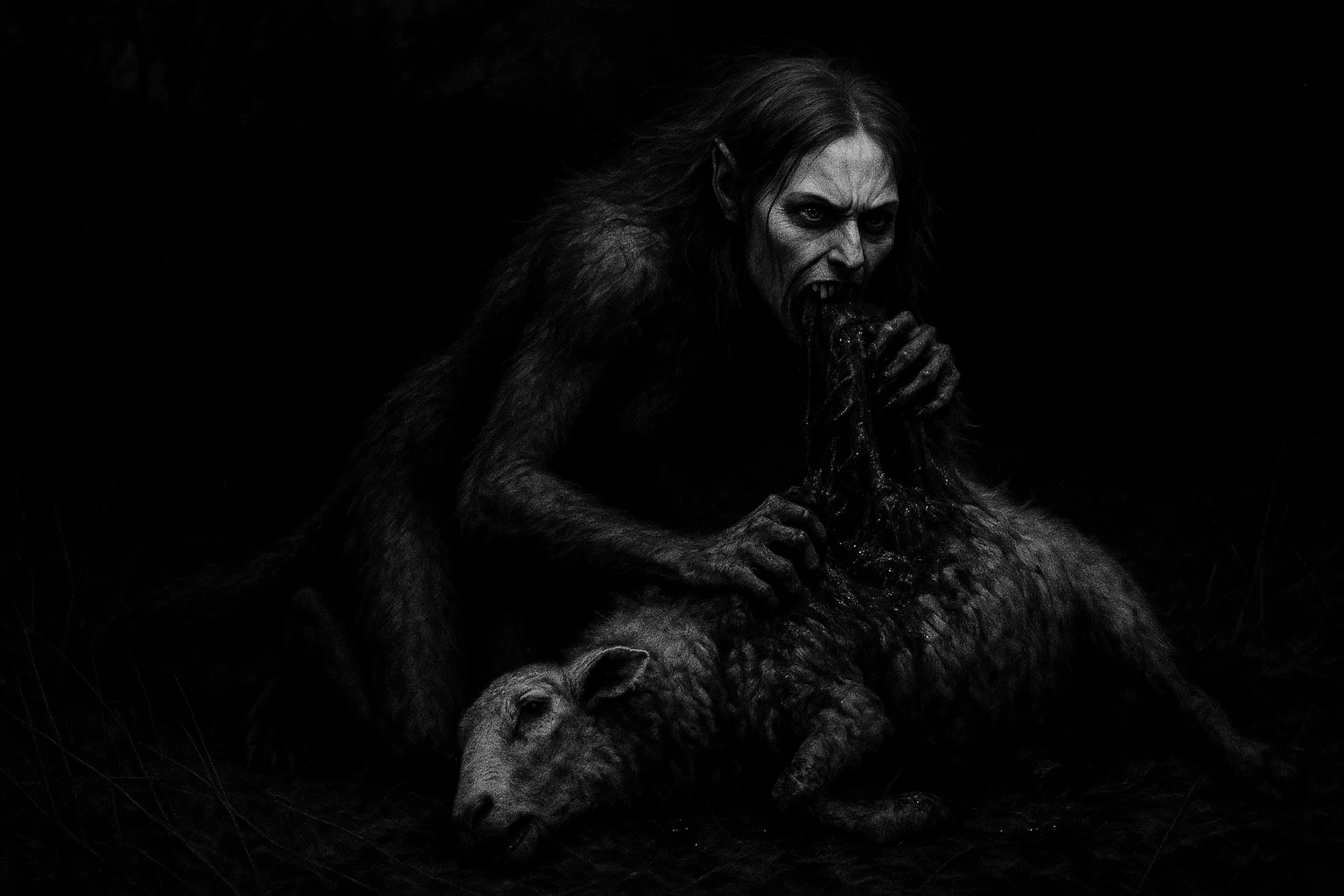
The Wolf Woman of Mobile is one of the strangest and most short-lived monster panics in American folklore, a creature said to have the head and torso of a woman fused to the body of a wolf, prowling the streets of a Gulf Coast city for barely two weeks before vanishing forever.
Also referred to online as the Chunchula Wolf Woman, after a community in the same Mobile County area, the legend has all the ingredients of a classic cryptid case: frantic eyewitnesses, a skeptical newspaper caught in the middle, and a mystery that was never actually solved.
What makes it stand out from better-known cryptids like Bigfoot or the Jersey Devil is how well-documented and short-lived the whole affair was, giving researchers an unusually clear paper trail to work from.
Summary
Wolf Woman of Mobile Infobox
| Attribute | Details |
|---|---|
| Name | Wolf Woman of Mobile |
| Aliases | Chunchula Wolf Woman; Wolf Woman of Davis Avenue |
| Ancestry | 1971 Newspaper-Driven American Urban Legend, with possible folk echoes of the French Gulf Coast loup-garou/rougarou tradition |
| Species | Humanoid-canid hybrid (unconfirmed/speculative) |
| CCI Score | 2/10 (Almost certainly misidentification) [See the Cryptid Credibility Index] |
| Threat Level | 🟢 Harmless (Safe to track; essentially a ghost story) |
| Physical Traits | Human female head and upper torso, described as “pretty” with long hair, fused to a hairy, wolf-like lower body; moved on all fours |
| Habitat | Urban and semi-rural residential streets, backyards, and wooded lots at the edge of a Gulf Coast city |
| Core Sighting Corridor | Davis Avenue and the Plateau/Africatown neighborhoods, Mobile, Alabama |
| Time Active | After dark, though the Mobile Register reported that calls came in “during the day and even at night” |
| Movement | Ran on all fours in a wolf-like gait |
| First Sighting | Late March–April 1, 1971 (Davis Avenue, Mobile, Alabama) |
| Last Notable Sighting | Late April 1971 (the panic ended abruptly; no confirmed sightings since) |
| Sighting Frequency | Occasional (more than 50 calls concentrated within roughly two weeks in April 1971; no other reports documented before or since) |
| Evidence | More than 50 eyewitness phone reports and one contemporary newspaper sketch; no photographs, footprints, or physical remains were ever recovered |
| Rational Explanations | Mass hysteria/social contagion (comparable to the 1944 Mad Gasser of Mattoon); quasi-ostension (ambiguous sightings reinterpreted through an existing rumor); misidentified animal (the documented Prichard collie dog incident); a possible prank timed to April Fools’ Day |
| Status | Dormant; treated by historians and folklorists as a resolved, single-episode urban legend rather than an actively reported cryptid |
Who or What Is the Wolf Woman of Mobile?
The Wolf Woman of Mobile is a cryptid and urban legend that originated in Mobile, Alabama, in April 1971, when residents of the Davis Avenue and Plateau neighborhoods began reporting a creature described as having the upper body of a woman and the lower body of a wolf.
Over the course of about two weeks, the local newspaper, the Mobile Press-Register (referred to at the time simply as the Mobile Register), received more than 50 phone calls from frightened residents who claimed to have seen, been chased by, or heard the creature at night.
Witnesses consistently described the creature as having a human-like upper half and a hairy, wolf-like lower half that allowed it to run on all fours. One alleged witness summarized it succinctly as “pretty and hairy.” At the same time, another explained, “[…] the top half was a woman, and the bottom was a wolf. It didn’t seem natural.”
Local police in both Mobile and the neighboring city of Prichard fielded calls about the creature and, in at least one documented instance, responded to a report of a “cornered” wolf woman only to find a frightened collie dog at the scene.
From the outside, the evidence seems to point to the Wolf Woman of Mobile being nothing more than a case of localized mass hysteria, likely sustained by a sensationalized newspaper story, word-of-mouth exaggeration, and the pre-existing atmosphere of monster fascination that marked the United States in the early 1970s.
The Timeline
The whole legend began quietly around the last days of March 1971, with isolated reports circulating informally in the Davis Avenue area before reaching the press. The Mobile Register at first dismissed the calls, and staff later admitted they had been ignoring reports of a “mysterious wolf woman or dog woman” before deciding the volume of calls warranted a story.
On April 1, 1971, calls began flooding into the newsroom in earnest. By April 8, 1971, the paper ran a feature headlined “But Would You Believe?” that asked readers outright, “Does a ‘wolf woman’ exist in Mobile?” The article was accompanied by a sketch of the creature, drawn by a newspaper illustrator based on witness descriptions, showing a wild-haired, humanlike face atop a hunched, animalistic body.
Rather than calming the public, the story had the opposite effect. According to the paper’s own follow-up reporting, treating the panic in a lighthearted, tongue-in-cheek tone backfired almost immediately: phone calls “rose to a crescendo” in the days after, with residents reporting chases, nighttime sightings in backyards, and creatures glimpsed slipping between houses after dark.
Some families even reportedly began locking doors and windows they normally left open.
Here’s what happened:
- Late March 1971: Informal, scattered reports begin circulating around Davis Avenue.
- April 1, 1971: Phone calls to the Mobile Register increase sharply.
- April 8, 1971: The paper publishes “But Would You Believe?” with an illustrated sketch of the creature, claiming more than 50 calls had been received.
- Mid-April 1971: The number of sightings increased dramatically, with many reporting chases and nighttime encounters; Prichard police field calls, including the collie dog incident.
- Late April 1971: Reports taper off and disappear from the newspaper entirely within about two weeks of the initial story.
By the end of April, the Wolf Woman had gone quiet, and coverage of the creature never returned to the paper’s pages in any serious capacity.
Where the Sightings Happened
The vast majority of alleged sightings were concentrated in two adjoining areas: Davis Avenue (now Martin Luther King Jr. Drive) and the Plateau neighborhood, both in Mobile, Alabama.
Davis Avenue was, at the time, the commercial and cultural heart of Mobile’s African American community, home to businesses, churches, and the historic Davis Avenue Recreation Center, which had opened decades earlier as the city’s first public leisure facility for Black residents.
The Plateau neighborhood carries a historical importance that rarely makes it into retellings of the legend. Plateau, along with the adjoining area of Magazine Point, is part of what is now known as Africatown, a community founded in 1866 by survivors of the Clotilda, the last known ship to illegally bring enslaved Africans to the United States, which arrived in Mobile Bay in July 1860, more than five decades after the international slave trade had been banned by Congress.
Roughly half of the group, led by a man named Oluale Kossola, better known as Cudjo Lewis, pooled money after emancipation to buy land and build their own self-governing settlement, complete with a church, school, and cemetery, so they could preserve their West African language and customs.
Cudjo Lewis, the last surviving member of the group, lived in the neighborhood until his death in 1935, and in 1927 the writer and anthropologist Zora Neale Hurston traveled from New York to interview him there, an encounter that later became the basis for her book “Barracoon: The Story of the Last ‘Black Cargo.’”
The Clotilda’s wreckage itself was not located and confirmed until 2019, discovered in the Mobile River not far from the neighborhood where the ship’s survivors had settled generations earlier. So the streets where residents reported chasing and being chased by the Wolf Woman in April 1971 sit inside one of the most historically significant African American communities in the United States, a detail that adds real weight to a story otherwise treated as a lighthearted curiosity.
Geographically, Plateau and Magazine Point also straddle a municipal boundary, with the historic settlement’s territory eventually divided between the city of Mobile and the neighboring city of Prichard as both cities expanded and annexed surrounding land through the 20th century.
That divided jurisdiction helps explain a detail that otherwise seems odd in the first reporting: both the Mobile Register (covering the Mobile side of the neighborhood) and the Prichard Police Department (covering the Prichard side) fielded calls about the creature during the same two-week cover, rather than the reports being handled by a single city government.
Beyond its residential streets, the Plateau area also provided a mix of undeveloped, wooded lots along the Mobile River and Chickasaw Creek drainage, the kind of low-visibility, semi-rural edge that so many localized cryptid scares depend on: enough open, poorly illuminated space for a nighttime shape to seem plausible, but close enough to dense housing for word to spread quickly among neighbors.
How Coverage Fed the Frenzy
Instead of deflating the rumor, publishing it validated the experiences of frightened callers. It introduced the story, along with the illustrator’s sketch, to thousands of readers who had not previously heard of the creature.
However, in its original story, the paper’s own coverage never fully committed to describing the creature as a physical animal, instead hedging its language by referring to it as a “phantom” and using similarly noncommittal terms. This editorial choice let the paper cover the panic without either endorsing or flatly denying it.
That hedging is captured in one of the more revealing lines from the paper’s own coverage, in which staff concluded, “Apparently the fears are real, regardless of the status of the phantom or whatever.” The comment shows a newsroom that had stopped trying to determine whether a creature existed and instead simply acknowledged that the fear seizing their readers was undeniably genuine, whatever its ultimate cause.
According to the paper’s own account, the calls had come in “during the day and even at night” throughout the week leading up to the April 8 story, indicating the volume of reports was constant rather than confined to nighttime hours when fear and poor visibility would be expected to play the largest role.
The paper openly speculated on its own role in spreading the legend, floating the idea that it could have started as what folklorists now call a “foaf tale,” or friend-of-a-friend story: an account that spreads through informal social chains, gaining detail and certainty with each retelling even though no one can trace it back to a firsthand source.
Discover More Cryptids:
Is Detroit Cursed by the Nain Rouge?
May 20, 2025
Bigfoot: What Are We Still Missing?
July 8, 2025
Honey Island Swamp Monster: The Cajun Sasquatch of Louisiana
September 25, 2025
The Police Response
Local police did not dismiss the reports outright. The Mobile Register noted that officers “refused to comment officially” but had quietly opened an inquiry in light of the volume of calls. In the neighboring city of Prichard, Police Chief Dan T. Davis later spoke publicly about the number of calls his department fielded describing sightings of the Wolf Woman.
Prichard, incorporated in 1925 and named for landowner Cleveland Prichard, was by 1970 a densely populated industrial suburb directly north of Mobile with a population of roughly 41,000 residents, meaning the Wolf Woman panic happened across two separate, moderately sized municipal police forces working the same story simultaneously rather than a single department.
The most memorable documented incident from the police response involved officers being called out by a resident who claimed to have physically cornered the creature. When officers arrived at the scene, they found not a wolf-woman hybrid but a frightened collie dog, an anecdote that has become one of the most cited pieces of evidence for the ordinary, misidentification-driven origins of at least some of the reports.
A confused or injured dog, glimpsed briefly in poor lighting by someone already primed to expect a monster, presents a plausible, non-supernatural explanation for at least a portion of the sightings.
Leading Theories: Prank, Feral Woman, Misidentification, or Folklore
No single explanation for the Wolf Woman of Mobile has ever been proven. Having spent considerable time with the primary source material, I don’t think any one theory on its own fully accounts for everything that happened in Mobile that April.
What I find more convincing is that several ordinary phenomena stacked on top of one another in a short window of time, and the newspaper’s own coverage acted as the accelerant that turned scattered, unrelated incidents into a single, unified “wolf woman” narrative.
Mass hysteria and social contagion. This is, in my view, the best-supported explanation, and it’s backed by more than just intuition. The Wolf Woman panic has a genuine academic parallel in the “Mad Gasser of Mattoon,” a 1944 case in Mattoon, Illinois, in which more than two dozen residents reported a prowler spraying a sickly-sweet gas into their homes, causing nausea and temporary paralysis.
University of Illinois psychology student Donald M. Johnson investigated the Mattoon case. He published his findings in the Journal of Abnormal and Social Psychology in 1945. It remains one of the most frequently cited textbook examples of mass psychogenic illness in American history.
The parallels to Mobile are remarkable: both panics lasted roughly two weeks, both were amplified rather than dampened by local newspaper coverage, both produced dozens of independent-seeming reports from otherwise credible residents, and both concluded not with a resolved mystery but with public attention simply moving elsewhere. I think the Wolf Woman deserves to be discussed alongside Mattoon as a comparable case study, rather than being treated purely as an isolated monster story.
Quasi-ostension: how an existing story reshapes ambiguous events. Folklorists have a specific term for what I believe happened after the Mobile Register’s April 8 article ran: quasi-ostension, a concept developed by folklorists Linda Dégh and Andrew Vázsonyi in their influential 1983 paper “Does the Word ‘Dog’ Bite? Ostensive Action: A Means of Legend-Telling.” Quasi-ostension describes the process by which ambiguous, real-world events get recast through the lens of an already-circulating legend.
Once the “wolf woman” framework existed in the public mind, an ordinary shadow, a stray dog, or an unfamiliar noise at night stopped being a neutral event. It became a data point confirming the story everyone was already telling each other. This is precisely what I think happened with the Prichard collie dog: the animal itself never changed, but the interpretive lens the community was using to process what they saw absolutely did.
Misidentified animals. Related to the point above, the collie dog incident is the single clearest documented case of misidentification in the entire affair. It strongly suggests that at least a portion, and possibly the majority, of the 50-plus calls were built on similarly mundane sightings, amplified by darkness, fear, and the expectation of seeing something important.
A complex prank or hoax. I take the April Fools’ timing seriously as a contributing factor, even if it doesn’t explain the full two weeks of sustained reports.
It’s entirely plausible that an initial rumor, joke, or costume prank around March 31 or April 1, 1971, provided the kick off, after which the story circulated and mutated through word of mouth far beyond anything the first prankster intended or could control. No individual ever came forth to claim credit, which is consistent with either a prank that got away from its creator or, just as likely, no deliberate hoax at all.
A feral or reclusive individual. This is the weakest of the theories in my assessment. The “wild child” or feral-human motif is genuinely old in Western thought, most famously documented in cases such as Victor of Aveyron, a boy found living alone in the forests of southern France in 1800, whose case became foundational to the study of child development.
But nothing in the first Mobile Register reporting or the Prichard police records points to an actual person being sighted, chased, or identified, which makes the theory more a reflection of a much older cultural archetype than a serious explanation grounded in the 1971 evidence.
Discover More Cryptids:
Is the Beast of Busco Real? Inside America’s Forgotten Cryptid Case
September 25, 2025
The Lobizon Legend: Werewolf, Curse, or Cryptid?
May 17, 2025
The Nandi Bear: Africa’s Terrifying “Brain-Eating” Cryptid
November 11, 2025
What Is Mpisimbi, The Strange African Leopard-Hyena Cryptid?
February 6, 2026
Werewolf and Shapeshifter Folklore
The Wolf Woman of Mobile sits at the intersection of several much older folklore traditions, which modern retellings often blend together without distinguishing them.
The European werewolf tradition, which shaped centuries of folklore across France, Germany, and the British Isles, typically describes a human who is transformed into a wolf, often against their will, through a curse, a bite, or a pact with dark forces, and who commits violence while transformed before returning to human form. This tradition focuses on involuntary transformation and moral corruption, and it is the version most familiar to American audiences through decades of Hollywood horror.
What I think gets missed in almost every other write-up of the legend is Mobile’s specific, documented relationship to a regional variant of that same European tradition: the French loup-garou. Mobile was founded in 1702 as Fort Louis de la Louisiane and served as the first capital of colonial French Louisiana, a full sixteen years before New Orleans existed and roughly twenty years before the French Louisiana capital relocated first to Biloxi and then to New Orleans in the early 1720s.
The city also hosted the first documented Mardi Gras celebration in North America, in 1703. This matters because the same French colonists, Catholic settlers, and later Acadian refugees who carried loup-garou folklore into the Louisiana bayou country, where it evolved into the regional creature now known as the rougarou, were part of the same colonial population that first settled the Mobile Bay area.
According to folklorist Barry Jean Ancelet, a professor emeritus at the University of Louisiana at Lafayette, the shift from “loup-garou” to “rougarou” is a straightforward linguistic drift common in Cajun French, where the liquid consonants “l” and “r” frequently swap places.
Louisiana State University Press author Nathan J. Rabalais has also documented that the rougarou, once transplanted into the Gulf Coast, rarely resembles an actual wolf in eyewitness accounts, since wolves have long been scarce in the region; witnesses more often describe something closer to a large dog or an owl-like monster.
I find that detail genuinely relevant here, because it suggests that “wolf” in Gulf Coast folklore, including possibly in Mobile, may function more as an inherited label from centuries-old French storytelling than as a literal physical description, which could help explain why 1971 witnesses so consistently paired a distinctly humanoid, “pretty” face with an animal body that behaved more like a large dog running on all fours than an actual wolf.
Separately, numerous Native American oral traditions include figures capable of taking on animal form. However, these vary enormously by nation and region and should not be treated as a single, interchangeable “Native American werewolf” concept. The skinwalker, specifically, comes from Navajo (Diné) belief and describes a malevolent witch capable of assuming animal shape, a custom embedded in the Southwestern United States, far from coastal Alabama.
Applying the skinwalker label to a Gulf Coast legend, as many retellings of the Wolf Woman do, is a geographic and cultural mismatch I think is worth correcting: the Indigenous nations historically associated with the Mobile area were primarily Choctaw and other Muskogean-speaking peoples, whose documented spiritual traditions are distinct from Navajo belief and should not be confused with it simply because both involve metamorphosis.
It’s worth noting that Choctaw oral tradition does include other figures associated with craftiness and transformation, but attaching the specific, culturally distant term “skinwalker” to those traditions, or to the Wolf Woman, isn’t historically accurate; it’s a case of one popularized term getting applied well outside the nation it actually belongs to.
Taken together, I don’t think the Wolf Woman of Mobile is a direct, single-source descendant of either the European werewolf or any Indigenous shapeshifter tradition.
My own read is that it’s a distinctly American 20th-century hybrid, most plausibly seeded by a regional folk memory of the French loup-garou that had been present in the Mobile Bay area since the early 1700s, then reshaped and modernized by decades of werewolf cinema, a national wave of Bigfoot-mania following well-publicized sightings elsewhere in the country during the late 1960s, and the ordinary, cross-cultural interest with beings that blur the line between person and predator.
Why “Chunchula Wolf Woman”? Clarifying the Alternate Name
Some modern sources refer to the legend as the Chunchula Wolf Woman, a name that has caused some confusion, given that the original 1971 sightings were centered on Davis Avenue and the Plateau neighborhood, both located within the city of Mobile itself, not in Chunchula.
Chunchula is a real, unincorporated community located in Mobile County to the north of the city, along Highway 45. There is no documented connection in the original published 1971 newspaper reporting that specifically places sightings in Chunchula.
The alternate name appears to be a modern addition used by some cryptid catalogs and blogs, possibly showing the way the legend has been loosely associated with Mobile County’s rural areas as a whole, rather than an indication that the first sightings took place there. Those researching the legend should treat “Wolf Woman of Mobile” as the historically accurate name and “Chunchula Wolf Woman” as a later, informal variant.
Not Mobile’s First Monster
Mobile’s newspaper itself pointed out in 1971 that the Wolf Woman was not the city’s first brush with monster mania. The Mobile Register’s own coverage referenced a previous monster scare that had struck the city in the 1930s, indicating that Mobile had a pre-existing local memory of and vocabulary for this kind of collective scare well before the Wolf Woman appeared.
The detail is significant because it shows the 1971 panic did not erupt in a cultural vacuum; Mobile already had a template for how a monster rumor could spread through the community and capture the local newspaper’s attention, making residents and reporters alike more primed to recognize, and perhaps to indulge, a new version of the same phenomenon four decades later.
The 1971 panic also arrived at a specific moment in the wider national culture that made a story like this unusually easy to embrace. Just four years earlier, on October 20, 1967, Roger Patterson and Bob Gimlin filmed their famous, still-debated footage of an alleged Bigfoot at Bluff Creek, California, which set off a nationwide wave of Bigfoot sightings, amateur investigations, and media coverage throughout the late 1960s and early 1970s.
Mobile’s own drive-in theaters capitalized directly on that same wave by booking screenings of the film “Bigfoot” in the very weeks the Wolf Woman story was fading from the news. Seen in that light, the Wolf Woman of Mobile wasn’t an isolated local oddity so much as a Gulf Coast expression of a monster-hunting mood that had already gripped much of the country.
Wolf Woman of Mobile vs Other Similar Cryptids
| Cryptid | Danger Level | Details |
|---|---|---|
| Michigan Dogman | ⚠️ MEDIUM. Described as an aggressive, upright canine humanoid that has chased vehicles and stalked campers, though no killings have ever been documented. | Ironically began as an admitted April Fools’ Day radio prank in 1987 by DJ Steve Cook of WTCM-FM in Traverse City, after which he received over 100 independent sighting reports from listeners. |
| Beast of Bray Road | 🕊️ LOW. Mostly reported crossing rural roads or standing near fields; no confirmed human injuries are tied to the creature. | The earliest documented sighting dates to 1936, more than 50 years before journalist Linda Godfrey’s 1991 newspaper coverage turned it into a national cryptozoology story. |
| Rougarou | 💥 HIGH. Cajun tradition holds that the creature specifically hunts down individuals who break the rules of Catholic Lent, tracking and cursing them. | Despite its name deriving from the French “loup-garou,” most Louisiana eyewitnesses describe something closer to a large dog or owl rather than an actual wolf, since wolves have long been scarce in the region. |
| Skinwalker | 💀 EXTREME. Regarded within Navajo (Diné) tradition as a malevolent witch capable of causing serious harm, illness, or death to those it targets. | The belief is treated with genuine cultural seriousness rather than as entertainment folklore, and many Navajo people consider it inappropriate to discuss the figure in detail outside their own community. |
| Werewolf of Bedburg | 💀 EXTREME. Unlike most entries on this list, this case involved real, documented killings; Peter Stumpp confessed under torture to 16 murders before his execution in 1589. | Stumpp’s trial near Cologne, Germany, remains one of the most thoroughly documented werewolf cases in European history, and many historians now view it as a politically charged show trial rather than genuine evidence of lycanthropy. |
| Wendigo | 🩸 SEVERE. Algonquian tradition describes it as a cannibalistic spirit that can possess or transform starving or morally corrupt humans, driving them to consume other people. | The Wendigo is so central to Algonquian, Ojibwe, and Cree belief systems that “Wendigo psychosis,” a controversial culture-bound syndrome describing an intense craving for human flesh, was named after it. |
| Kappa | 💥 HIGH. Japanese folklore describes it luring people, especially children, into rivers to drown them and extract the shirikodama, a mythical organ believed to hold the soul. | Despite its dangerous reputation, the kappa is also depicted as bound by strict etiquette, and legend holds that bowing to one forces it to bow back, spilling the water from the head-dish that gives it its power. |
| Kelpie | 🩸 SEVERE. Appears as a beautiful, tame-looking horse near Scottish lochs, but its skin becomes adhesive once a traveler mounts it, trapping the rider before it drags them underwater. | The legend is widely believed to have doubled as a practical warning to Scottish children to stay away from dangerous, fast-moving lochs and rivers. |
| Owlman of Mawnan | 🕊️ LOW. Typically described as hissing and fleeing rather than attacking, with no injuries ever attributed to it. | Its 1976 origin is tied to Tony “Doc” Shiels, a self-described magician and prankster, leading researchers to debate whether the entire legend began as a deliberate hoax. |
| Honey Island Swamp Monster | ⚠️ MEDIUM. Generally described as avoiding human contact, though a few accounts describe territorial aggression when cornered. | The legend traces to a single 1963 encounter reported by retired air traffic controller Harlan Ford, whose distinctive four-toed, webbed plaster track casts remain on public display at Louisiana’s Abita Mystery House. |
The Wolf Woman’s Today
Unlike cryptids with decades of continuous reported sightings, the Wolf Woman of Mobile never returned to the news after April 1971. Her heritage today survives mainly through local historians, folklore writers, and Alabama-based journalists who have kept the story alive.
Longtime Alabama journalist Kelly Kazek, known for her writing on the state’s oddities and legends for outlets including AL.com, has written about tracking down the first newspaper illustration of the creature in the Mobile paper’s archives decades after it was drawn, finding the artwork still intact after more than forty years in a file folder.
Kazek has also authored full-length collections of Alabama folklore, including a book gathering stories that have “existed only in rumor, anecdote, legend and lore” from across the state, from Muscle Shoals to Mobile, expressing the same kind of regional storytelling tradition that produced the Wolf Woman.
Mobile Bay Magazine, the city’s regional lifestyle publication, has also revisited the story as part of a regular “Port City Legends” feature covering Mobile’s folklore and ghost stories, and independent podcasters and paranormal researchers based in the Southeast continue to cite the Wolf Woman as one of Alabama’s clearest documented examples of a short-lived, newspaper-driven monster panic.
The story has since become a frequent feature in regional folklore roundups covering Mobile’s 300-plus years of history, standing alongside the city’s other ghost stories and unexplained tales as a distinctly local, distinctly brief brush with the unknown.
Whether the Wolf Woman of Mobile was ever anything more than a frightened collie dog, a runaway rumor, and a newspaper story that circled out of its own editors’ control remains unresolved.
What is certain is that for roughly two weeks in April 1971, a section of Mobile, Alabama, sincerely believed something was looking at them from the dark, and that belief, however it started, was real enough to lock doors, summon police, and fill a newsroom with fifty frightened phone calls in a single week.
Discover More Cryptids:
Popobawa Sightings: Inside Zanzibar’s Most Feared Cryptid
November 12, 2025
What Are the Teihiihan—the Cannibal Dwarves of the Great Plains?
November 4, 2025
Dingonek: The Mysetrious Predator That Terrified East Africa
November 10, 2025
Sources
- Blasts from the Past: The Wolf Woman of Mobile, Alabama. Fortean Times, Aug. 2018.
- Bartholomew, Robert E., and Jeffrey S. Victor. A Social-Psychological Theory of Collective Anxiety Attacks: The ‘Mad Gasser’ Reexamined. The Sociological Quarterly, vol. 45, no. 2, 2004, pp. 229–48. JSTOR, http://www.jstor.org/stable/4121171. Accessed 20 July 2026.
- Tucker, Elizabeth, and Janet L. Langlois. Introduction: Emerging Legends in Contemporary Society. The Journal of American Folklore, vol. 118, no. 468, 2005, pp. 129–40. JSTOR, http://www.jstor.org/stable/4137698. Accessed 20 July 2026.
- Kossola, Oluale (Cudjo Lewis). Encyclopedia of Alabama, Alabama Humanities Alliance.
- Diouf, Sylviane A. Dreams of Africa in Alabama: The Slave Ship Clotilda and the Story of the Last Africans Brought to America. Oxford University Press, 2007.
- Hurston, Zora Neale. Barracoon: The Story of the Last “Black Cargo.” HarperCollins, 2018.
- Rabalais, Nathan J. Folklore Figures of French and Creole Louisiana. Louisiana State University Press, 2021.
- Summers, Montague. The Werewolf in Lore and Legend. Dover Publications, 2003.
- Bores, George, translator. A True Discourse Declaring the Damnable Life and Death of One Stubbe Peeter. 1590.
- Godfrey, Linda S. The Beast of Bray Road: Tailing Wisconsin’s Werewolf. Black Earth, Wis.: Prairie Oak Press, 2003.
- Africatown. Encyclopedia of Alabama, Alabama Humanities Alliance.
- Mobile. Encyclopedia of Alabama, Alabama Humanities Alliance.
- Rougarou. 64 Parishes, Louisiana Endowment for the Humanities.