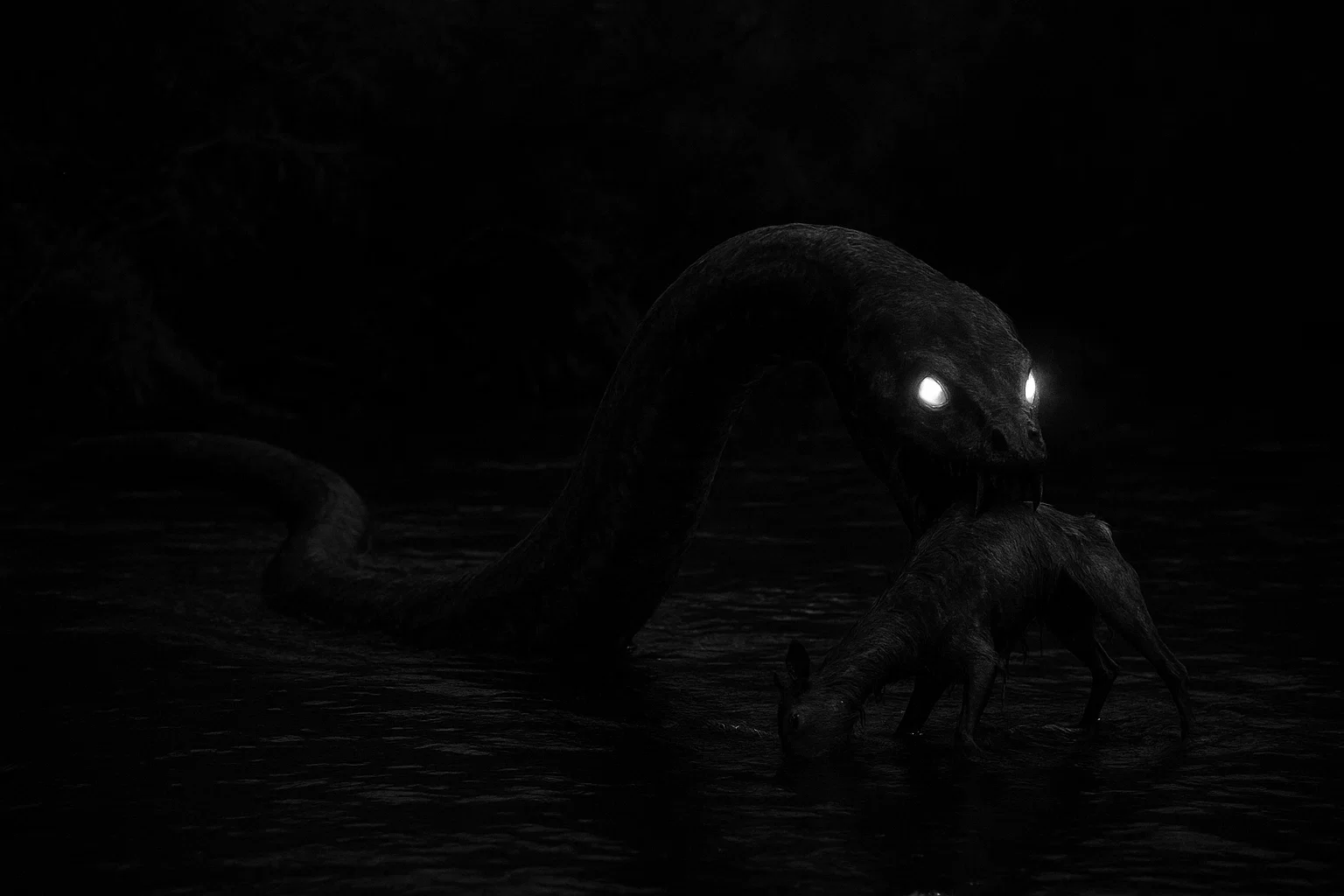
The Cahaba River Monster is a strange and little-known cryptid said to live in the waters of the Cahaba River in central Alabama. However, unlike other famous freshwater creatures with many reported sightings, this one sits at the very edge of cryptozoology, with no verified historical records or official eyewitness accounts. Because it is so obscure, I think the creature is likely a modern internet myth or just a made-up story online.
Summary
Infobox
| Attribute | Details |
|---|---|
| Name | Cahaba River Monster |
| Ancestry | Modern digital myth |
| CCI Score | 1/10 (Proven misidentification or hoax) [See the Cryptid Credibility Index] |
| Threat Level | ⚫ N/A (Proven hoax) |
| Habitat | Cahaba River, Central Alabama |
| Sighting Frequency | Isolated incident |
| Rational Explanations | Misidentification of native American alligators, large alligator gar, or deliberate digital fabrications |
| Status | Debunked |
Who or What Is Cahaba River Monster?
According to a few obscure sources, the Cahaba River Monster is a “mysterious” creature spotted in Alabama’s Cahaba River. According to these sources, stories about the creature started in the early 1900s, mostly from fishermen and others on the river who noticed strange disturbances or saw a large shape under the water.
Those who claim to have seen the cryptid describe it as a relatively large, long creature suited for life in the river. The monster is allegedly shaped like a snake, with several humps or waves along its back that stick out of the water as it swims. Its body is between 15 and 30 feet long and about 2 to 3 feet thick at its widest. Its skin looks scaly and is usually green or muddy brown.
Habitat
The supposed home of this cryptid is the Cahaba River, which runs about 190 miles through central Alabama before joining the Alabama River. The river starts in rocky hills near Birmingham, then moves south through rolling hills and finally into the flat, fertile plains of the Black Belt region.
The area around the river has a humid, subtropical climate and is lined with oak, hickory, and sweetgum trees. The rare “Cahaba lily” (“Hymenocallis coronaria”) grows right in the middle of the river’s fast, shallow rocky spots. Towns along the river range from busy city edges to quiet, forested rural areas in Bibb, Perry, and Dallas counties.
Looking at the environment, it’s clear that a huge, hidden predator couldn’t survive here. The Cahaba River is full of different fish, but it’s too shallow and clear for a big animal to stay hidden. Unlike deep northern lakes, the river has lots of gravel bars and rocky spots. A large creature couldn’t move through these areas or avoid being seen by the many researchers and kayakers who visit the river all the time.
Also, when you compare the river’s area to where local animals live, you find many chances for mistaken identity. The lower part of the Cahaba River is home to the American alligator (“Alligator mississippiensis”). An adult alligator swimming with just its back and eyes above water looks a lot like what people might imagine as a river monster.
The river is also home to big native species like the alligator gar (“Atractosteus spatula”), a prehistoric fish that can grow over seven feet long, and the rare Alaon (“Scaph in lengthirhynchus suttkusi”). Seeing these large, old-looking fish, or even snapping turtles and otters moving in dim light, can easily explain strange shapes in the water. This gives a real, scientific reason for sightings, unlike the unproven idea of a monster.
You may also enjoy:
Ronové in Demonology: Appearance, Powers, and Lore
August 27, 2025
Andras in the Ars Goetia: The Great Marquis of Discord
April 28, 2025
Behemoth in Demonology: The Colossal Tempter
August 29, 2025
Theories
One strong scientific explanation for reports of a strange creature in the Cahaba River is that people are actually seeing the alligator gar (“Atractosteus spatula”). This ancient fish has a long, heavy body covered in hard, armor-like scales and a wide snout full of sharp teeth. Since these fish can grow over seven feet long and sometimes come up for air in the summer, someone who sees a quick glimpse of one might easily think they’ve spotted a real river monster.
Another likely explanation is that people are surprised by seeing American alligators (“Alligator mississippiensis”) near the river’s fall line. Alligators are common in southern Alabama, but sometimes they move north into the faster, rockier streams near Birmingham, which can surprise locals. A big alligator swimming at dusk, with just its head and back showing, can look just like a mysterious river creature to someone who doesn’t know about alligator movements.
However, since there are no old stories or records about this creature before the internet, the most likely explanation is that it was made up online. On internet forums and folklore websites, people often create new monster names by linking a county or river to a generic creature. Over time, these made-up names get picked up by search engines or shared on social media, making it seem like there’s a real local legend when there isn’t one.
Other Similar Cryptids
| Cryptid | Danger Level | Details |
|---|---|---|
| Kappa | 💥 HIGH. Lurks in rivers to drag down swimmers and extracts the shirikodama (a mythical jewel containing the soul) directly from its victims. | Ancient Japanese traditions require carving a family’s names onto cucumbers and tossing them into local waterways to appease these regional spirits. |
| Kelpie | 🩸 SEVERE. Appears as a beautiful, lost horse near lakes, but once a weary traveler mounts it, its skin turns hyper-adhesive, trapping them as it dives into deep water to devour them. | According to Scottish lore, a kelpie can be brought completely under human control if an individual manages to steal its magical bridle. |
| Bunyip | 💀 EXTREME. Waits in billabongs and swamps to ambush unsuspecting humans, making terrifying booming cries before devouring its prey whole. | Early nineteenth-century Australian newspapers frequently treated the creature as a legitimate, undiscovered marsupial rather than a purely mythological entity. |
| Mokele-Mbembe | 💥 HIGH. Aggressively attacks canoes and small boats navigating the swampy rivers, killing humans instantly out of territorial rage, though it does not eat them. | Many cryptozoologists hypothesize that reports of this African beast actually describe a relict population of sauropod dinosaurs surviving in isolation. |
| Champ | 🕊️ LOW. Swims peacefully through open lake waters, presenting no known threat to human swimmers or local boat traffic. | The famous 1977 photograph taken by Sandra Mansi was heavily analyzed by optical physicists who verified that the negative was not artificially altered. |
| Ogopogo | 🕊️ LOW. Navigates deep lake channels without acting aggressively toward swimmers, divers, or local watercraft. | First Nations peoples historically left small live animals as bloodless offerings at Squally Point to ensure safe passage across the deep waters. |
| Altamaha-ha | ⚠️ MEDIUM. Startles local fishermen by breaching near boats, though it exhibits wild animal panic rather than deliberate predatory behavior toward humans. | Local sightings of this serpent-like creature are concentrated heavily around the brackish salt marshes where the river system meets the Atlantic Ocean. |
| Coosa River Monster | ⚠️ MEDIUM. Thrashes violently near riverboat traffic, creating dangerous wakes that threaten to capsize smaller watercraft. | This historical creature caused widespread regional panic in 1877 when multiple steamboat captains reported a ninety-foot-long, multi-finned serpent. |
| White River Monster | 🕊️ LOW. Exhibits non-aggressive behavior, occasionally overturning empty docks or breaking commercial fishing nets while foraging. | The Arkansas State Legislature officially created the White River Monster Sanctuary in 1973, making it strictly illegal to harm the creature. |
| Loch Ness Monster | 🕊️ LOW. Remains entirely elusive and passive, avoiding direct physical contact with human beings. | The iconic ‘Surgeon’s Photograph’ of 1934 was later exposed as an elaborate hoax utilizing a toy submarine outfitted with a plastic wood-putty head. |
Is Cahaba River Monster Real?
Looking at all the historical, biological, and digital evidence, it’s clear that the Cahaba River Monster is not a real animal but a made-up story. Even the most mysterious cryptids usually leave some kind of trace in local stories, old newspapers, or community rumors. This one, however, leaves no evidence at all, showing it has no real roots in the region.
The real value of this legend isn’t in finding a new river monster, but in what it shows about how digital myths are created today. The Cahaba River, with its rich and beautiful environment, naturally attracts made-up stories online. The river’s real wildlife—like the huge alligator gar and ancient sturgeons and mussels—already offers plenty of true mysteries for people to enjoy. In the end, while Alabama’s rivers are full of rare and amazing animals, the monster itself is just a product of the internet’s imagination.
You may also enjoy:
Alabama Sasquatch: Every Confirmed Hotspot, Mapped
April 18, 2025
What Is a Centaur? The Greek Monsters Born from Sin
October 31, 2025
Jean Grenier: Cannibal, Child Killer, Werewolf?
June 17, 2025
Altamaha-ha: The Creepy Cryptid Lurking in Georgia’s Waters
September 25, 2025
Phenex: The Fiery Demon Marquis of Hell
August 26, 2025
The Loveland Frog Mystery: Real Cryptid or Local Hoax?
September 25, 2025