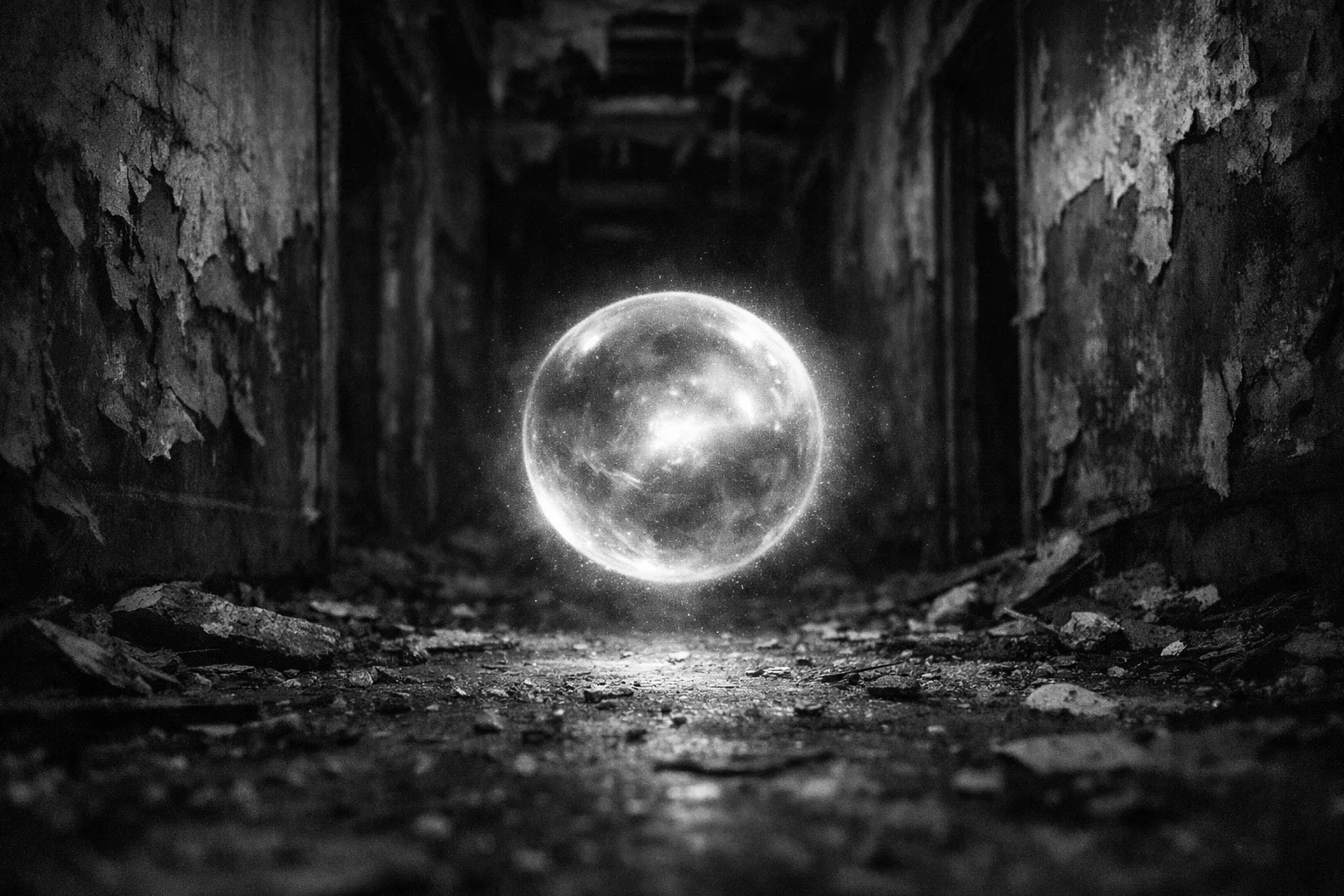
A ghost orb is the single most photographed — and most argued about — piece of “evidence” in the entire paranormal world. Walk into any online ghost-hunting forum, and you’ll find thousands of photos of small, glowing spheres floating in graveyards, old houses, and family snapshots, each one offered up as proof that a spirit was nearby.
Photographers, physicists, and ghost hunters have been arguing for decades about what these little balls of light actually are. The answer turns out to be a lot more interesting — and a lot less mysterious for most cases — than the legend suggests.
Summary
What Is a Ghost Orb?
A ghost orb (also called a spirit orb) is a round, glowing, semi-transparent ball of light that appears in photographs, video footage, or — much more rarely — to the naked eye, usually in locations associated with hauntings or strong emotion, such as cemeteries, battlefields, old buildings, or funerals.
In the paranormal community, a ghost orb is generally interpreted as a spirit or soul manifesting in its simplest, most basic form — a concentration of energy that hasn’t (or can’t) take on a more recognizable human shape. Some investigators treat orb color, movement, and behavior as clues about the type of entity present, treating an orb sighting the same way they’d treat an EVP recording or an EMF spike: as one data point in building a case for a haunting.
Outside the paranormal community, the explanation is far more grounded. The overwhelming majority of photographed “orbs” are airborne particles — dust, pollen, moisture, insects, or even lint — that are too close to the camera lens to be in focus. When a camera’s flash bounces off one of these particles, the out-of-focus point of light renders on the image as a soft, round blob.
Photographers call this an out-of-focus highlight, or “circle of confusion,” and it has nothing to do with ghosts; it’s simple optics. This effect explains why orb photos exploded in number once affordable digital point-and-shoot cameras — with their flash units mounted just millimeters from the lens — became common in homes around the world.
A much smaller category of orb reports involves people describing a glowing light seen directly with the naked eye, with no camera involved at all. These accounts are harder to dismiss with a simple “it’s dust on the lens” explanation, since there’s no lens in the equation. Still, they’re also far less common, much harder to verify. Not something mainstream science has been able to confirm as paranormal.
Where and When Are Ghost Orbs Most Often Reported?
Ghost orb sightings and photographs tend to cluster around a fairly predictable set of locations and occasions:
- Cemeteries and graveyards — among the most common settings for orb photography, often shot at dusk or at night with a flash.
- Old or abandoned buildings — historic homes, hotels, prisons, and asylums that ghost-hunting groups frequently investigate.
- Battlefields and sites of mass death — locations like the Gettysburg battlefield have long been associated with reports of unexplained lights at night.
- Religious or ritual settings — churches, séances, and other spiritual gatherings.
- Emotionally significant family events — funerals, anniversaries of a death, weddings, and birthdays, where believers say a deceased loved one may be present.
Paranormal investigators often explain this pattern by suggesting that orbs — and spirits generally — are drawn to places of strong emotion, unresolved business, or significant life events.
The more grounded explanation is largely about photography conditions rather than the supernatural: these are exactly the settings where people are most likely to use a camera flash in dim, dusty, poorly ventilated indoor spaces, or where humidity, candle smoke, and incense create more airborne particles for a flash to catch.
You may also enjoy:
The 15 Most Haunted Dolls in the World
June 26, 2026
Who Is Aka Manah? The Terrifying Demon of Wicked Intention
October 2, 2025
What Is a Ghost Orb? The Paranormal Phenomenon Explained
January 5, 2026
The Leshy: Shape-Shifting Monster of Slavic Mythology
September 10, 2025
What Do Different Ghost Orb Colors Supposedly Mean?
There is no scientific basis for assigning meaning to orb color — the color of a dust-reflection orb is determined by lighting conditions, camera settings, and the surface of the particle itself, not by any spiritual property. That said, within paranormal folklore, different investigators and ghost-hunting communities have developed their own (often conflicting) color interpretations.
The most commonly cited ones include:
- White or silver orbs — often described as a sign of a trapped or protective spirit, or a general connection to a higher spiritual source.
- Blue orbs — associated with calm, psychic energy, and spiritual guidance.
- Green orbs — sometimes linked to a human spirit’s presence, or associated with nature and emotional balance.
- Red or orange orbs — interpreted by some investigators as a protector spirit or a sign of strong emotion.
- Black or brown orbs — considered by some to represent heavier, lower-vibration energy, though believers are quick to note this doesn’t automatically mean something malevolent.
- Clear orbs — frequently described as an attempt at spirit communication.
Because there’s no governing body or consistent system behind these interpretations, you’ll find different ghost-hunting sites assigning different — sometimes opposite — meanings to the same color. Treat color symbolism as folklore and personal belief rather than an established framework.
The Science Behind Most Ghost Orb Photos
For the vast majority of photographed orbs, the explanation comes down to basic camera optics rather than anything paranormal. Here’s what’s actually happening:
- Flash proximity to the lens. On compact cameras and nearly all smartphones, the flash sits just a centimeter or two from the lens. This creates a narrow “cone” where the flash’s light and the lens’s field of view overlap very close to the camera.
- Particles in that overlap zone. Dust, pollen, moisture droplets, insects, or even a strand of hair drifting through that narrow zone get hit directly by the flash.
- Out-of-focus reflection. Because the particle is so close to the lens, it’s far outside the camera’s focus range. An out-of-focus point of light doesn’t render as a sharp dot — it spreads into a soft circular shape, the same “circle of confusion” effect used in traditional photography to describe any out-of-focus highlight.
- Digital processing exaggerates it. JPEG compression and in-camera sharpening can add texture, rings, or patterns inside that circle, which is part of why some orbs appear to have internal structure or “faces” that aren’t really there — a phenomenon related to pareidolia, the brain’s tendency to find familiar patterns (like faces) in random visual noise.
This is also why DSLR and mirrorless cameras with an external or bounce flash — positioned further from the lens — tend to produce far fewer orb photos than the same scene shot with a built-in compact-camera flash. Cave photographers have known about this effect for years: keeping the light source separate from the lens avoids the “orb” and “mist” artifacts that close-mounted flashes create.
The same physics applies to infrared night-vision cameras used by ghost hunters, in which an LED ring around the lens illuminates nearby dust in the same way. Higher ISO settings can make the effect even more pronounced by increasing the camera’s sensitivity and introducing additional digital noise.
You may also enjoy:
Abalam: Demon of Sorrow and Knowledge
August 13, 2025
Who Is Leraje, the Demon of Gangrene and Battle?
August 22, 2025
Who Is Vual in Demonology? Powers, Lore, and Origins
August 12, 2025
A Brief History: From Victorian Spirit Photography to Digital “Orbs”
The idea of capturing spirits on camera is far older than the modern orb trend. Still, it’s a different phenomenon with a different mechanism.
In the 1860s, Boston photographer William Mumler became famous — and infamous — for “spirit photography,” in which faint, ghostly human figures appeared to stand alongside living sitters in formal portraits, most especially in a photo of Mary Todd Lincoln with what appeared to be the ghost of her assassinated husband.
Mumler’s images were created through deliberate techniques like double exposure and pre-exposed glass plates, not by accident, and he was tried for fraud in 1869 (though ultimately acquitted). The practice spread to Victorian England and remained popular into the early 20th century, fueled by grief over the American Civil War and, later, World War I.
The “orb,” as we know it today, is a distinctly different and much more recent phenomenon. It became widespread only after affordable digital cameras put a built-in flash a few centimeters from the lens into millions of ordinary households starting in the 1990s and 2000s.
Round, glowing artifacts that previously would have gone unnoticed on film became instantly visible on a digital camera’s screen. The rise of ghost-hunting reality television — led by shows like Ghost Hunters, which premiered on the Sci-Fi Channel in 2004 — helped cement “orbs” as a recognized category of paranormal “evidence” in popular culture, often discussed alongside EVP recordings and EMF readings.
How Ghost Hunters Try to Rule Out Dust and Bugs
Even within the paranormal community, many serious investigators acknowledge that most orb photos are mundane and try to apply some basic tests before treating one as potential evidence:
- Control shots. Photographing the same empty space beforehand establishes a baseline for normal dust and lighting conditions in that room.
- The “dust test.” Deliberately shaking out a dusty rug or blanket and photographing the resulting cloud with the same flash setup reliably reproduces orb-like images, which investigators use as a point of comparison.
- Separating the flash from the lens. Using an external flash, a tripod-mounted infrared illuminator placed away from the camera, or simply avoiding flash in dusty rooms, cuts down dramatically on false orbs.
- Looking for “true” orb traits. Some investigators apply informal criteria — a solid, evenly lit center with no light “spokes,” a self-luminous appearance, or a movement pattern that seems to defy air currents — before considering an orb worth a second look. Even by these informal standards, these criteria are subjective and haven’t been validated by a controlled scientific study.
Researchers and writers in the skeptical wing of the paranormal field — among them long-time ghost researcher Troy Taylor — have run repeated experiments proving that dust, moisture, and even substances like flour or pet dander reliably produce convincing “orb” photos on command, which is part of why mainstream paranormal investigation groups increasingly treat orb photography as weak or inconclusive evidence on its own.
Ghost Orbs in Pop Culture
The term “ghost orb” isn’t confined to real-world paranormal claims — it has also become a recognizable piece of vocabulary in horror entertainment.
In the cooperative horror video game Phasmophobia, “Ghost Orbs” are a specific category of in-game evidence: small, glowing spheres that drift through a haunted location’s “favorite room” and can only be seen through a video camera’s night-vision feed.
While entirely fictional, this kind of detail shows just how profoundly the orb concept has worked its way into the broader language of ghost hunting, well beyond grainy cemetery photographs.
Should You Believe a Ghost Orb Photo?
If you’ve taken a photo with a glowing circle in it, the most likely explanation is also the simplest one: a flash, some airborne dust or moisture, and a lens doing exactly what out-of-focus optics are supposed to do.
Before treating any orb photo as meaningful evidence, it’s worth ruling out the mundane explanations first — check for dust in the room, see whether the same effect happens in a control shot, and consider how close your flash sits to your lens.
Genuine, unexplained light phenomena reported with the naked eye by multiple witnesses are a different and much rarer category, and they remain a matter of personal interpretation rather than settled fact.
Either way, understanding the photography behind most “ghost orbs” doesn’t have to take the fun out of the mystery — it just means you’ll know exactly what to rule out before you get spooked.
You may also enjoy:
The Mare: The Nightmare Monster That Crushes Men in Their Sleep
October 27, 2025
Who Is Marbas? The Demon of the Ars Goetia
August 25, 2025
Who Is Pazuzu? The Terrifying Demon of Mesopotamia
August 26, 2025
Is The Anguished Man Painting Truly Cursed?
May 26, 2025
Sources
- Guiley, Rosemary Ellen. The Encyclopedia of Ghosts and Spirits. 3rd ed., Facts On File, 2007. Internet Archive.
- Kaczmarek, Dale D. A Field Guide to Spirit Photography. Whitechapel Productions Press, 2002.
- Taylor, Troy. The Ghost Hunter’s Guidebook: The Essential Guide to Investigating Ghosts & Hauntings. Whitechapel Productions Press, 1999.
- Taylor, Troy. Ghosts on Film. Whitechapel Productions Press, 2005.
- Kaplan, Louis. The Strange Case of William Mumler, Spirit Photographer. University of Minnesota Press, 2008.