Some of the most lasting internet horror stories aren’t about monsters. They’re about ordinary cruelty that takes on a lasting, patient form. The Mirror Boy is a new urban legend in the style of creepypasta, telling the story of a boy scarred by tragedy and bullying who becomes something that waits just behind glass, appearing only to those who deserve to see him. This is a short horror story of childhood trauma, revenge, and body horror, much like the modern internet legends passed between strangers in different towns. Each person swears they heard the same six words from the other side of a mirror.
Story File
| 👁️ Title | The Mirror Boy |
| 🪶 Author | Razvan Radu |
| 🪦 Genre | Creepypasta / Urban Legend Horror / Short Horror Story |
| 🏷️ Themes | Childhood Trauma, Bullying, Vengeance, Body Horror, Urban Legend, Grief |
| ⏳ Read Time | 10 minutes |
| ☠️ Warnings | Death of a parent, graphic injury description, themes of child abuse/bullying, body horror, brutal ending |
| 📜 The Lore | An urban legend passed between unconnected small towns, always involving a missing mirror and a voice that asks the same six words. |
| 🎬 The Scoop | A boy disfigured by tragedy and shaped by a childhood of cruelty becomes something that lives behind glass — and only people who’ve hurt someone smaller than themselves ever hear him speak. |
Before he was anything else, Caleb Reyes was the kid at Brindlewood Elementary who never had a reflection anyone could agree on.
That sounds like an exaggeration, the kind of thing that gets added to a story after the fact to make it sound mythic from the start, but the teachers at Brindlewood will tell you, if you ask them carefully enough and buy them a second coffee, that there really was something off about how Caleb looked in glass — not invisible, not distorted, just slightly delayed, the way a video call lags half a second behind the voice.
Kids noticed before adults did. Kids always do. They started calling him Mirror Boy in third grade, not as an insult exactly, more the way children name anything strange they don’t have better words for, and Caleb let them, because it was better than the names that came before — the ones about his stutter, about the thick glasses, about the way his single mother sent him to school in clothes a size too big so they’d last another year.
His mother, Dolores, worked nights at a glass plant two towns over, cutting and polishing mirror stock for furniture companies, and she’d bring scraps home for Caleb to play with — odd-shaped offcuts, beveled edges, sometimes a full pane with a flaw in the silvering that made the reflection swim if you tilted it just right.
He built things with them in the garage. Not anything anyone would call art. Just shapes. A box he could sit inside, lined on every surface, where if you stood in the center and turned slowly, your reflection multiplied into a hallway of yourself stretching backward forever, smaller and smaller, until the last one was too small to be sure it was even you anymore.
He called it the Long Hall. He was eleven when he finished it, and he never once told another living person it existed, until the night everything changed and there was no one left to tell.
The accident at the glass plant happened on a Tuesday in March, the kind of industrial failure that gets two paragraphs in a local paper and a settlement check that doesn’t come close to covering what it takes. A tempering furnace overpressurized; Dolores was eleven feet from it when the safety glass it was processing failed catastrophically, and what the report called “a significant glass-fragment event” took most of her face and both of her hands before anyone could reach the emergency shutoff.
She lived four more days in a burn unit two hours from home, long enough for Caleb to visit twice, both times finding himself unable to look directly at her, not from disgust — he’d swear that for the rest of his life — but because the bandages where her face used to be reflected the room’s fluorescent light in a way that made it look, for one sick half-second each time, like there was a face still under there, watching him watch her.
He was twelve when she died. The state put him in a group placement outside Brindlewood, a converted farmhouse with eleven other kids and two overworked caseworkers, and it’s here that the story gets harder to verify, because nobody who was there has ever wanted to talk about it for long.
What’s documented is this: six months after Caleb arrived, the placement home had a fire that gutted the east wing, that three boys who’d made a habit of cornering him in the laundry room never came forward to identify who’d locked them in there that night, and that Caleb himself was found two days later, eleven miles away, sitting calmly in the bed of an abandoned pickup truck, holding a shard ofr mirrored glass roughly the length of his forearm, with a face that the responding officer described, in a report that somehow made it into local legend decades later, as “smiling in a way that didn’t look practiced. Like he’d been doing it his whole life and we’d just never been close enough to see.”
He was never charged with anything. There was no surviving evidence tying him to the fire, and a traumatized twelve-year-old holding a piece of glass eleven miles from a group home isn’t, on its own, a crime. He went into another placement, then another, and at some point in his teenage years, he simply stopped appearing in any system’s records at all — no further school enrollment, no further caseworker notes, nothing, as if he’d decided that the version of himself with a paper trail had served its purpose and could be set down like a coat.
What exists instead, scattered across small towns in a loose, inconsistent radius for the better part of two decades, are stories — never confirmed, never quite dismissed, each one almost identical in its particulars, no matter how far apart in distance or time they’re told.
A house with a missing mirror found, days later, propped somewhere unexpected — a closet, a basement, the back of a parked car — angled to catch whoever opened the door off guard with their own reflection a half-second before they understood why something felt wrong. A teenager, always one with a history of cruelty nobody quite wanted to call by its name, found in the morning, having apparently walked, fully conscious by every account, into a sheet of glass set up specifically to be walked into, the wound pattern too clean, too deliberate, for any accident report to explain comfortably.
And before each one, always, the same small detail, repeated by enough unrelated witnesses across enough unrelated towns that it stopped reading as coincidence to anyone who’d heard more than two of these stories: a young man’s voice, calm, almost gentle, coming from somewhere just behind the glass rather than in the room itself, saying the same six words every time, in the same unhurried cadence, like a question he already knew the answer to.
Do you like what you see?
Marisol Quintana heard those words at nineteen, in the bathroom of a gas station off Route 9, eleven years after Caleb Reyes disappeared from every system meant to track him, and she is, as far as anyone has been able to determine, the only person who ever heard them and lived to describe what came after — which is the only reason any of this story can be told at all with anything resembling an ending.
She’d pulled in for gas after a party two towns over, the kind of night that blurs at the edges from cheap beer and bad decisions, and she’d gone into the gas station bathroom mostly to splash water on her face and convince herself she was sober enough to drive the last stretch home.
The mirror above the sink was cracked across one corner, nothing unusual for a gas station bathroom at one in the morning, and she didn’t think anything of her reflection lagging a half-second behind her movements until she’d already noticed, already registered it, already felt the particular cold drop in her stomach of a body realizing something before the mind has caught up enough to name it.
Do you like what you see? The voice came from inside the cracked corner, specifically, low and unhurried, and when she looked there — really looked, the way you look at something you already regret looking at — there was a face pressed close from the other side of the glass that had no business having another side at all behind a sink mounted flush against a cinderblock wall.
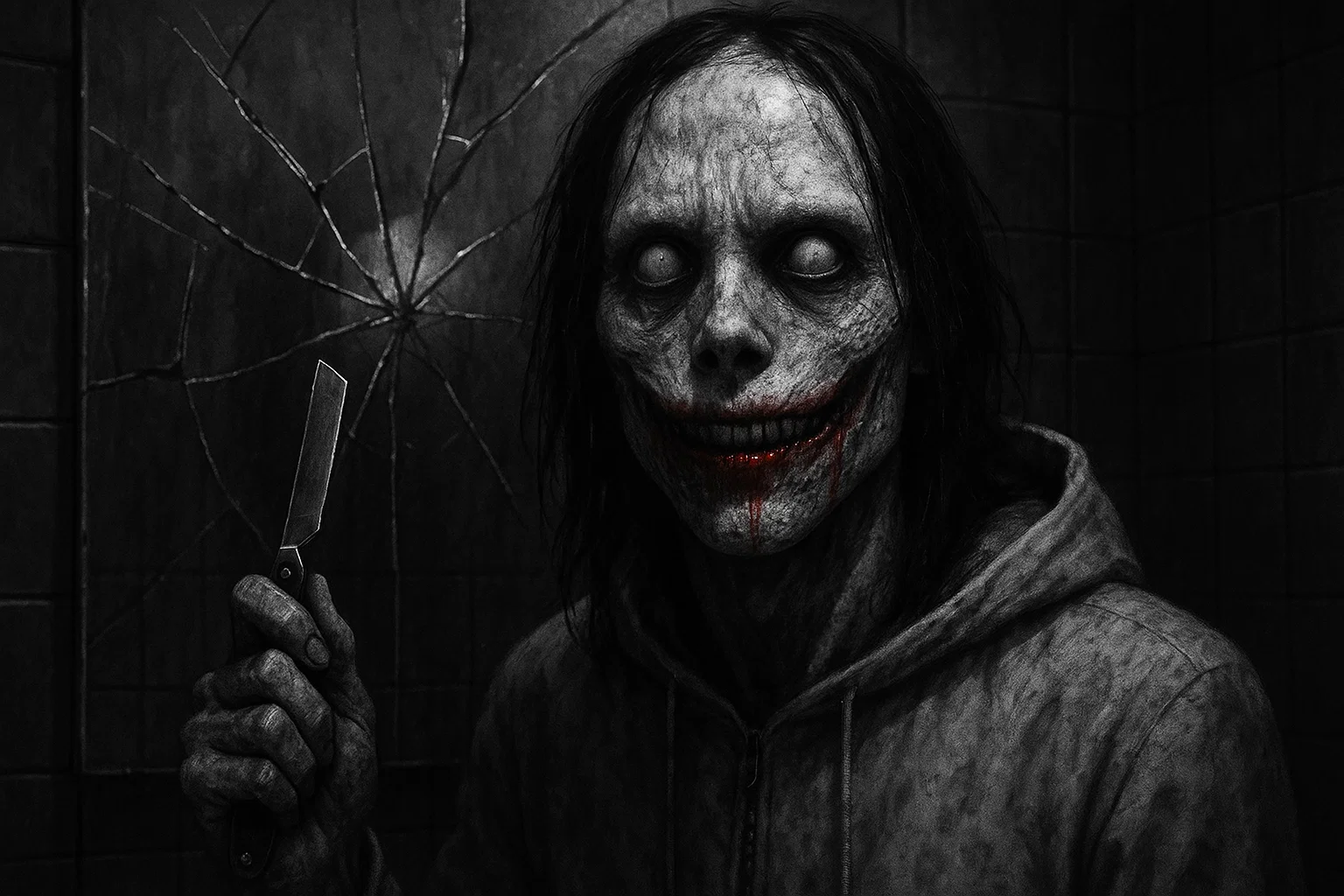
A young man’s face, smooth-skinned in some places and strangely smoothed-over in others, the kind of smooth that happens to skin that’s been burned and healed wrong, his eyes too patient for the urgency the rest of the moment demanded, and his mouth curved into a smile that wasn’t cruel exactly, just entirely, devastatingly certain of how this was going to go.
Marisol had, by her own later account, exactly one piece of luck that night, and it was this: she had been cruel to no one. She had bullied no one, locked no one in any room, carved nothing into any wall. She had simply walked into a gas station bathroom at the wrong hour with the wrong cracked mirror, and something in the face behind the glass seemed, for one suspended moment, to actually consider this — to weigh, with what she swears even now was genuine deliberation rather than mercy, whether she qualified for whatever came next.
“He looked disappointed,” she told the one reporter who ever got her to talk about it, years later, off the record, in a conversation that never made print because there was nothing in it that could be verified. “Not angry. Disappointed, like I’d interrupted something he’d been looking forward to and I wasn’t even going to be worth finishing it for.”
The face receded back into the crack in the glass the way a held breath releases, and the lagging reflection caught up to her own movements at last, and she ran for her car without daring to look at a single other reflective surface in that gas station — not the chrome napkin dispenser, not the dark windows, not the rearview mirror she drove the rest of the way home by feel and headlights alone, refusing to glance up at it even once.
What happened to whoever Caleb Reyes became, nobody can say with any confidence. The stories keep surfacing, every few years, in towns that have nothing in common except a mirror that ends up somewhere it shouldn’t be, and a person — always, every single time, someone with a documented history of hurting someone smaller or weaker than themselves — found afterward with a wound pattern too clean and too deliberate to belong to any accident report.
The towns don’t compare notes. The stories don’t travel on their own; somebody has to carry them, town to town, the way Marisol eventually did, against her better judgment, because she said the silence around it felt worse than the telling, like keeping it unsaid was its own kind of glass with something patient still pressed up against the other side of it.
She still covers every mirror in her apartment with a sheet at night. Not because she thinks it would stop anything, she says. Just because some nights, half-asleep, she swears she can hear something behind the cloth asking, very gently, whether she’s ready yet to look.