Today, the Qalupalik is often seen as just a scary story to keep kids away from dangerous ice. Originally, though, it was much more: a guardian of the shoreline, representing the harsh reality of Arctic waters. The Qalupalik symbolized the ever-present danger of unstable ice and the sudden disappearances that worried coastal communities.
Summary
Overview
| Attribute | Details |
| Names & Etymology | Qalupalik (alternatively spelled Qalupallik or Kalopaling); derived from the Inuktitut root word “qalupaq,” which refers to the large, specialized pouch of an amauti (the traditional parka used by Inuit mothers to carry infants). |
| Classification | Marine spirit, mythological ogress, or environmental guardian entity within Inuit cosmology. |
| Species | Humanoid (aquatic/marine manifestation). |
| Threat Level | Level 2 (Conditional Hazard) [See the Threat Level Guide] |
| Origin | Born directly from traditional Inuit oral history and environmental trauma, the myth originated as a cultural manifestation of the lethal dangers of freezing waters and thin ice, personifying the silent, sudden disappearance of children. |
| Earliest Record | Late 19th century; specifically documented in the formal academic record by anthropologist Franz Boas in his 1888 ethnographic study, “The Central Eskimo.” |
| Habitat | The sub-zero marine depths, shorelines, mudflats, and unstable floe edges (sinaa) across the Arctic regions, including Nunavut, Nunavik, the Northwest Territories, and Greenland. |
| Diet | Does not typically consume human flesh; instead, the entity preys exclusively on children to kidnap them, placing them into a magical state of suspended animation beneath the waves. |
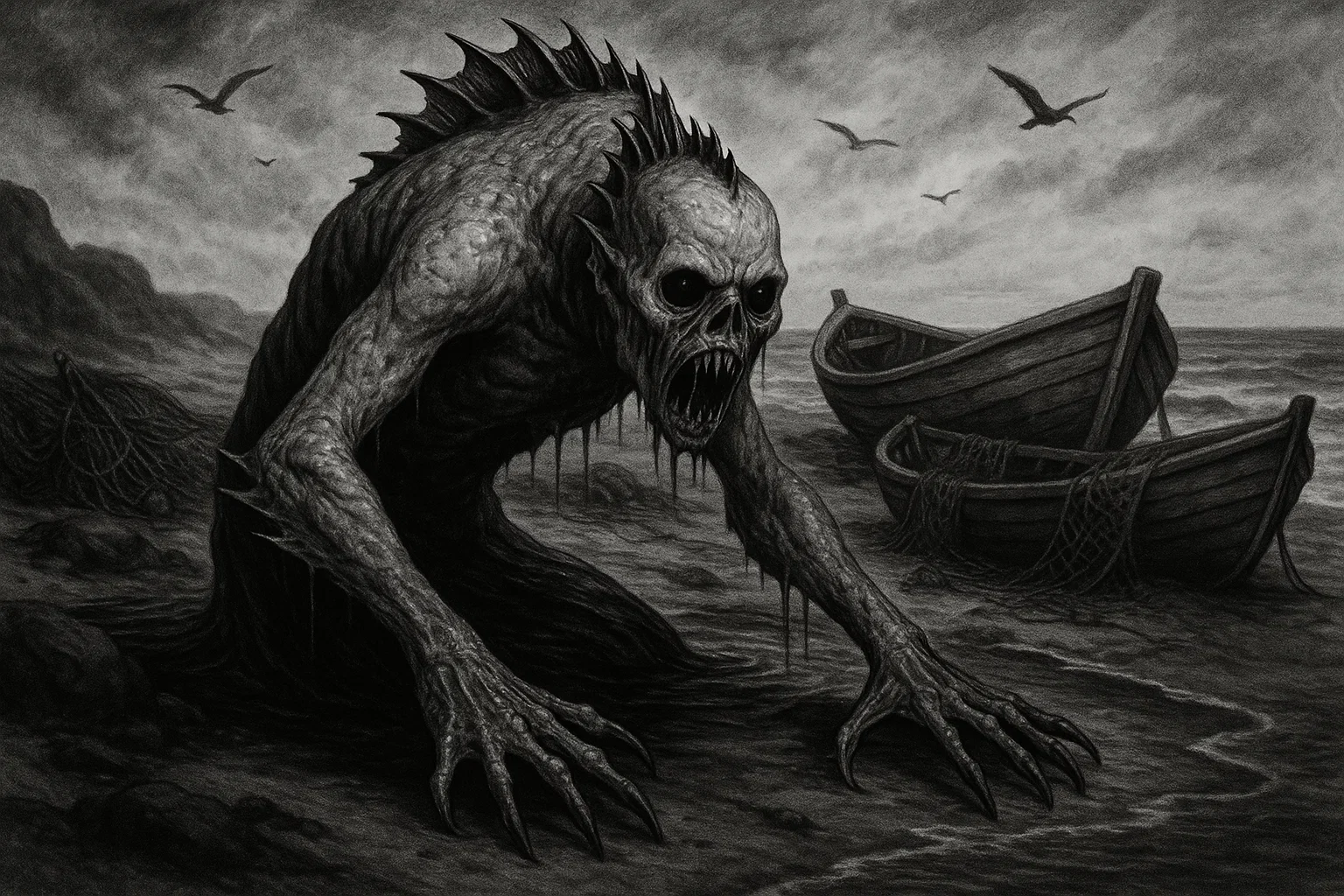
| Physical Details | A bloated humanoid figure featuring translucent sea-green or mottled purple-black skin, webbed fingers terminating in elongated claws, an overwhelming odor of sulfur and stagnant salt water, and garments crafted from rotting eider-duck skins or kelp. |
| Strengths | Superhuman underwater stealth, absolute immunity to freezing temperatures, acoustic manipulation to shatter ice sheets from below, and the ability to induce a deep, magical slumber in its victims. |
| Weaknesses | Extremely vulnerable to terrestrial sounds (such as the aggressive barking of an Inuit sled dog), iron tools tempered in fresh river water, and specific shamanic string-game symbols (ajarajit). |
| Warning | Do not play unsupervised near the Arctic shorelines or step onto the thin, cracking floe edges when you hear a rhythmic scratching or a low “uuk-uuk-uuk” echoing beneath the ice. |
| Survival Odds | 65% (Survival is highly probable provided you recognize the acoustic warning signs, remain on stable ground, or possess iron tools and protective dogs to break her magical hold). |
Who or What Is the Qalupalik?
The Qalupalik is a human-like sea creature featured in Inuit stories from regions such as Nunavut, Nunavik, and Greenland. She is usually described as a female spirit or ogress who lives where the sea meets the ice. Unlike land-based monsters, she waits in the freezing ocean just under the ice, looking for her next victim.
The Qalupalik mainly targets children who get too close to the breaking ice (sinaa) or play near the shore without adults watching. She doesn’t take them out of hunger, but is known for kidnapping them, hiding them in her large parka, and pulling them down into her underwater world.
After being taken underwater, the children are believed to fall into a magical sleep or a kind of suspended animation. They stay there for years, keeping the lonely Qalupalik company. In Inuit stories, she is similar to other sea monsters like Sedna or the Mahaha, but is remarkable for targeting children and emitting warning sounds that echo through the ice.
You may also enjoy:
Bennu: The Dark Bird of Fire, Death, and Eternal Return
December 8, 2025
What Is Redcap? The Bloodthirsty Goblin of Scottish Folklore
February 5, 2026
Andromalius in the Ars Goetia: The Great Earl of Hell
April 29, 2025
Phenex: The Fiery Demon Marquis of Hell
August 26, 2025
Origin & Lineage
The Qalupalik’s origin isn’t usually tied to a specific creation story or curse. Instead, she is seen as a force that comes straight from the harsh realities of the Arctic environment.
In early Inuit stories, the Qalupalik is thought to have come from the shared fear of the ocean—especially the dangers of drowning and losing people suddenly to the sea. She isn’t part of a family or group, but is seen as a single, immortal being with no known parents or children.
The first detailed Western record of the Qalupalik comes from Franz Boas’s 1888 study, The Central Eskimo. He wrote down stories from the Inuit of Baffin Island, describing the creature as a sea monster dressed in eider-duck skins who appeared when people were desperate.
One early story tells of a poor grandmother during a famine who, unable to feed her grandson, called on the Qalupalik to take him away. The creature came, took the boy, and tied him under the ice with seaweed until hunters finally rescued him.
Stories about the Qalupalik are found in Nunavut, Nunavik, the Northwest Territories, and Greenland. In each place, the legend connects to local dangers. On Baffin Island, for example, it focuses on the sinaa (the floe edge), where hunters often faced breaking ice.
In inland areas such as the Kivalliq Region, the story was adapted to fit the local setting. There, people feared the Qalupalik as a monster living in deep freshwater lakes. In southern Nunavik, the legend linked her to strong tides and risky mudflats along the shore.
The Qalupalik legend is found everywhere because keeping children safe near water is so important in the Arctic. By tying the monster to local dangers—like ocean currents, lake ice, or tidal zones—elders turned fear into a way to teach kids how to survive.
Etymology
The name Qalupalik comes from the Inuktitut word qalupaq, which means the large back-pouch of an amauti, the traditional Inuit parka used to carry babies. The word itself hints at both care and danger.
The creature’s name turns the idea of the amauti upside down. Instead of warmth and safety, it becomes a symbol of kidnapping and drowning.
Across the Arctic, the name is pronounced and spelled slightly differently in each region, but the meaning remains the same. In the Kivalliq Region, some versions of the name even sound like the splash of water against ice.
Some elders in the early 1900s said the name also sounds like stepping on wet, thin snow, linking the word’s sound to the dangers it represents.
By the mid-1900s, the name became standardized as Qalupalik (or Qalupallik), highlighting the pouch and turning a symbol of home and safety into a warning about the dangers of water.
What Does the Creature Look Like?
Old stories describe the Qalupalik as a strange, human-like creature with features that mix people and sea animals. This is very different from the cartoon versions seen in children’s books today.
The Qalupalik’s skin is a pale green or dark purple-black, swollen from being underwater and covered in slimy scales. Her hands are webbed, ending in long, yellow claws that can grip ice or tear through caribou hide.
Today, the Qalupalik is often shown as a mermaid or witch, but older stories say she wears clothes made from rotting eider-duck skins or kelp. Her hood is huge and seems to stretch to fit the children she captures.
The Qalupalik smells strongly of sulfur, old salt water, and rotting sea life. Instead of footsteps, you hear her coming by the scratching of her claws under the ice and a low, haunting sound—“uuk… uuk… uuk…”—echoing through the ice.
You may also enjoy:
Yuki-onna Legends: Tales of Love, Death, and Betrayal
September 9, 2025
The Demon Räum in Ars Goetia: What You Need to Know
August 11, 2025
Myths, Legends, and Stories
Stories about the Qalupalik have been passed down for centuries by word of mouth, and later collected by researchers and Indigenous writers. These tales were usually told during the long, dark winter nights inside snow houses, meant to teach children to be careful.
The most common story is about children who are taken after ignoring their parents’ warnings. But on the northern coast of Baffin Island, there’s a lesser-known, darker version of the legend.
In this story, a young orphan boy, ignored by his camp and with no family to warn him, went in search of the Qalupalik at the edge of the ice. He stood on the sinaa and sang a forbidden, teasing song until the green-skinned monster appeared from the water.
Instead of running away, the boy let the Qalupalik put him in her smelly parka. Because he didn’t feel loved by his community, the magic sleep didn’t work on him. He stayed awake for months underwater, watching the Qalupalik care for other children who were frozen like ice statues.
The story’s twist is in how the boy escaped. He didn’t use weapons, but made a special string pattern with whale sinew that looked like eagle claws—the one thing the Qalupalik feared. Scared by the symbol, she threw him out of the water. He returned to his camp as a shaman, always carrying the smell of the deep sea.
Qalupalik vs Other Monsters
| Creature & Lore | Danger Level | Details |
| Kappa (Japan) | High. Lurks in rivers to drag down unsuspecting swimmers and extracts the shirikodama—a mythical soul-carrying jewel—directly from the victim’s anatomy. | Its immense physical power on land is entirely dependent on keeping the shallow, water-filled depression on top of its skull completely full. |
| Kelpie (Scotland) | Severe. Appears as a beautiful horse near lakes; once mounted, its skin becomes hyper-adhesive, trapping the victim as it dives into deep water to drown and devour them. | It can be completely tamed and forced into manual labor if a traveler manages to successfully secure a bridle over its head. |
| Rusalka (Slavic regions) | High. Rises from rivers and marshes at night to entice young men with mesmerizing songs, ultimately tangling them in her hair or laughing as she tickles them to death. | Her supernatural power is tied directly to her hair; if her locks dry out completely while she is ashore, her magical essence instantly fades. |
| Bunyip (Australia) | Severe. Inhabits swamps, billabongs, and creeks, waiting in absolute silence to ambush animals or humans who approach the water’s edge at night. | Early 19th-century fossils of unique, extinct marsupials are believed by historians to have sustained the physical reality of this legend. |
| Näcken (Scandinavia) | Medium. Sits in rivers playing a haunting, enchanted violin melody that compels listeners to blindly walk into the currents and drown. | A traveler could supposedly learn his hypnotic musical skills by offering him a black animal or a drop of blood on a Thursday night. |
| La Llorona (Mexico) | Severe. Wanders coastal waterways and riverbanks, weeping loudly, violently snatching away stray children whom she mistakes for her own drowned offspring. | The earliest roots of her narrative are heavily linked by historians to Aztec omens predicting the devastating Spanish conquest. |
| Grootslang (South Africa) | Extreme. Guarding a treasure-filled cave in the Richtersveld, this massive hybrid crushes intruders or swallows them whole to protect its hoard. | According to local myth, the primordial gods accidentally made it too powerful by combining the intelligence of an elephant with the stealth of a snake. |
| Vodyanoy (Slavic regions) | High. Rules over deep river pools and millponds, dragging down swimmers or breaking dams to flood local villages when angry. | Local millers and fishermen traditionally drowned a black pig or poured oil into the water to appease his volatile temper. |
Can You Defeat a Qalupalik? Powers & Weaknesses
The Qalupalik’s power depends on the sea ice. She is not just strong—her strength grows with the pressure of the ocean and the way sound travels through the ice. She can break the ice from below, making cracks (quminiq) open under someone’s feet and pulling them into the water.
To escape her magic, people must use her fear of land sounds and her weak spots. Regular harpoons don’t work if thrown into the water, but iron tools made with fresh river water can hurt her. This comes from the old idea that river water is pure and can fight the power of the salty sea.
The Qalupalik can also be scared away by the loud barking of an Inuit sled dog (Qimmiq). If a hunter hears the “uuk-uuk” sound under the ice, they should quickly hit the ice with an iron-tipped chisel (tooq) while saying a protective chant. This breaks the sound she uses to move and makes her retreat.
The Guardian of the Thin Ice
The Qalupalik legend is more than just a scary story. It’s a smart way for people to survive in the harsh Arctic. In a place where one wrong step on the ice can be deadly, the Qalupalik became a symbol of the dangers people faced. The story gave a face to hidden threats like strong currents and thin ice, helping keep children safe by making certain places off-limits.
Even though schools now use different ways to teach safety, the Qalupalik story is still important. Descriptions of this underwater kidnapper have inspired modern Indigenous stories, books, and art that keep old warnings alive.
The myth lasts because it reminds people of a basic truth: in the Arctic, survival is never certain, and you must always respect nature.
You may also enjoy:
Who Is Vapula? The Lion-Winged Demon of Hell
August 28, 2025
Ghoul: The Original Monster Worse Than Zombies
February 18, 2026
Who Is Flauros, the Demon Duke of Fire?
August 29, 2025
Poludnitsa: The Noon Witch Who Haunts the Fields of Slavic Folklore
September 11, 2025
Sources
- Boas, Franz. The Central Eskimo. Sixth Annual Report of the Bureau of Ethnology to the Secretary of the Smithsonian Institution, 1884-1885. Government Printing Office, 1888. Internet Archive.
- Kusugak, Michael Arvaarluk, and Robert Munsch. A Promise Is a Promise. Illustrated by Vladyana Krykorka, Annick Press, 1988.
- Kilabuk, Elisha. The Qalupalik. Illustrated by Joy Ang, Inhabit Media, 2011. Internet Archive.
- Boas, Franz. The Eskimo Tribes of North-East America [Map]. The Central Eskimo, Sixth Annual Report of the Bureau of Ethnology to the Secretary of the Smithsonian Institution, 1884–’85, Government Printing Office, 1888, plate II. The Project Gutenberg.
- Campbell, S. (2012). The Qalupalik by E. Kilabuk. The Deakin Review of Children’s Literature, 1(3). https://doi.org/10.20361/G2NK59.
- Your Guide to the Monsters in Inuit Art. Inuit Art Quarterly, Inuit Art Foundation. Accessed 8 June 2026.
- Boas, Franz. The Central Eskimo. University of Nebraska Press, 1964. Internet Archive.