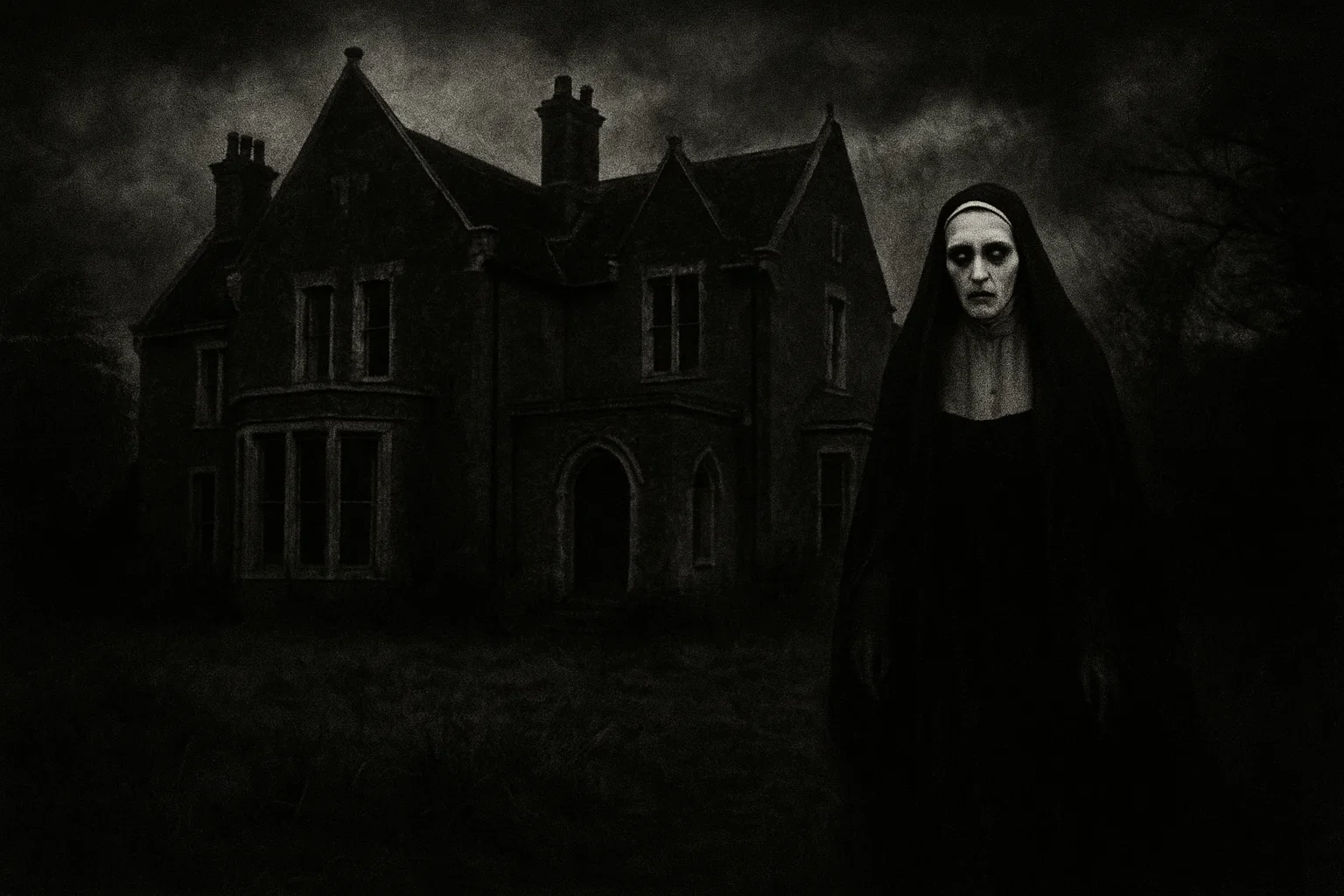
The strange events related to the Borley Rectory haunting are a mix of old stories and documented psychic disturbances. Most people know the site from its dramatic media coverage in the 1930s, but many miss the fact that a woman’s skull was found hidden in a library cupboard in 1929, before the most famous investigations.
Ongoing reports suggest there may be something in the environment itself, possibly due to the area’s geology or the trauma experienced by people who lived there.
Summary
Overview
| Attribute | Details |
|---|---|
| Name | Borley Rectory; The Most Haunted House in England |
| THC Scale | L-3 [See the THC Scale Explanation] |
| Location / Origin | Borley, Essex, CO10 7AE, UK (52.0544° N, 0.6939° E) |
| Classification | Poltergeist; Residual |
| History | Built in 1862 by Rev. Henry Bull; destroyed by fire in 1939. |
| Casualties & Deaths | 5 confirmed historical deaths (natural causes) + 0 attributed to the entity. |
| Associated Entities | The Nun (Marie Lairre), The Headless Coachman, Sunex Amures. |
| Manifestations | Auditory (bells, footsteps), Visual (apparitions), Physical (stone-throwing), Environmental. |
| First reported sighting | Circa 1863 (unexplained footsteps) |
| Recent reported sighting | 1972 (photographic evidence in the churchyard) |
| Threat Level | 5/10 (potentially aggressive) [See the Threat Level Explanation] |
| HCR | 5/10 (leans fabricated) [See the Hoax Confidence Rating Explanation] |
| Access Status | Private. The original building is demolished; the site is private property near Borley Church. |
Borley Rectory’s Origins
Borley Rectory rose on Hall Road, Borley, Essex, in July 1862, built for Reverend Henry Dawson Ellis Bull, the parish rector. Designed by architect Henry Hakewill, the Gothic-style mansion replaced an earlier rectory destroyed by fire on February 17, 1841.
With 23 rooms, a private chapel, and sprawling cellars, it housed Bull’s wife, Caroline Sarah Foyster, and their 14 children. By 1875, a new wing added space for the growing family, but the rectory’s odd layout—narrow hallways, hidden staircases, and a gloomy courtyard—gave it an unsettling vibe from day one.
Locals whispered about hauntings tied to the site’s supposed past as a 13th-century Benedictine monastery. A legend claimed a nun ghost and a monk, caught in a forbidden romance, were executed—she was bricked up alive, he was hanged.
No records confirm a monastery ever stood there, but the tale, likely spun by Bull’s imaginative kids, set the stage for Borley Rectory’s spooky rep. By early 1863, villagers reported hearing footsteps in the empty rectory, a sign of trouble to come.
The Bull Family’s Encounters
Henry Bull served as rector until his death on May 27, 1892, in the rectory’s Blue Room. His son, Reverend Henry “Harry” Bull, took over, living there with his wife, Ivy, and their daughters—Ethel, Freda, Mabel, and Elsie—until his own death in the Blue Room on June 9, 1927.
The Bulls embraced the rectory’s eerie aura.
On July 28, 1900, the four sisters, aged 16 to 22, spotted a nun ghost at twilight, 40 yards from the house near the “Nun’s Walk” path. They described her as pale, in a black habit, gliding silently before vanishing. They chased her, but she was gone.
Local organist Ernest Ambrose later confirmed the family’s account, stating that they saw the nun’s ghost “multiple times” between 1900 and 1910.
Other oddities piled up. In 1886, servant Sarah Mills heard a woman’s voice cry, “Don’t, Carlos, don’t!” near the Blue Room. By 1911, Harry Bull built a summerhouse to watch the Nun’s Walk, claiming he saw the nun ghost himself.
Witnesses like gardener James Benton reported a phantom coach with headless horsemen on Hall Road in 1915, while bells rang without cause in 1920. These stories, though vivid, lacked hard proof, and skeptics later chalked them up to the Bulls’ storytelling flair.
New Residents, More Hauntings
The Smiths (October 2, 1928–July 14, 1929)
Reverend Guy Eric Smith and his wife, Mabel, moved into Borley Rectory on October 2, 1928, hoping for a quiet parish life. They got anything but. Within weeks, Mabel found a human skull—possibly female—in a library cupboard on November 12, 1928.
By December, they heard footsteps pacing the Blue Room, where Harry Bull had died. On January 15, 1929, Mabel saw a “gray, wispy figure” by the garden gate, vanishing when she approached. Guy reported that servant bells were ringing, though the wires had been cut, on February 3, 1929.
Poltergeist activity followed: keys vanished, dishes smashed, and on March 10, 1929, a candlestick flew across the dining room, narrowly missing Guy.
Desperate, the Smiths contacted the Daily Mirror on June 10, 1929, sparking a media frenzy. Reporter V.C. Wall arrived with Harry Price and his secretary, Lucie Kaye, on June 12.
That night, Wall saw a light flicker inside the rectory, but found no source. Outside, he glimpsed the nun ghost near a stream, her face “sorrowful” before she faded. The Smiths, overwhelmed by publicity and paranormal stress, fled to Long Melford on July 14, 1929, never returning.
Detailed Events:
- November 17, 1928: Mabel heard whispers from the chapel: “Mabel, help me.”
- February 20, 1929: Guy saw a headless entity in the courtyard at midnight.
- March 25, 1929: A phantom carriage was heard on Hall Road by neighbor Mary Pearson.
- June 13, 1929: Price recorded temperature drops (from 68°F to 55°F) in the Blue Room during a séance.
You may also enjoy:
Who Is Leraje, the Demon of Gangrene and Battle?
August 22, 2025
Top 5 Most Haunted Mirrors in the World
July 13, 2026
What Is Igopogo, the Monster of Lake Simcoe?
May 20, 2025
The Foyster Family (October 16, 1930–October 29, 1935)
Reverend Lionel Algernon Foyster, his wife, Marianne, and their daughter, Adelaide, moved in on October 16, 1930. The hauntings turned violent. Marianne, then 31, became the poltergeist’s focus.
On November 5, 1930, she heard her name called from the Blue Room. By December, objects—books, a hairbrush, even a hammer—flew at her. On January 7, 1931, Lionel found chairs in the library studded with upright pins, as if they had been rigged to harm.
The family reported more than 2,000 incidents, involving 200 witnesses, including parishioners and maids.
The most chilling events involved wall writings, scrawled in pencil or charcoal, starting March 15, 1931. Messages such as “Marianne, please help get” and “Light mass prayers” appeared on the staircase and in the Blue Room, some of them illegible.
Marianne claimed they were pleas from a spirit, possibly the nun ghost. On April 22, 1931, she was slapped by an unseen force while bathing, leaving red marks.
Adelaide, only 3, was locked in her room on June 10, 1931, with no key, screaming until freed. A guest, Edwin Whitehouse, saw the nun’s ghost on July 19, 1932, and described her as “young, with hollow eyes.”
Harry Price returned to Lionel’s invitation on October 13, 1931. He brought two wine bottles as gifts, but on October 14, the wine in the glasses turned to ink and perfume, though the bottles were untouched.
Price documented 300 incidents in 1931 alone, including a heavy table flipping in the library on November 20. However, he clashed with Marianne, suspecting that she had fabricated certain events.
By 1935, the Foysters were broke and exhausted. They left on October 29, 1935, after Marianne admitted to having staged minor pranks, though she insisted that most phenomena were real.
Detailed Events:
- December 12, 1930: Lionel saw a black-robed entity vanish in the chapel.
- February 9, 1931: A stove in the kitchen ignited without fuel, nearly burning maid Jane Carter.
- May 17, 1931: Wall writing read, “Marianne, I cannot get out.”
- August 3, 1932: A heavy iron gate slammed shut, trapping Adelaide outside, witnessed by gardener Tom Bates.
- March 10, 1933: Marianne was pushed down stairs, bruising her arm, with no one nearby.
- July 7, 1934: Over 50 pebbles rained inside the dining room, recorded by guest Ralph Howard.
Harry Price: Ghost Hunter or Master Manipulator?
Harry Price, a British psychic researcher born January 17, 1881, was no stranger to the spotlight. Known for busting fake mediums, he saw Borley Rectory as his big break. His first visit on June 12, 1929, with the Daily Mirror, hooked him.
He returned repeatedly, but his most intense probe began May 19, 1937, when he leased the rectory for £200. For a year, Price and 48 observers—mostly students such as Sidney Glanville and Alan Webster—lived there, equipped with thermometers, cameras, and notepads.
Price’s team logged thousands of incidents.
On June 2, 1937, Glanville heard bells clang simultaneously, impossible without human tampering.
On July 15, 1937, a locked door in the Blue Room flew open, recorded by observer Helen Shaw. Séances, held weekly, were Price’s obsession.
On October 27, 1937, medium Helen Glanville (Sidney’s sister) contacted a spirit named Marie Lairre, who claimed she was a French nun ghost murdered in 1667 and buried in the cellar.
On March 27, 1938, another spirit, “Sunex Amures,” warned the rectory would burn that night at 9 p.m. No fire came, but Price hyped the prophecy.
Price’s methods were meticulous for the time. He mapped the rectory, noting “cold spots” (49°F in the Blue Room vs. 65°F elsewhere). He used string traps to detect movement and dusted flour to catch footprints.
On December 10, 1937, a brick “levitated” in the library, witnessed by three students. Price’s books, The Most Haunted House in England (April 1940) and The End of Borley Rectory (June 1946), detailed 10 years of findings and claimed that Borley Rectory proved that ghosts existed.
Key Investigation Dates:
- June 25, 1937: Price photographed wall writings, later analyzed as human-made.
- August 12, 1937: Observer Charles Sutton was hit by a stone in the cellar, blaming a poltergeist.
- November 5, 1937: A séance revealed a “monk” spirit, tied to the nun ghost legend.
- February 19, 1938: Price recorded 12°F temperature drops during a nun ghost sighting by observer Mary Brooks.
The Borley Rectory Case File
The haunting of Borley Rectory is the most extensively documented and debated case in British history, primarily due to the intense, prolonged investigation led by Harry Price.
Forensic and Interpretative Analysis of the Wall Writings
During the Foyster occupancy (1930–1935), the appearance of pencil and charcoal writings on the walls—messages pleading for help, often addressed to Marianne—became the most signature element of the haunting.
The analysis of these messages presented a critical conundrum. If genuine, they represented a direct, intelligent communication from a trapped entity, specifically mentioning “Light mass prayers” and “Marianne, I cannot get out.” This would classify the haunting as a rare intentional communicative type, rather than merely as residual or poltergeist phenomena.
However, the discovery that Marianne Foyster admitted to having staged some of the minor incidents, combined with the Society for Psychical Research’s later judgment that all writings were attributable to human agency, shifted the evidence.
The writings became the focal point of the hoax controversy, prompting investigators to distinguish between genuine paranormal pleas and the psychological effects of the house’s intense atmosphere on its residents.
Post-Fire Excavation and The Bone Controversy
A defining, quasi-forensic action in the case took place after the rectory burned down in 1939. Harry Price conducted an official excavation of the cellar ruins in 1943, based on the supposed direction of the “Marie Lairre” spirit, as reported during a 1937 séance.
The dig yielded several bones, later identified by Dr. K. P. Oakley as belonging to a young female skull and other remains—though some fragments were identified as belonging to pigs. Price concluded he had found the remains of the murdered nun. This discovery, while sensational, remains contentious.
Critics argued the area was a dumping ground for kitchen waste and old graves. The bones’ limited, ambiguous nature provided no definitive proof that they belonged to a 17th-century nun, allowing skeptics to dismiss the evidence as opportunistic.
The SPR Report (1956)
A key analytical component of the Borley case file is the Society for Psychical Research (SPR) ‘s comprehensive institutional critique, published in 1956. Known as the “Borley Report,” it was not a refutation of the idea of ghosts, but a methodical dismantling of Price’s methodology.
The SPR investigators argued that Price’s handling of evidence was careless, that he failed to implement proper controls, and that he likely encouraged, exaggerated, or even faked evidence to sensationalize the case (a process they termed “salting the mine”).
The SPR Report permanently reclassified Borley Rectory from an authentic haunting to a case of investigational fraud and mass suggestion, making the Borley Rectory haunting less about the phenomena itself and more about the historical difficulty of maintaining scientific rigor in a sensationalized paranormal investigation.
Controversy and Hoax Claims
Price’s work wasn’t bulletproof. On January 26, 1956, the Society for Psychical Research (SPR), led by Eric Dingwall, Mollie Goldney, and Trevor Hall, published the “Borley Report,” tearing into him. They argued that he “salted the mine,” planting evidence such as the brick or coaching witnesses.
Marianne Foyster’s 1947 admission—that she faked some wall writings and bell-ringing—hurt his case.
In 2000, Louis Mayerling, a Foyster family friend, confessed in We Faked the Ghosts of Borley Rectory to having staged tricks, such as wearing a cape to mimic the monk or using phosphorus to ignite fires. He claimed Lionel and Marianne, strapped for cash, boosted the hauntings to draw crowds.
Yet, not everything was debunked.
On Easter Sunday, April 21, 1935, a séance with George Bernard Shaw, Montagu Norman, Bernard Spilsbury, Marianne, and Mayerling featured kitchen bells clanging in unison, followed by a silver-blue flash without explanation.
Price’s supporter, Peter Underwood, called the SPR report “biased” in 1973, noting 300 unexplained incidents. Skeptics, like scientist Terence Hines, countered that rats, acoustics, and suggestion explained most events. Price died on March 29, 1948, leaving his legacy—and Borley Rectory’s truth—hotly debated.
The Ghosts That Haunted Borley Rectory
Borley Rectory’s spirits were vivid characters:
- The Nun Ghost (Marie Lairre?): Seen since 1900, she appeared on the Nun’s Walk, a young woman in a black habit. On September 12, 1931, guest Dom Richard Whitehouse saw her near the chapel, “weeping silently.” Price’s 1937 séance named her Marie Lairre, killed for loving a Waldegrave heir.
- The Monk: A shadowy, sometimes headless entity, spotted by Lionel Foyster on January 19, 1932, in the garden. Linked to the nun ghost’s doomed romance.
- Phantom Coach: Heard on Hall Road, with headless horsemen, by villager John Mason on February 28, 1929.
- Poltergeist: The star of the Foyster era, it threw objects (e.g., a kettle on April 3, 1931), wrote messages, and locked doors. On June 15, 1933, it trapped Marianne in the Blue Room for 20 minutes.
- Henry Bull’s Spirit: Marianne claimed to see him on November 10, 1930, glowering in the library.
No physical evidence—such as bones or artifacts—linked these to real people. The SPR attributed the sightings to pareidolia and stress-fueled hallucinations, but the sheer volume of reports kept the legend alive.
| Date | Phenomenon | Location in Rectory | Details |
|---|---|---|---|
| July 28, 1900 | Nun Ghost Sighting | Nun’s Walk (garden) | Four sisters saw a pale nun in a black habit, vanishing when chased. |
| November 12, 1928 | Skull Discovery | Library cupboard | Mabel found a human skull, possibly female, sparking fear. |
| January 15, 1929 | Nun Ghost Sighting | Garden gate | Mabel saw a gray figure vanish near the gate. |
| February 3, 1929 | Bell-Ringing | Servant quarters | Bells rang despite cut wires. |
| June 12, 1929 | First Investigation | Blue Room, garden | Wall saw a flickering light and a nun’s ghost; Price noted a drop in temperature. |
| November 5, 1930 | Voice Calling | Blue Room | Marianne heard her name called at night. |
| March 15, 1931 | Wall Writings Begin | Staircase, Blue Room | Messages like “Marianne, please help get” appeared. |
| April 22, 1931 | Physical Assault | Bathroom | Marianne was slapped by an unseen force, leaving marks. |
| October 13–14, 1931 | Price’s Return | Dining room | Wine turned to ink/perfume; table flipped. |
| June 10, 1931 | Child Trapped | Adelaide’s room | 3-year-old locked in with no key, screaming. |
| July 19, 1932 | Nun Ghost Sighting | Garden | The guest saw a nun with “hollow eyes.” |
| July 7, 1934 | Pebble Rain | Dining room | 50+ pebbles fell inside, no source found. |
| May 19, 1937 | Price Leases Rectory | Entire rectory | Price began a year-long investigation with 48 observers. |
| June 2, 1937 | Bell-Clanging | Servant quarters | All bells rang at once, no human cause. |
| October 27, 1937 | Marie Lairre Séance | Blue Room | Spirit claimed to be a murdered nun buried in the cellar. |
| December 10, 1937 | Brick Levitation | Library | Brick “floated” before three witnesses. |
| March 27, 1938 | Fire Prophecy | Blue Room | “Sunex Amures” warned of fire at 9 p.m.; none occurred. |
| February 27, 1939 | Rectory Fire | Hallway | Lamp “tipped,” burning rectory down. |
| August 15, 1943 | Bone Discovery | Cellar ruins | Two bones were found, possibly human or pig. |
Borley Rectory’s Bizarre Fire
On February 27, 1939, Captain William Hart Gregson, the rectory’s new owner, was unpacking when an oil lamp “tipped over” in the hallway at 10 p.m., igniting a fire.
The rectory, unconnected to gas or electricity, burned fast. Neighbor Miss Williams swore she saw the nun ghost in an upstairs window, demanding a guinea from Price to talk. The insurance company, in a March 1939 report, suspected arson, but Gregson wasn’t charged.
Price dug in the ruins on August 15, 1943, finding two bones in the cellar—possibly a young woman’s, though locals insisted they were pig bones. On May 29, 1945, Reverend Alfred Henning buried them in Liston churchyard, after Borley’s parish refused, citing the bones’ dubious origin.
The rectory was razed in April 1944, leaving just a grassy plot. Yet, reports lingered—villagers heard bells on Hall Road in 1945, and Borley Church, nearby, became a new hotspot for ghost hunters.
Borley Rectory vs. Other Haunted Locations
| Name | Location | Type of Haunting | Activity Level |
|---|---|---|---|
| Enfield House | London, UK | Poltergeist | 8 (very active) |
| Ancient Ram Inn | Gloucestershire, UK | Intelligent/Demonic | 9 (very active) |
| The Skirrid Inn | Monmouthshire, Wales | Residual/Intelligent | 7 (very active) |
| Preston Manor | Brighton, UK | Residual | 4 (occasional) |
| Myrtles Plantation | Louisiana, USA | Intelligent | 7 (very active) |
| Chillingham Castle | Northumberland, UK | Residual | 6 (occasional) |
| Berry Pomeroy Castle | Devon, UK | Crisis Apparition | 5 (occasional) |
| Whaley House | California, USA | Intelligent | 6 (occasional) |
Theories
Infrasound and Structural Resonance
One interesting scientific idea is that infrasound, which is sound below what humans can hear (usually under 20 Hz), might be involved. Because the rectory is near open fields and has certain architectural features, wind could have created standing waves inside the house.
Research shows that infrasound can make people feel uneasy, notice cold spots, or even see things differently because it can vibrate the human eye, which is probably why visitors often report a heavy feeling in the air.
Quartz Piezoelectricity
The soil in Essex has a lot of flint and quartz. According to the Quartz-Squirrel Theory, pressure or stress on these minerals can create a small electric charge, known as piezoelectricity.
The “piezoelectricity” might be able to ‘record’ strong emotional events or affect the human brain, causing people to have vivid hallucinations, which could explain why people keep seeing the nun over and over again.
The “Living Agent” Poltergeist Theory
Many of the most intense events happened when Marianne Foyster lived there. Today, parapsychologists often think ghosts do not cause poltergeist activity, but rather a phenomenon called Recurrent Spontaneous Psychokinesis (RSPK) in a living person under a lot of stress. Marianne was reportedly unhappy and felt alone in the village.
This explanation fits well for the years 1930 to 1935, when incidents such as wall-writing and objects moving were reported.
So, What’s Left Today?
The famous Borley Rectory played a major role in shaping the haunted-house lore. Price’s books sold thousands of copies, inspiring films such as The Ghosts of Borley Rectory (October 11, 2021) and Borley Rectory (November 9, 2017), an animated drama narrated by Julian Sands.
Sean O’Connor’s 2022 book, The Haunting of Borley Rectory, framed it as a mirror of 1930s anxieties—war, poverty, and doubt. Podcasts like Haunted and blogs like SpookyIsles.com keep Borley Rectory trending, with fans citing its 2,000-plus documented incidents as proof of the paranormal.
Skeptics see it differently. The SPR’s 1956 report and Louis Mayerling’s 2000 confession paint Borley Rectory as a grand hoax, amplified by Price’s flair and media hype. Still, its mix of tragedy, mystery, and maybe a hint of truth hooks us. Why else do we keep telling its story?
My Takeaway
After reviewing all the information, I think this case is a mix of real environmental oddities and made-up stories. With more than 200 witnesses, it seems unlikely that everything was faked.
Still, Harry Price’s involvement, especially since he was later accused of bringing stones to throw during séances, makes it hard to fully trust the evidence.
I believe the site acts like an “Environmental Conductor.” The original Borley Rectory may have worked like a battery, storing the emotional energy of the Bull family and releasing it during the stressful time when the Foysters lived there.
While the stories about the ghost nun were probably local legends that gave people something to focus their fears on, the strange sounds and physical events, like bells ringing and stones being thrown, point to a real, though not necessarily spiritual, kind of energy at work.
You may also enjoy:
Bigfoot: What Are We Still Missing?
July 8, 2025
Is the Brown Lady of Raynham Hall’s Real?
May 5, 2025
Sources
- Price, Harry. The Most Haunted House in England: Ten Years’ Investigation of Borley Rectory. Longmans, Green & Co., 1940. Internet Archive.
- Stratton, Frederick John Marrian. The Haunting of Borley Rectory. Nature 177 (1956): 595-595.
- Adams, Paul, with Eddie Brazil and Peter Underwood. The Borley Rectory Companion: The Complete Guide to ‘The Most Haunted House in England’. The History Press, 2009. Internet Archive.
- O’Neill, Terry, editor. Haunted Houses. Greenhaven Press, 2004. Internet Archive.
- Dullin, Eric. A Detailed Phenomenology of Poltergeist Events. Journal of Scientific Exploration, 2024. Academia.edu.
- Price, Harry. The End of Borley Rectory. Harrap & Co., 1946. Internet Archive.
- The London Archives (City of London Corporation). Harry Price Library and Archives. ACC/3527, University of London collection.
- Society for Psychical Research. The Borley Rectory Files and Correspondence (1929–1956). SPR Archive, London, UK.
- Danielson, Lindsey. Using GIS to Analyze Relationships to Explore Paranormal Occurrences in the Continental United States. Papers in Resource Analysis, vol. 12, Saint Mary’s University of Minnesota, 2010. GIS at Saint Mary’s University of Minnesota.