There is a ghost story in Japan that people are to afraid to talk about. Not because it has been forgotten or forbidden, but because knowing it — truly knowing it in full — is said to be fatal. It goes by a single, simple name: Gozu (牛頭), meaning “Cow Head.”
What makes the legend unlike nearly any other horror story in the world is that its terror does not come from a fiend lurking in the dark or a curse triggered by a specific action. It comes from the story itself — from the very act of hearing or reading its words.
Every person who has encountered the complete tale is said to have been overcome with such a devastating, bone-deep panic that they shivered intensely for days, lost their minds, or simply died from fright. The details of the story, because of that, have never survived. Only fragments remain, scattered, half-remembered, incomplete — and even those fragments are believed to be enough to leave a person shaking. Gozu is not a monster hiding under your bed. It is a story. And the story will kill you.
Summary
The Origin of the Monster: Who — or What — Is Gozu?
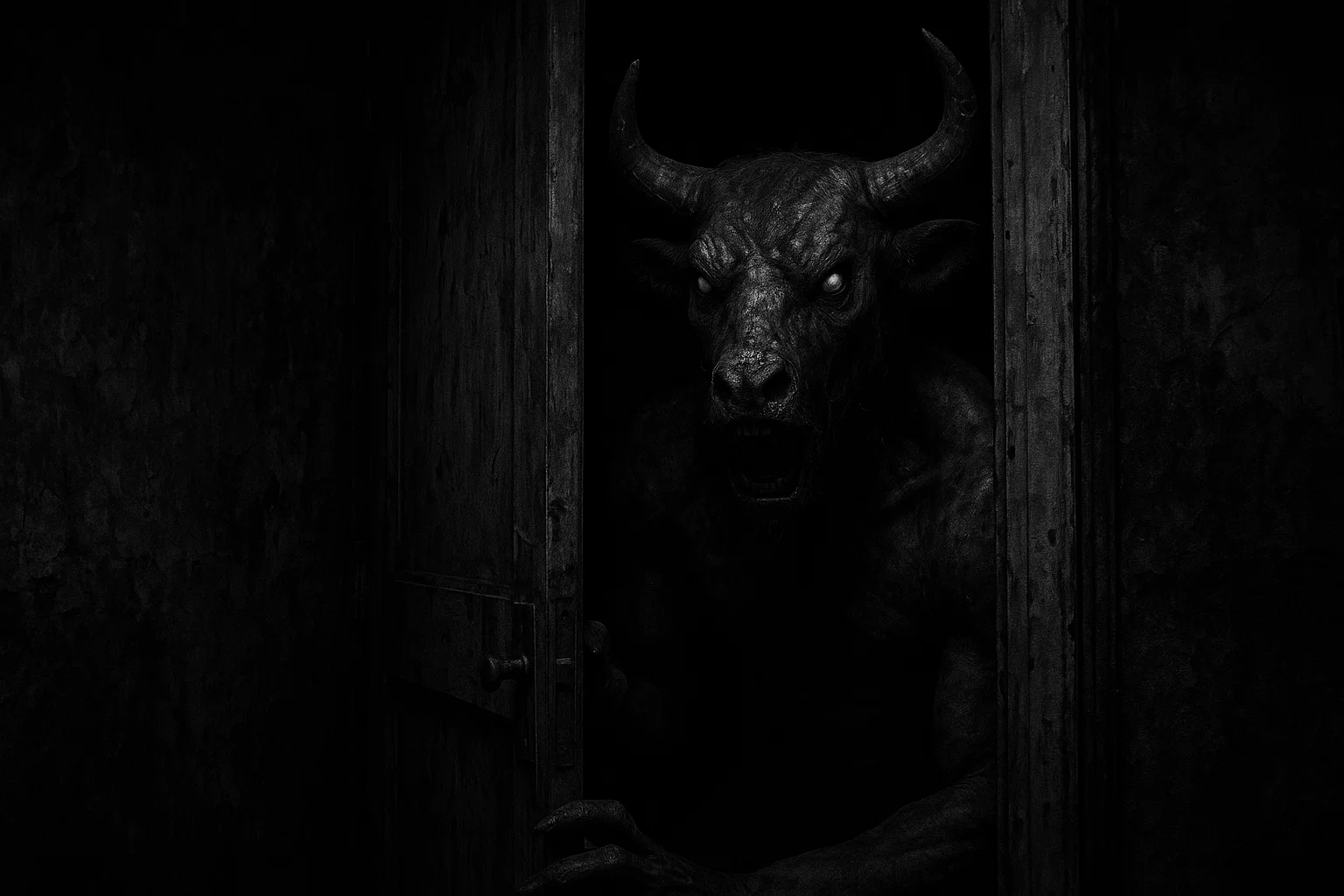
Before the urban legend, before the school buses and trembling children, there was an entity. The word gozu (牛頭) in Japanese mythology refers specifically to a being with the body of a man and the head of an ox or cow — a chimeric creature that appears across multiple layers of Japanese and East Asian religious tradition, each time carrying a sense of fear, judgment, or forbidden power.
The most ancient and theologically significant version is Gozu Tennō (牛頭天王), the “Ox-Headed Heavenly King.” Gozu Tennō is a Japanese syncretic deity of disease and healing, an entity that fuses Buddhist and Shinto belief into something disconcerting and paradoxical — a god who both caused pestilence and could cure it.
Gozu Tennō was historically conflated with Susanoo-no-Mikoto, the Japanese storm god, and was widely revered since the Heian period as a god of pestilence who both caused disease and cured it.
The deity was worshiped at Yasaka Shrine in Kyoto, and in 869, when people were suffering from plague and pestilence attributed to the rampaging deity Gozu Tennō, Emperor Seiwa ordered that the people pray to appease him. The Gion Matsuri Festival — one of Japan’s most famous and spectacular festivals, held annually in Kyoto to this day — began as a ritual to calm Gozu Tennō and protect Kyoto from widespread disease during the Heian period.
Then there is a second, equally ancient monster: the underworld Gozu, a jailer of the dead. In many texts, Gozu and Mezu are referred to collectively as Ox-Head and Horse-Face, a pairing that originates from Chinese Buddhist literature, where they first appeared as underworld guards.
In this mythology, Gozu is not a deity to be worshipped but a supernatural enforcer — a being whose job is to drag the souls of the dead before King Enma (the lord of the underworld) for judgment. Classical writings describe Gozu as capable of outrunning spirits, restraining them with chains, or dragging them back before King Enma for sentencing.
What connects both of these ancient figures to the urban legend is the image itself: something wearing the face of a bovine — an animal associated in Japanese culture with both sacred ritual and the slaughterhouse — imposed on a human body. It is inherently, viscerally wrong. It is the shape of something that should not exist.
Where Did the Gozu Urban Legend Come From?
According to legend, a horrific short story called “Cow Head” was discovered in Japan in the 17th century. The actual origin of the story is still covered in mystery. Several written accounts from this era refer to the awful story. Still, they cite only its title and describe it as a tale too terrible to tell.
That is the official version, and it is frustratingly circular. The oldest “records” of the story are accounts the say it is too terrible to record. It is a legend that documents itself through the act of refusing to document itself.
The real history of Gozu is multi-layered, and understanding it requires separating several distinct threads.
The Literary In-Joke That Became a Legend
The concept of a terrifying-but-unknown story called “Cow Head” was popularized in 1965 by the acclaimed Japanese science fiction writer Sakyo Komatsu.
He published a short story titled “Gozu,” which was not the story itself, but a meta-narrative about the rumor of such a tale. Komatsu later stated that he didn’t invent the idea; it was an old in-joke among fellow authors that had been going around for decades. The premise acted as a playful jab at the nature of horror: a story so scary it couldn’t even be written.
This is an essential detail that almost every popular retelling buries or omits. The Gozu legend, in its modern, identifiable form, began as something close to a literary joke — a winking acknowledgment from horror writers that the scariest story is the one you never actually write. It was a meta-fictional concept before it became a folkloric one.
You may also enjoy:
Is the Jersey Devil Real? Eyewitness Accounts and Chilling Encounters
September 24, 2025
Who Is Lucifer? Names, Myths, Titles, and Powers
August 25, 2025
Mahazael: The Demon Prince Who Devours Earthly Beauty
September 1, 2025
Chimera: The Three-Headed Beast That Even Gods Feared
October 28, 2025
The Rain Ritual That Was Forbidden to Speak Of
Beneath the literary joke, however, there appears to be something more ancient and stranger. While the modern legend is a literary creation, the term “Cow Head” has much deeper, darker roots in Japanese folklore.
Researcher Yuki Yoshida has proposed a convincing theory linking the legend to forgotten, taboo rituals. In many parts of western Japan, there was a secret rain-making ceremony that involved sacrificing a bull and throwing its severed head into a river or pond.
These “Gozu rituals” were considered sacred and highly secretive, and speaking of them to outsiders was strictly forbidden. Yoshida suggests that the real-world taboo — “You must not speak of the Cow Head ritual” — morphed over time toward the supernatural taboo of the urban legend: “You must not tell the Cow Head story.”
This is possibly the most compelling origin theory for the legend’s emotional core. The forbidden nature of the story — the absolute insistence that it cannot be told, that hearing it is dangerous — maps perfectly onto a cultural memory of genuinely secret ceremonial practices. Real secrecy, over time, curdles into supernatural prohibition.
The Edo Period Precedent
Even before the rain rituals, the image of a strange cow head as something distinctively horrifying appears in Japanese literature.
An 18th-century story tells of a man who encounters a floating cow’s head on a snowy night, a spooky and surreal image that predates the modern legend.
The visual — a calm, cold environment interrupted by something biologically wrong and profoundly out of place — suggests that the cow’s head, as a symbol of horror, was already embedded in the Japanese imaginative tradition long before the modern urban legend coalesced around it.
Burned, Shredded, Scattered
The Cow Head story was deemed too dangerous, and most existing copies of it were burned years ago. The few copies that survived were cut into sections and distributed across the country. Today, it is believed that only fragments of the first story remain. Most of the actual details of the story remain unknown. The unfortunate people who read the story never lived long enough to repeat it.
This element of the legend — the deliberate destruction of knowledge — is important. It signals that the fear surrounding Gozu wasn’t just accidental or superstitious, but active and institutional.
Someone, the legend implies, knew what the story was capable of and chose to undo it. Fragments were scattered like the bones of something dangerous, never to be reassembled.
The Full Gozu Urban Legend
Here, then, is the complete urban legend of Gozu, as it has been passed down in its most widely recognized form.
There was once an elementary school teacher who somehow — no one knows how, no one is willing to say — came into possession of several pages of what appeared to be fragments of the genuine Cow Head story.
The teacher was taking his class on a school trip. He was the sort of person who liked to entertain his students on long bus rides with ghost stories. The children, ordinarily restless and noisy, would go quiet as he narrated his tales, and the hours would pass more easily. They genuinely enjoyed being frightened by him.
On this particular trip, the teacher worked through his usual repertoire: stories of yurei (vengeful ghosts), legends of cursed objects, accounts of disappearances in forests at night. The children shivered and gasped on cue. Then, when the usual stories were exhausted, the teacher did something unusual. He announced that he would tell them the legendary, forbidden story called Gozu — the Cow Head.
Before he could finish even the first sentence of the story, the children burst in panic.
“Stop!” they screamed. “Don’t tell us! Please!”
One child turned pale and threw his hands over his ears. Others began to cry. A girl at the back of the bus started screaming for no apparent reason. The bus driver grabbed the wheel and began to sweat despite the cold air conditioning.
But the teacher did not stop. His eyes, witnesses later reported, had gone blank — wide open but unseeing, as though something had reached inside him and switched off the person behind them. He continued speaking in a low, flat voice, neither raising nor lowering it, completely indifferent to the turmoil around him. Something unseen had taken over his body and was finishing what had been started.
The bus had to be pulled off the road. The driver, trembling uncontrollably, could no longer drive.
When it was over — nobody who was present could say how much time had elapsed — the teacher came back to himself. He found the bus stopped in a ditch. The children were unconscious in their seats, several of them foaming slightly at the mouth. The bus driver was slumped over the steering wheel, drenched in cold sweat.
The teacher never spoke of the incident again. He never told the Cow Head story again. Whatever pages he had, they were not seen after that day. What he had said during those lost, blank minutes was never repeated by anyone present, because no one present could remember a single word.
The contents of the story were lost once again.
You may also enjoy:
Adrammelech in the Bible: Child Sacrifices and Idolatry
September 30, 2025
Likho: The One-Eyed Crone Who Brings Death and Bad Luck
September 11, 2025
Who Is Seere? The 70th Demon of the Ars Goetia
May 29, 2025
Variations of the Legend
Because the Gozu legend centers on a story that no one can tell completely, it has naturally split into multiple versions, each filling the void of the original version in different ways.
The Wandering Storyteller Version
Set during the Edo period (1603–1868), this historical variation tells of a wandering storyteller who arrives in a remote village in what is now Fukushima Prefecture. Hungry and tired, he offers to relate stories in exchange for food and shelter. The locals, eager for entertainment, gather around a fire as he begins.
His stories of yurei (ghosts) and oni (demons) captivate them, but he saves the Cow Head story for last. As he starts, the mood shifts. The inhabitants beg him to stop, but, like the teacher in the school-bus version, the storyteller cannot. By morning, several villagers are dead. The storyteller has no memory of the night. He leaves the village and is never seen again.
The Cannibal Village Version
One of the most disturbing internet-era reconstructions attempts to imagine the actual content of the story. The story is set in a remote village in the 17th century, suffering from a devastating famine. Driven to madness, the locals perform a grim ritual.
They dress a person in a cow’s hide and severed head and declare them a “divine messenger.” Then, in a frenzy of starvation, they hunt, kill, and eat this “cow-person.” The horrific act of cannibalism becomes the village’s dark secret, a story so traumatic that it is forbidden to be told, lest the curse be unleashed again.
The Two-Village Massacre Version
This version tells of a feud between two villages. The son of a powerful figure in one village commits a series of brutal murders, decapitating his victims and replacing their heads with cow heads. To prevent a war, both villages agree to cover up the incident, creating a pact of silence. The “Cow Head” story becomes the forbidden truth of their common, bloody history.
The Archaeologist Version
This is the partial reconstruction of the story that appears in fragmented Japanese summaries, considered by some to be the closest thing to an “original” version.
It begins with archaeologists excavating a deserted village, trying to understand why it was abandoned. They unearth a strange skeleton — the body of a man, with the skull of a cow. Their research leads them backward in time to a catastrophic famine.
The locals, having eaten everything — their livestock, their pets, everything — are slowly dying. Then, one night, a strange figure wanders into the village: a being with a human body and the head of a cow.
Whether it is a god, a demon, a damned man, or something else entirely, the story does not make clear. In their desperation, the residents attack the creature, tear it apart, and eat it. And then — the village becomes cursed.
The fragmentary summaries of this version end here. What the curse is, what it does, what exactly fell apart in the village after that meal, is the part that has been lost — or that cannot be told.
The Digital-Age Version
In the internet era, the legend has taken on a modern variant in which a student discovers an online file claiming to contain the full Cow Head story.
The student reads it alone, at night, and begins experiencing severe physical symptoms — trembling, heart palpitations, and an overwhelming and indescribable sense of terror. By morning, the student is found catatonic. The file, when others try to access it, is gone.
This version replicates the Gozu legend’s original mechanics precisely — it just transplants them onto contemporary anxieties about what we consume alone on our screens late at night.
The Story That Keeps Generating Stories
Despite — or because of — the lack of definitive content, Gozu has left a remarkable cultural footprint.
The first film to reference the urban legend was Takashi Miike’s Gozu (2003). The surreal, profoundly strange yakuza horror film buries its bovine imagery in layers of dream logic. The film does not adapt the legend directly; it inhabits the same psychological territory — the sense of a horror that cannot be fully seen or described.
The image most commonly circulated online in connection with the legend — that of a boy or young man with an oversized, realistic cow’s head — actually originates from the film, not from any older source.
The image most commonly associated with the cow head myth is a photograph of a boy with the oversized head of a cow, which is actually from this Japanese comedy crime thriller film directed by Takashi Miike. Many people encountering the legend online have mistaken a movie prop for folkloric evidence.
The entire idea is strongly reminiscent of Robert W. Chambers’ The King in Yellow — both in its concern with reading material of such wicked influence on the process of reading or even involvement. Chambers’ 1895 work features a fictional play that drives anyone who reads it to madness — the book is named after a play with the same title, which recurs as a motif, inducing despair or madness in those who read it.
The parallel between Gozu and The King in Yellow is close enough to be remarkable: both are meta-horror constructs in which the medium itself is the threat, the story within the story is the monster, and the horror is fundamentally about the danger of certain kinds of knowledge. The difference is that Chambers was writing deliberate literary fiction. At the same time, the Gozu legend presents itself — with a straight face — as documented fact.
There are also cross-cultural parallels worth noting. A folk tale also bearing the “Cow’s Head” name has been documented in Ukraine. In the Ukrainian version, a woman receives a reward for hosting a headless cow’s head that visits her home one night. The tonal difference is dramatic: the Ukrainian version is a fairy tale about hospitality and reward.
The Japanese version is about something that will kill you if you listen. What these two traditions share is the uncanny image of a bovine head detached from its body — something deeply wrong with the natural order — interpreted through entirely different cultural lenses.
You may also enjoy:
Who Really Is Mephistopheles in the Faust Legend?
August 26, 2025
Poludnitsa: The Noon Witch Who Haunts the Fields of Slavic Folklore
September 11, 2025
Who Is Lucifuge Rofocale in Demonology?
August 25, 2025
What the Legend Is Actually Doing
Most articles about Gozu treat it as a straightforward piece of Japanese horror folklore — mysterious, creepy, end of story. But the legend is doing something a lot more interesting than that, and it rewards a closer look.
Gozu is a self-sealing horror system. The structure of the legend is specifically designed so that the core content can never be revealed, and the mechanism that prevents revelation is itself made terrifying. No one can tell the full story because everyone who hears it dies or goes mad. The story cannot be recovered because all copies were destroyed.
The fragments are too dangerous to share. Every possible route to the actual content of the story is blocked by a horror-shaped wall. This is not an accident. It is the legend’s most sophisticated feature. The lack of content is the content. The Gozu legend is essentially a horror story about a horror story — a container that uses the idea of an unimaginable threat to make it more frightening than any specific threat could be.
It weaponizes the human mind against itself. When we are given a concrete horror — a monster with a specific shape, a ghost with a specific appearance, a killer with a specific method — our fear is bound by that specificity. We can examine it, categorize it, and because of that, on some level, prepare for it.
The Gozu legend denies us this. It tells us only that something is so terrible it kills people to hear it. Our own minds, obedient to the shape of the fear, then supply the worst thing we can personally conceive. The legend becomes a personalized horror generator. No two people are frightened by the same thing, and so Gozu is simultaneously the most terrifying story for everyone.
The legend maps onto a very real Japanese cultural phenomenon: the “too dark to speak” secret. Japanese culture has historically contained concepts like haji (shame) and chinmoku (silence/withholding) that frame what can and cannot be said in social contexts.
There is a recognized cultural pattern of collective amnesia around certain events — things that are known to have happened but that social consensus has decided must not be discussed.
The Gozu legend aestheticizes this: the “thing that cannot be told” comes to be not just socially forbidden but cosmically dangerous. The urban legend is, in this reading, a horror-inflected meditation on the violence of enforced silence.
The ritual sacrifice theory opens a genuinely dark window into agricultural Japan. The theory connecting the Gozu legend to secret rain-making ceremonies involving the sacrifice of cattle is, on its own terms, historically plausible.
In pre-modern Japan, water rights and agricultural survival were literally life-and-death matters. Secret rituals tied to rainfall were documented in various regional contexts.
The idea that one such ritual — the severed head of a bull thrown into a river — might have been so sacred and so gruesome that speaking of it to outsiders was genuinely forbidden is not a stretch.
Over enough generations, the exact memory of the ritual dissolves. What remains is the taboo: do not speak of the Cow Head. The reason why has been forgotten. The prohibition, stripped of its context, becomes supernatural.
The Sakyo Komatsu connection, properly understood, is not a debunking — it is itself fascinating. Many people, after learning that the modern legend can be traced partly to a 1965 science fiction story, treat it as a deflating revelation — “so it’s not real folklore, it’s just a writer’s joke.” But this misunderstands how folklore actually propagates.
The Komatsu story did not invent the Gozu legend from nothing; it crystallized a pre-existing aesthetic anxiety — the idea of a story too terrible to tell — that was already circulating in horror-writing circles. And once that crystallization entered popular culture, it began to accrete genuine folkloric behavior: regional variations, eyewitness accounts, children frightening other children, the whole self-replicating machinery of legend.
The Gozu legend is a case study in how modern folklore is actually made — not discovered whole from ancient origins, but assembled in real time from literary invention, cultural anxiety, and oral tradition, each feeding the others.
Finally, Gozu forces a genuinely interesting question about what horror is for. Most horror stories, at their core, are teaching tools. They say: here is a thing to be afraid of; here is the consequence of particular behaviors; here is the shape of the darkness outside the hearthlight. Gozu cannot do any of this because it refuses to have a shape.
What it teaches instead is something all the more unsettling: that there are things in the world that exceed the capacity of horror itself to describe them. The truly terrible thing is not what can be narrated but what cannot, which is a lesson that lands differently depending on who you are — but for most people, it lands hard.
Why We Keep Telling the Story of the Story That Cannot Be Told
What is remarkable about the Gozu legend is that it has survived and grown for over sixty years in its modern form — and arguably for centuries in its older, ritual-adjacent form — without ever resolving its central mystery.
Most urban legends exhaust themselves when they become too well-known or when the fear they generate is eventually laughed off. Gozu has resisted both. It cannot be debunked because there is no specific claim to debunk. It cannot be laughed off entirely because the structure of the legend turns mockery into hubris: go ahead, doubt it. Try to hear the full story. See what happens.
The Gozu legend also has the rare quality of being genuinely interactive. Every time someone learns about it, they are invited to participate in the same way the schoolchildren on the bus were — to decide whether they want to know, whether they are brave enough to hear more. Most legends are passive: they happen to people. Gozu is a legend that asks something of its listeners.
In Japan, the name has become shorthand for a whole category of horror: the horror of the unknowable, the horror of the thing so bad that no language can contain it.
In that sense, Gozu (牛頭) — a creature first conceived as the head of a beast placed on the body of a man, standing guard at the gates of Hell — has found its most natural home: not in the underworld, but in the space between the story and the telling, where the worst fears of everyone who has ever heard the name live, wordlessly, waiting.
You may also enjoy:
Who Is Azazel, the Demon Who Corrupted Humanity?
September 29, 2025
Bear Creek Swamp Haunting: The Darkest Ghost Story in Alabama
September 23, 2025
Glasya-Labolas: The Griffin-Winged Demon of Blood and Wisdom
August 21, 2025
The Demon Megaera: Serpents, Blood, and Divine Vengeance
September 1, 2025
Vassago: The Demon Who Pretends to Be an Angel
May 29, 2025
Sources
- Bingham, Adam (2015). Contemporary Japanese Cinema Since Hana-Bi (Traditions in World Cinema EUP). Edinburgh University Press.
- Garcia, Nicole. Comparison and Analysis of Japanese and Mexican Popular Urban Legends: Focus on Female Figures. Honors Thesis, University of Florida, 2021. University of Florida Digital Collections (UFDC).
- Wadhams, Erin. The Essentials of Mukashibanashi: A Study of Motifs & Morals in Japanese Folk Tales. 2019. Florida State University, Honors Thesis. FSU Digital Repository.
- R. Nicholas Carleton. Fear of the unknown: One fear to rule them all? Journal of Anxiety Disorders, Volume 41, 2016, Pages 5-21, ISSN 0887-6185, https://doi.org/10.1016/j.janxdis.2016.03.011.
- Michael Dylan Foster. Pandemonium and Parade: Japanese Monsters and the Culture of Yokai. Published November 3, 2008, by University of California Press.
- McMullin, Neil. On Placating the Gods and Pacifying the Populace: The Case of the Gion ‘Goryō’ Cult. History of Religions, vol. 27, no. 3, 1988, pp. 270–93. JSTOR, http://www.jstor.org/stable/1062279. Accessed 10 June 2026.