Aka Manto is a well-known urban legend in modern Japanese folklore. It tells of a sinister spirit that haunts the last stall in public and school bathrooms.
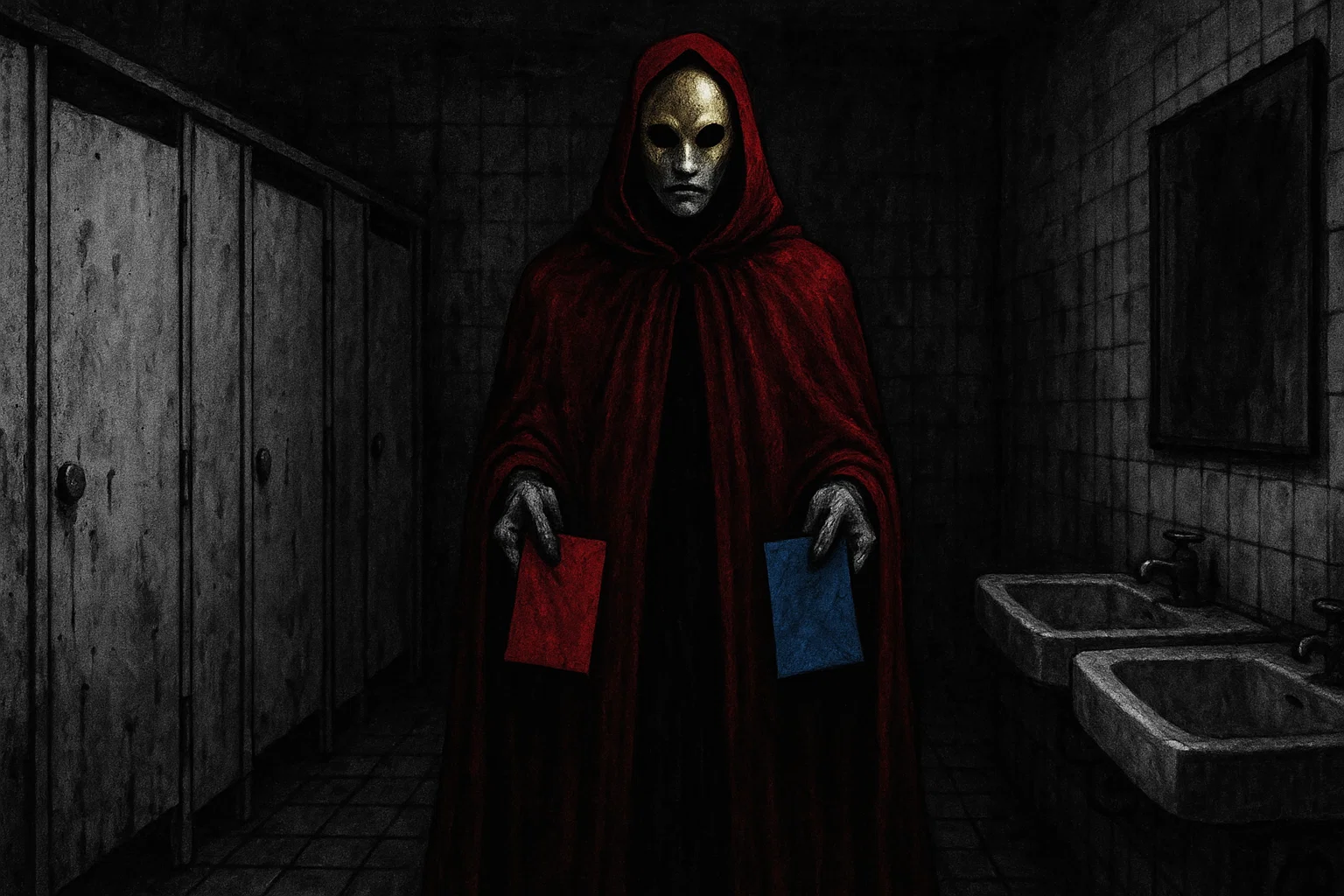
The spirit appears to people alone in the bathroom and asks them to choose between red or blue toilet paper. No matter what they pick, the result is deadly—either a violent end or slow suffocation.
Aka Manto shows how old spiritual fears have moved into the everyday spaces of modern Japan, especially in the practical, confined areas of public buildings after World War II.
Summary
Overview
| Attribute | Details |
| Names & Etymology | Aka Manto, Aoi Manto, Aka Hanten; Japanese for “Red Cloak” or “Red Mantle.” |
| Classification | Yōkai, Toshi Densetsu (Urban Legend), Onryō (Vengeful Spirit). |
| Species | Spectral, Humanoid. |
| Threat Level | Level 2 (Conditional Hazard) [See the Thread Level Guide] |
| Origin | In Japanese urban folklore, the entity manifests from the collective psychological dread of modernization, schoolyard isolation, and academic anxiety, emerging initially from mid-1930s kamishibai theater rumors. |
| Earliest Record | 20th Century, specifically documented in schoolyard oral records and local police logs around 1935 in Osaka, Japan. |
| Habitat | The final cubicle stall in public, municipal, and school restrooms, traditionally housed in old or dimly lit concrete infrastructure across Japan. |
| Diet | Does not consume food; it feeds purely on the life force, terror, and blood of its victims. |
| Physical Details | A tall, slender male silhouette wearing a sweeping crimson cloak and concealing an overwhelmingly beautiful, madness-inducing face behind a smooth, expressionless white porcelain mask. |
| Strengths | Absolute reality-warping dominion within its localized stall dimension, supernatural execution speed, manipulation of invisible blades, and an inescapable contractual trap bound by language. |
| Weaknesses | Strict adherence to its own semantic logic; the entity can be completely defused and forced to vanish by offering a neutral refusal that rejects the premise of the question entirely, such as “I do not need any paper.” |
| Warning | Never use the unlit final stall of an old school or public restroom alone at dusk, and completely refrain from answering with any color if a disembodied voice queries you from the darkness. |
| Survival Odds | 65% (High survival rate, but only if you know the rules and deliver the exact neutral verbal protocol to break the linguistic contract). |
Who or What Is Aka Manto?
Aka Manto is a modern version of the yōkai tradition, seen as a harmful urban ghost (toshi densetsu). Unlike older spirits tied to nature or mountains, this ghost is found only in modern bathrooms, often targeting school children and people alone in old, dimly lit public restrooms.
The spirit is purely malicious, with no clear reason or purpose. It neither punishes wrongdoers nor protects sacred places. Instead, it traps people in a deadly situation based on their answers.
In Japanese ghost stories, Aka Manto is remarkable. It came before other bathroom spirits like Hanako-san, but is known for being much more violent and frightening.
The spirit attacks when people are most vulnerable—alone and trapped in a bathroom stall. What should be a normal part of life becomes a source of fear. Folklore experts see Aka Manto as a symbol of the stress, pressure, and loneliness many Japanese students felt during the country’s fast urban growth in the Showa and Heisei periods.
You may also enjoy:
Origin & Lineage
The story of Aka Manto began during the big social and building changes in early 20th-century Japan. Folklore says the ghost comes from the fears and worries of people living in modern cities, not from old curses or religious reasons.
People probably created the ghost story to deal with their anxiety about Western influences, the impersonal feel of new concrete schools, and the feeling of being exposed when alone in private spaces. The legend started as a twist on the kamishibai (paper theater) plays from the 1930s, especially the hero wizard in Kōji Kata’s play called “Aka Manto”.
Children in schools changed the hero from the play into a scary monster, mixing the idea of a fancy Western cloak with old fears of dark, underground places. Over time, this turned the 1930s theater character into a popular schoolyard rumor in Osaka. As cities grew and schools changed after the war, the story became the well-known bathroom ghost we know today.
The first records of Aka Manto come from schoolyard stories and police reports around 1935 in Osaka. At first, the ghost was said to hide in a dark getabako (shoe locker) in the basements of elementary schools.
Records show that the story spread quickly. Within two years, it reached Tokyo’s Ōkubo district, where people called the ghost a vampire attacking people at night in dark alleys. By 1940, the legend had spread to Kitakyūshū and even to Japanese schools in Korea. After the 1950s, the story became known everywhere in Japan as the ghost haunting the last stall in school bathrooms.
The ghost is most closely linked to the big cities of Osaka, Kyoto, and Tokyo. These cities were the first to replace old wooden outdoor toilets with large, concrete indoor bathrooms. The dark, windowless ends of these new bathrooms became the perfect setting for stories about Aka Manto, where modern buildings met old fears of the unknown.
This connection to certain regions ties Aka Manto to older bathroom legends. In Kansai and Kantō, there is also Akaname, a yōkai from the Edo period known as the ‘filth licker,’ which represents people’s dislike of dirty, dark bathrooms.
But while Akaname was a harmless reminder to keep bathrooms clean, Aka Manto is much more dangerous. Folklore experts also see a connection to Kainade, a hairy spirit from old Shinto stories that hides under squat toilets and touches people’s skin.
In some Showa-era versions, instead of choosing paper, people saw a red tongue or a white hand appear from the toilet, which shows that the legend borrowed ideas from old toilet gods (toire no kami), turning them from protectors into something frightening and deadly.
Etymology
The way the name Aka Manto has changed over time shows how Japanese culture has transitioned, too. It is usually written in katakana as アカマント or in kanji as 赤マント, meaning ‘Red Cloak’ or ‘Red Mantle.’ The word ‘manto’ comes from Portuguese or English and refers to a sleeveless cloak that became popular in Japan in the late Meiji and Taishō periods as a sign of Western style and high status.
It is ironic that a foreign piece of clothing, once seen as modern and fancy, became a symbol of fear in this legend. In some older versions, especially in Kansai, the ghost was called Aoi Manto (‘Blue Cloak’) or Aka Hanten (‘Red Quilted Jacket’), using a traditional Japanese jacket instead of a Western cloak.
By the late 1970s and 1980s, the name Aka Manto became common across Japan thanks to media and schoolyard stories. The name itself highlights the contrast between the fancy red cloak and the dirty reality of a public bathroom.
What Does the Aka Manto Look Like?
Early stories and records describe Aka Manto in a simple but scary way, which is often altered in movies and TV. Pop culture usually shows the ghost as a tall, thin man with a dramatic mask and a red cape. Still, older schoolyard stories describe it as something much more mysterious and unsettling.
In the original stories, Aka Manto is said to have a face so handsome or beautiful that seeing it can drive people mad or leave them frozen. To hide this, or maybe to tease people, the ghost wears a plain white porcelain mask with no expression. The cloak is not always real fabric; sometimes it is described as moving shadows or even as a covering of dried blood on the ghost’s shoulders.
Some early stories say Aka Manto makes a low, mechanical humming sound, like old pipes, before it appears. The ghost has no visible feet and makes no noise when it moves. Instead, it glides silently over the wet bathroom floor, often bringing a strong smell of sulfur and stale water.
Myths, Legends, and Stories
Stories about Aka Manto have been passed down through word of mouth, schoolyard research, and early internet forums. They all focus on a deadly encounter in a public or school bathroom, usually in the last, often unused stall. The main legend is about the ghost giving victims a scary choice when they are out of toilet paper, with every answer leading to a terrible outcome.
In the main version of the story, the ghost appears when someone finds there is no toilet paper left. A calm, eerie voice comes from under the stall, the pipes, or even the ceiling, asking: “Do you want red paper or blue paper?”
If the person asks for red paper, the ghost attacks them violently, leaving the stall covered in blood. If they choose blue, the ghost either strangles them or drains their blood, leaving their body pale and blue from lack of air.
As the story spread to different areas, new versions appeared. In some cases, if someone tried to avoid the choice by picking a different color, the ghost would immediately take them away.
For example, asking for a white paper makes a pale hand appear from the toilet and pull the person into darkness. In other versions, choosing yellow or green leads to the ghost harming the victim or making them sick until their skin turns the color they picked.
Most stories focus on the paper choice, but a version from 1960s Yamagata Prefecture changes the question to clothing. In this version, the voice asks: “Do you want a red cloak or a blue cloak?”
In the most well-known story from this version, a schoolgirl tries to trick the ghost by saying ‘yellow cloak.’ Instead, the ghost tears off her clothes and pulls her up through the ceiling. Her body is later found under the gym floor, her skin turned yellow from illness.
This version shows that trying to outsmart the ghost does not work. Aka Manto is not a trickster, but a dangerous spirit that uses language to carry out its threats.
Aka Manto vs Other Monsters
| Creature & Lore | Danger Level | Details |
| Hanako-san (Japan) | Low. Manifests in the third stall of the third-floor girls’ bathrooms when summoned, generally acting as a harmless or mildly frightening school ghost. | While she is typically considered benign, some regional post-war legends claim she guards a multi-headed lizard that devours intruders. |
| Kuchisake-onna (Japan) | High. Approaches solitary pedestrians while wearing a surgical mask to ask if she is beautiful, violently slashing their faces if they answer incorrectly. | You can temporarily confuse her and escape by throwing hard candies called bekko ame or repeating the phrase “so-so” back to her. |
| Kashima Reiko (Japan) | Severe. Haunts school and station restrooms asking victims where her legs are, decapitating or severing the limbs of those who fail her riddle. | Her legend spread as a hyper-specific memory virus, with school children believing she would manifest within three days of hearing her story. |
| Bloody Mary (Western Diaspora) | Medium. Appears in darkened bathroom mirrors when her name is chanted repeatedly, scratching, cursing, or trapping the summoner’s soul in the glass. | Historians trace her origins to ancient mirror-gazing divination rituals used by young women to glimpse the faces of their future husbands. |
| Kainade (Japan) | Low. Lurks directly beneath old-fashioned squat toilets to stroke the buttocks of unsuspecting users with a cold, hairy hand. | This Edo-period entity could be entirely repelled by merely clearing your throat or coughing loudly before entering the outhouse. |
| The Midnight Man (Pagan/Western Urban Legend) | Severe. Haunts the home of anyone who performs his midnight summoning ritual, inducing vivid hallucinations of their worst fears until hunting them down. | The mythic rules state that if your candle goes out during the game, you have exactly ten seconds to relight it or surround yourself with a ring of salt. |
| Lechusa (Mexico / Texas Border) | High. Disguises itself as an oversized, human-faced owl at night to mimic the sounds of crying babies, snatching anyone who ventures outside to investigate. | These creatures are believed to be vengeful witches who sold their souls to Satan in exchange for the power of avian shape-shifting. |
Can You Defeat an Aka Manto? Powers & Weaknesses
To understand Aka Manto’s powers, it helps to look at the strange spiritual rules behind the legend. The ghost does not use brute force; instead, its power depends on a kind of magical contract created by words.
When someone enters the stall and answers the ghost, they become completely vulnerable. The ghost’s power to harm them comes from the person agreeing to the choice it offers.
This strict rule about words also creates a way to survive. If someone tries to break the rules by picking another color, the ghost sees it as breaking the contract and drags them into the underworld.
According to folklore, the only way to escape is to refuse the question entirely. The best defense is to calmly say, “I do not need any paper,” or “No paper is necessary.”
By refusing the offer, the person avoids making a deal with the ghost, so it cannot harm them. The idea is based on kotodama, the old Japanese belief that words have real spiritual power. Giving a neutral answer breaks the spell, and the ghost disappears.
Is Aka Manto Real?
The story of Aka Manto is more than just a scary tale. It also reflects the deep changes in Japanese society as it became modern. In older stories, evil spirits lived far from people, in mountains, crossroads, or rivers.
But in this modern legend, the supernatural moves right into the middle of everyday life. The bathroom, meant to be clean and safe, becomes the place where old fears and chaos suddenly appear.
The legend connects to the hidden worries of a strict society. For students, the school bathroom is one of the few places without adults, but it is also a place where they feel alone and exposed. Aka Manto turns everyday fears about fitting in or not having what you need into a life-or-death situation.
You may also enjoy:
Pan: From Forest God to Christian Demon
August 26, 2025
Gaines Ridge Dinner Club Haunting: Why Do Diners Hear Babies Crying?
September 3, 2025
Malaga Inn Haunting: Why Room 007 Terrifies Guests to This Day
September 22, 2025
Sources
- Foster, Michael Dylan. The Book of Yokai: Mysterious Creatures of Japanese Folklore. University of California Press, 2015. Internet Archive.
- Yanagita, Kunio. Tōno Monogatari [The Legends of Tōno]. Kyōdo Kenkyūsha, 1910.
- Reider, Noriko T. Japanese Demon Lore: Oni from Ancient Times to the Present. Utah State University Press, 2010. DigitalCommons@USU.
- Druga, Michele. Terrifying Toilets: Japanese Toilet Ghosts and Sexual Liberation in the Postwar Period. Wittenberg University East Asian Studies Journal, vol. 38, 2013, pp. 1–6. WittProjects OJS.
- Joly, Dom (2012). Scary Monsters and Super Creeps: In Search of the World’s Most Hideous Beasts. Simon & Schuster. ISBN 978-0857207647.