Some legends don’t need a face to be unforgettable — just a silence that arrives too suddenly, and something patient enough to wait inside it. The Tall and Quiet Man is an original creepypasta horror story about a faceless forest entity that doesn’t hunt so much as catalog — methodical, unhurried, and far more disturbing for its patience than any jump scare could manage. It’s a tale of group survival horror and small-town folklore in the tradition of internet urban legends, centered on six friends, a dare, and a state forest that goes quiet just before it decides who gets to leave.
Story File
| 👁️ Title | The Tall and Quiet Man |
| 🪶 Author | Razvan Radu |
| 🪦 Genre | Creepypasta / Cosmic Horror / Short Horror Story |
| 🏷️ Themes | Urban Legend, Wilderness, Group Survival Horror, Ancient Presence, Folklore, Isolation |
| ⏳ Read Time | 11 minutes |
| ☠️ Warnings | Disappearance/implied death, intense dread, psychological horror, disturbing imagery, brutal ending |
| 📜 The Lore | A state forest near a small town goes unnaturally silent right before something patient and unhurried decides who gets to leave. |
| 🎬 The Scoop | Six friends dare each other into the woods to debunk a local legend about a faceless figure that “catalogues” anyone who notices the forest’s sudden silence — and only one of them comes back. |
Every small town near a state forest has its own version of the same rumor. In Pinehollow, people called him The Tall and Quiet Man. No one could say where the name came from or who first used it. It was just a phrase that seemed to have always existed alongside the woods, passed between kids at sleepovers the way some towns share which house to avoid on Halloween.
The rule, as far as anyone could state it consistently, was simple: the deeper parts of Garrow State Forest went silent in a way regular forests don’t, and if you noticed the silence — really noticed it, stopped and registered that the birds and insects and wind had all gone quiet at once — something noticed you noticing, and came to see what you’d seen.
Priya Okafor had heard the rule a hundred times and believed exactly none of it, which is precisely why she organized the Halloween hike in the first place — six friends, four flashlights, a dare nobody had the nerve to back out of once it existed in their group chat.
Her friend Desmond came along mostly to film it for his channel, more interested in capturing fake fear for an audience than feeling any real version of it himself. Behind them came Wren, quiet and watchful, the only one of the group who’d actually grown up near the forest’s edge and who kept glancing at the tree line the way you’d glance at a dog you weren’t sure had finished deciding whether to bite.
The trail in was ordinary enough for the first mile — birdsong, the rustle of October leaves, Desmond’s running commentary into his phone about “the legendary Tall and Quiet Man” in a voice pitched for laughs. It was Wren who first noticed, a half mile past the ranger marker, where the maintained trail gave out, that the commentary had become the only sound in the entire forest.
No birds. No wind in the canopy, despite a breeze they could still feel against their skin. No insects, not even the late-season drone of crickets that should have been everywhere in the underbrush. Desmond kept talking, oblivious, until Priya put a hand on his arm, and he finally heard what Wren had already gone pale hearing: nothing at all, behind his own voice, in any direction.
“That’s the thing my grandmother used to call going under the quiet,” Wren said, very low, as if a normal volume might count as noticing too loudly. “She said it happens right before. Not during. Before.”
Before they could decide whether to turn back, the quiet did something none of the legends had ever described, at least as far as any of them knew. It deepened, becoming a physical pressure against their ears, like the moment before holding your breath becomes painful.
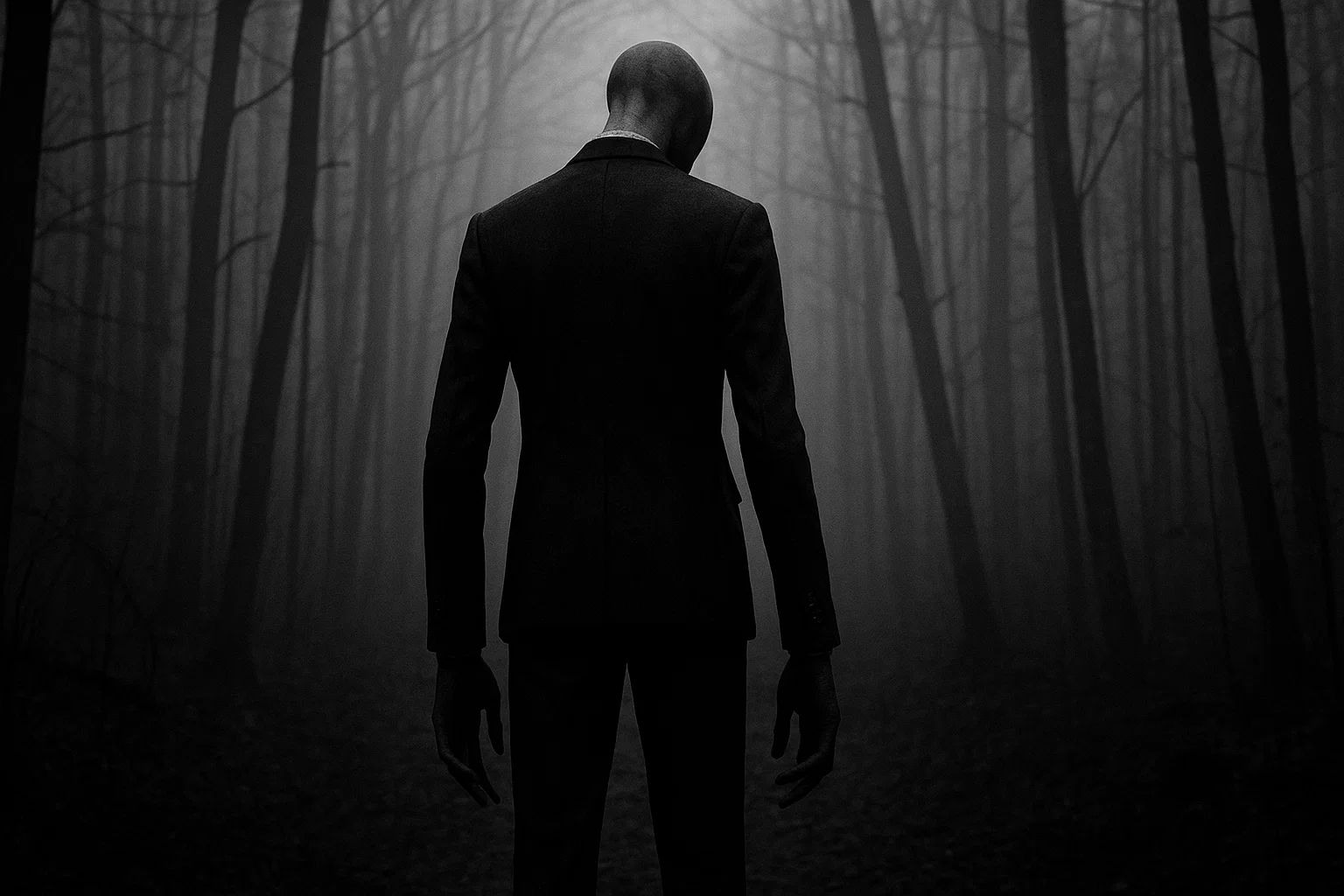
At the edge of Priya’s flashlight beam, something appeared out of the dark tree shapes that hadn’t been there a moment before. It was tall, far too tall, with shoulders narrower than any human frame should have. Its outline was blurred at the edges, like heat blurs a horizon. It stood absolutely still between two pines, as if it had always been there, and the six of them were the ones who had just arrived in its field of view, not the other way around.
It had no features Priya could afterward describe with any confidence — not faceless in the way of a mask, more like a face that existed but refused to resolve into something the eye could hold onto, the way a word you’ve stared at too long stops looking like a real word.
What she could describe, what all six of them would later separately and consistently describe to the one reporter who briefly took the disappearances seriously, was the feeling that came with seeing it: not fear exactly, not at first, but a vertiginous certainty that they had each, individually, just been catalogued — weighed, measured, filed — by something that had absolutely no urgency about what came next, because it had never once, in however long it had existed, needed to hurry.
Desmond, predictably, lifted his phone to film it, and the figure’s response to being filmed was the first piece of the night that broke from anything resembling ordinary physics: his phone screen didn’t show static, didn’t glitch, didn’t do any of the things forest-legend footage always claimed. It simply showed the empty space between the two pines, no figure at all, while all six of them stood there watching the actual figure with their own eyes, not twelve feet away.
“It’s not there,” Desmond said, his voice climbing toward panic for the first time all night. “Look — it’s not on the screen, it’s not — ” and that was the exact moment the Tall and Quiet Man moved, not toward them, but sideways, fast, faster than anything that size should move, into the dark beyond the trail, and Desmond’s flashlight beam, swinging wildly to follow it, found nothing at all.
They ran, because running was the only instinct any of them had left, and the forest seemed to actively assist their panic in ways none of them could rationalize afterward — paths that should have led back toward the ranger marker instead curved deeper, deadfall that should have been climbable instead seemed to rearrange itself into walls of broken branches exactly where they needed clear ground, and the silence pressed harder the longer they ran, until even their own footsteps seemed swallowed half a beat after landing, as if the quiet were eating sound on a slight delay, the way a bad phone connection eats syllables.
It was Marcus, the group’s quietest member, who fell behind first — not dramatically, just a slow widening gap nobody noticed until they stopped to catch their breath and realized there were five of them where there should have been six.
They called his name into a silence that swallowed the calling almost before it left their mouths, and got nothing back except, after a long moment, the unmistakable and deeply wrong sound of someone laughing — Marcus’s laugh, recognizably his, but coming from a direction none of them could pin down, distant and close at the same time, the kind of acoustic trick that shouldn’t have been possible in open forest and was somehow worse for being impossible than if it had simply been a scream.
Wren was the one who articulated, breathless and shaking, what the rest of them had each separately started to suspect: that the Tall and Quiet Man didn’t take people the way a predator takes prey, fast and final. It took them the way a landlord takes a tenant who’s stopped paying rent — patiently, procedurally, one at a time, while making sure the remaining tenants stayed too afraid to leave the building and warn anyone else.
The forest wasn’t trying to kill them quickly. It was making sure they each had time to fully understand what was happening before it was their turn, the same unhurried cataloging they’d felt in that first look extending itself across the whole night, across however many of them it took.
Priya, Desmond, Wren, and the twins, Ola and Toni, kept moving toward what they hoped was the original trail. Instead, they found a clearing none of them remembered passing. It was a perfect circle of bare earth, with no undergrowth and no fallen needles, as if something had kept that patch of ground swept clean for longer than any of them had been alive.
In the center stood a single dead tree, leafless. Nailed to its trunk at eye level was something that made Toni scream before anyone else understood what they were seeing: Desmond’s phone, screen still lit, looping the same fifteen seconds of empty forest footage on repeat. The timestamp kept ticking forward in real time, even though Desmond was no longer with them. They all realized at once that he had not been among them for longer than any of them could explain. The gap in their group had widened twice now, and none of them had noticed the second time.
Ola broke first, sprinting blindly into the trees rather than standing near that looping phone for another second. Toni’s scream when she lost sight of her twin was the last fully human sound any of the survivors would later say they heard that night.
It wasn’t because what followed was silent, but because what followed sounded almost, unbearably, like comfort. There was a low, warm hum, not threatening at all, moving through the clearing the way a parent hums to calm a frightened child. Beneath it, very close now and very patient, was a voice that wasn’t quite a voice, forming words that weren’t quite words, but still making it clear there was no more need to run. The running had only ever been the part it found interesting, and what came next required no effort from them at all.
Priya was found four days later, eleven miles from the trailhead, by a search team that had given up expecting to find anyone alive. She was sitting upright against a tree, uninjured, perfectly silent, and would not speak a single word for six weeks afterward — not to her parents, not to police, not to the trauma specialists flown in from the state capital — until the night she finally broke her silence to tell her mother, in a voice flattened by something that had nothing to do with grief, that she hadn’t been hiding from it those four days at all.
She’d been waiting with it, because it had explained to her, somewhere in that clearing, in the warm wordless hum that still visited her dreams every single night since, that it didn’t take everyone who noticed the quiet.
Most nights, it explained, it only ever wanted one — and it had chosen her specifically to keep, and to send back, not as a victim but as a kind of standing invitation, so that the story of Garrow State Forest would keep spreading exactly the way it needed to, town to town, sleepover to sleepover, drawing the next six curious teenagers, and the six after that, deeper into woods that had never once, in all the years the rumor existed, actually needed to hurry.