How to summon a spirit? That’s something people have been fascinated by for centuries, leading different cultures to create their own ways of summoning spirits. From the serious rituals of ancient Mesopotamian necromancers to the parlor games of nineteenth-century American Spiritualism, the urge to connect with the world beyond life is found everywhere.
Although both past and present practitioners often view these rituals to summoning a spirit or ghost through a mystical lens, modern research in cognitive science and environmental physics offers more practical explanations for the experiences people report during these encounters.
Summary
The History of Spirit or Ghost Summoning
Throughout human history, the attempt to establish contact with incorporeal entities has relied on highly structured protocols driven by distinct political, psychological, and religious motivations.
The earliest formalized documentation of how to summon a spirit appears in the Old Assyrian archives from Kanesh, dating between 1950 and 1850 BCE. In ancient Mesopotamia, practitioners known as manzazuu or šā’ilu systematically categorized the dead based on their burial status and manner of death.
The main reason for these rituals was to seek guidance. People tried to contact spirits to find hidden knowledge, settle property disputes, or get warnings about possible dangers.
These early Semitic and Babylonian rituals were very detailed. They often took place at night at crossroads or burial sites, where practitioners used a special way of speaking described as a “mixture of high-pitched squeaking and low droning” to imitate the state of a spirit.
One well-known example of ancient spiritual rituals is found in the Greek Magical Papyri, a large collection of magical texts discovered in Egypt, dating from the second century BCE to the fifth century CE.
One text, known as PGM IV. 1928–2144, gives a detailed recipe for summoning a spirit using certain plants and animal materials. Instead of just saying special words, the ritual involved making a specific mixture to attract and hold a spirit.
According to this manuscript, the practitioner must create a consecrated writing fluid using the blood of a completely black lapwing bird, which is then bound with unrefined Syrian resin, liquid frankincense, and burnt myrrh. The chemical mixture was used to draw geometric symbols onto a clean sheet of hieratic papyrus.
Translations of the text show that these ingredients were chosen because their thick, fragrant smoke and the way they burned were thought to give spirits something physical to hold onto.
The ancient text claims that the smoke helps the spirit become visible to people, which shows that practitioners saw the ritual as a real way to transform matter, not just a symbolic act.
Later, the Greeks divided these practices to summoning a spirit or a ghost into two types: katabasis, a journey to the underworld, and nekyia, a ritual to summon ghosts to a specific place.
In Book XI of Homer’s Odyssey, the ritual is very direct. Spirits were seen as shadows without clear minds, so to help them remember and speak, the person performing the ritual had to dig a trench and pour out honey, milk, wine, water, and barley, then add the blood of sacrificed black rams.
In Roman times, people often sought to summon spirits for military or political purposes rather than simply to seek advice from ancestors. Historians and poets such as Lucan wrote about leaders like Sextus Pompey hiring Thessalian witches to perform these rituals to predict the outcomes of civil wars.
In the Late Middle Ages and the Renaissance, these practices transitioned a lot to fit within the rules of the Christian Church, which was very powerful at the time.
Because the Catholic Church maintained that only God possessed the power to genuinely raise a human soul, any successful operations concerning how to summon a spirit were reinterpreted as maleficium—the conjuration of demonic entities masquerading as human ghosts. Consequently, the practice was adopted by a highly literate “clerical underworld” consisting of educated priests, monks, and scholars who repurposed the Church’s own Latin exorcism formulas.
Practitioners used detailed books like the Ars Goetia or Arabic texts to figure out the right times based on the planets and the moon. The focus of the rituals changed from offering food and blood to using strict psychological and spiritual control.
Clerical practitioners would stand inside circles with special symbols, drawn on parchment or on the ground. They used blessed wands and called on angels or saints to control the spirit, making it reveal hidden treasures, find thieves, or influence people’s thoughts.
How to Summon a Spirit or a Ghost
For generations, people seeking to summon a spirit or a ghost have relied on a mixture of folklore, intention, and specific tools to connect our world and the next. Whether approached as an experiment in human consciousness or an occult science, the process is less about grand theatrical gestures and more about creating an exact, highly focused environment.
To see how these rituals work, it’s important to look at the tools, the way the space is set up, and the mental state of the people involved.
The Preparation
Traditional spiritualists believe that making contact with spirits needs careful preparation. They usually start by making a room free of modern distractions, turning off electronics, dimming the lights, and waiting until late at night when everything is quiet.
The traditional protocol usually follows these core steps:
- Setting the Boundary: Practitioners clean the physical space and establish a designated seating area, often around a wooden table.
- Focusing the Intent: Participants sit quietly for several minutes to calm their heart rates and align their expectations.
- The Invitation: The leader of the group speaks a direct, clear invitation aloud, such as, “Is there anyone here who wishes to communicate?”
- Observing the Room: The group remains completely still, watching for subtle shifts in the room’s atmosphere, such as flickering candle flames or slight drops in temperature.
You may also enjoy:
The Japanese Kappa Monster: A Dark Obsession With Humans
September 9, 2025
What Is a Pukwudgie? Spirit, Cryptid, or Something Worse?
November 5, 2025
Who Is Lucifuge Rofocale in Demonology?
August 25, 2025
Is Detroit Cursed by the Nain Rouge?
May 20, 2025
Anamelech: The Forgotten Lunar Demon of Ill Omens
August 16, 2025
Crystals, Metals, and Plants
In folklore and mystical traditions, people believe spirits are drawn to or repelled by certain natural materials. Practitioners place these items around their work area, believing they help connect with or protect against spirits.
- Crystals and Stones: Black tourmaline and obsidian are highly prized in ghost-hunting communities. Practitioners use them as “grounding” stones, believing they absorb negative or chaotic energy. On the other hand, clear quartz is often used as an amplifier to make it easier for an entity to manifest.
- Metals: Silver has long been linked to the moon and spiritual purity, and is often used in charms to invite friendly spirits. In contrast, cold iron is believed to keep away harmful spirits, as folklore says they cannot cross a line of raw iron.
- Plants and Resins: Burning white sage or frankincense resin is standard practice to clear “stagnant” energy before an attempt. To invite gentle or ancestral shades, practitioners often introduce dried lavender or rosemary into the space.
- Salt: Coarse sea salt is probably the best-known protective tool. People use it to draw circles that act as barriers, since salt is thought to be pure and unchanging, forming a spiritual wall that keeps spirits inside a set area.
Why the Invitation Often Goes Unanswered
Beginners often find it frustrating that most attempts to summon a spirit or ghost fail. In old occult beliefs, spirits are not easily called and need a lot of energy to appear in our world. If a spirit does not have a strong connection to the place, the people, or the objects in the room, it simply will not come.
From a modern investigative perspective, the lack of results is actually the baseline truth. True paranormal events are incredibly rare, and most historical “responses” can be traced back to overactive imaginations or simple environmental changes.
Is the Practice Dangerous?
Whether these rituals are safe depends on how you look at them. In mystical and religious circles, the risks are seen as psychological or spiritual.
Practitioners warn that if a ritual is not done properly, a negative spirit might attach itself to a person or a home, which can lead to trouble sleeping, anxiety, and a heavy feeling in the house.
Note: The real, proven risk of trying to summon a ghost is psychological. Being in a dark, quiet room with an open mind can cause panic attacks, paranoia, or strange sensory experiences. For people with anxiety, the stress of the ritual can harm mental health even if no ghost appears.
The Mechanics of Spirit or Ghost Summoning
Mystical traditions focus on certain key factors for safely and effectively summoning a spirit. These methods involve altering both the environment and the mental state of the people involved to align with what occultists call the “subtle vibrations” of the spirit world.
Instead of waiting for something to happen by chance, practitioners follow a set process, using specific tools and changing their physical and mental state.
Sensory Redirection and Scrying Mediums
A primary mechanic in occult operations involves the use of specialized reflective surfaces, a process historically known as catoptromancy (or scrying).
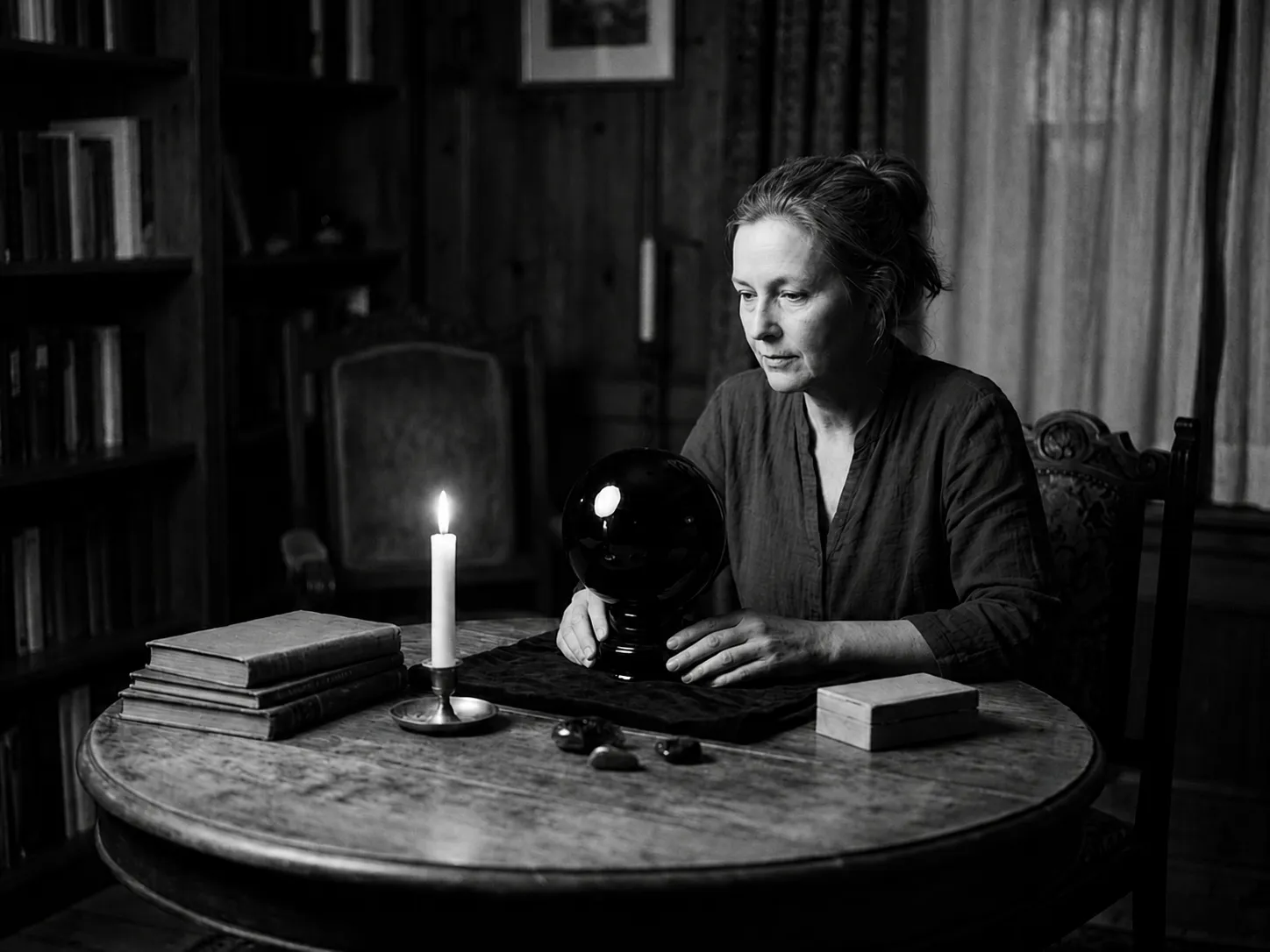
Practitioners use black obsidian mirrors, crystal balls, or even a bowl of water with oil as a focus. They place a candle behind them, out of direct view, so only a soft glow reaches the reflective surface.
The person is told to look through the mirror, not at its surface, and to let their eyes go out of focus. Old manuals, like John Dee’s diaries, say this technique helps activate “spiritual sight,” making the mirror seem to cloud over or fill with mist before any vision appears.
Environmental Mimicry and Psychometry
To increase the chances of contact, mystical rituals use the idea of “sympathetic resonance,” meaning like attracts like. The idea shapes every choice about the ritual space.
- Geographic and Spatial Anchoring: Rituals are usually held in places that mark a boundary or transition, such as crossroads, graveyards, or rooms left untouched for years. This is believed to reduce distractions from the living world and make it easier to reach the spirit world.
- Relics and Psychometry: Practitioners often use items belonging to the deceased, such as hair, letters, or old jewelry. These objects are thought to hold the person’s energy and help attract their spirit.
- Aromatic and Alchemical Formulation: Burning certain resins is required. Manuals say to burn frankincense to attract friendly or ancestral spirits, and myrrh or asafoetida for more chaotic ones. The smoke is believed to help spirits appear and also helps practitioners enter a trance.
You may also enjoy:
Complete Guide to New York Bigfoot Sightings (1840–2025)
August 5, 2025
What Is a Harpy, The Winged Horror That Tormented Kings?
October 31, 2025
The Dark Story Behind the Boyington Oak Haunting
September 18, 2025
Dingonek: The Mysetrious Predator That Terrified East Africa
November 10, 2025
Why Spirit Summoning May Be a Physiological Burden
While ancient mystical texts say spirits appear due to external forces, modern research shows that certain psychological and environmental factors can make people feel as if they are having these experiences.
Investigating the human body’s response to sensory deprivation, subconscious expectation, and low-frequency acoustics reveals that the physiological baseline of the operator is heavily manipulated during operations regarding how to summon a spirit.
The “Ideomotor Phenomenon”
Many signs people see as proof of spirits, like a swinging pendulum, a tilting table, or a moving planchette on a talking board, are actually caused by the ideomotor phenomenon.
English scientist Michael Faraday first described the effect in 1853. It happens when people make tiny, unconscious movements in response to their expectations or thoughts, without realizing it.
In lab studies, the effect is even stronger when several people are involved. Research shows that when people use talking boards together, their eyes and minds often predict where the planchette will go, based on their own expectations or memories.
Because no single participant feels a conscious sense of personal agency over the physical pointer, a dissociative state is induced. The illusion that the object is moving under its own independent control is so powerful that it convinces honest, intelligent people that an external entity is guiding their hands.
The Bizarre 18.9 Hz Frequency
Research shows that infrasound, or sound waves below 20 Hertz, can have a strong and unsettling effect on people, even though we cannot hear them.
British engineer Vic Tandy published research showing a direct link between low-frequency sound waves and the perception of ghostly shapes. He found that a fan in his lab made a constant hum at 18.9 Hz, which matched these experiences.
This specific frequency is highly significant because it matches the natural, structural resonant frequency of the human eyeball. When a person enters an environment flooded with 18.9 Hz waves, the acoustic energy induces microscopic, involuntary vibrations along the eye itself.
These tiny vibrations make the brain see gray shapes, spots, or moving figures out of the corner of the eye.
Exposure to these frequencies can also cause stress on the body. The vibrations can make your chest feel strange and lead to fast or shallow breathing.
The sudden lack of efficient oxygenation triggers an automatic, primal survival response, flooding the body with cold sweat, a drop in perceived ambient temperature, and an overwhelming, generalized sense of dread.
For someone trying to summon a spirit, these sudden feelings and quick glimpses can easily be mistaken for something supernatural when the room’s acoustics are actually the cause.
Sensory Deprivation Hallucinations
Traditional ritual spaces often use total darkness, lots of incense smoke, and complete silence. These conditions can cause a brain effect called the Ganzfeld effect.
The term Ganzfeld comes from German, meaning “whole field.” Since the 1930s, research has shown that when people are exposed to unchanging sights and sounds, their brains get no new information from the outside world.
When the brain gets the same input over and over, like staring into darkness or smoke while hearing a steady sound, it stops treating the environment as important.
To make up for the lack of outside input, the brain starts to boost its own internal noise. After less than 10 minutes, people may start to see or hear things that aren’t really there.
These experiences can include seeing patterns, hearing voices, or even seeing human shapes, which gives a scientific explanation for many visions reported in rituals over the centuries.
The 1924 SPR Sessions
In 1924, British researchers from the Society for Psychical Research conducted a controlled laboratory study using early sound analysis to investigate what mediums called a “direct-voice” event.
The setup was meant to show a spirit speaking out loud, separate from the medium’s own voice. Investigators used early sound-recording devices and wax cylinders in a dark, quiet room to capture the event.
The goal was to find out where the voice was coming from and whether it was a machine in the room or people faking it.
When researchers studied the wax recordings, they found strange sound patterns. The “spirit voices” had frequency changes that did not match a human voice or the medium’s usual sound.
But later analysis showed that these odd frequencies matched the natural echoes of the room itself.
Instead of proving a spirit was present, the evidence showed that the sounds came from the room’s acoustics. The medium likely used hidden devices or whispered into the recording horn to create the effect, showing how physical space can be used to fake a ghostly presence.
You may also enjoy:
Behemoth in Demonology: The Colossal Tempter
August 29, 2025
Top 10 Most Haunted Hotels and Inns in Connecticut
December 3, 2025
Who Is Iblis in Islamic Mythology?
August 21, 2025
Fouke Monster 2024: New Sightings Shake Locals
July 7, 2025
Proserpina: Queen of the Underworld’s Dark Secrets
August 26, 2025
Zombie: Origins, Mythology, and Folklore
February 20, 2026
Sources
- Börütecene, A., & Buruk, O. T. (2019). Otherworld: Ouija Board as a Resource for Design. Proceedings of the Halfway to the Future Symposium 2019, 1-4. https://doi.org/10.1145/3363384.3363388.
- Braine, J. (2006). A Study of the Effects of Acoustic Phenomena and Their Possible Use in Multimedia. (Master’s thesis).
- Gilchrist, Roberta. (2008). Magic for the Dead? The Archaeology of Magic in Later Medieval Burials. Medieval Archaeology. 52. 119-159. 10.1179/174581708×335468. ResearchGate.
- Kapcar, Andrej. The Origins of Necromancy or How We Learned to Speak to the Dead. 2015.
- Natale, Simone. (2015). Spreading the Spirit Word: Print Media, Storytelling, and Popular Culture in Nineteenth-Century Spiritualism. communication +1. 4. 10.7275/R5GF0RF9.
- Tandy, Vic. (2000). Something in the Cellar. Journal of the Society for Psychical Research. 64. ResearchGate.
- Tretter, K. E. (2013). Relating the Tellegen Absorption Scale to Ideomotor Tasks. (Undergraduate Honors Thesis, Middle Tennessee State University).
- Walker, William H, and Judy Berryman. Ritual Closure: Rites De Passage and Apotropaic Magic in an Animate World. Journal of archaeological method and theory vol. 30,2 (2023): 449-494. doi:10.1007/s10816-022-09565-7.