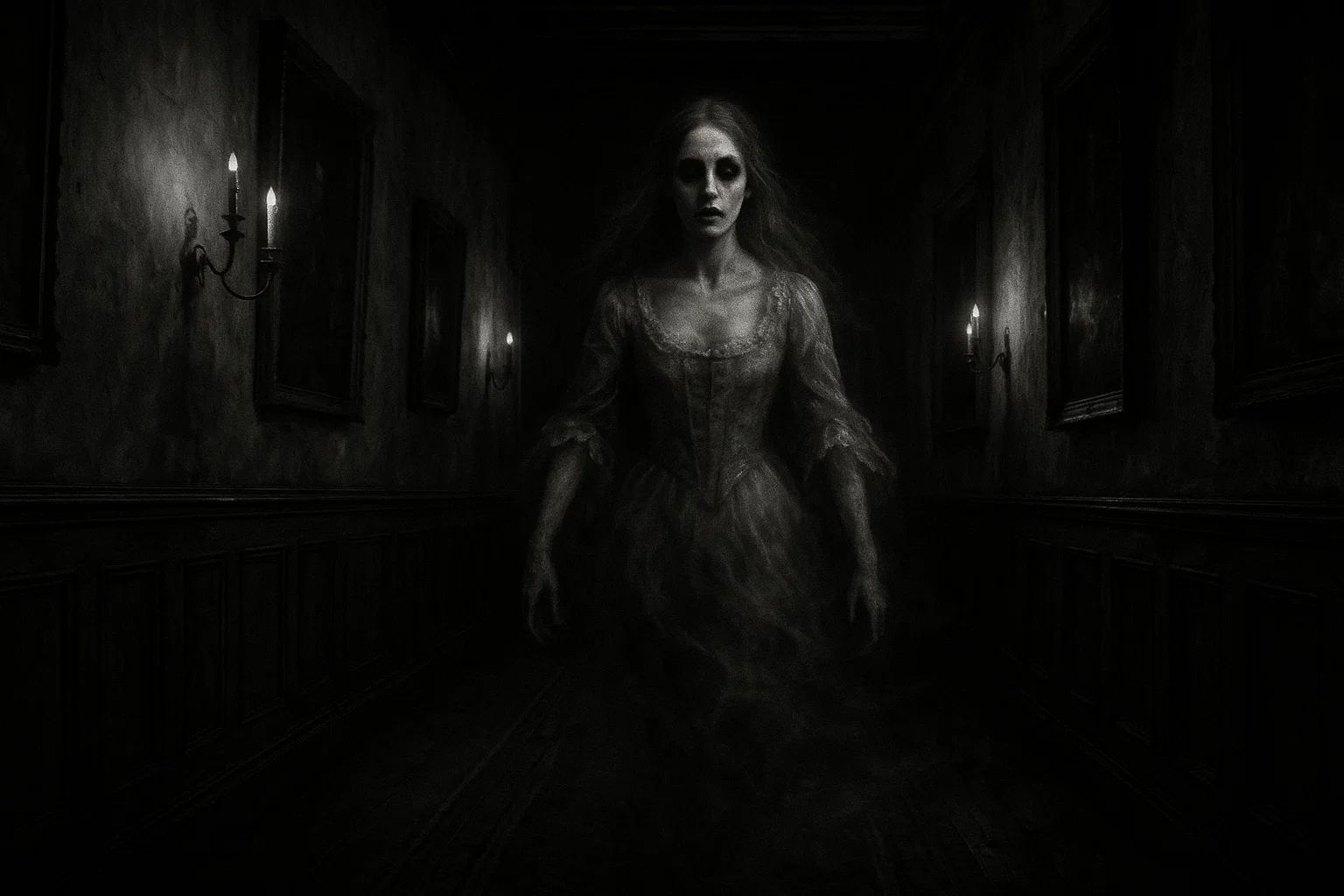
The Brown Lady of Raynham Hall is the common name for the mysterious ghost said to haunt the country house in Norfolk, England. The entity is widely believed to be the ghost of Lady Dorothy Walpole (1686–1726), the sister of Britain’s first Prime Minister, Robert Walpole.
The haunting gained prominence in 1936 after the publication of a photograph allegedly depicting the apparition descending the main staircase.
Summary
Key Takeaways
| Attribute | Details |
| Name | The Brown Lady of Raynham Hall, Lady Dorothy Walpole |
| Location | Raynham Hall, Norfolk, England |
| Longland Scale | Class L-3 [See the Longland Scale Explanation] |
| History | Dorothy Walpole married Charles Townshend, 2nd Viscount Townshend, in 1713. She was allegedly confined to the Hall due to suspected adultery until her official death by smallpox in 1726. |
| Death Toll | 1 confirmed historical death (Lady Dorothy Walpole, 1726) + 0 deaths attributed to the entity |
| Type of Haunting | Apparitions, Ghost (General), Intelligent, Residual |
| Lunar / Seasonal Pattern | The first confirmed sighting in the 19th century took place during the Christmas season. |
| Entities | Lady Dorothy Walpole. Secondary entities include the spectral Duke of Monmouth, and children’s ghosts. |
| Manifestations | Full-bodied spectre in a brown brocade dress, dark empty eye sockets, floating movement, swishing sounds, temperature drops, inducing extreme fright in witnesses. |
| First reported sighting | c. 1735 (Reported to be observed by King George IV when he was Prince Regent) |
| Recent activity | 2024 (EVP and thermal anomalies reported by Paranormal Research Network) |
| Threat Level | 4/10 (mildly threatening) [See the Threat Level Explanation] |
| Hoax Confidence Rating | 3/10 (Probably authentic) [See the Hoax Confidence Rating Explanation] |
| Open to the public? | No. Raynham Hall is a private residence. |
What Is the Brown Lady of Raynham Hall Haunting?
The Brown Lady is a regular paranormal phenomenon centered on Raynham Hall. The apparition is consistently described as a woman dressed in a heavy, old-fashioned brown brocade dress with a coif on her head, corresponding to early 18th-century attire.
The most distinguishing characteristic reported by numerous witnesses is the face, which frequently displays empty sockets where eyes should be or, at times, a sinister, grinning visage. The entity is typically observed moving silently, often floating or gliding rather than walking, with a sound of swishing silk accompanying its presence.
The majority of important sightings occur on or near the main oak staircase and within rooms designated for guests. The phenomenon is classified as an intelligent haunting, based on accounts in which the entity turns its head to look directly at observers, suggesting awareness rather than simple residual activity.
Ever Walk Into a Room and Instantly Feel Something Watching You?
Millions have used burning sage to force out unwanted energies and ghosts. This concentrated White Sage & Palo Santo spray does the same job in seconds – just a few spritzes instantly lifts stagnation, breaks attachments, and restores peace most people feel immediately.

Brown Lady of Raynham Hall Haunted History
The historical basis for the Brown Lady is centered on the life and death of Lady Dorothy Walpole, born in 1686. Dorothy was the daughter of Robert Walpole, Sr., and the sister of Sir Robert Walpole, who later became the de facto first Prime Minister of Great Britain.
She became the second wife of Charles Townshend, 2nd Viscount Townshend, in 1713. Townshend was known for his volatile temper, earning him the nickname “Turnip Townshend” for his agricultural methods and his prominent political career as Secretary of State.
The marriage was allegedly marred by Townshend’s suspicion of Dorothy’s infidelity. Popular narrative claims that Dorothy had an affair with Lord Wharton, a figure especially antagonistic to her brother’s political establishment.
After discovering this transgression, Townshend, known for his mercurial temper and violent disposition, confined her to her rooms within Raynham Hall, effectively making her a prisoner. It is widely alleged that her isolation was confined primarily to a suite in the building’s west wing.
The official record states that Lady Dorothy died of smallpox on March 29, 1726, and was buried at the Hall. However, other stories surrounding the haunting suggest a darker end.
The darker version claims that she either died from a broken neck after being pushed down the main staircase by her husband or died from neglect and following illness while confined to the property. This conflict between the verifiable record (smallpox) and the long-lasting folklore (traumatic death) is the foundation for the persistent spectral manifestations at the Hall.
The house, built in the 17th century, is also linked to other alleged spirits, including the ghost of the Duke of Monmouth, executed for treason, and the apparition of two children’s ghosts, occasionally seen in the secondary quarters. A spectral Black Dog has also been reported in the proximity of the main staircase, often preceding or following the Brown Lady apparition.
You may also enjoy:
Complete Guide to Ohio Bigfoot Sightings (1860–2025)
August 5, 2025
Andras in the Ars Goetia: The Great Marquis of Discord
April 28, 2025
Forks of Cypress Haunting: Eerie Columns and the Curse of 6/6/66
September 22, 2025
Is Busby’s Stoop Chair Curse Really Deadly?
May 26, 2025
Brown Lady of Raynham Hall Ghost Sightings
The documentation of the Brown Lady phenomenon spans over two centuries, beginning shortly after the death of Lady Dorothy Walpole. The reports consistently involve a spectral woman associated with the same visual attributes and location within Raynham Hall.
| Date | Witnesses/Observers | Location/Context | Manifestations/Details |
| c. 1735 | Prince Regent George IV (then a young prince) | A room at the Hall | Reportedly encountered a small figure of a woman dressed in brown. |
| 1835 (Christmas) | Colonel Loftus and a hunting guest (Hawkins) | Corridor leading to the main staircase | Loftus saw the figure twice. The first night, she smiled at him. The second night, he noted the figure had a grinning face and dark, hollow eye-sockets. |
| 1836 | Captain Frederick Marryat (Novelist) | Dorothy Walpole’s bedroom | Marryat saw the figure emerge from a closet and approach him. He fired a pistol at it, and the figure vanished. The bullet lodged in the door opposite where the apparition stood. |
| 1926 | Lady Townshend and her son, George | Main staircase | George and a friend observed the Brown Lady descending the stairs. She was described as wearing the distinctive brown brocade dress. |
| 1936 (September 19) | Captain Hubert C. Provand and Indre Shira (Photographers for Country Life magazine) | Main staircase | Captured the famous photograph known as The Brown Lady of Raynham Hall. |
Colonel Loftus (1835)
During a Christmas gathering at Raynham Hall, Colonel Loftus encountered the apparition. He and another guest named Hawkins observed a woman in brown brocade within the corridors of the house.
Loftus described the ghost as having a brown satin dress and noted that after the second encounter, which happened the following night, the entity’s face was luminous but characterized by empty, dark sockets where the eyes should have been. Loftus noted that he was attempting to sketch the apparition when it retreated into a door panel and vanished.
Captain Frederick Marryat (1836)
The novelist and naval officer, Captain Frederick Marryat, chose to sleep in the reportedly haunted room, intending to confront the entity. Marryat described seeing a spectre appear from a cupboard in the room.
In an effort to prove the material nature of the apparition, Marryat discharged a pistol directly at the figure. He reported that the alleged ghost vanished at the moment of the shot, and the bullet passed through the location where the entity stood, later lodging in the door frame behind the original location of the entity.
The bullet mark in the door was allegedly kept as physical evidence of the encounter.
Why Do So Many Successful People Secretly Wear a Little Blue Eye?
Limited time offer: 28% OFF. For thousands of years, the Turkish Evil Eye has quietly guarded wearers from the unseen effects of jealousy and malice. This authentic blue glass amulet on a soft leather cord is the real thing – beautiful, powerful, and ready for you.
The 1936 Photograph
The 1936 photograph of the Brown Lady is a landmark in paranormal history, often cited as one of the most compelling pieces of evidence for ghostly apparitions.
Taken on September 19, 1936, by Captain Hubert C. Provand and his assistant Indre Shira during a photoshoot for Country Life magazine, the image depicts a misty, ethereal entity descending the grand oak staircase at Raynham Hall.
The photo was published on December 26, 1936, and it sparked global attention. However, it remains a subject of intense debate today, with its authenticity neither fully proven nor disproved.
Circumstances of the Photograph
Provand and Shira were commissioned to photograph the interiors of Raynham Hall, with a focus on its architectural beauty for a Country Life feature.
On September 19, 1936, they set up their equipment—a large-format camera with glass-plate negatives—in the main hall to photograph the grand staircase. After taking an initial shot, they prepared for a second, adjusting the camera’s long-exposure settings to account for the dim lighting.
As Provand focused the lens, Shira suddenly shouted, claiming to see a shadowy entity descending the stairs, its form vaguely human and translucent. Provand, trusting his assistant, quickly triggered the shutter, capturing the image within seconds.
The photographers later stated that they were unaware of Raynham Hall’s reputation as haunted. They insisted the event was spontaneous, with no staging or prior intent to produce a ghost photograph. The glass plate was developed immediately, revealing the spectral form.
Elements of the Photograph
The photograph shows a faint, mist-like entity on the staircase, with discernible features including a face, upper body, and what appears to be a flowing dress, consistent with descriptions of the Brown Lady’s brown brocade dress.
The alleged ghost is semi-transparent, allowing the staircase’s oak railings and steps to be visible through it, enhancing its unnatural appearance. Some observers note a slight white aura or glow around the figure, suggesting an ethereal presence.
The image’s grainy quality, typical of 1930s photographic technology, adds to its mysterious allure, while the ghost’s positioning—centered on the staircase—aligns with historical sightings. Critics, however, point to inconsistencies, such as blurred edges and lighting angles that may not match the hall’s natural illumination.
Claims Supporting Authenticity
Paranormal researcher Harry Price, renowned for his work on Borley Rectory, examined the glass plate in 1936 and found no evidence of double exposure, tampering, or chemical manipulation. His endorsement, published in Country Life, lent significant credibility.
Additionally, Provand and Shira were professional photographers with no prior history of fraud. Their detailed account, corroborated by Country Life staff, emphasized the event’s spontaneity, with no time to stage a hoax.
The photograph’s alignment with centuries of Brown Lady sightings, particularly on the grand staircase, also supports its plausibility. The brocade dress matches Dorothy’s documented attire, as noted in family records.
Early forensic analyses, including a 1937 study by the Society for Psychical Research, found no evidence of superimposition or mechanical trickery, thereby reinforcing claims of authenticity.
Modern Analysis
The photograph’s long exposure (several seconds) could have captured movement—such as a person, a servant, or cloth—as a ghostly blur, a common issue in 1930s photography. Photography expert John Cohen, in a 1937 analysis, suggested this as the most likely explanation.
Critics also propose that the “ghost” was created using translucent materials such as gauze, muslin, or smoke, techniques quite common in spirit photography during the 1920s and 1930s.
Reflections, light leaks, or lens flares in the dimly lit hall could have produced the spectral form. A 2004 study by Joe Nickell suggested a stray light source or a lens smudge as potential causes, though these remain speculative.
However, a 2018 analysis by the University of East Anglia’s photography department suggested camera shake or accidental exposure as possible causes, yet found no evidence of digital manipulation in the original plate.
You may also enjoy:
The Lake Tanganyika Monster: A Living Prehistoric Beast?
November 10, 2025
What Is a Residual Haunting and Why Do Ghosts Replay the Same Scenes?
September 4, 2025
Who Is the Demon Valefor, the Treacherous Duke of Hell?
August 12, 2025
Bennu: The Dark Bird of Fire, Death, and Eternal Return
December 8, 2025
Modern Investigations and Paranormal Activity
Raynham Hall remains a focal point for paranormal research, with investigations spanning decades and employing advanced technology to explore the Brown Lady’s presence. The hall’s eerie atmosphere, coupled with its historical significance, makes it a prime site for ghost hunters.
The Scole Experiment (1993–1998)
The Scole Experiment, conducted in Scole, Norfolk, from 1993 to 1998, was a landmark paranormal investigation led by Robin Foy with mediums Diana and Alan Bennett. More than 500 séances were conducted in a controlled setting, using audio recorders, infrared cameras, and sealed environments to minimize fraud.
In a 1993 session, mediums contacted a spirit matching Dorothy Walpole’s description—a noblewoman in a brown brocade dress tied to a grand staircase. In 1996, the spirit identified herself as Lady Dorothy and provided verified details about her life, including her marriage to Charles Townshend, her confinement at Raynham Hall, and her separation from her children.
Historical records, cross-referenced with the Norfolk Record Office, confirmed these details, including Charles’s political role and Dorothy’s death from smallpox in 1726. The experiment reported anomalous phenomena, such as hard to explain voices and light orbs, though skeptics questioned the mediums’ credibility.
The Forbidden Encyclopedia That Makes Every Ouija Session Ten Times More Dangerous
Limited-Time: Up to 49% OFF!
Angels, devils, nature spirits, ancestors, tricksters, and creator gods – all catalogued with their true names, powers, and protocols. Judika Illes created the definitive directory of the spirit realm that practitioners around the world swear by when they need to know exactly who (or what) just answered.
2022 Séance at Raynham Hall
On October 31, 2022, the Norfolk Paranormal Society, led by John Harris and psychic medium Sarah Thompson, conducted a séance in the ballroom of Raynham Hall with 10 participants. The event, designed to contact the Brown Lady, used EVP recorders, thermal cameras, and EMF meters to detect paranormal activity.
Participants reported multiple phenomena:
- A shadow creature moving across the room, captured on infrared video at 11:47 PM, appeared humanoid but faded within seconds.
- Sudden temperature drops from 68°F to 50°F, measured by thermal sensors in the ballroom’s northwest corner, lasting 12 minutes.
- A whispering voice saying, “They won’t let me go,” was recorded on EVP devices at 12:03 AM and later analyzed as a female voice with no identifiable source.
- A brief sighting of a semi-transparent woman in a brown dress, reported by Thompson and one attendee, appeared near the ballroom’s fireplace before vanishing.
Other Modern Investigations (2010–2024)
East Anglia Ghost Hunters (2010s): From 2012 to 2015, this group reported cold spots (drops to 45°F), mysterious footsteps in the portrait gallery, and EVP recordings containing phrases such as “Help me and my babies.” A 2014 session caught a shadow entity on the staircase, though low resolution prevented clear identification.
Paranormal Research Network (2020): This team reported EMF spikes near Dorothy’s former rooms, peaking at 3.2 milligauss, and a strange voice saying, Where are they? on a spirit box. A thermal camera detected a human-shaped anomaly in the library, dissipating after 10 seconds.
Paranormal Research Network (2024): In June 2024, the network returned, reporting anomalous EMF spikes (4.1 milligauss) in the ballroom, thermal anomalies (brief drops to 40°F), and a strange voice saying, “My children,” recorded at 1:15 AM. A REM pod activated near Dorothy’s portrait, indicating an electromagnetic disturbance. These investigations, combining historical accounts with modern technology, have sustained the Brown Lady’s legend.
The Brown Lady Case File
The Mechanism of the “Empty Sockets”
The Brown Lady of Raynham Hall is famously and consistently described by witnesses as having a terrifying, malevolent face, often lacking eyes, and appearing either as a skeletal grin or as “empty, dark sockets.”
This unusual feature, unlike the soft, translucent appearances of many common specters, suggests a residual trauma or emotional intensity unique to the alleged spirit, Lady Dorothy Walpole. The folklore surrounding her death—imprisonment by her husband, Charles Townshend—might be the source of this terrifying appearance.
It is speculated that the “empty sockets” represent the spirit’s inability to truly see freedom or the trauma of her life ending in isolation. This feature acts as a powerful, distinct identifier for the haunting, setting it apart from other manor house ghosts and underscoring a theme of betrayal and emotional darkness.
The 1936 Photo Forensic Debate
The single most critical piece of evidence is the 1936 photograph taken by Captain Hubert C. Provand and Indre Shira. While initially lauded, the forensic debate continues to be the core controversy.
The early investigation by paranormal researcher Harry Price focused on the glass plate negative. It confirmed the lack of evidence for a simple double-exposure hoax (superimposing two images). However, critics highlight the necessity of a long exposure time—required in the dimly lit hall—as the perfect condition for a subtle, staged hoax.
The entity could have been created using a translucent, gauzy material dropped from above and immediately pulled away, leaving a blurred, mist-like impression consistent with the alleged ghost descending the stairs. The technical proficiency of Provand and Shira makes it difficult to determine whether the spontaneity was genuine or an expertly executed photographic deception.
The Marryat Pistol Incident
One of the most physically demonstrative alleged encounters was by novelist Captain Frederick Marryat in 1836. Marryat not only witnessed the ghost but also claimed to have deliberately and aggressively acted against it.
He reportedly fired a pistol at the spectre, with the bullet lodging in the paneling of the door where the apparition stood before it vanished. This incident serves two purposes in the case file: first, it provides a tangible, verifiable piece of evidence—the bullet hole in the door frame—that can be tied directly to the haunting narrative.
Second, it establishes the semi-physical nature of the entity, suggesting that it occupies sufficient space to block a projectile. Yet it can dissolve instantly, which contradicts purely residual theories of haunting.
Theories
Explanations proposed for the manifestation known as the Brown Lady of Raynham Hall are divided between traditional folkloric beliefs that uphold the reality of the apparition and skeptical analyses that attribute it to environmental or technical non-paranormal causes.
Intelligent Haunting
The primary folkloric theory attributes the haunting to the residual or intelligent presence of Lady Dorothy Walpole. Her alleged confinement and potentially violent or neglected death are cited as the cause of her unrest.
The persistent sighting of the entity on the main staircase is theorized to be a residual haunting, replaying the event of her demise, specifically the fall that may have broken her neck.
However, the reports about the ghost engaging with witnesses—such as smiling at Colonel Loftus or gliding toward Captain Marryat—suggest an intelligent or conscious spiritual entity tied to the location by tragic memory or a desire for recognition.
Pareidolia and Expectation Bias
The human tendency to see figures in ambiguous stimuli (pareidolia) or anticipate ghosts in a haunted location (expectation bias) may explain sightings.
In Raynham Hall, with its creaking floorboards, dimly lit corridors, and shadowy staircases, visitors primed by the Brown Lady’s legend may misinterpret natural phenomena as spectral figures.
Psychologist William James (1842–1910), in his 1890 work The Principles of Psychology, noted that suggestibility in eerie settings amplifies such perceptions, a theory echoed by modern researchers such as Susan Blackmore, who studied apparitional experiences at historic sites in 1995.
Misunderstanding of Natural Phenomena
Raynham Hall’s 17th-century structure produces unexplained noises—creaking wood, settling foundations, or wind through old windows—that could be mistaken for strange footsteps.
Shadows cast by candlelight or reflections in aged mirrors, common in the hall’s portrait gallery, may appear as fleeting figures. The 1980s tourist’s photograph, dismissed as a camera malfunction, likely captured a lens flare or shadow mistaken for Dorothy, highlighting how the hall’s eerie atmosphere fuels misperceptions.
You may also enjoy:
Sallos: The Mysterious Demon of Love
August 13, 2025
The Terrifying Troll: Scandinavian Monster of Stone and Shadow
September 12, 2025
Who or What Was the Alabama Metal Man: Real Cryptid or Hoax?
April 16, 2025
Mass Hysteria
The 1735 sighting by Major Loftus, which caused servants to flee, may reflect mass hysteria, where collective fear in a haunted setting amplifies individual perceptions.
Folklorist Jan Harold Brunvand, in his 1986 book The Vanishing Hitchhiker, argued that ghost stories like the Brown Lady’s evolve through oral tradition, blending historical facts with embellished details. The legend’s spread in 18th-century Norfolk, a region steeped in superstition, likely exaggerated Dorothy’s tragic story into a spectral narrative.
What If the Scariest Children’s Book Ever Written Was Never Meant for Children?
Limited-Time: Up to 51% OFF!
Alvin Schwartz collected these stories from graveyards, backroads, and old people who swore they were true – then paired them with Stephen Gammell’s grotesque, dripping, eyeless illustrations that look like they crawled off the page. Three complete books of pure nightmare fuel in one volume.
Brown Lady of Raynham Hall vs Other Haunted Locations
| Name | Location | Type of Haunting | Activity Level |
| Borley Rectory | Borley, Essex, England | Poltergeist, Apparitions (Nun, Headless Horseman) | 10 (extremely active and dangerous) |
| Tower of London | London, England | Apparitions (Anne Boleyn, Princes in the Tower), Residual | 9 (extremely active and dangerous) |
| Blickling Hall | Norwich, Norfolk, England | Apparitions (Headless Anne Boleyn), Crisis Apparitions, Residual | 7 (very active) |
| Ancient Ram Inn | Wotton-under-Edge, Gloucestershire, England | Demonic, Poltergeist, Apparitions (Incubus, Succubus) | 10 (extremely active and dangerous) |
| Pluckley Village | Kent, England | Apparitions (Highwayman, Screaming Man) | 8 (very active) |
| Berry Pomeroy Castle | Totnes, Devon, England | Apparitions (White Lady, Blue Lady) | 6 (occasional) |
| Chillingham Castle | Alnwick, Northumberland, England | Apparitions (Blue Boy, Lady Mary) | 8 (very active) |
| Mary King’s Close | Edinburgh, Scotland | Intelligent, Apparitions (Plague Victims) | 9 (extremely active and dangerous) |
| The White Lady | Shepton Mallet Prison, Somerset, England | Apparitions, Residual | 5 (occasional) |
| Pendle Hill | Lancashire, England | Apparitions (Pendle Witches), Shadow People | 7 (very active) |
Is the Brown Lady of Raynham Hall’s Ghost Real?
The authenticity of the Brown Lady of Raynham Hall’s haunting remains unresolved within the established fields of paranormal investigation and historical research.
While the primary character, Lady Dorothy Walpole, is an authenticated historical personality whose life at Raynham Hall and following death in 1726 are verifiable, the causal link between her life events and the spectral manifestations relies solely on anecdotal evidence and local folklore.
The disparity between the official record of death (smallpox) and the narrative of traumatic confinement and demise provides the necessary ambiguous foundation for the spectral narrative to persist.
The evidentiary component of the haunting is anchored by consistent accounts from multiple witnesses spanning a broad chronological cover, especially those of Colonel Loftus and Captain Marryat. What’s more, the 1936 photograph published in Country Life magazine continues to function as the most tangible, yet inconclusive, piece of proof.
Although the image has resisted easy dismissal as a crude forgery, the developers’ confirmation of the negative’s integrity complicates the analysis. Technical experts and skeptics have put forth plausible non-paranormal explanations, including reflections and photographic error, that challenge its status as definitive documentation of a spectre.