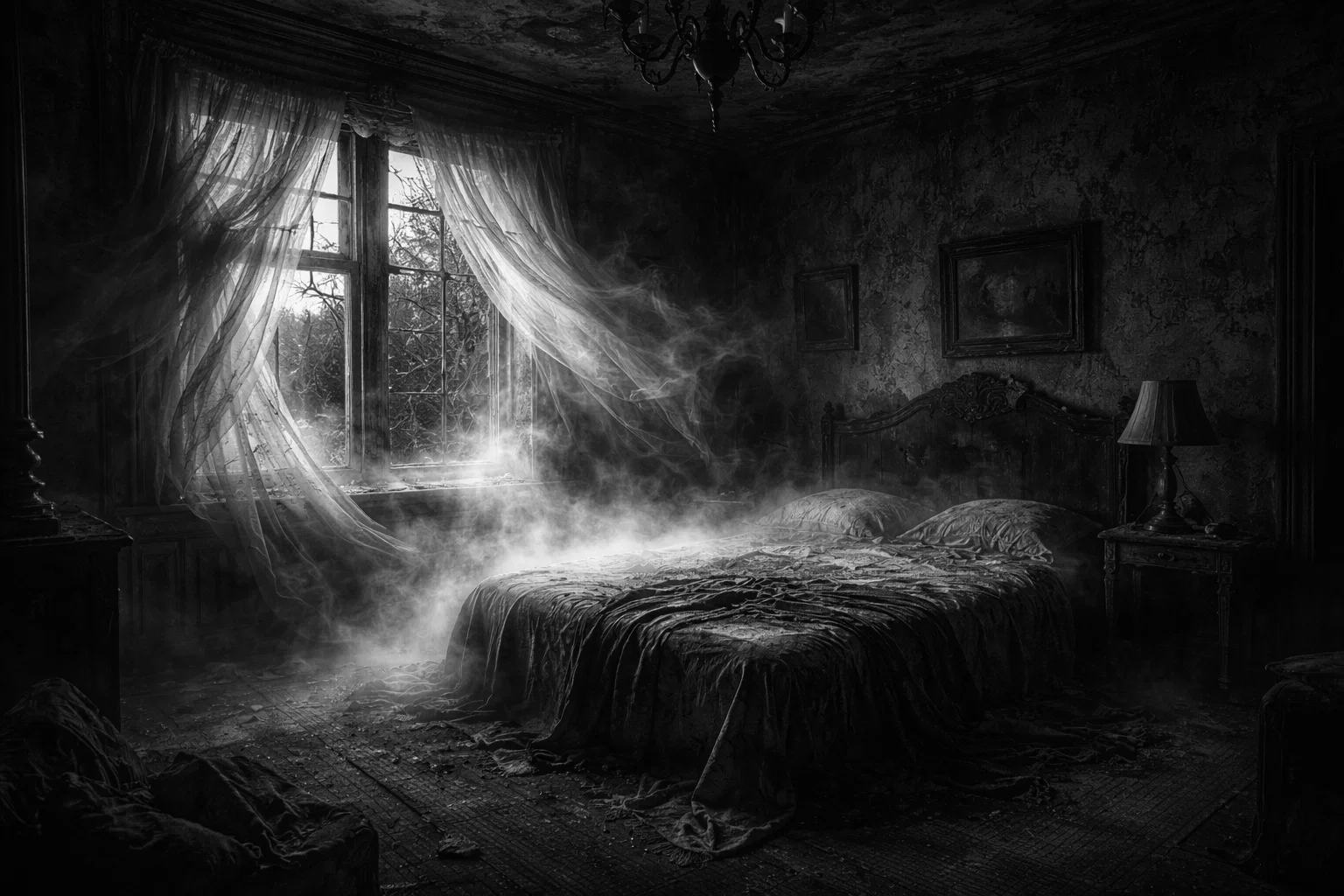
In paranormal research, a cold spot is a small area in which the temperature drops for no apparent reason, even though the rest of the room remains warm. These cold spots are often found in places known for hauntings. People sometimes feel a sudden chill, describing it as so strong it “penetrates to the bone.” Most paranormal cold spots are typically a few square feet wide and may remain stationary or move around the room.
The study of these occurrences involves a combination of historical lore, anecdotal accounts, and the use of modern technology to measure environmental fluctuations.
While many individuals consider these chills to be primary evidence of a spirit’s presence, the scientific community typically attributes such experiences to natural phenomena like air drafts, convection currents, or psychological factors.
Summary
The Definition and Characteristics of Cold Spots
A paranormal cold spot is unusual because it shows up suddenly and only affects a small part of a room. Unlike cold rooms, these spots appear where the surrounding air is still warm. People often say the air feels heavy or thick in these areas. Sometimes, the drop in temperature is so strong that it causes shivering, goosebumps, or even fear.
Investigators often distinguish between two types of cold spots. The first is a stationary cold spot that remains in a specific location over an extended period. These are often associated with particular objects or architectural features, such as the top of a staircase or a specific chair.
According to Maurice Townsend, people frequently report encountering cold spots in haunted places, which are small areas that feel noticeably colder than the surrounding environment. Some believe these cold spots indicate the presence of a ghost.
The Role of Energy Absorption
One common idea in paranormal books is that spirits need energy to appear or interact with the world. This theory says a ghost takes heat from the air to make noises, move things, or show up as a mist, which makes the temperature drop in that spot. Brian Schill discusses this in “Stalking Darkness: Surveillance and Investigation Techniques for Paranormal Investigators,” where heattemptss to link thermodynamics to paranormal events and suggests that spirits absorb energy.
The theory suggests that a cold spot occurs when a spirit gathers energy. Michelle Belanger also looks at this idea in “The Ghost Hunter’s Survival Guide,” exploring how entities might use energy from their surroundings.
While energy absorption is a prominent explanation, some paranormal researchers suggest alternative theories to explain these phenomena. These include the influence of electromagnetic fields, thought by some to cause disturbances that might be perceived as ghostly presences.
Another idea is that psychic energy, produced during heightened emotional or spiritual states, could be responsible for cold spots. These diverse theories highlight the complexity and variety of thinking within the paranormal community.
Why Do So Many Successful People Secretly Wear a Little Blue Eye?
Limited time offer: 28% OFF. For thousands of years, the Turkish Evil Eye has quietly guarded wearers from the unseen effects of jealousy and malice. This authentic blue glass amulet on a soft leather cord is the real thing – beautiful, powerful, and ready for you.

Historical and Literary Context
Stories and books have long linked ghosts to cold air. For centuries, people have reported feeling “a chill in the air” when they think a ghost is near. Today, this idea is common in modern books and movies.
One influential work is “The Haunting of Hill House” by Shirley Jackson. In this novel, the characters encounter a specific cold spot in the hallway outside a nursery. They attempt to measure the area and find that it is a lot colder than the rest of the house, even though there are no drafts. This literary representation helped cement the cold spot as a standard sign of a haunting in the public imagination.
Ed and Lorraine Warren also often talk about sudden temperature drops. In books about their cases, such as “The Demonologist” by Gerald Brittle, cold spots are described as early signs that a spirit is beginning to gather energy to appear or make a sound.
The Influence of Spiritualism
When Spiritualism was popular in the 19th and early 20th centuries, people often reported feeling cold breezes, called “spirit winds,” during séances. Participants reported feeling cool air on their hands or faces, even in closed rooms.
Arthur Conan Doyle wrote about these experiences in “The History of Spiritualism.” At that time, people believed these chills meant a medium’s “spirit guides” were present or that “ectoplasm” was appearing.
You may also enjoy:
Baba Yaga: Iron-Toothed Witch of Slavic Folklore
September 10, 2025
The Nandi Bear: Africa’s Terrifying “Brain-Eating” Cryptid
November 11, 2025
Gainesridge Dinner Club Haunting: Why Do Diners Hear Babies Crying?
September 3, 2025
Tools Used to Measure Paranormal Cold Spots
Today, paranormal investigators use electronic devices to track temperature changes. These tools help them collect real data instead of just relying on personal feelings.
Common devices include the K-II EMF meter and the FLIR thermal camera. The K-II meter is simple and affordable, but it can pick up signals from non-paranormal sources. The FLIR camera provides detailed images of temperature changes, but it is more expensive and more difficult to use. These tools help investigators study cold spots and other unusual events more carefully.
Infrared Thermometers and Thermal Cameras
The most common tool for finding a paranormal cold spot is the infrared (IR) thermometer, also known as a “laser thermometer.” Investigators use it to point a laser at a surface and get an instant digital temperature reading. It helps them scan walls, floors, and the air to find unusual temperature changes.
Thermal imaging cameras are more advanced and give a visual map of temperature changes. They detect infrared radiation and convert it into a color-coded image, with colder areas shown in blue or purple and warmer areas in red or yellow. In many TV shows and professional investigations, a “blue mass” on a thermal camera is shown as evidence of a cold spot or a spirit.
Data Loggers and Weather Meters
Some investigators use digital data loggers to track changes over time. These devices stay in a room and record temperature and humidity at set times. If the temperature drops suddenly when no one is there, it is considered more important than a drop that happens when people are moving around, because it rules out body heat or movement as the cause.
The Guardian reports that paranormal researchers use advanced instruments, such as the Kestrel 3500NV, which simultaneously measures temperature, pressure, humidity, and wind speed. This helps them decide if a cold spot is caused by a draft or a change in air pressure, rather than something supernatural.
Skeptical and Scientific Explanations
Mainstream scientists have several reasons why people notice cold spots. Most researchers and skeptics believe these experiences are caused by natural factors in the environment or by how our bodies respond.
Convection and Drafts
The most common scientific explanation for a cold spot is a convection current. In older buildings, air is always moving—warm air goes up and cool air sinks. This can create cold pockets in areas such as the bottom of stairs or near windows. Even if a room looks sealed, small gaps in the floor or around doors can let in cold air and cause a chill in one spot.
Additionally, different objects in a room lose heat at different rates. For example, a stone wall or metal object will feel colder than a wooden table, and the surrounding air will be cooler as well. This can lead someone to believe they have found a cold spot when it is actually due to the building’s materials.
The Forbidden Encyclopedia That Makes Every Ouija Session Ten Times More Dangerous
Limited-Time: Up to 49% OFF!
Angels, devils, nature spirits, ancestors, tricksters, and creator gods – all catalogued with their true names, powers, and protocols. Judika Illes created the definitive directory of the spirit realm that practitioners around the world swear by when they need to know exactly who (or what) just answered.

The “Fear Frequency” and Infrasound
Another scientific concept is infrasound, which refers to sound waves too low for humans to hear, typically below 20 Hz. Infrasound can come from wind, large machines, or vibrating pipes in buildings. Recent studies have examined how infrasound, such as 8 Hz, can alter our perception of other sounds. We can’t hear these sounds, but our bodies can still feel them.
Vic Tandy, an engineer and researcher, found that infrasound can elicit fear. This “fear response” can cause symptoms such as rapid breathing, feeling uneasy, and a “chill” on the skin.
In his paper “The Ghost in the Machine,” Tandy described how a silent fan in his lab produced infrasound that made him and his coworkers to feel cold and see “gray shapes” at the corners of their eyes.
Psychological Factors and Suggestion
Psychology also plays a major role in the perception of cold spots. When people enter a location they believe is haunted, they are often in a state of “high arousal” or hyper-vigilance. In this state, the brain is more likely to interpret ambiguous sensory data as significant.
A small, natural change in temperature that would go unnoticed in a modern office building can feel like a “ghostly chill” in a dark, old basement. To reduce these biases, investigators are encouraged to use methods such as blind testing, in which the person measuring the temperature does not know the location’s history or reputation.
Using control areas in the same environment—places where no paranormal activity is expected—can help distinguish between normal temperature changes and possible cold spots.
According to Maurice Townsend, people’s perceptions of cold spots can be very subjective. Those who expect to find them in certain places may be more likely to notice small changes and see them as proof of the paranormal.
Once a cold spot is identified, it is often treated as evidence, whereas normal areas are ignored. Using these methods can help reduce confirmation bias and improve the reliability of the findings.
You may also enjoy:
Flatwoods Monster: What Really Happened in 1952?
June 30, 2025
Who Was Moloch, the Child-Devouring God?
August 26, 2025
Complete Guide to Nevada Bigfoot Sightings (1970–2025)
August 4, 2025
Notable Cases Involving Cold Spots
Some famous hauntings have cold spots as a main feature. These cases are often used as classic examples in the paranormal community.
The Borley Rectory
In the early 1900s, Borley Rectory in England was called “the most haunted house in England.
Investigator Harry Price recorded many strange events there and wrote about them in “The Most Haunted House in England: Ten Years’ Investigation of Borley Rectory.” He found several rooms where the temperature dropped suddenly and used early thermometers to measure it.
Later, some critics argued that the cold spots were likely caused by the building’s large, poorly insulated stone walls.
The Myrtles Plantation
The Myrtles Plantation in Louisiana is another place where people often report cold spots.
Visitors report walking through “pockets of ice” in the hallways. Frances Kermeen, in “The Myrtles Plantation: The True Story of America’s Most Haunted House,” writes that many people link these cold spots to the legend of Chloe, a slave whose ghost is said to haunt the house. The author shares several stories of sudden temperature drops inside the house.
Conclusion on the Phenomenon
People still report and talk about paranormal cold spots in ghost hunting groups. At Borley Rectory, temperature readings indicated that the air remained colder and continued to drop, whereas the wood temperature leveled off. Believers see these drops as proof of spirits, while skeptics think they are caused by building problems, drafts, or people’s expectations.
No matter the cause, feeling a sudden, unexplained chill in a place said to be haunted is still a strong and unsettling experience for many people. Modern tools such as thermal cameras and weather meters have generated additional data. Still, they have not provided a clear answer that both scientists and paranormal believers accept.