The zombie is one of the most well-known figures in folklore around the world, symbolizing the space between life and death. Today, people often think of zombies in terms of viral outbreaks. Still, their real roots are in the spiritual traditions of Haitian Vodou.
Rather than just a fictional monster, the zombie is a complex monster shaped by history, magic, and the fear of losing control over one’s own life.
Summary
Key Takeaways
| Attribute | Details |
| Names | Zombie, Zombi; derived from the Kikongo word ‘nzambi’ (god) or ‘zumbi’ (fetish/object with power). |
| Nature | Undead, reanimated corpse, or soul-less human. |
| Species | Humanoid. |
| Appearance | Vacant eyes, graying or decaying skin, slow motor functions, and a lack of self-awareness. |
| Area | Haiti, West Africa, and the Caribbean. |
| Creation | Reanimation through necromancy (Bokor) or the administration of specialized neurotoxins. |
| Weaknesses | Salt, the death of the master (Bokor), or returning to the grave. |
| First Known | 1697, Pierre-Corneille Blessebois’ ‘Le Zombi du Grand Pérou’ (earliest literary mention). |
| Myth Origin | West African spiritualism and Haitian Vodou. |
| Strengths | Relentlessness, lack of physical pain, and obedience to a master. |
| Diet | None traditionally; modern versions consume human flesh or brains. |
| Time Active | Nocturnal or permanent state. |
Who or What Is a Zombie?
A zombie is known for losing its sense of self and being brought back to life in a physical body. In Haitian Vodou, a zombie is someone revived from the dead or from a deep trance by a sorcerer called a Bokor.
Traditional zombies are not the violent creatures seen in movies today. Instead, they are passive and tragic, forced to work without memory, speech, or will, doing manual labor for the person who controls them.
Zombies are usually divided into two types: the zombi astral, which is a soul taken to perform magic, and the zombi cadavre, which is a body brought back to work. This idea is closely linked to Vodou beliefs about the soul, which is seen as having two parts: the gros bon ange, or vital breath, and the ti bon ange, which is the personality and conscience.
If the ti bon ange is taken away, the body becomes empty and lifeless. The zombie represents the trauma of slavery, showing a fate worse than death: endless forced labor with no hope of peace after death.
What If One Crystal Tower Could Flush Out Spirits, Bad Vibes, and Years of Bad Luck?
Limited-Time: Up to 12% OFF!
Purification Black Tourmaline Crystal Tower – Authentic raw black tourmaline obelisk • Neutralizes harmful ghosts & jinxes • Clears emotional & energetic blockages for prosperity • Root-strengthening ally in crystal grids. From ancient earth veins, designed for modern metaphysical warriors.
Genealogy
| Relation | Identity |
| Creator | The Bokor (Sorcerer). |
| Spiritual Ruler | Baron Samedi (Loa of the Dead). |
| Associated Spirits | The Gede (Family of spirits governing death and fertility). |
| Victim | Commonly a human deceased or cursed by the Bokor. |
Etymology
The word ‘zombie’ comes from West African languages that arrived in the Caribbean during the Transatlantic slave trade. Most experts link it to the Kikongo word ‘nzambi,’ which means ‘god’ or ‘spirit of a dead person.’
In some Central African languages, ‘zumbi’ means a ‘fetish’ or an object with spiritual power. As African beliefs mixed with colonial life in Saint-Domingue (now Haiti), the word came to mean a reanimated corpse instead of just a spirit.
By the late 1600s and early 1700s, the word ‘zombi’ appeared in French Caribbean records, often used to describe a ghost or ‘dark spirit’ that haunted people. The word didn’t enter English in its modern sense until after the American occupation of Haiti in 1915.
When William Seabrook published The Magic Island in 1929, he introduced the Western world to the idea of the ‘dead man who walks and works in the cane fields.’ This helped make the zombie a unique creature in global folklore, shifting its meaning from a spiritual being to a physical, undead body.
You may also enjoy:
Who Is Leraje, the Demon of Gangrene and Battle?
August 22, 2025
Is the Drish House the Most Haunted Mansion in Alabama?
September 3, 2025
Hyakume: The Hundred-Eyed Yokai That Watches from the Shadows
September 10, 2025
Is Ahriman the Oldest Demon in History?
August 13, 2025
12 Haunted Places in Arkansas You Should Never Visit Alone
October 8, 2025
Who Is Lucifuge Rofocale in Demonology?
August 25, 2025
What Does the Zombie Look Like?
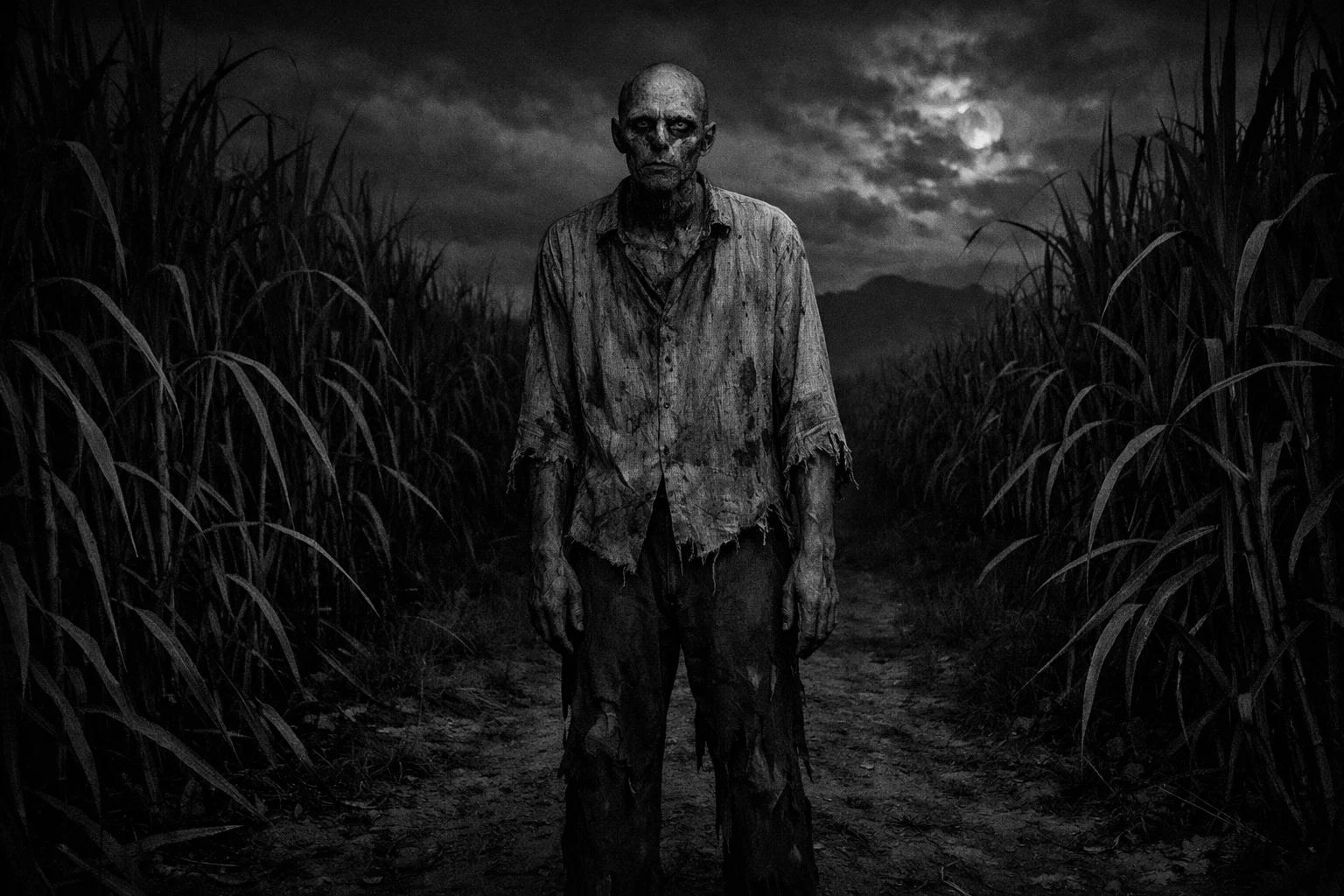
Zombies look very different in old stories than they do to movies today. In traditional Haitian tales, a zombie doesn’t look like a decaying skeleton but instead appears much like a living person, though deeply unresponsive.
People often describe a zombie’s eyes as blank and unfocused, missing any sign of intelligence or awareness. They move in a repetitive, robotic way and usually make only moaning sounds or stay silent.
A zombie might show some signs of injury from before they died, but they don’t usually have the severe decay seen in movies. Instead, they look thin, pale, and very tired. They are often found in the clothes they were buried in, and their skin can appear dry and leathery. Their most noticeable feature is a blank face that never changes, showing the loss of their personality, or ti bon ange.
Mythology
Zombie myths are closely tied to Haiti’s history and Vodou practices. They grew out of a mix of West African Bantu beliefs and the harsh life on plantations. In these stories, people feared becoming a zombie more than being attacked by one. The zombie became a strong symbol for slavery, where someone else controlled your body.
In Vodou, death is seen as a process, not just a single moment. It is guided by spirits called the Loa, especially Baron Samedi. A Bokor can break this natural order by taking someone’s soul before it moves on.
The Bokor traps the soul in a clay jar or bottle called the zombi astral, allowing them to control the body. The body is dug up soon after burial and brought back to life with a secret mixture. Stories often tell of zombies working in hidden plantations or mountains, kept out of sight from the authorities and the families of the dead.
Demons, Ghosts, and Vengeful Spirits
Limited-Time: Up to 22% OFF!
Something Wicked from Japan – 150+ haunting ukiyo-e masterpieces • Yūrei, yōkai, and oni • Blood-soaked legends • Severed heads • Demonic seduction • Erotic horrors & grotesque beauty. The most terrifying (and beautiful) book of Japanese art ever printed.
Legends
The Case of Clairvius Narcisse
One of the best-known stories, which some researchers believe is a real case of zombification, is about a Haitian man named Clairvius Narcisse.
In 1962, Narcisse was pronounced dead at the Albert Schweitzer Hospital in Deschapelles, Haiti, after a serious illness. Doctors and his sister confirmed his death, and he was buried the next day.
Eighteen years later, in 1980, a man met Narcisse’s sister at a market and used a childhood nickname only her brother would know. He said he had been awake but unable to move or speak during his funeral, even as he was buried.
He claimed a Bokor dug him up that night, beat him, and took him to a sugar plantation, where he worked as a slave with other zombies for two years. He said he got his senses back after the Bokor died, and he stopped receiving doses of a hallucinogenic paste called ‘zombie cucumber.’ After that, he was able to return to his village.
The Dead Who Worked the Fields
A common story from the Artibonite Valley is about a rich landowner who never hired local workers but always had the best harvests. People passing by at night said they saw figures moving in perfect, silent unison, working the fields together.
One night, a neighbor hid near the fields to watch the workers. He saw that none of them blinked or stopped to drink or rest, even in the heat. When the landowner saw him, he blew some powder into the air, and the workers disappeared into the tall cane.
The story goes that when the landowner died, the workers were found standing still in his barn. Without his control, their bodies quickly began to decompose.
You may also enjoy:
Fomorian: The One-Eyed Giants of Doom
February 12, 2026
The Lernaean Hydra: Greek Myth’s Deadliest Creature
October 28, 2025
Is the Lake Iliamna Monster Alaska’s Real-Life Sea Cryptid?
November 5, 2025
Hillbilly Beast of Kentucky: What Boone Really Saw
June 30, 2025
Naamah: The Seductive Demon Queen of Infernal Desires
September 30, 2025
The Salt of Life
Many Haitian zombie stories mention the special power of salt. People say a zombie should never eat salt, because it is the one thing that can break the Bokor’s spell.
In one story, a group of zombies was being moved across the country. Someone who didn’t know what they were gave them a bowl of salty stew. After tasting the salt, the zombies suddenly ‘saw the sun and the trees for the first time in years.’
When they realized they were dead, the zombies felt a strong need to return to their graves. They walked back to their village, ignored their families, and crawled into the earth, where their bodies turned to dust.
What If the Scariest Children’s Book Ever Written Was Never Meant for Children?
Limited-Time: Up to 51% OFF!
Alvin Schwartz collected these stories from graveyards, backroads, and old people who swore they were true – then paired them with Stephen Gammell’s grotesque, dripping, eyeless illustrations that look like they crawled off the page. Three complete books of pure nightmare fuel in one volume.
Zombie vs Other Monsters
| Monster Name | Origin | Key Traits | Weaknesses |
| Ghoul | Arabian Folklore | Consumes flesh, inhabits graveyards. | Fire, decapitation. |
| Vampire | Slavic Europe | Drinks blood, aristocratic, nocturnal. | Sunlight, garlic, stakes. |
| Draugr | Norse Mythology | Superhuman strength, guards tombs. | Iron, burning the body. |
| Jiangshi | China | Hopping corpse, feeds on qi (life force). | Mirrors, sticky rice. |
| Revenant | Medieval Europe | Returned for vengeance, physical. | Completion of mission. |
| Vetalas | India | Spirit inhabiting corpses, prophetic. | Mantras, rituals. |
| Nachzehrer | Germany | Devours its own shroud, causes plague. | Coin in mouth, decapitation. |
The zombie stands out from other monsters because it has no will of its own. Vampires and ghouls have their own minds and desires, but a zombie is just a tool. Like the Draugr and Jiangshi, it is reanimated, but it doesn’t have their special powers or hunting instincts.
A revenant comes back for its own reasons, like revenge, but a zombie is revived to serve someone else. The main difference is that zombies show a loss of self and social death, while most other monsters are threats to the living.
Powers and Abilities
Traditional zombies don’t have magical or superhuman powers. Their main trait is that they can keep going in situations that would tire or hurt a living person. Since they don’t feel pain or get tired, they can work for long periods without stopping.
- Pain Immunity: The nervous system is effectively shut down; zombies can sustain injuries that would incapacitate a human without slowing down.
- Infinite Stamina: They do not require rest or sleep as long as the animating force remains active.
- Total Obedience: They follow the commands of the Bokor without hesitation or moral conflict.
- Sensory Stasis: They are unaffected by extreme heat, cold, or hunger.
You may also enjoy:
Gainesridge Dinner Club Haunting: Why Do Diners Hear Babies Crying?
September 3, 2025
Cadborosaurus: Is the Pacific Northwest Hiding a Sea Serpent?
September 25, 2025
Who Is Xezbeth, the Demon of Lies and Fraud?
August 29, 2025
Can You Defeat a Zombie?
In Haitian folklore, defeating a zombie is not about fighting it, but about setting it free. Since zombies are usually victims, the main goal is to release their souls or let their bodies rest in peace.
The best way to free a zombie is to give it salt. Salt is thought to bring back the zombie’s senses, helping it realize it is dead and breaking the Bokor’s control. Another way is for the Bokor to die, thereby ending the spell and freeing the zombies.
To stop a loved one from becoming a zombie, some Haitian families would bury the dead with a knife in their hand or perform a ritual to ‘kill’ the body again, like decapitation or strangulation, so the Bokor could not use it.
Conclusion
The zombie is a powerful symbol that shows the mix of African spiritual beliefs and the painful history of the Caribbean. Unlike the monsters in today’s movies, the original zombie is someone to feel sorry for—a person who lost their soul and was forced to serve forever. It reminds us of a time when losing control over your own life was scarier than death.
Looking at the word’s history, the stories, and real-life legends, we see that the zombie is closely linked to the idea of social death.
Whether it’s caused by a Bokor’s curse or by chemicals, the zombie is a strong symbol of how fragile our will can be. As long as people fear losing their identity to something more powerful, the story of the zombie will live on in our minds.