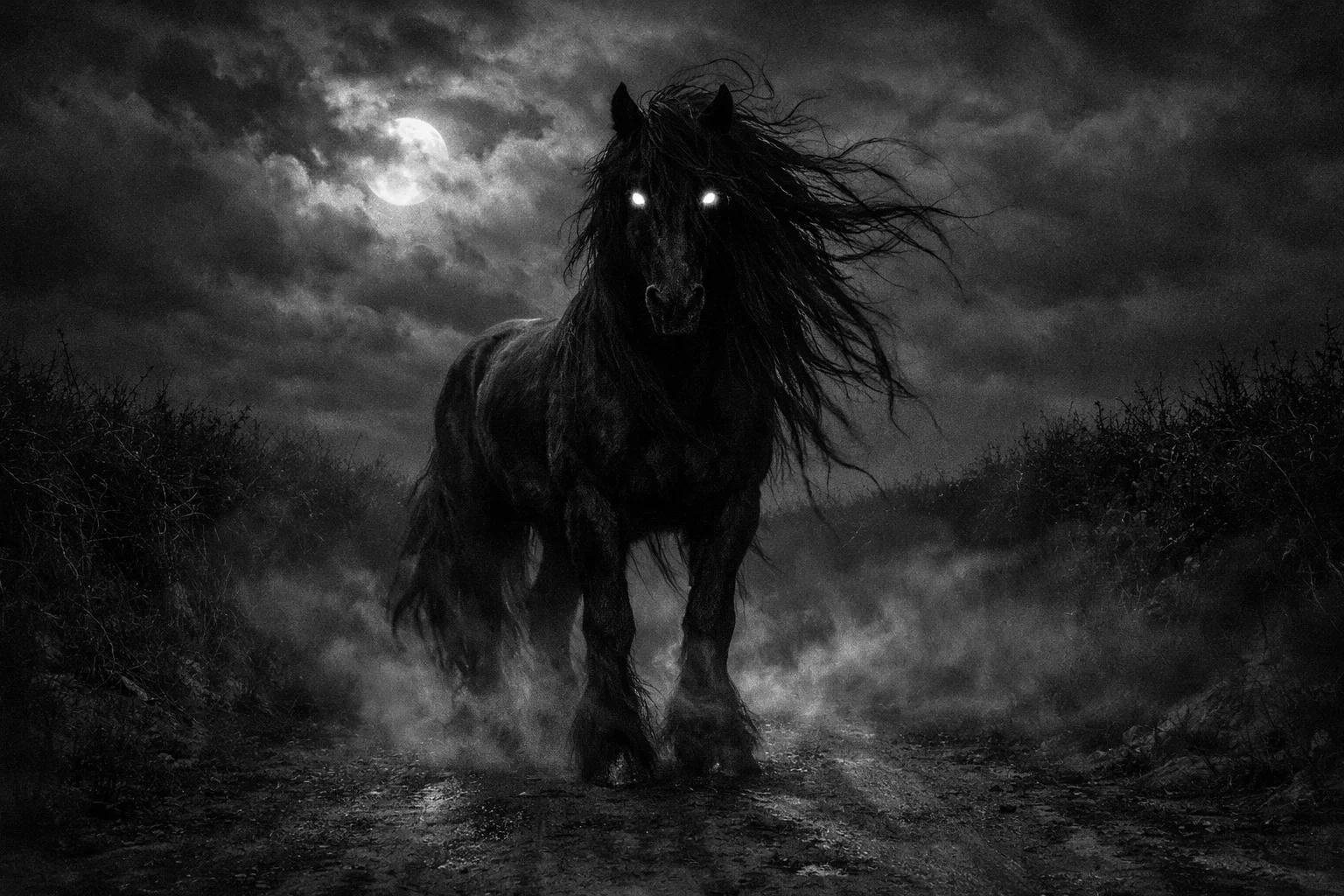
The Púca is a well-known and mysterious creature in Irish, Welsh, and Cornish folklore. It is often described as a shapeshifter that can be both helpful and frightening.
Usually seen as a dark horse or a goat, the Púca lives in remote places like mountains, ruins, and coastlines. Although it does not usually try to kill, its unpredictable behavior and effect on the harvest make people treat it with caution.
Summary
Key Takeaways
| Attribute | Details |
| Names | Púca, Pooka, Phouka; derived from Old Norse ‘puki’ or Old Irish ‘púc’ (spirit/demon). |
| Nature | Supernatural spirit and shapeshifter. |
| Species | Fae / Spectral Beast. |
| Appearance | Commonly a large black horse with golden eyes; also appears as a goat, rabbit, or goblin. |
| Area | Ireland, Wales (as Pwca), and Cornwall (as Bucca). |
| Creation | Indigenous Celtic spirit; traditionally considered a native inhabitant of the Otherworld. |
| Weaknesses | Iron, sharp spurs, and the ‘Púca’s share’ (leaving a portion of the harvest). |
| First Known | Early medieval period; documented in oral tradition and later in 19th-century folklore collections. |
| Myth Origin | Celtic mythology and Gaelic folklore. |
| Strengths | Shapeshifting, human speech, and agricultural influence. |
| Time Active | Nocturnal; specifically active during Samhain (November 1st). |
| Diet | Harvested crops (specifically wild berries after November 1st). |
Who or What Is Púca?
The Púca is a unique monster among the Aos Sí, or the people of the mounds, in Irish tradition. Unlike other faerie beings that follow strict rules, the Púca is a loner and does whatever it wants. Its main trait is metamorphosis, changing between animal and partly human forms at will. Most stories describe it as a night creature that comes out from hidden spots to meet travelers or farmers.
People often call the Púca a trickster, but it plays two roles in rural life. Sometimes, it brings good luck to homes and farms, helping with chores or giving prophecies to those it likes.
Other times, it is a scary entity that takes people on wild, frightening rides through the countryside. The Púca is most active during Samhain, the festival at the end of the harvest, when it is believed to take its share of the crops.
Tired of Bad Luck, Dark Spirits, and Toxic Vibes Draining Your Life?
Limited-Time: Up to 25% OFF!
Natural Black Tourmaline Crystal Healing Pendant – Genuine raw tourmaline • Absorbs & transmutes negativity • Guards against psychic attacks & hauntings • Deep spiritual cleansing for home & body • Purifies chakras & spaces from bad vibes. A portable force field—essential for sensitive souls in chaotic times.

Genealogy
| Relation | Identity |
| Ancestry | Descended from the Tuatha Dé Danann or ancient nature spirits. |
| Related Entities | The Welsh Pwca and the Cornish Bucca. |
| Associated Spirits | The Dullahan (sometimes seen traveling together) and the Banshee. |
You may also enjoy:
What Is a Vila? The Beautiful Yet Deadly Spirit of Slavic Myth
September 11, 2025
Hillbilly Beast of Kentucky: What Boone Really Saw
June 30, 2025
6 Real Haunted Houses in Arkansas with Chilling True Stories
October 8, 2025
Gainesridge Dinner Club Haunting: Why Do Diners Hear Babies Crying?
September 3, 2025
Etymology
Scholars still debate where the name Púca comes from. One common idea is that it comes from the Old Norse word “puki,” which means a nature spirit or demon. This could mean that the Vikings influenced Irish folklore during the Middle Ages.
Other linguists think the name comes from the Old Irish word “púc,” which means a spirit or ghost and may be older than Norse influence. In Middle English, the word became “puck,” made famous by Shakespeare for a playful sprite. Still, the Irish Púca is much more powerful and wild than the English version.
In Wales, this creature is called the Pwca, and in Cornwall, it is known as the Bucca. Both names keep the “p-k” or “b-k” sound, which is often used in North-Western Europe for mischievous or ghostly beings.
In some parts of Ireland, the name is also linked to the word for “goat” (poc), which matches one of the Púca’s usual forms. No matter where the name comes from, it has always described a creature that lives between worlds—between wild and tame, animal and human.
What Does the Púca Look Like?
The Púca is almost always described as having jet-black fur or hair, no matter its shape. Most often, it appears as a remarkable wild horse with a long mane and glowing yellow or golden eyes. In this form, it can move very fast and travel over any terrain, including water and mountains.
Sometimes, the Púca shows up as a big black goat with large horns or as a huge rabbit. In a few rare and creepy stories, it looks like a dark, hairy man or a goblin with animal features.
No matter what form it takes, the Púca can always speak like a person. It often uses this skill to trick people or give mysterious warnings. Even when it looks like a farm animal, it always seems wild and messy, setting it apart from other animals.
Mythology
Stories about the Púca are closely tied to Ireland’s farming seasons. It is seen as a harvest spirit, and its actions follow certain dates on the Gaelic calendar. The most important of these is November 1st, known as Samhain.
Tradition says that any crops left in the fields after this date belong to the Púca. People believe it travels the countryside on Samhain night, spoiling any unpicked berries or fruit and making them unsafe to eat.
In the past, people did not just fear the Púca—they also tried to keep it happy. Farmers would leave a bit of grain at the edge of their fields as an offering, hoping the Púca would not harm their land.
In some areas, people thought the Púca could tell the future. On Samhain, it was said to stand on high ground and answer questions about the coming year for anyone brave enough to ask. In stories, the Púca brings chaos but respects people who treat it with the right respect.
Demons, Ghosts, and Vengeful Spirits
Limited-Time: Up to 22% OFF!
Something Wicked from Japan – 150+ haunting ukiyo-e masterpieces • Yūrei, yōkai, and oni • Blood-soaked legends • Severed heads • Demonic seduction • Erotic horrors & grotesque beauty. The most terrifying (and beautiful) book of Japanese art ever printed.
Legends
The Wild Ride
One of the most famous stories about the Púca is how it kidnaps people walking alone at night. Usually, a man is heading home from a pub or fair when he sees a beautiful black horse by the road. Thinking it is safe, he tries to ride it. As soon as he sits down, the Púca shows its true self. The horse screams and races wildly across the land, and the rider cannot get off, as if he is glued to its back.
All night long, the Púca leaps over big hedges, swims through cold rivers, and runs along steep cliffs. It does not stop until just before sunrise, when it throws the tired and scared rider into a ditch or a patch of thorns. Before disappearing, the Púca often teases the traveler in a human voice, warning him to be more careful about what he rides at night.
You may also enjoy:
Semyaza: The Fallen Angel Suspended Between Heaven and Earth
September 29, 2025
Domovoi: The Creepy Household Spirit
September 11, 2025
The Dark Haunting of Fort Morgan: Soldiers, Spirits, and Tragedy
September 3, 2025
Hillbilly Beast of Kentucky: What Boone Really Saw
June 30, 2025
Satanachia: Demon General of Hell’s Legions
August 28, 2025
The Púca and the Prince
In a rare story where a person defeats the Púca, a young Irish prince—sometimes called Brian Boru in later tales—manages to tame it. The prince knew the Púca was causing trouble in his land, breaking fences and frightening cattle. He got ready by putting on silver spurs and bringing a bridle made of blessed iron. When the Púca tried to attack, the prince threw the bridle over its head and climbed on.
The prince used the spurs to keep control and made the Púca ride until it was worn out. When the Púca saw it could not win, it begged for mercy. The prince made it promise never to hurt a Christian or damage his people’s property, as long as they did not bother it. This story explains why the Púca is sometimes seen as helpful or less dangerous in some parts of Ireland.
The Helpful Púca of the Mill
Another story is about a Púca living near a country grain mill. The miller, an old man who had trouble with his work, noticed that every morning the grain was ground and the floors were clean, even though he left the mill in a mess at night. One night, he hid and saw a big, hairy creature come in and finish all the work very quickly.
To thank the creature, the miller left it a nice silk coat and shoes. When the Púca found the clothes, it put them on and danced with happiness. But then it said it was now “too grand for manual labor” and disappeared, never helping the miller again. This story shows that the Púca can be helpful, but its kindness does not last long.
Púca vs Other Monsters
| Monster Name | Origin | Key Traits | Weaknesses |
| Púca | Ireland | Shapeshifting, black horse/goat, trickery. | Iron, spurs, Samhain offerings. |
| Kelpie | Scotland | Water horse, drowns victims, adhesive skin. | Its bridle. |
| Nuckelavee | Orkney | Skinless centaur-like beast, toxic breath. | Fresh water. |
| Each-Uisge | Scotland | Carnivorous water horse, liver remains. | Iron, heat. |
| Banshee | Ireland | Female spirit, wailing, omen of death. | None (is a messenger). |
| Dullahan | Ireland | Headless horseman, carries spine whip. | Gold. |
| Kappas | Japan | Water imp, turtle-like, head bowl. | Bowing, cucumbers. |
| Skinwalker | Navajo | Shapeshifting witch, animal skins. | Its true name. |
| Leshy | Slavic | Forest spirit, size manipulation. | Backwards clothes/shoes. |
| Redcap | Border Folklore | Goblin, dips cap in blood. | Scripture, iron. |
The Púca, like the Scottish Kelpie and Each-Uisge, can turn into a horse. However, it is not as deadly as those creatures. The Scottish ones usually try to eat or drown people. Still, the Púca mostly wants to confuse and scare people rather than harm them physically.
Unlike the Dullahan or Banshee, which are signs of certain death, the Púca is connected to the living world and the harvest. This makes it a more active, though still risky, part of everyday rural life.
This Book Turns the Entire United States Into One Giant X-Files Map
Limited-Time: Up to 38% OFF!
J.W. Ocker traveled the country collecting the weirdest local legends and marks the real-world locations where the Beast of Bray Road, the Dover Demon, the Wendigo, and hundreds more have been spotted. Part travel guide, part bestiary, 100% nightmare fuel.

Powers and Abilities
The Púca has many supernatural powers that let it affect the real world in special ways. Its main skill is metamorphosis, not just into animals but also into certain people to trick others. It also seems to read minds or sense what travelers fear or where they are going.
- Metamorphosis: The ability to instantly transform into a horse, goat, rabbit, dog, or humanoid.
- Human Speech: The capacity to speak any language fluently, often used for riddles or mockery.
- Supernatural Speed: In its horse form, it can cover vast distances in a single night.
- Agricultural Influence: The power to bless or blight crops, specifically during Samhain.
- Prophecy: The ability to foresee the future, which it occasionally shares on specific nights of the year.
You may also enjoy:
Thiess of Kaltenbrun: History’s Only “Good” Werewolf?
June 13, 2025
Ghost Orb Color Meaning: A Complete Guide
January 5, 2026
January 14, 2026
Is My Home Haunted or Just Old? How to Tell the Difference
September 5, 2025
Can You Defeat a Púca?
You cannot usually defeat a Púca by fighting it, since it is a spirit and normal weapons do not work. Instead, people try to keep it away. The best way to protect yourself is with iron. Like many faerie creatures in Celtic stories, the Púca hates “cold iron,” so carrying something made of iron or wearing a horseshoe can keep it from coming near.
If someone ends up riding a Púca, the only way to control it is by using sharp spurs or a bridle with silver or iron. This makes the Púca obey. Still, the most common way to avoid trouble with the Púca is to keep it happy. Leaving its share of the harvest and showing respect can help you stay safe from its anger.
Conclusion
The Púca is still one of the most interesting and lasting characters in Gaelic mythology. It symbolizes the unpredictable side of nature, acting as both a helpful worker and a frightening night creature. It’s part of the harvest, and Samhain shows how people have always tried to balance survival with respect for the unknown.
In the end, the Púca is a creature of shadows and crossroads, reminding us that the land is never really empty. Whether it shows up as a dark horse on a quiet road or as a voice in the wind, it still stands for the in-between spaces that are so important in British Isles folklore.