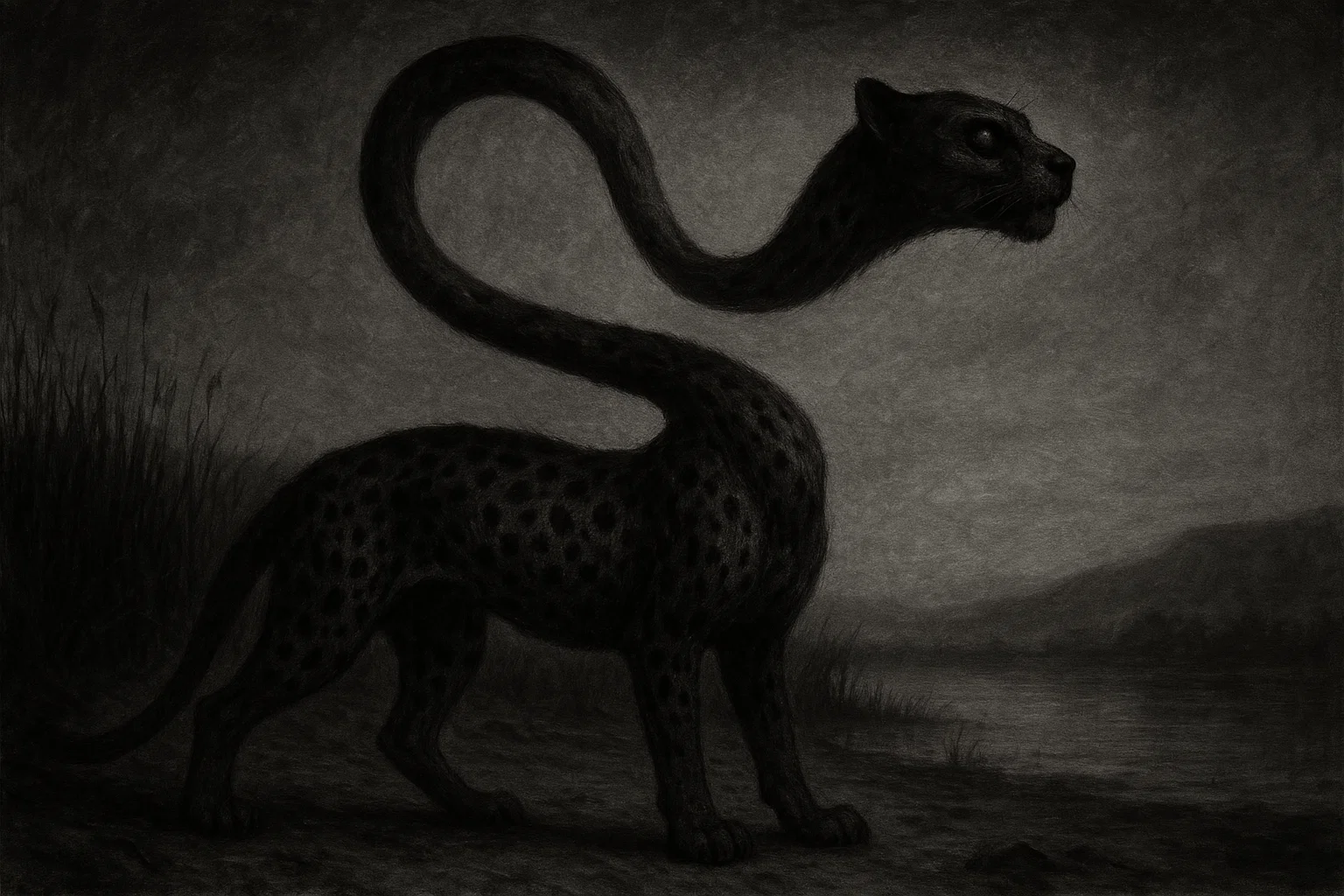
The Serpopard is a unique mythological creature primarily recognized from Pre-Dynastic Egyptian and Mesopotamian artwork. It is characterized by its combination of a leopard or lion body with an incredibly elongated, snake-like neck.
Despite its fearsome appearance in art, the creature’s role in mythology is not clearly defined, which creates an air of mystery around its intended meaning and function in these ancient cultures. The Serpopard often appears in pairs, flanking central figures or objects, suggesting a symbolic guardian or cosmological role.
Summary
Key Takeaways
| Attribute | Details |
| Names | Serpopard; A modern portmanteau from “serpent” and “leopard,” as no ancient name is known. |
| Nature | Mythological Hybrid Beast; A fantastic, chimerical entity. |
| Species | Chimeric Beast. |
| Appearance | Body of a leopard or lion, typically depicted with spots (leopard); exceptionally long, snake-like neck; often lacks a clear delineation for the mane; sometimes depicted with a single head, but frequently with two necks entwined or separate. |
| Area | Primarily Egypt (Pre-Dynastic Period, particularly the Naqada III culture) and Mesopotamia (Sumerian, Proto-Elamite). |
| Creation | Unknown; presumed to be a creature born of ancient artistic and symbolic convention. |
| Weaknesses | No known weaknesses, as it is a symbolic creature and not one of narrative action. |
| First Known | Circa 3200–3100 BCE, on the Narmer Palette (Egypt) and various Proto-Elamite seals (Mesopotamia). |
| Myth Origin | Ancient Egyptian and Mesopotamian iconographic tradition, possibly symbolizing an abstract concept or power. |
| Associated Creatures | Griffin, Sphinx, Serpopard-headed creatures in later Egyptian art; other hybrid beasts. |
| Habitat | Iconographic only; depicted on palettes, seals, and cylinder carvings. |
| Protection | None specified; its role appears to be protective/symbolic, not predatory. |
Who or What Is the Serpopard?
The Serpopard is a fanciful, composite creature composed of a feline body and a serpent’s neck. This motif appears in the earliest phases of recorded civilization in both the Nile Valley and the Near East.
Despite its imposing presence on some of the era’s most critical artifacts, such as the Narmer Palette in Egypt, the Serpopard is unique among mythological entities because no corresponding written accounts, legends, or religious texts have ever been definitively linked to it.
Instead of a creature of narrative mythology (like the Minotaur or Sphinx), the Serpopard is understood almost exclusively through iconography. The name Serpopard itself is a modern coinage used by archaeologists to describe the fusion of serpent and leopard features.
Its appearance spans an important time in history, the transition from Pre-Dynastic to Early Dynastic Egypt, and the height of the Proto-Elamite and Sumerian cultures in Mesopotamia. This creature is one of several hybrid beasts (including Griffins and winged lions) that were popular in the ancient world, often symbolizing the chaos or untamed nature that needed to be controlled by the ruling power.
Ever Wondered About the Secret Lives of Greek Gods and Heroines?
Limited-Time: Up to 32% OFF!
The Classical Mythology Encyclopedia: Gods, Heroes, and Heroines – 1,000+ entries • Epic tales of Olympus • Goddesses, monsters, and divine intrigues • Ancient rituals & timeless legends. This is Nancy LoCicero’s ultimate guide to the myths that inspired Western civilization.
Genealogy
As the Serpopard does not appear to be part of a recorded narrative mythology, its genealogy—parents, siblings, or offspring—is unknown. It is a figure of iconography rather than a character in a story, so it has no established lineage in ancient texts.
Etymology
The term Serpopard is a descriptive, modern scholarly portmanteau and not the creature’s original name. It was introduced by combining the elements “serpent” and “leopard” to accurately describe the creature’s distinct physical characteristics.
Serpens is the Latin word for serpent or snake, referencing the creature’s extremely elongated neck, which often coils or entwines with the neck of a paired creature. The second element, pardus, is the Latin word for leopard or panther, denoting the feline body structure, which is typically spotted like a leopard or sometimes plain like a lion.
Crucially, no ancient name for the Serpopard has been discovered in Egyptian or Mesopotamian records. This lack of a clear indigenous term points out the creature’s primary existence as a visual symbol rather than a character in oral or written tradition.
The widespread presence of the motif across geographically and linguistically distinct regions—Mesopotamia and Egypt—suggests it may have been an international symbol adopted by different cultures, or an example of cross-cultural influence during the late fourth millennium BCE.
In Mesopotamia, similar hybrid creatures were often called Mushhushshu, but the Serpopard’s feline body makes that connection tenuous. Its earliest appearance in Egypt, on artifacts like the Narmer Palette (c. 3100 BCE), is thought by some researchers to be an imported motif from the Near East, where it appears on earlier seals.
You may also enjoy:
The Dark Haunting of Fort Morgan: Soldiers, Spirits, and Tragedy
September 3, 2025
Sturdivant Hall Haunting: A Southern Mansion with a Dark Secret
September 23, 2025
Who Is Xezbeth, the Demon of Lies and Fraud?
August 29, 2025
Crocell – The Mysterious Demon Duke. Powers, Legends, and Lore
August 13, 2025
What Does the Serpopard Look Like?
The physical representation of the Serpopard is characterized by an unusual combination of features drawn from the animal world. Its most consistent feature is the body of a large feline, generally interpreted as a lion or, more commonly, a leopard, due to the frequent depiction of spots.
This body is strong, signifying strength. However, the hardest to ignore and defining characteristic is its neck, which is exaggeratedly long and slender, twisting and coiling like a snake or serpent.
The head is usually that of a feline, although sometimes depicted with long, pointed ears and no visible mane. In the most famous Egyptian representation, on the Narmer Palette, the creature is shown in a pair.
The necks of the two Serpopards are interlaced, forming a circular depression that is understood to be the area where cosmetics were ground. This intertwining is often interpreted as a visual metaphor for the unification of Egypt.
In Mesopotamian cylinder seals, Serpopards are frequently depicted as rampant (standing on their hind legs), and their long necks may be used as framing or decorative elements. The feet are distinctly paws, further emphasizing the creature’s feline nature.
Mythology
The mythology of the Serpopard is highly speculative, as there are no known ancient texts that explain the creature’s meaning, origin, or role in any specific pantheon or story. Its significance is derived purely from the context and location of its appearance in early Egyptian and Mesopotamian art.
In Mesopotamia, the earliest depictions of the Serpopard appear on cylinder seals and seal impressions from the Proto-Elamite period (c. 3300–3000 BCE). These creatures are frequently shown engaged in combat with human heroes or other monstrous entities, or flanking gateways and entrances.
This context suggests it may have been a symbol of untamed nature, the forces of chaos, or a powerful guardian to be overcome or controlled. Its hybrid nature links it to other Mesopotamian creatures that guard the thresholds between the known and unknown worlds.
In Pre-Dynastic Egypt, the Serpopard motif is prominent on the magnificent ceremonial cosmetic palettes of the Naqada III period (c. 3200–3100 BCE). The most famous example is on the Narmer Palette, one of the most important surviving artifacts from Early Dynastic Egypt, which depicts the unification of Upper and Lower Egypt.
Here, two Serpopards with long, intertwined necks are positioned to form a recess. This image has been interpreted by Egyptologists as a powerful visual metaphor for the coalescence of the two lands, as the necks are literally bound together.
Alternatively, the Serpopard, like the desert leopard, may have represented the wild and chaotic forces that the newly unified kingship was required to master to create an ordered state (Ma’at).
After the beginning of the Dynastic period, the Serpopard motif largely disappeared from major Egyptian royal art, suggesting its symbolism may have been supplanted by other, more formalized royal and religious iconography.
The One Book That Turned “Monster Hunting” From Joke to Actual Science
Limited-Time: Up to 46% OFF!
Bigfoot, Loch Ness, Chupacabras, Mothman, Yeti, and dozens more – the original A-to-Z encyclopedia with 100+ fully researched cryptids, eyewitness accounts, expedition histories, and the evidence that made skeptics sweat. Loren Coleman and Jerome Clark’s 1999 classic that launched a thousand investigations.
Legends
Due to the lack of accompanying texts, there are no known narrative legends or myths about the Serpopard. The creature’s existence is confined to iconography and artistic representation, rather than active participation in a story or myth cycle.
Serpopard vs Other Monsters
The Serpopard shares the common characteristic of being a hybrid creature with many other monsters from the ancient world, especially those representing chaos, power, or guardianship.
| Monster Name | Origin | Key Traits | Weaknesses |
| Sphinx | Egyptian/Greek | Human head, lion body, sometimes falcon wings. | Riddles (Greek context); none (Egyptian context). |
| Griffin | Near East/Greek | Head and wings of an eagle, body of a lion. | None |
| Manticore | Persian/Greek | Human head, lion body, bat wings, scorpion tail. | None |
| Lamassu | Assyrian | Human head, body of a lion or bull, eagle wings. | None |
| Chimera | Greek | Lion, goat, and serpent parts; breathes fire. | Bellerophon and Pegasus. |
| Dragon (Mushhushshu) | Mesopotamian | Serpent neck/body, lion forelegs, eagle hind legs, horns. | None |
| Basilisk | Classical/Medieval | Serpent with a crown, sometimes a cock’s head/wings. | Weasel/Stoat, or its own reflection. |
| Ammit | Egyptian | Head of a crocodile, forequarters of a lion, hindquarters of a hippopotamus. | None; she is an agent of judgment. |
| Nemean Lion | Greek | Massive lion with impenetrable skin. | Strangled by Heracles. |
| Qilin/Kirin | East Asian | Deer/horse body, dragon/lion head, scales, horn(s). | None |
The Serpopard fits neatly into the ancient Near Eastern tradition of chimeric entities created by combining the most powerful or symbolic animals. Like the Sphinx and the Lamassu, it combines a powerful feline body with another significant feature—the snake-like neck—to create a figure of intense, symbolic power.
It differs a lot from narrative monsters like the Greek Chimera or Manticore, as its depictions do not show it actively engaging in combat or preying on victims; its role is static and iconographic. The Serpopard’s closest conceptual counterpart is the Dragon (Mushhushshu) from Mesopotamia, as both creatures merge feline and snake/draconic features, signifying a mastery over the natural world.
The intertwining of the necks on the Narmer Palette is a uniquely Egyptian symbolic adaptation, setting it apart from its other hybrid contemporaries, which are typically depicted as single, autonomous beings. The lack of a clear-cut weakness further classifies it as a symbolic entity of great power rather than a monster to be slain in a heroic tale.
You may also enjoy:
Who or What Is the Owlman of Mawnan Church?
November 5, 2025
Japanese Horror: The Terrifying Ghost of Aka Manto
June 4, 2025
What Is a Banshee and Why Does It Scream Before Death?
December 9, 2025
Powers and Abilities
Since the Serpopard is primarily a symbolic creature in ancient art rather than a character in a mythological narrative, it doesn’t have a defined set of supernatural powers or abilities in the way a demon or god might. Its power is derived from its hybrid nature and the visual impact it creates.
The creature’s combination of the power of the great feline (lion or leopard) and the sinuous, deadly nature of the serpent visually projects an image of untamed, chaotic strength.
When it comes to the Narmer Palette, the power implied is the potential for chaos and discord, which the King (Narmer) must subdue and unify. In Mesopotamian seals, the power is that of a formidable guardian or a representation of primal forces.
Its elongated neck may suggest a power related to reaching far distances or binding/constricting (as seen in the intertwined depiction). However, this is purely based on visual interpretation.
The Forbidden Encyclopedia That Makes Every Ouija Session Ten Times More Dangerous
Limited-Time: Up to 49% OFF!
Angels, devils, nature spirits, ancestors, tricksters, and creator gods – all catalogued with their true names, powers, and protocols. Judika Illes created the definitive directory of the spirit realm that practitioners around the world swear by when they need to know exactly who (or what) just answered.
Can You Defeat a Serpopard?
Given that the Serpopard is a creature of symbolic iconography rather than a monster from a narrative legend, the question of its defeat is not applicable in a literal sense. There are no documented ancient methods to ward off or destroy the creature because it was not perceived as a physical threat requiring a hero to slay.
However, if its symbolism is considered, one could argue that the Serpopard is “defeated” or “controlled” by the establishment of order. Regarding Egyptian unification, the creature’s chaos-representing power is subdued and harnessed by the pharaoh and the creation of the Egyptian state.
The intertwining of the necks on the Narmer Palette—used as a functional cosmetic well—shows the creature’s wild power being put to use for a royal purpose, symbolizing a conquest and mastery rather than a simple destruction.
Because of that, the way to neutralize the Serpopard’s inherent power is through political and religious order and control by a supreme authority, such as the King.
Conclusion
The Serpopard is a compelling and enigmatic figure from the dawn of recorded civilization, representing a powerful intersection of Pre-Dynastic Egyptian and Mesopotamian visual culture. Unlike many other mythological entities, its existence is embedded in iconography on ceremonial palettes and cylinder seals rather than in narrative literature, leaving its exact purpose open to scholarly interpretation.
Researchers generally agree that this feline-serpent hybrid embodied the wild, chaotic forces of nature or acted as a formidable guardian.
The long-lasting power of the Serpopard lies in its function as a visual metaphor.
Its dramatic appearance on the Narmer Palette makes it an indispensable symbol of unification and royal control, signifying the moment the newly established Egyptian kingship mastered the discord of the land. Its shared presence across the Near East highlights an early network of artistic and symbolic exchange between distinct cultures.
When all is said and done, the Serpopard proves the power of ancient art to communicate complex political and cosmological concepts without the aid of text, leaving an unresolved mystery at the heart of the earliest human empires.