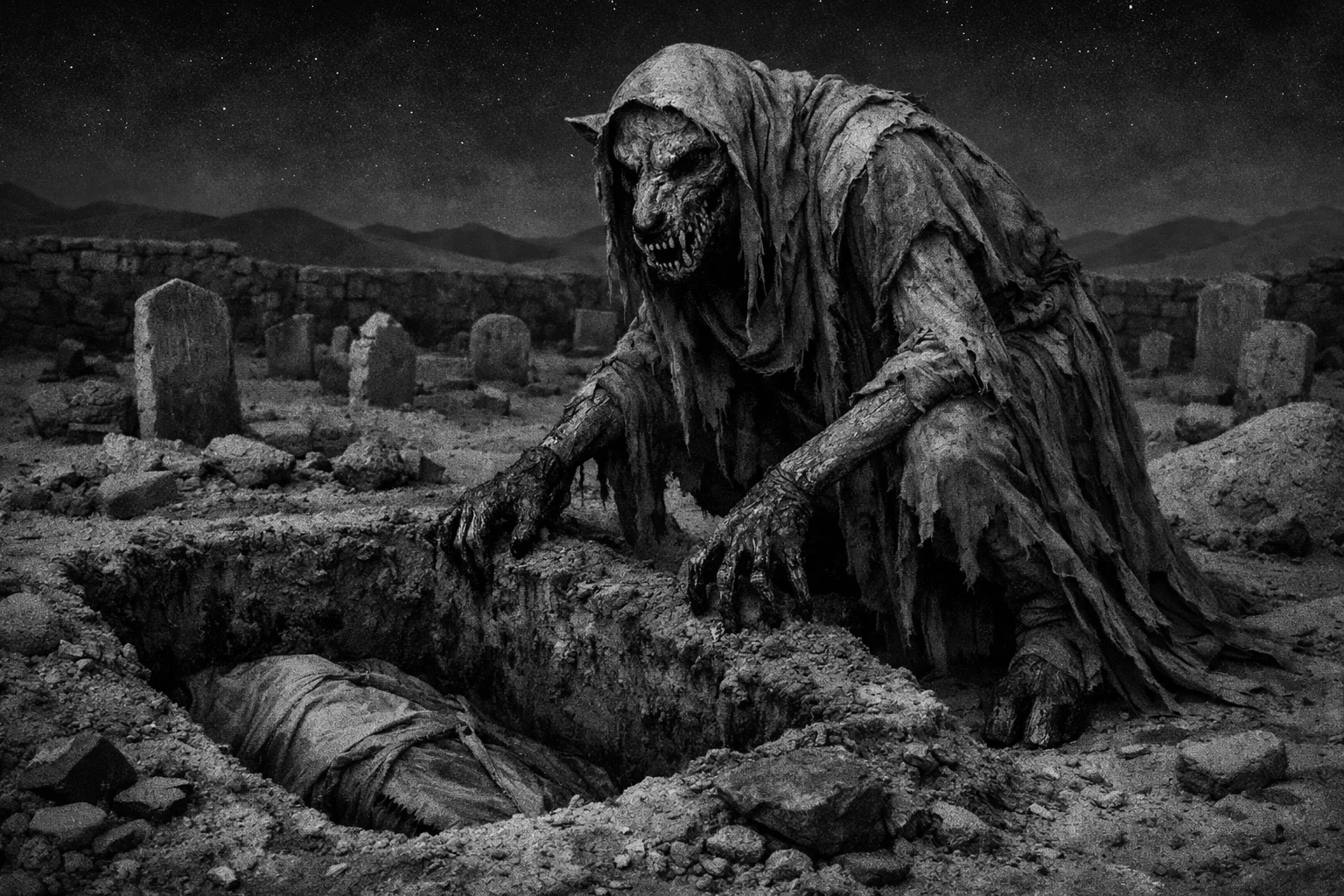
The Ghoul is a flesh-eating creature from ancient Arabian folklore, known for haunting graveyards and deserted places to feed on the dead. In the pre-Islamic desert, it symbolized deep fears about graveyards and disturbing the dead.
Unlike the mindless zombies of modern stories, the original Ghoul was clever and could change its shape to trick people into danger.
Summary
Key Takeaways
| Attribute | Details |
| Names | Ghoul, Ghul; Arabic for ‘to seize’ or ‘demon’ |
| Nature | Demonic spirit or jinn |
| Species | Humanoid / Shapeshifter |
| Appearance | Hunched, pale or sallow skin, canine features, hoofed feet |
| Area | Arabian Peninsula, North Africa, Middle East |
| Creation | A type of Shaytan (demon) or a rebellious jinn |
| Weaknesses | A single decisive blow, fire, religious invocations |
| First Known | Pre-Islamic Arabian oral tradition; 8th-century poetry |
| Myth Origin | Arabian folklore and Islamic demonology |
| Diet | Human carrion, freshly killed travelers, and infants |
| Time Active | Nocturnal |
| Strengths | Shape-shifting, superhuman strength, mimicry |
Who or What Is a Ghoul?
The Ghoul is a type of demon from the folk beliefs of the Arabian Peninsula. In traditional stories, it is often seen as a particularly evil kind of Jinn or shaitan.
Unlike other spirits that might ignore people, the Ghoul is known for eating the dead and hunting for victims. It usually lives in places considered unclean, such as cemeteries, ruins, and battlefields, where it searches for human remains.
Besides scavenging, the Ghoul is also a dangerous hunter of the living. It often waits along desert paths and empty roads, looking for travelers or caravans. Instead of just using strength, it relies on tricks, like changing its shape and copying human voices.
The Ghoul tricks people by calling out the names of their friends or pretending to be a helpless woman, leading them away from their group into the desert, where it kills and eats them. In stories, the Ghoul represents the dangers of the wild and the fear of cannibalism.
Demons, Ghosts, and Vengeful Spirits
Limited-Time: Up to 22% OFF!
Something Wicked from Japan – 150+ haunting ukiyo-e masterpieces • Yūrei, yōkai, and oni • Blood-soaked legends • Severed heads • Demonic seduction • Erotic horrors & grotesque beauty. The most terrifying (and beautiful) book of Japanese art ever printed.
Genealogy
| Relation | Identity |
| Progenitor | Iblis (in some Islamic traditions) |
| Class | Jinn (specifically the Si’lat or Qutrub) |
| Offspring | Ghouls are typically solitary, but some lore mentions ‘Ghulah’ (females) |
| Affiliation | Shaitans (demonic spirits) |
You may also enjoy:
The Winchester Mystery House Haunting: The Real Story
October 23, 2025
The Lake Tanganyika Monster: A Living Prehistoric Beast?
November 10, 2025
Is the Richards DAR House Haunting Evidence of Intelligent Spirits?
September 22, 2025
Malaga Inn Haunting: Why Room 007 Terrifies Guests to This Day
September 22, 2025
Etymology
The word Ghoul comes from the Arabic word ghūl, which is based on the root ghāla, meaning “to seize,” “to destroy,” or “to take suddenly.” This matches the Ghoul’s main behavior: suddenly grabbing travelers. In the Middle East, the word was also used for anything that could strike or overpower someone without warning, like a disaster or a wild animal.
In old Arabic poetry and stories, the ghūl was often shown as a demon of the desert. The plural, ghīlān, refers to groups of these creatures said to haunt empty places.
The word Ghoul entered English in the late 1600s and early 1700s, largely due to Antoine Galland’s French translation of The Thousand and One Nights. Galland changed the Arabic ghūl to the French gouls, which later became the English Ghoul.
Before the word spread to the West, it was only used for the desert spirits of the Bedouin tribes. In early stories, the name was also connected to the Si’lat, a female Jinn known for changing shape.
Over time, the word Ghoul also came to mean “grave robber” or “cannibal.” In Western medicine and law, it lost some of its supernatural meaning. Still, in classical mythology, it kept its dark roots.
What Does the Ghoul Look Like?
The Ghoul is usually described as a twisted, human-like figure, but it can change its shape to hide its real look. In its true form, it often has pale or earth-toned skin that resembles old, dried-out parchment. Many stories say it has a dog-like face, with a long snout and sharp fangs for tearing flesh.
A Ghoul’s feet are one of its most telling features. No matter what form it takes, even if it looks like a beautiful woman, the creature will keep the hooves of a donkey or goat. Its arms and legs are often long and thin, ending in claws for digging up graves. Ghouls usually smell terrible, like sulfur or rotting meat, which can warn travelers before they see it.
This Book Turns the Entire United States Into One Giant X-Files Map
Limited-Time: Up to 38% OFF!
J.W. Ocker traveled the country collecting the weirdest local legends and marks the real-world locations where the Beast of Bray Road, the Dover Demon, the Wendigo, and hundreds more have been spotted. Part travel guide, part bestiary, 100% nightmare fuel.

Mythology
Stories about the Ghoul are older than Islam and come from pre-Islamic Arabia’s oral traditions. In these early tales, desert nomads saw the Ghoul as a real threat. People believed it was a metamorph demon living in places like the Wadi al-Ghulat, far from towns. Some said Ghouls were the children of Iblis, the main demon in Islamic belief, or a group of Jinn who refused to follow divine rules.
When Islamic literature appeared, the Ghoul became part of the spiritual world. The Hadith, or traditions of the Prophet, mention ghouls, and some say they are a kind of Jinn that can be driven away by the Adhan, the call to prayer. Still, their most famous stories are found in The Thousand and One Nights.
In these stories, Ghouls live in ruined cities and graveyards. They are not just wild animals; they are smart, can talk, and have their own social order. Often, they speak with people before trying to eat them, showing a clever and evil mind that is very different from the idea of mindless undead.
Legends
The Tale of Sidi Nouman
In one of the stories from the Arabian Nights, a man named Sidi Nouman marries a beautiful woman named Amine. He soon discovers that she has very strange eating habits, consuming only a few grains of rice at a time using a toothpick.
Suspicious of her behavior, he decides to follow her one night when she secretly leaves their home. He tracks her to a local cemetery, where he watches in horror as she meets with a Ghoul.
Together, the woman and the creature dig up a recently buried corpse and begin to feast upon its flesh. This legend highlights the belief that humans could consort with ghouls or even be ghouls in disguise, reinforcing the theme of domestic betrayal and the desecration of the sacred dead.
You may also enjoy:
Why Lumley Castle Is One of England’s Most Disturbing Hauntings
January 12, 2026
Balberith: The Infernal Scribe Who Tempts Humanity
August 16, 2025
Who Is Mammon, the Demon of Greed?
August 29, 2025
The Complete List of All Haunted Places in Arizona
November 18, 2025
Lilith: First Wife of Adam, Queen of Hell
August 22, 2025
The Encounter of the Traveler in the Desert
A common motif in Bedouin folklore involves a lone traveler who becomes lost during a sandstorm. As night falls, he sees a fire in the distance and approaches it, hoping for hospitality. He finds a lone woman sitting by the flames, who invites him to rest. As the traveler prepares to sleep, he notices that under her long robes, she has donkey’s hooves instead of feet.
Realizing he is in the presence of a Ghoul, he remembers the old wisdom: a Ghoul can only be killed by a single strike. If hit a second time, it will miraculously revive. The traveler strikes the creature once with his sword and refuses to strike again despite her pleas for a finishing blow, successfully slaying the demon.
The Forbidden Encyclopedia That Makes Every Ouija Session Ten Times More Dangerous
Limited-Time: Up to 49% OFF!
Angels, devils, nature spirits, ancestors, tricksters, and creator gods – all catalogued with their true names, powers, and protocols. Judika Illes created the definitive directory of the spirit realm that practitioners around the world swear by when they need to know exactly who (or what) just answered.
Ghoul vs Other Monsters
| Monster Name | Origin | Key Traits | Weaknesses |
| Zombie | Haiti | Mindless, reanimated corpse, infectious bite | Destruction of the brain |
| Wendigo | North America | Associated with winter and cannibalism, insatiable hunger | Fire, silver (in some lore) |
| Vetala | India | Inhabits corpses, hangs from trees, knows the past | Mantras, magical spells |
| Jiangshi | China | Hopping corpse, drains Qi (life force), stiff limbs | Taoist talismans, mirrors |
| Draugr | Scandinavia | Superhuman strength, guards treasure, blue skin | Decapitation and burning |
| Strigoi | Romania | Vampiric spirit, rises from the grave, drinks blood | Garlic, staking the heart |
| Rakshasa | India | Shape-shifting demon, illusionist, eats human flesh | Holy weapons, sunlight |
The Ghoul, like the Zombie and the Vetala, eats the dead, but it stands out because it is smart and can change its shape. Unlike the Zombie, which is a modern idea of a reanimated body, the Ghoul is an ancient spirit or Jinn.
The Wendigo is a human turned monster by greed or hunger. Still, the Ghoul usually comes from a different supernatural origin.
Powers and Abilities
The Ghoul has many supernatural powers that make it a strong hunter in deserts and graveyards. Its main strength is its superhuman power, which allows it to dig through heavy dirt and move large stones to reach buried bodies.
Its senses are also very sharp, especially for the smell of blood and decay, so it can track victims from far away in the desert.
- Metamorphosis: The ability to transform into animals (usually hyenas or dogs) or alluring humans to deceive prey.
- Mimicry: The power to perfectly imitate the voices of a traveler’s friends or family members.
- Agility: Despite their often hunched appearance, they can move with incredible speed and climb steep ruins with ease.
- Necromancy-lite: While they don’t always raise the dead, they have an innate connection to the spirit world, allowing them to sense the presence of the recently deceased.
You may also enjoy:
Piasa Bird: The Terrifying Cryptid That Devoured Men
November 6, 2025
Who Is Vual in Demonology? Powers, Lore, and Origins
August 12, 2025
Pegasus: The Blood-Soaked Horror Born from Medusa’s Neck
December 4, 2025
Can You Defeat a Ghoul?
To defeat a Ghoul, you need both skill and spiritual strength. An ancient Arabian legend says the most important rule is the Single Strike Rule: if you hit a Ghoul once with a sword or axe, it will fall.
But the dying Ghoul will beg for a second blow to end its pain. You must never give in, because a second strike will heal it right away and make it much stronger, almost impossible to defeat.
Besides fighting, ghouls are also scared of iron, which is a common weakness for many Jinn. Carrying an iron blade or wearing iron jewelry can help keep them away. Fire also works well, since these creatures fear the cleansing power of flames.
Spiritually, people believe that reciting the Ayat al-Kursi or other religious verses can drive ghouls away, since they are demonic and cannot stand the presence of the divine name.
Conclusion
The Ghoul is still a lasting creature in folklore, showing our deep discomfort with death and the importance of respecting graves. Its roots in the harsh Arabian desert gave people a way to explain real dangers like thirst, loneliness, and wild animals, mixing natural fears with stories about the supernatural.
Today, the Ghoul is often shown as just another undead monster. Still, the original stories describe a much more complex and evil creature. By looking at its pre-Islamic roots and its role in the Arabian Nights, we see that the Ghoul is not just a flesh-eater, but a master of trickery and a symbol of how close life and death can be.