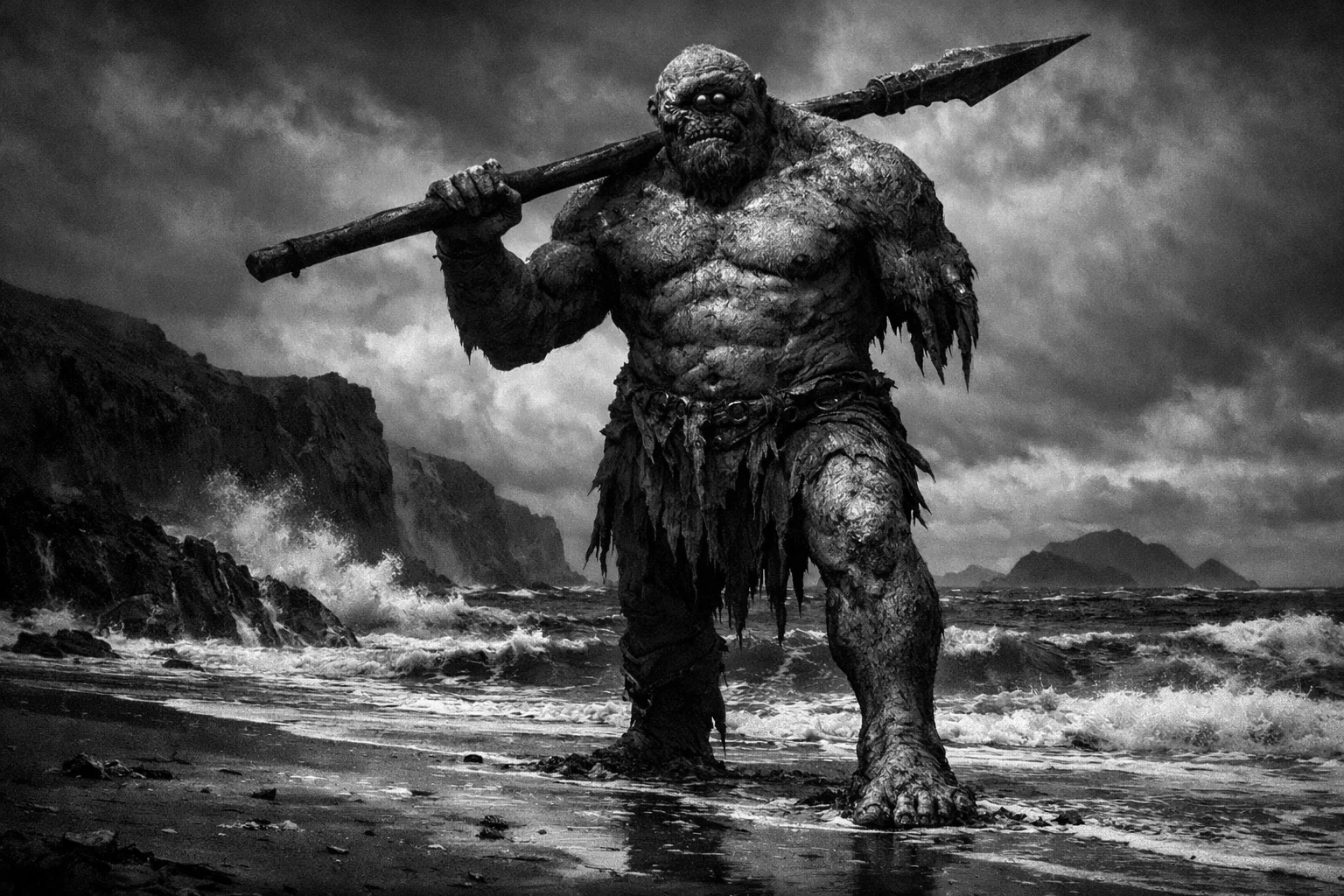
The Fomorians are key villains in Irish mythology. They are usually shown as twisted giants or sea monsters, symbolizing chaos and destruction in nature. Before the Tuatha Dé Danann arrived, the Fomorians fought many violent battles for control of Ireland.
Summary
Key Takeaways
| Attribute | Details |
| Names | Fomorian, Fomoraig, Fomorii; possibly meaning “under-demons” or “sea-dwellers.” |
| Nature | Supernatural adversaries, often classified as gods of chaos or malevolent spirits. |
| Species | Humanoid, though frequently described with monstrous or animalistic features. |
| Appearance | Often one-eyed, one-armed, and one-legged; some possess animal heads. |
| Area | Ireland; specifically coastal regions and the mythical Western Isles. |
| Creation | Indigenous primordial beings; descendants of the biblical Ham in later Christianized texts. |
| Weaknesses | Divine magic, superior craftsmanship, and specific artifacts used by the Tuatha Dé Danann. |
| First Known | 11th-12th century, Lebor Gabála Érenn (The Book of the Takings of Ireland). |
| Myth Origin | Gaelic/Celtic mythology. |
| Strengths | Immense physical size, mastery over storms and blight, and sorcery. |
| Habitat | The sea, islands like Tory Island, and the underworld. |
| Diet | Agricultural tribute; they were known to demand cattle, grain, and children. |
Who or What Is Fomorian?
The Fomorian, also called Fomoraig, is a supernatural being said to have lived in ancient Ireland. According to the Lebor Gabála Érenn, they were the main enemies of every group that settled in Ireland, from the Partholonians to the Tuatha Dé Danann.
While the Tuatha Dé Danann stood for civilization, light, and art, the Fomorians were usually shown as hostile giants. They came from the sea or deep underground to rule harshly and demand heavy tributes.
The Fomorians are more than just monsters; they stand for the wild and untamed forces of nature, like winter frost, storms, and crop blight. Some stories say they looked hideous, with goat or horse heads, while others describe them as beautiful or even human-like. This is shown by the many marriages between Fomorian royalty and the Tuatha Dé Danann.
They exist somewhere between the physical world and the supernatural, acting as the darkness that Irish heroes must overcome to prove themselves.
Demons, Ghosts, and Vengeful Spirits
Limited-Time: Up to 22% OFF!
Something Wicked from Japan – 150+ haunting ukiyo-e masterpieces • Yūrei, yōkai, and oni • Blood-soaked legends • Severed heads • Demonic seduction • Erotic horrors & grotesque beauty. The most terrifying (and beautiful) book of Japanese art ever printed.
Genealogy
| Relation | Name |
| Early King | Cichol Gricenchos |
| Prominent King | Indech mac Dé Domnann |
| Champion/King | Balor of the Evil Eye |
| Wife of Balor | Cethlenn |
| Daughter of Balor | Ethniu |
| Grandson of Balor | Lugh Lamfada (Tuatha Dé Danann hero) |
| King/Suitor | Elatha |
| Son of Elatha | Bres the Beautiful |
| Champion | Tethra |
Etymology
Celtic scholars have debated the meaning of the name Fomorian. In Old Irish, the plural is Fomoraig, made up of ‘fo’ meaning ‘under’ or ‘below,’ and a second part with two main possible meanings.
The most common view connects the name to the Irish word ‘muir,’ meaning ‘sea.’ So, Fomorian would mean ‘those under the sea’ or ‘under-sea dwellers.’ This fits with stories of them as sea raiders from places like Tory Island or underwater worlds.
A newer theory says the root is ‘mór,’ which here is not the word for ‘great’ or ‘sea,’ but is linked to the Old English ‘maere’ and Middle Low German’ mar.’
In this sense, it means a phantom, demon, or nightmare, which is the same root as in the word ‘nightmare.’ So, Fomorian could mean ‘under-demons’ or ‘underground phantoms.’ This meaning highlights their supernatural and evil side more than their link to the sea.
Some old texts call them ‘muiredach,’ a word also tied to the sea. Later, medieval monks sometimes tried to link their name to biblical family lines.
These monks sought to connect Irish myths to Christian history by claiming that the Fomorians were descendants of Ham, Noah’s cursed son. This made them a ‘cursed race’ in a Christian context, while still keeping them as the main enemies of the ‘blessed’ Tuatha Dé Danann.
Ever Wondered About the Secret Lives of Greek Gods and Heroines?
Limited-Time: Up to 32% OFF!
The Classical Mythology Encyclopedia: Gods, Heroes, and Heroines – 1,000+ entries • Epic tales of Olympus • Goddesses, monsters, and divine intrigues • Ancient rituals & timeless legends. This is Nancy LoCicero’s ultimate guide to the myths that inspired Western civilization.
What Does the Fomorian Look Like?
The way Fomorians look changes a lot depending on the story. In the oldest tales, they are described as strange hybrids, often with human bodies but the heads of goats, horses, or bulls. Some are said to have just one eye, one arm, and one leg, which is linked to dark magic and the ‘evil eye’ in Celtic tradition.
On the other hand, some Fomorians are described as very beautiful. Bres, who was half-Fomorian, was so handsome that his name became a standard for beauty. This shows that the Fomorians could be either symbols of deformity and chaos or powerful, noble giants.
Fomorians are usually shown as much bigger and stronger than humans. They often use huge weapons or have deadly powers, like the powerful eye of their leader, Balor.
You may also enjoy:
Pope Lick Monster: Louisville’s Most Haunted Cryptid
September 26, 2025
Satanachia: Demon General of Hell’s Legions
August 28, 2025
Demon Valac Explained: Origins, Powers, and Lore
August 28, 2025
Utukku: The Faceless Shadow Demon of Mesopotamia
October 1, 2025
Viné: King of Demonic Forces. Facts & Myths
May 28, 2025
Mythology
Stories about the Fomorians mostly come from the Lebor Gabála Érenn. They first appear during the time of Partholon, the second group to settle in Ireland. Led by Cichol Gricenchos, the Fomorians fought Partholon’s people at the Battle of Mag Itha. Early stories call them a ‘group of demons’ who lived on fish and birds instead of farming.
After Partholon’s people vanished, the next settlers, the Nemedians, also had to deal with the Fomorians. At first, the Fomorians lost some battles under kings Gann and Sengann, but they eventually enslaved the Nemedians.
The Fomorians forced the Nemedians to pay a harsh tax, taking two-thirds of their children, cattle, and crops every Samhain. This harsh rule ended with a violent uprising at the Tower of Conand, which nearly wiped out the Nemedians.
The best-known story about the Fomorians is their fight with the Tuatha Dé Danann. After the Tuatha Dé Danann beat the Fir Bolg, they tried to make peace by marrying into the Fomorian royal family. The Fomorian prince Elatha had a son, Bres, with a woman from the Tuatha Dé Danann.
But when Bres became king of Ireland, he favored the Fomorians and mistreated the people. This led to the Second Battle of Mag Tuired, which ended Fomorian rule in Ireland.
The Forbidden Encyclopedia That Makes Every Ouija Session Ten Times More Dangerous
Limited-Time: Up to 49% OFF!
Angels, devils, nature spirits, ancestors, tricksters, and creator gods – all catalogued with their true names, powers, and protocols. Judika Illes created the definitive directory of the spirit realm that practitioners around the world swear by when they need to know exactly who (or what) just answered.
Legends
The Tyranny of Bres
When Nuada, leader of the Tuatha Dé Danann, lost his arm in battle, he could no longer be king. To make peace with the Fomorians, the people chose Bres, son of the Fomorian prince Elatha, as king. Bres was very handsome, but he ruled with greed and was not generous. He forced the Tuatha Dé Danann to do hard labor and pay heavy taxes to the Fomorian lords.
The story says that under Bres, the Tuatha Dé Danann grew tired of high taxes and no feasts. The poet Coirpre then wrote the first satire in Ireland against Bres, making him lose his ‘honor’ and his good looks. Bres fled to his father, Elatha, and to the Fomorian king, Balor, to gather an army and try to reclaim the throne. This started the final war between the two groups.
Balor of the Evil Eye
Balor is probably the most famous Fomorian. He was a king who lived on Tory Island and had one huge eye that was usually closed. Legend says the eye was poisoned by magic fumes, so it could destroy anything it looked at. It took several men to lift the heavy eyelid with a hook.
A prophecy said Balor would be killed by his grandson. To stop this, he locked his daughter, Ethniu, in a glass tower. But a man named Cian reached her, and she had a son named Lugh. Years later, during the Second Battle of Mag Tuired, Lugh fought Balor.
As the Fomorians got ready to open Balor’s eye to destroy the Tuatha Dé Danann army, Lugh used a sling (or a spear in some stories) to drive the eye through the back of Balor’s head. The deadly gaze then turned on the Fomorian army, leading to their defeat.
You may also enjoy:
Dingonek: The Mysetrious Predator That Terrified East Africa
November 10, 2025
Sturdivant Hall Haunting: A Southern Mansion with a Dark Secret
September 23, 2025
Andras in the Ars Goetia: The Great Marquis of Discord
April 28, 2025
The Tower of Conand
In the time of the Nemedians, the Fomorians held a fortress called the Tower of Conand on Tory Island. The Fomorian leaders, Conand and More, were known for their cruelty. The Nemedians, nearly wiped out by the yearly ‘Samhain tax’ of children and goods, finally gathered a huge fleet of thirty thousand men to attack the tower.
The battle was intense, and the Nemedians managed to kill Conand. But as they celebrated, More came back with a new Fomorian fleet. A huge tidal wave or sea surge rose during the fight, drowning nearly everyone. According to legend, only one ship with thirty Nemedian men escaped Ireland, so the Fomorians ruled the island again until the Fir Bolg arrived.
Fomorian vs Other Monsters
| Monster Name | Origin | Key Traits | Weaknesses |
| Jotunn | Scandinavia | Elemental giants, rivals to gods. | Thor’s hammer, heat/fire. |
| Cyclops | Greece | One-eyed giants, blacksmiths. | Blinding, divine weapons. |
| Titan | Greece | Primordial deities, massive size. | Olympian power, Tartarus. |
| Fir Bolg | Ireland | Humanoid, previous settlers. | Inferior weaponry. |
| Draugr | Scandinavia | Undead, super strength, sea-linked. | Decapitation, fire. |
| Rakshasa | India | Shape-shifting, man-eating demons. | Sacred weapons, sunlight. |
| Oni | Japan | Horns, clubs, ogre-like appearance. | Soybeans, holy wards. |
| Troll | Scandinavia | Stone-like skin, forest/mountain dwellers. | Sunlight (turns to stone). |
| Wendigo | North America | Cannibalistic, cold-associated. | Fire, silver. |
The Fomorians are similar to the Norse Jotunn and Greek Titans, as they represent the old order that new gods must defeat. Unlike the often solitary Cyclops, Fomorians have a society with kings and taxes. Their mix of sea origins and strange looks sets them apart from other giants in myths.
Powers and Abilities
People feared the Fomorians for their great strength and control over harsh natural forces. As ancient giants, they were much stronger than humans, able to build huge stone forts and rule the Irish land.
Many Fomorians were also skilled in dark magic, using it to create mists, storms, and blights to weaken their enemies.
- Superhuman Strength: Ability to lift massive stones and overpower armies.
- The Evil Eye: Specifically attributed to Balor; a gaze that causes instant death or incineration.
- Weather Manipulation: Invoking storms, fog, and frost to destroy crops and confuse sailors.
- Immortality/Longevity: As supernatural beings, they lived for centuries unless killed in battle.
- Metamorphosis: Some legends suggest the ability to change form or appear as beautiful humans to deceive others.
You may also enjoy:
Who Is Aka Manah? The Terrifying Demon of Wicked Intention
October 2, 2025
The Lernaean Hydra: Greek Myth’s Deadliest Creature
October 28, 2025
The Complete List of All Haunted Places in Arkansas
October 8, 2025
Siren: The Haunting Monster That Lured Sailors to Death
October 31, 2025
Halphas Demon in Ars Goetia – Rank, Powers, and Lore
August 11, 2025
Bean Nighe: A Sinister Highland Death Omen
February 11, 2026
Can You Defeat a Fomorian?
Beating a Fomorian usually takes more than just strength; it needs help from the gods or magical items. In the myths, the Tuatha Dé Danann only won by using better skills and magic. Weapons forged by the divine smith Goibniu were said to never miss and always kill, giving them an edge over the Fomorian giants.
Ancient Irish legends say that sacred satires or poetic curses could weaken the Fomorians. These curses could take away a Fomorian leader’s authority and ‘truth,’ which also took away their power.
Physically, iron and blessed weapons are often used in stories to fight Fomorians. The best way to defeat them was to take out their leaders; when someone like Balor or Conand was killed, the Fomorian army usually fell apart or ran back to the sea.
Conclusion
The Fomorians play an important part in Irish mythology as the first enemies of the land. They are more than just villains; they stand for the wild forces of nature—cold, darkness, and the sea—that every society must face. Their role in the Lebor Gabála Érenn gives balance to the story, setting them as a shadow to the Tuatha Dé Danann’s light.
Although the Fomorians were finally beaten at the Second Battle of Mag Tuired, their legacy lived on through their descendants and their mark on the land. They still stand as a strong symbol of nature’s power and the ongoing fight for control in ancient times.