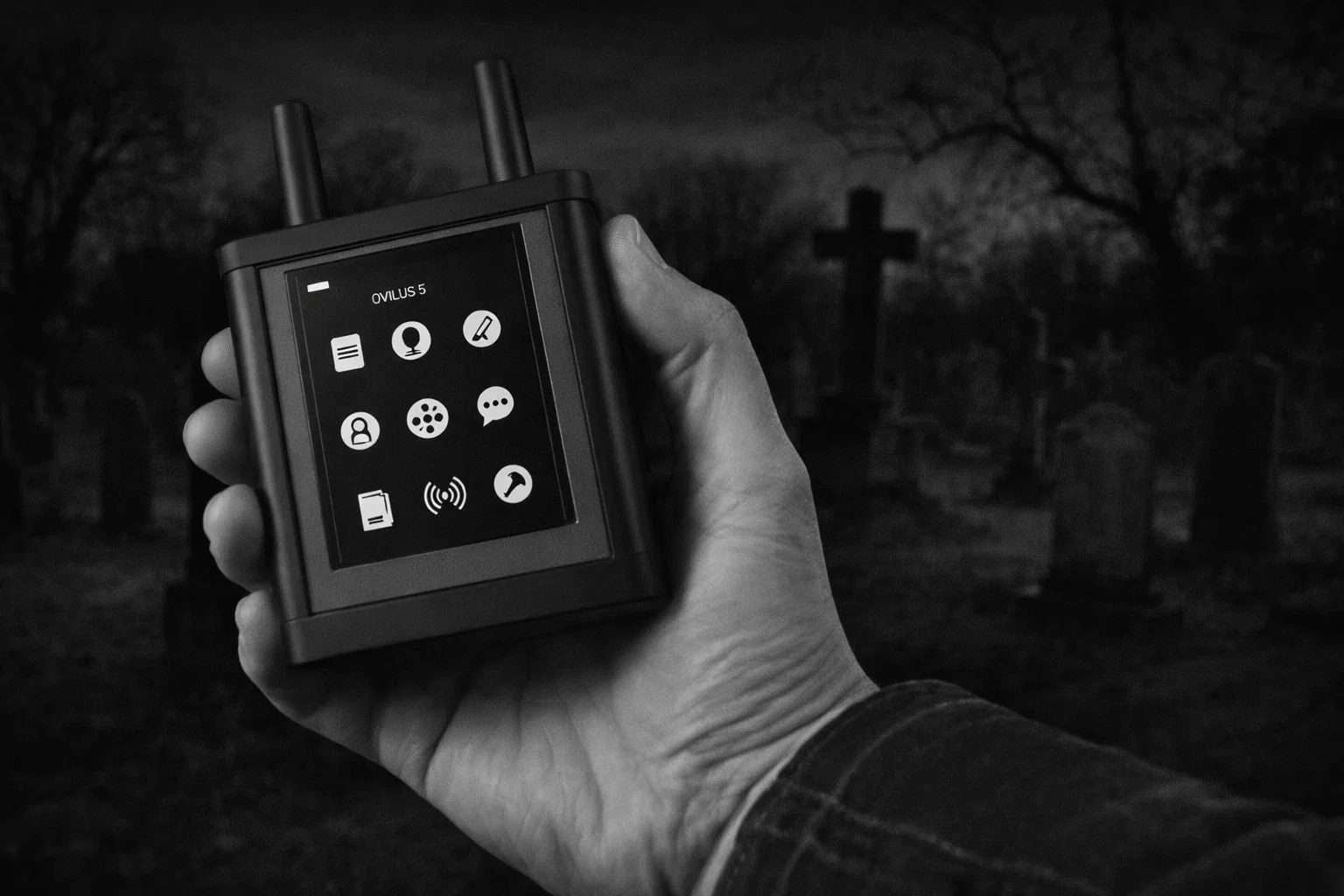
The Ovilus is an electronic device used in paranormal investigations to try to talk to spirits. It often appears on TV shows like “Ghost Adventures” and is advertised as an advanced Instrumental Transcommunication (ITC) tool.
Investigators use it in places believed to be haunted, where it changes environmental readings into spoken words. Still, many people doubt its effectiveness because the technology and data processing are considered unreliable.
Summary
What is an Ovilus?
The Ovilus is described as a “multimodal environmental sensor array that uses an internal processor to map environmental fluctuations to a fixed linguistic index.” The manufacturer calls it a “bridge” to the spirit world, but in practice, how it works is not fully understood.
Bill Chappell from Digital Dowsing created the Ovilus based on the idea that spirits can change electromagnetic fields (EMF) and other energies to pick words from its built-in database. Even though it is used on TV shows like “Ghost Adventures,” many researchers see it as controversial and believe it doesn’t have solid scientific support.
A History of Ghost Hunting Devices
People have tried to use technology to contact spirits since before the digital age. In the 19th century, the Spiritualist movement grew alongside inventions such as the telegraph and the telephone. Early ghost hunters thought that if people could talk across oceans with wires, maybe the dead could use similar signals to communicate.
During this time, people used spirit boards, “spirit trumpets,” and even Thomas Edison tried to imagine a “spirit phone” to detect the energies of the dead.
During the 20th century, people’s interest in ghost hunting tools shifted from seeking comfort to wanting scientific proof. Investigators began using professional equipment such as Geiger counters, tape recorders for Electronic Voice Phenomena (EVP), and EMF meters. They tried to rely less on personal experiences and more on measurable data. This change led to today’s focus on using gadgets to find evidence that can be reviewed later.
The Forbidden Encyclopedia That Makes Every Ouija Session Ten Times More Dangerous
Limited-Time: Up to 49% OFF!
Angels, devils, nature spirits, ancestors, tricksters, and creator gods – all catalogued with their true names, powers, and protocols. Judika Illes created the definitive directory of the spirit realm that practitioners around the world swear by when they need to know exactly who (or what) just answered.

The Evolution of the Ovilus
The Ovilus, as we know it, began in 2007 when electronics engineer Bill Chappell started making equipment specifically for paranormal investigations. The first Ovilus came out in 2008 with a small black-and-white screen and a dictionary of about 512 words. Unlike the Spirit Box, it used internal sensors instead of radio waves.
Over the next twenty years, the Ovilus was updated several times to match new technology:
- Ovilus I & II: Early prototypes that established the “sensor-to-dictionary” method.
- Ovilus III: A popular model that introduced a larger screen, a thermal flashlight, and an expanded library of over 2,000 words.
- Ovilus IV: A more compact version that refined the sensor sensitivity and improved the speech-synthesis quality.
- Ovilus 5 & 5b: The current industry standard, which features a full-color touchscreen, rechargeable lithium batteries, and a suite of eight different modes, including Dictionary, Phonetic, and Draw.
- Ovilus App: A digital version developed for iOS and Android that attempts to replicate the sensor-mapping logic using a smartphone’s internal magnetometers and accelerometers.
You may also enjoy:
Is Maple Hill Cemetery Really Haunted at Night?
May 12, 2025
Who Is Samael? The Angel of Death in Demonology
August 27, 2025
How Does an Ovilus Work?
The basic idea behind the Ovilus is that spirits can change energy and environmental conditions. The device monitors these changes and uses the data to trigger specific outputs from its internal database. It works in several different modes, each offering a unique way to interact.
Dictionary Mode
In this primary mode, the device utilizes a built-in library of approximately 2,048 words (though some models feature larger word banks). The Ovilus monitors the environment for energy fluctuations; when a specific value or combination of readings is detected, it correlates that data to a word in its dictionary and voices it through the speaker.
Proponents suggest this allows entities to select specific words to answer questions. At the same time, critics point out that there is no logical link between a particular EMF value and words like “gate” or “danger.”
Phonetic Mode
Phonetic Mode does not use a dictionary. Instead, it breaks down speech into its basic building blocks, known as phonemes. The device monitors environmental changes and triggers various vocal sounds (such as “ee,” “oh,” or “th”) based on those readings.
This mode is intended to allow entities to form their own words or phrases by stringing sounds together, providing a more fluid, albeit often incoherent, form of communication.
Draw Mode
In Draw Mode, the Ovilus uses environmental readings to make pictures on its screen. When the sensors pick up changes in EMF or temperature, the software turns these into lines or patterns. Investigators sometimes look for shapes that look like letters or faces, but most of the images are abstract.
True/False Mode
This mode is designed for direct questioning. The Ovilus monitors the environment for specific spikes to trigger a “True” (green) or “False” (red) response. It simplifies communication to a binary system based on the intensity of the detected energy.
Ever Walk Into a Room and Instantly Feel Something Watching You?
Millions have used burning sage to force out unwanted energies and ghosts. This concentrated White Sage & Palo Santo spray does the same job in seconds – just a few spritzes instantly lifts stagnation, breaks attachments, and restores peace most people feel immediately.

Energy and Proximity Modes
These modes focus on the visual representation of environmental data. Energy Mode displays fluctuations in electromagnetic fields as a graph on the screen, allowing users to see spikes in real-time. Proximity Mode functions similarly to a theremin, emitting a tone whose pitch or frequency changes when something enters the device’s immediate capacitive field.
Motion and Vibration Mode
This mode uses an internal accelerometer to detect movement or vibrations where the device sits. It is often used to detect signs of footsteps or moving furniture in places thought to be haunted.
Pros and Cons
The Ovilus is a common topic of debate among people interested in the paranormal. It is often used on TV, but many experienced researchers are skeptical because of its mysterious design. Here are the main arguments for and against using it.
Pros:
- Real-Time Interaction: The Ovilus gives instant audio and visual feedback, which is helpful during investigations. Long silences can be discouraging, but the device’s constant activity keeps the team interested and gives them more chances to ask questions, making the process feel more interactive.
- Consolidated Sensor Array: The Ovilus 5 acts like an all-in-one lab. It combines an EMF meter, thermometer, barometer, and hygrometer in one device. This lets investigators track many environmental changes at once without needing lots of equipment, and it can log these changes over time.
- Diversity of Experimental Modes: The Ovilus has eight modes, such as Dictionary, Phonetic, and Draw, giving users many ways to experiment. This flexibility lets researchers try different methods if one is not working, and it provides a range of data—visual, audio, and yes-or-no—in a single session.
Cons:
- Arbitrary Data Mapping: The biggest technical challenge is the lack of is clear connection between environmental data and natural language. For example, there is no scientific reason why a certain EMF reading or a small temperature change should match a word like “murder” or “basement.” Since the manufacturer decides how sensor values link to words, the device mostly turns random environmental changes into words.
- High Susceptibility to Apophenia and User Bias: The human brain is naturally wired to find patterns in random data, a phenomenon known as apophenia. Because the Ovilus dictionary contains many “spooky” or contextually “loaded” words (such as “death,” “help,” or “hidden”), investigators often experience confirmation bias. They may ignore dozens of random, nonsensical words and only focus on the one word that seems to fit the location’s history, falsely interpreting it as an “intelligent response.”
- The “Black Box” Problem: Ovilus’s software is proprietary and not open to users, unlike a digital recorder or a Spirit Box. Investigators cannot tell what caused a word to be chosen, so the results cannot be repeated or checked scientifically. Because of this, many people see the Ovilus as more of an entertainment device than a real scientific tool.
- Vulnerability to Interference: The Ovilus sensors are highly sensitive and can be triggered by everyday objects, not just paranormal activity. Cell phones, walkie-talkies, electrical wiring, or even the paranormal investigator moving can cause EMF spikes or static. The device then turns these normal changes into words, which often leads to false positives.
You may also enjoy:
Who Is the Demon Valefor, the Treacherous Duke of Hell?
August 12, 2025
The Complete List of All Haunted Places in Alaska
November 20, 2025
Is the Gaineswood Plantation Haunting Real or Just Southern Folklore?
September 18, 2025
Ovilus vs Spirit Box
Both the Ovilus and the Spirit Box are considered Instrumental Transcommunication (ITC) tools, but they work in very different ways. The main difference is how they turn environmental data into sound.
The Spirit Box, such as the popular “P-SB7” or “P-SB11”, is essentially a modified radio receiver. It utilizes a high-speed frequency sweep—usually across the FM and AM bands—without stopping on any specific station. This creates a constant stream of white noise and fragmented radio shards. The theory is that spirits can manipulate this raw “audio energy” or use white noise to form their own voices in real time.
In contrast, the Ovilus works as a digital interpreter. It does not listen for outside sounds. Instead, it uses its sensors to measure things like EMF or temperature, then plays a pre-recorded digital voice. This makes the process feel less natural.
A Spirit Box gives a natural audio feed that can be checked for things like tone or accent, while the Ovilus produces a clear, robotic voice. Because the Ovilus selects words via an algorithm, many researchers believe it is less reliable and more likely to produce false results.
The Spirit Box is generally viewed as the more reliable tool because it allows for the capture of Electronic Voice Phenomena (EVP) that can be reviewed for “intelligent” qualities that a computer chip simply cannot replicate.
In a Spirit Box session, an investigator might hear a multi-syllabic response spanning several radio frequencies, which is statistically improbable for a random broadcast.
The Ovilus, however, can only ever say the words it was programmed with, making it a “closed system” that many believe serves more for entertainment than for objective evidence gathering.
Is the Ovilus a Reliable Ghost Hunting Tool?
The Ovilus is a popular tool, but many people question is reliability. Technically, it is based on technology that does not clearly connect environmental data to human language. Since the word list is set and the way words are chosen is unclear, the Ovilus often acts like a digital random word generator.
While the Ovilus can be entertaining or create spooky coincidences, it does not give the solid evidence needed for scientific research. For people seeking real paranormal data, it is often seen as an expensive novelty rather than a precise tool.