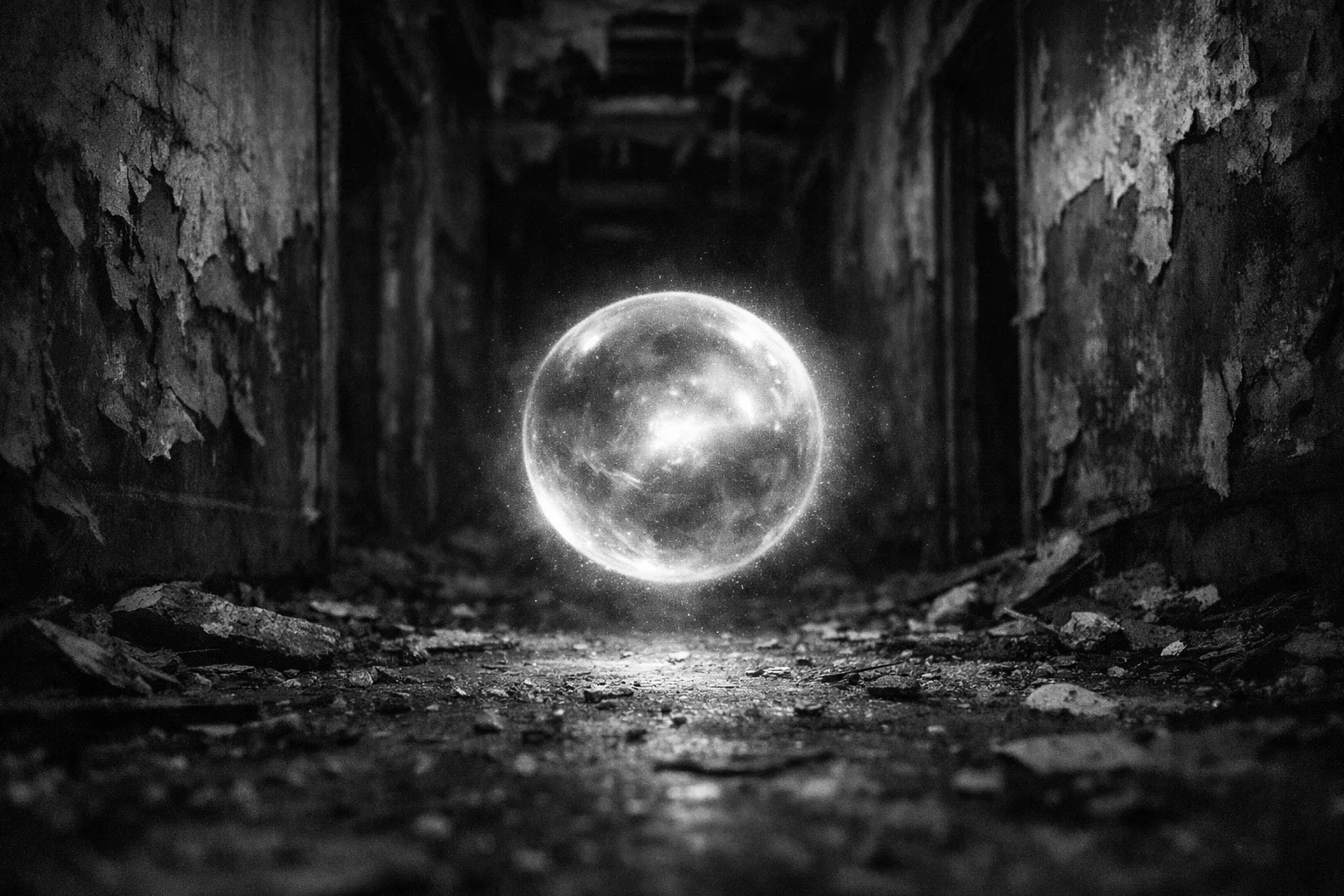
A ghost orb, also known as a spirit orb, is a circular or spherical light anomaly that appears in photographs, video recordings, and occasionally to the naked eye. These objects are typically white or semi-transparent, though they can manifest in various colors.
In the field of paranormal investigation, a ghost orb is often interpreted as an energy manifestation or as the simplest form of a spirit. On the other hand, in the field of photography and optics, these shapes are generally classified as backscatter or “orb artifacts” caused by environmental particles reflecting light into a camera lens.
Summary
What Is A Ghost Orb?
A ghost orb is defined as a free-floating sphere of light or energy. In many paranormal belief systems, it is theorized that spirits require substantial energy to manifest in a fully human form.
Because a sphere is a highly efficient shape for containing energy, it is believed that spirits often take this form when they lack the power to appear as a full apparition. According to the book “The Encyclopedia of Ghosts and Spirits”, these orbs are frequently the first sign of activity in a location thought to be haunted.
Believers suggest that these orbs are the souls of the deceased or other supernatural entities, such as angels or elementals. They are described as three-dimensional and possessing an internal light source.
This distinguishes them from mundane reflections, which depend on external lighting. In a spiritual context, a ghost orb is not merely a visual artifact but a conscious entity that can move intentionally, respond to requests, and interact with its environment.
Demons, Ghosts, and Vengeful Spirits
Limited-Time: Up to 22% OFF!
Something Wicked from Japan – 150+ haunting ukiyo-e masterpieces • Yūrei, yōkai, and oni • Blood-soaked legends • Severed heads • Demonic seduction • Erotic horrors & grotesque beauty. The most terrifying (and beautiful) book of Japanese art ever printed.
The Evolution of Orb Photography
The phenomenon of ghost orbs became much more prominent with the transition from film to digital photography. In the era of film, “spirit photography” usually involved images of misty figures or “ectoplasm.
Orbs were rarely reported or recognized as paranormal evidence during the early 20th century. However, as compact digital cameras became widely available in the late 1990s and early 2000s, the number of reported orb sightings increased a lot.
This technological shift is a major point of discussion in books like “Paranormal Technology: Understanding Investigator’s Tools and Techniques”, which examines how different types of sensors and lenses affect the recording of alleged spiritual activity.
In the mid-1990s, the “orb” became a central fixture in paranormal media. One significant case that brought orb photography to the public eye was the investigation of the Brown Mountain Lights in North Carolina.
Although these lights are often viewed as part of a larger atmospheric phenomenon, researchers using early digital equipment captured smaller, localized spheres that they termed “ghost orbs.” These smaller lights appeared to detach from larger masses, leading investigators to hypothesize that orbs were the fundamental building blocks of spiritual manifestations.
Another important moment in the evolution of this photography happened during the investigation of the Stanley Hotel in Colorado. During the late 1990s, a surge of “orb” photos appeared from the hotel’s ballroom and tunnels.
In these cases, the transition from film to digital was evident: investigators who used film cameras in the same room as those using digital cameras often found that the digital sensors captured dozens of orbs, whereas the film remained clear. This discrepancy led to the first major academic debates within the field.
In the book “Ghost Hunters: True Stories from the World’s Most Famous Demonologists”, it is noted that the proximity of the flash to the lens in digital “point-and-shoot” cameras was the primary driver of this new wave of evidence.
As smartphone technology advanced, the evolution continued. Modern sensors are designed to be more sensitive to light, but they also use software to “clean up” images. This has created a new category of “digital artifacts” that can be mistaken for orbs.
For example, during the 2011 investigation of the Villisca Axe Murder House, many visitors claimed to capture orbs on their mobile devices. Researchers found that the phones’ internal processing often produced “lens flares” or “computational ghosts” that mimicked the appearance of spirit orbs.
The evolution of the orb is, all things considered, inextricably linked to the evolution of the hardware used to view them, moving from the chemical reactions of film to the complex algorithms of modern digital sensors.
You may also enjoy:
Scientific Explanations and Backscatter
The most common scientific explanation for ghost orbs is a phenomenon known as backscatter, also referred to as near-camera reflection. This occurs when a bright light source—typically a camera flash or an infrared LED—reflects off a tiny particle situated very close to the lens. Because the particle is outside the camera’s depth of field, it appears as a blurry, out-of-focus circle.
Several types of environmental particles can cause these artifacts:
- Dust and Pollen: Microscopic motes of dust are present in almost every environment. When a flash fires, these particles reflect the light back toward the sensor.
- Moisture and Rain: Water droplets have a high refractive index. In humid or rainy conditions, hundreds of orbs can appear in a single photograph, often appearing as “bright” or “solid” spheres.
- Insects: Small gnats or flies can appear as glowing orbs when they fly close to a camera’s infrared light. Because they move quickly, they often create “orbs with trails” or “rods.”
A Note on Orb Colors
Ghost orbs can appear in a wide spectrum of colors. While I will not go into detail about the meanings of each specific color here, remember that colors like white, blue, and green are the most common.
In paranormal circles, the color of a spirit orb is often used to interpret the mood or intention of the entity. For instance, white is generally viewed as neutral or positive. In contrast, darker colors such as brown or black are sometimes viewed with greater caution by investigators.
Important Cases of Allegedly Spotted Ghost Orbs
There are several well-known cases in which ghost orbs have been captured by investigators and presented as evidence of the afterlife. At the Myrtles Plantation in Louisiana, a location frequently cited in books such as “The World’s Most Haunted Places”, orbs are a regular occurrence.
One specific case involved a photograph taken in the main hallway, in which a large, translucent orb appeared to be floating at chest height. Believers claim this is the spirit of “Chloe,” a former slave who is said to haunt the property.
In this instance, the orb was not merely a flat circle; it was reported to exhibit a swirling internal motion that was visible even in a still photograph. The photograph was analyzed by experts, who found no evidence of tampering. However, skeptics pointed to the high humidity of Louisiana’s climate as a likely source of moisture-based orbs.
At Waverly Hills Sanatorium in Kentucky, orbs are frequently captured on “ghost hunts.” In one reported case, an investigator used a high-speed video camera and captured a blue orb moving through a doorway in the “body chute” area.
Unlike typical dust, which drifts, this orb appeared to accelerate and decelerate as it moved through the hall. This case is often cited by proponents of the orb theory because the movement did not appear to follow the building’s natural air currents.
Plus, the orb appeared to “dodge” a piece of equipment left in the hallway, suggesting an intelligent navigation that dust particles do not possess.
The Queen Mary, a retired ocean liner in California, provides another significant case study. In the ship’s engine room and boiler room, investigators have captured “cascades” of orbs.
In one important 2005 investigation, a digital video recorder captured a series of bright spheres emerging from a solid wall and traveling toward the camera. These orbs were observed to change in intensity and size as they moved.
While critics argue that the damp, metallic environment is perfect for moisture-based backscatter, some mediums who have visited the ship claim to feel a distinct “pulse” of energy whenever these orbs are photographed, correlating the visual evidence with physical sensations.
In another instance at the Eastern State Penitentiary, a high-profile investigation recorded a “cluster” of orbs in Cellblock 12. These orbs were unique because they appeared to emit their own light, casting a faint glow on the stone walls as they passed. This self-illumination is a key feature often cited to distinguish these cases from dust.
In the book “Ghostology: The Art of Ghost Hunting”, this specific case is used to illustrate how an orb might be a precursor to a full-bodied apparition, as several witnesses reported seeing a shadowy entity in the same cellblock immediately after the orb cluster vanished.
You may also enjoy:
Is Cadborosaurus the Real Sea Serpent of the Pacific Northwest?
November 6, 2025
Differentiating Between Dust and Spirit Orbs
To avoid false positives, experienced investigators use several criteria to judge whether an orb is a potential ghost. One of the primary methods is to analyze the orb’s “nucleus,” or internal structure.
According to many researchers, a dust orb is usually a flat, uniform disk with a “fuzzy” or “halo” edge. In contrast, a spirit orb is said to have a complex internal geometry, often resembling a cellular structure or an onion. If an orb appears to have a “center” or a “nucleus” that is brighter than its edges, it is categorized as a high-interest anomaly.
Another critical factor is the luminosity and light source. A dust orb is entirely dependent on the camera’s flash; it is essentially a reflection. That’s why an orb is captured in a photograph taken with natural light or in a “no-flash” environment is considered much more likely to be paranormal.
Investigators also look for “self-shadowing,” or instances in which the orb appears to be behind objects in the room. If an orb is partially obscured by a chair or a person, it proves that the object exists in three-dimensional space at a distance from the camera, rather than being a microscopic particle right against the lens.
The path of motion in video recordings provides perhaps the most convincing differentiation. Dust particles and insects are subject to fluid-dynamic laws; they move with air currents or exhibit erratic, zigzagging patterns typical of flight.
A ghost orb, however, is often recorded moving in a direct, purposeful line or executing sharp, 90-degree turns that would be physically impossible for a drifting particle. Some investigators use “trigger objects,” such as balls or flashlights, and observe whether orbs move toward them on request. This intelligent interaction is a hallmark of what researchers call a “true orb.”
Finally, investigators consider the environmental context. If a single orb appears in a clean, controlled environment where there is no air movement, it is given more weight than dozens of orbs captured in a dusty attic or a rainy field.
Many modern teams use air-quality monitors to measure dust levels in a room in parts per million (ppm). If an orb is photographed when the dust count is low, the evidence is considered scientifically stronger.
In the book “The Ghost Hunter’s Survival Guide”, it is recommended that investigators always take “baseline” photos to understand how dust behaves in a specific location before claiming any anomaly is a spirit. By comparing the size, brightness, and motion of baseline particles with those to the target anomaly, researchers can more accurately identify a genuine spirit manifestation.
Conclusion
The study of ghost orbs remains a controversial subject that sits at the intersection of optical science and spiritual belief. While many “orbs” can be objectively explained as reflections of dust, moisture, or insects, the persistence of sightings at historically significant and supposedly haunted locations continues to fuel debate.
Whether these spheres are mere artifacts of modern camera technology or the simplest manifestations of the human soul, they remain a staple of contemporary paranormal research.