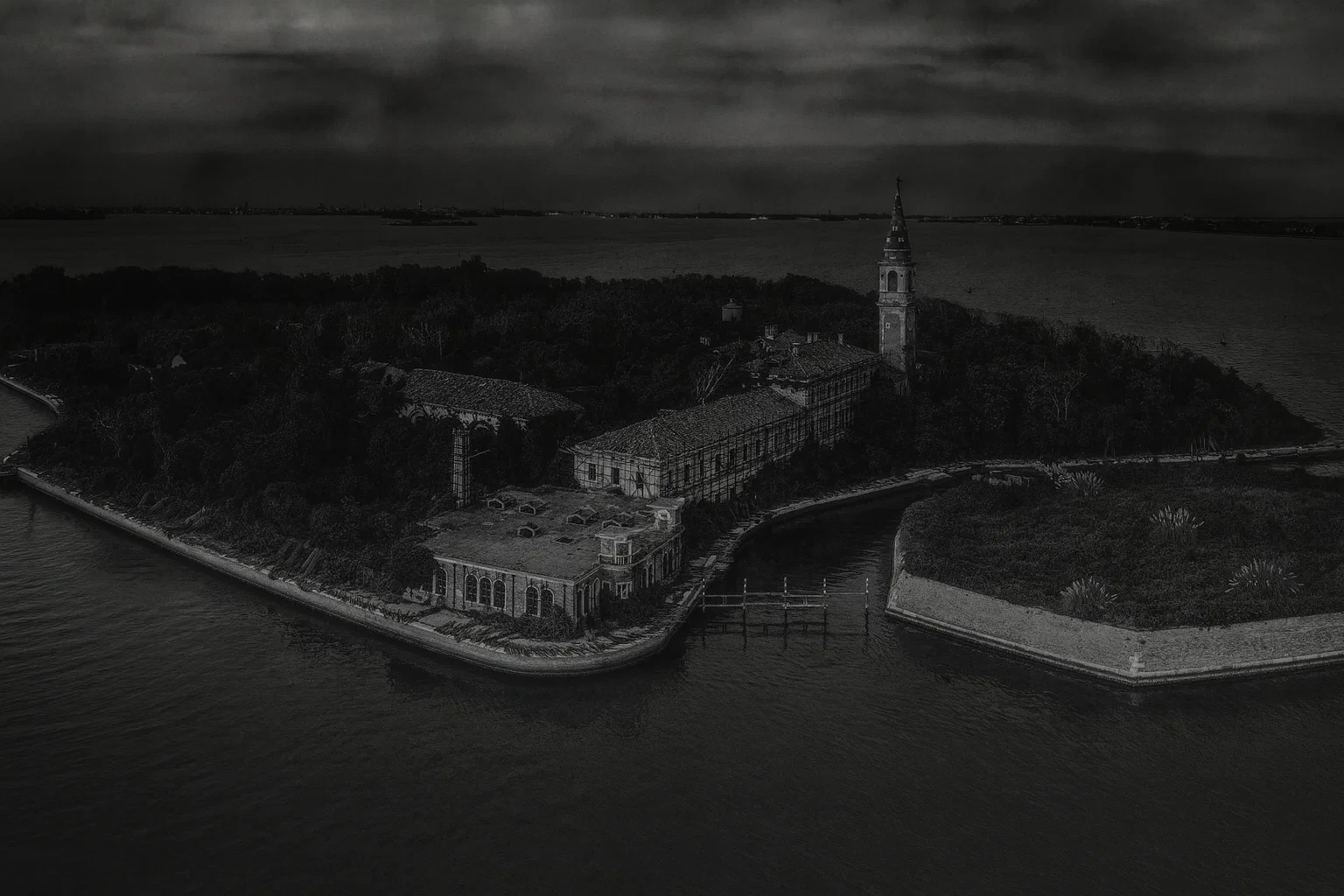
Poveglia Island is a small, restricted landmass in the Venetian Lagoon, Italy. The site is associated with centuries of immense suffering, initially as a plague quarantine station where tens of thousands died, and later as a site of psychiatric experimentation.
The place is widely regarded as one of the most haunted in the world, primarily for to intense residual energy and intelligent manifestations from its vast population of deceased inhabitants.
Summary
Key Takeaways
| Attribute | Details |
| Name | Poveglia Island — Island of the Dead, Island of No Return, Isola della Poveglia |
| Location | Venetian Lagoon, Venice, Italy |
| Longland Scale | L-7 [See the Longland Scale Explanation] |
| History | Used as a “lazaretto” (quarantine station) during plague epidemics (1776–1814) and later as an asylum/geriatric center (1922–1968). |
| Death Toll | 100,000–160,000 confirmed historical deaths (Plague victims and hospital patients) |
| Type of Haunting | Residual, Intelligent, Apparitions, Ghosts (General), Poltergeist, Curse |
| Lunar / Seasonal Pattern | The phantom bell is allegedly heard ringing during foggy, misty nights over the lagoon. |
| Entities | Masses of plague victims, the Mad Surgeon, the girl Little Maria, asylum patients. |
| Manifestations | Disembodied screams, moans, laughter, shadowy figures, cold spots, the phantom ringing of a bell, physical attacks (scratches, pushes), feelings of intense dread, technological anomalies (EVP). |
| First reported sighting | 14th Century (During first documented use as a mass burial site.) |
| Recent activity | Paranormal investigations have reported EVPs and motion sensor triggers in the abandoned hospital since the mid-2000s. |
| Threat Level | 9/10 (life-threatening/demonic) [See the Threat Level Explanation] |
| Hoax Confidence Rating | 3/10 (Probably authentic) [See the Hoax Confidence Rating Explanation] |
| Open to the public? | No. The island is officially restricted by the Italian government. Visiting requires special permission from the Municipality of Venice, usually for research or filming purposes. |
What Is the Poveglia Island Haunting?
The Poveglia Island haunting is defined by the immense mortality rate that has taken place on its confined space over centuries. The alleged haunting is classified as both residual and highly intelligent. The residual element is attributed to the estimated 100,000 to 160,000 souls who perished in agony during the plague epidemics, leaving a palpable imprint of suffering on the land.
The intelligent aspect focuses on specific, recognizable entities, primarily the alleged Mad Surgeon who performed crude lobotomies in the hospital during the 1920s and 30s.
Reports from the former asylum era and from modern visitors include mysterious screams, aggressive poltergeist activity (scratches and pushes), and sightings of apparitions of victims and staff, suggesting a high concentration of both patterned energy and conscious spirits who remain trapped on the island.
The Forbidden Encyclopedia That Makes Every Ouija Session Ten Times More Dangerous
Limited-Time: Up to 49% OFF!
Angels, devils, nature spirits, ancestors, tricksters, and creator gods – all catalogued with their true names, powers, and protocols. Judika Illes created the definitive directory of the spirit realm that practitioners around the world swear by when they need to know exactly who (or what) just answered.

Poveglia Island Haunted History
Poveglia Island has a history stretching back to 421 AD, when refugees from the Italian mainland first settled there. The island was a peaceful, thriving community until the 14th century, when the residents were relocated due to military conflicts.
After the relocation, the island remained largely abandoned until 1776, when the Venetian Public Health Office took control and repurposed it as a maritime customs and quarantine checkpoint. This function quickly transformed into a role of profound tragedy.
The true horror began with the major plague outbreaks that ravaged Venice. Poveglia was designated as the primary dumping ground for the sick and the deceased when the other two lazaretti (quarantine stations) became overwhelmed.
Citizens exhibiting any symptoms were forcibly removed from the city and confined to the island. The volume of casualties was overwhelming, necessitating the construction of massive plague pits where bodies were buried, and increasingly, burned in outdoor pyres.
Historical estimates indicate that the island received up to 160,000 corpses during this period, resulting in layers of human remains that fundamentally altered the soil composition.
Following the closure of the lazaretto in 1814, the structures were eventually converted into a geriatric center and later a psychiatric hospital in 1922. This chapter added a layer of human-inflicted suffering. This period generated the central legend of the Mad Surgeon, who reportedly subjected patients to barbaric lobotomies using crude, non-surgical instruments in the hospital tower.
The asylum was finally closed in 1968. The island’s grim reputation persisted, connecting the trauma of the plague victims directly to the psychological abuse of the asylum era.
You may also enjoy:
Asag: The Grotesque Plague-Bringer Demon of Mesopotamia
September 30, 2025
Kelpie: The Deadly Water Horse That Feeds on Human Victims
December 9, 2025
What Is Mpisimbi, The Strange African Leopard-Hyena Cryptid?
February 6, 2026
Poveglia Island Ghost Sightings
The reports of paranormal activity on Poveglia Island cover over two centuries, escalating in detail following the abandonment of the hospital in 1968. Reports range from sounds consistent with residual trauma to aggressive, physically interactive events suggestive of highly intelligent or poltergeist activity.
| Date/Era | Reporter/Source | Brief Summary of Event | Type of Manifestation |
| 1920s-1930s (Asylum Era) | Hospital Patients | Patients claimed to be tormented by the apparitions and voices of plague victims in the hospital halls. | Apparitions, Intelligent |
| 1930s (Asylum Era) | Nurses/Staff (Legend) | A nurse allegedly saw a black mist envelop the Mad Surgeon after he survived the fall from the bell tower. | Apparitions, Manifestations |
| Post-1968 | Local Fishermen | Hearing the tower’s bell ring loudly across the lagoon, despite the bell being removed. | Manifestations (Auditory, Residual) |
| Post-1968 | Fisherman Giovanni | Allegedly spent 15 nights on the island; reported being repeatedly pushed by the ghost of “Paolo,” a doctor. | Poltergeist, Intelligent |
| 1980s | Venetian Family (attempting reoccupation) | Family fled after their daughter claimed she was physically attacked by a dark entity. | Poltergeist, Intelligent |
| Undated (Locals) | Fishermen/Locals | Report seeing the ghost of Little Maria, a young child who died of the plague, crying on the beach. | Apparitions |
| Undated (Locals) | Fishermen/Locals | Report hearing the phantom wheelchair of the patient Pietro speeding down the main corridor. | Manifestations (Auditory) |
| 2007 | American Urban Explorers | Group members allegedly suffered physical scratches and were tormented by aggressive, demonic voices in the asylum ruins. | Poltergeist, Demonic |
| 2009 | Paranormal Investigation Crew | Captured EVP evidence of disembodied speech and unexplained motion sensor triggers in the upper wards of the hospital. | EVPs, Intelligent |
The Phantom Bell Ringing (Post-1968)
The most consistent and widely reported anecdotal phenomenon involves the bell tower of the main hospital structure. Although the bell itself was removed following the asylum’s closure, local fishermen have repeatedly and independently claimed to hear its distinct phantom ringing across the water, particularly during periods of high fog or at night.
The phenomenon is often attributed to a powerful residual echo, a passive energy imprint of a sound that was once central to the island’s functions, or alternatively, a crisis apparition of the sound itself, a distress call perpetually relived by the island.
The Attack on the American Trespassers (2007)
One of the most extreme reported events happened when a group of American urban explorers illegally accessed the island. After spending time inside the abandoned hospital, they claimed the atmosphere became intensely hostile.
The climax of their reported experience was the alleged physical injury of one of the group members, who reportedly received unexplained, deep scratches on his body. The group insisted they were being tormented by aggressive, demonic-sounding voices and had to be evacuated by local authorities.
Proponents of a strong haunting argue that this instance is clear evidence of a powerful, physically active, and intelligent entity.
Tired of Bad Luck, Dark Spirits, and Toxic Vibes Draining Your Life?
Limited-Time: Up to 25% OFF!
Natural Black Tourmaline Crystal Healing Pendant – Genuine raw tourmaline • Absorbs & transmutes negativity • Guards against psychic attacks & hauntings • Deep spiritual cleansing for home & body • Purifies chakras & spaces from bad vibes. A portable force field—essential for sensitive souls in chaotic times.

The Mad Surgeon (1930s Legend)
During the psychiatric hospital’s operation, a popular staff legend arose concerning the Head Surgeon. The story claims that the surgeon, having performed numerous cruel experiments, began to see the ghosts of the plague victims and his own tormented patients.
Driven to madness, he leaped from the bell tower. While he survived the fall, a nurse allegedly witnessed a black mist envelop his body, suffocating him. This widely circulated account is cited as the origin of the Mad Surgeon’s restless, intelligent spirit now alleged to roam the ruins.
The Poveglia Island Case File
Poveglia Island’s haunting is distinguishable by several factors unique to its historical role and cultural folklore, creating a highly specific case profile.
The Human Ash Composition of the Soil
The island is uniquely controversial due to the persistent claim that its soil is heavily contaminated with the ashes and remains of human bodies.
Due to the high number of deaths and the reliance on mass cremation during the plague, it is asserted that up to 50 percent of the island’s soil is composed of human ash. Although the exact percentage remains unverified, the existence of massive, historically documented plague pits (mass graves) is confirmed.
This circumstance supports a highly specific version of the Stone Tape Theory, where the sheer physical presence of the deceased biomass acts as a permanent, powerful capacitor for residual trauma energy, making Poveglia distinct from other ghost sites.
You may also enjoy:
Sallos: The Mysterious Demon of Love
August 13, 2025
What Is a Satyr, the Lust-Driven Monster of the Wild?
November 14, 2025
Ohio State Reformatory Haunting: A Legacy of Death and Despair
October 24, 2025
Villisca Axe Murder House Haunting—A Chilling True Story
October 22, 2025
The “Vampire Panic” and Post-Mortem Mutilation
A dark, documented historical detail from the quarantine period is the practice of placing rocks in the mouths of certain corpses. Archaeological findings, especially on the nearby Lazzaretto Vecchio (often referenced alongside Poveglia), revealed bodies with stones forcibly wedged in the jaw.
This practice originated from a 16th-century superstition that individuals whose decomposing bodies exhibited blood leaking from the mouth were vampires or plague-suckers attempting to spread the disease further.
This rare and bizarre fear of the undead among the plague victims highlights a unique cultural panic that adds a distinct layer of fear and curse to the island’s profile, distinct from the disease itself.
Resistance to Redevelopment
Since its abandonment in 1968, Poveglia has resisted all attempts at human resettlement and commercialization, a major point of discussion in the case file. Multiple renovation efforts have been abruptly abandoned by construction crews, and the highly publicized 2014 auction of a 99-year lease to an Italian businessman, Luigi Brugnaro, was later annulled without a clear public explanation.
The consistent failure of efforts to reoccupy or redevelop the island is cited as circumstantial evidence that the location is actively cursed or that the intelligent entities are aggressively protecting their domain from the living.
This resistance has created a local reputation that the island is literally the “Island of No Return” for anyone who attempts to claim it.
What If One Crystal Tower Could Flush Out Spirits, Bad Vibes, and Years of Bad Luck?
Limited-Time: Up to 12% OFF!
Purification Black Tourmaline Crystal Tower – Authentic raw black tourmaline obelisk • Neutralizes harmful ghosts & jinxes • Clears emotional & energetic blockages for prosperity • Root-strengthening ally in crystal grids. From ancient earth veins, designed for modern metaphysical warriors.

Theories
The Poveglia Island case demands a multidisciplinary approach due to the combination of extreme historical trauma and consistent, aggressive reports of paranormal phenomena. The proposed theories often blend scientific principles with case-specific anomalies.
Geomagnetic Amplification and Mineral Composition
This case-specific theory claims that the high concentration of mineral-rich soil, including the calcified human ash and the island’s placement in the fluctuating Venetian Lagoon, acts as a geophysical energy battery.
Geological stress, such as minor tectonic movements or the natural flow of the lagoon’s water, could generate low-frequency electromagnetic fields and piezoelectric currents.
These fields are believed to interact with the human temporal lobe, inducing phenomena such as auditory hallucinations (e.g., the phantom bell), visual distortions (e.g., shadowy figures), and overwhelming feelings of dread, which are then subjectively interpreted as paranormal attacks.
The “Dark Portal” Hypothesis
The Dark Portal Theory is a highly specific, non-scientific hypothesis sometimes applied to locations of extreme, concentrated violence and death.
Proponents suggest that Poveglia’s repeated layering of horrific trauma—plague, mass burning, and cruel psychiatric experimentation—has created a vortex of negative energy. This vortex is hypothesized to be a portal or dimensional thinning point through which malevolent or non-human entities, classified as demonic or elemental, can more readily manifest or cross into the physical world.
The bell tower, due to its height and spiral structure, is often cited as a potential focal point for this vortex energy. The increasingly aggressive nature of the later reported sightings supports the notion that an entity of higher negative intelligence has established a presence.
The Psychogenic Contagion and Suggestibility Model
This psychological theory addresses the high threat level and reports of aggression. According to this idea, the sheer volume of macabre history acts as a massive suggestion anchor. Visitors, including investigators, arrive with profound fear and expectation (a form of psychological priming).
This heightened state of anxiety makes them hyper-sensitive to natural stimuli (creaks, drafts, infrasound) and incredibly susceptible to the Nocebo Effect, where the belief in harm causes harm.
The fear itself, once shared among a small group, can rapidly escalate into mass hysteria or psychogenic contagion, resulting in shared hallucinations and even psychosomatically induced physical symptoms such as scratches and sickness.
Infrasound and Structural Vibrations
This scientific theory implies that the dilapidated structures on the island, particularly the large hospital wards and the tower, act as resonators. Wind passing over the ruins or wave action from the lagoon may generate infrasound—sound waves below 20 Hz, which are generally inaudible but physiologically detectable.
Infrasound is scientifically documented to cause feelings of anxiety, dread, panic, and even visual field distortions in humans, providing a non-paranormal explanation for the consistent reports of intense fear and the presence of shadowy figures observed on the island.
You may also enjoy:
Orthrus: The Two-Headed Hellhound of Greek Mythology
December 4, 2025
Demon Bifrons – The Two-Faced Necromancer of Hell
August 11, 2025
Forneus: The Terrifying Sea Demon of the Ars Goetia
August 21, 2025
Poveglia Island vs Other Haunted Locations
| Name | Location | Type of Haunting | Activity Level |
| Eastern State Penitentiary | Philadelphia, USA | Intelligent | 7/10 (very active) |
| The Tower of London | London, England | Apparitions | 5/10 (occasional) |
| Waverly Hills Sanatorium | Louisville, USA | Intelligent, Poltergeist | 9/10 (very active) |
| Bhangarh Fort | Rajasthan, India | Curse | 8/10 (very active) |
| The Queen Mary | Long Beach, USA | Residual, Intelligent | 6/10 (occasional) |
| Island of the Dolls | Xochimilco, Mexico | Curse, Ghosts (General) | 7/10 (very active) |
| Stanley Hotel | Estes Park, USA | Intelligent, Poltergeist | 6/10 (occasional) |
| Ancient Ram Inn | Wotton-under-Edge, England | Demonic, Intelligent | 10/10 (extremely active and dangerous) |
| Edinburgh Castle | Edinburgh, Scotland | Residual, Apparitions | 5/10 (occasional) |
| Myrtles Plantation | St. Francisville, USA | Ghosts (General), Intelligent | 8/10 (very active) |
| Winchester Mystery House | San Jose, USA | Ghosts (General) | 4/10 (occasional) |
| Château de Brissac | Brissac-Quincé, France | Apparitions | 3/10 (dormant) |
Is Poveglia Island Haunting Real?
The idea that Poveglia Island is haunted is difficult to refute due to the sheer volume of documented historical trauma it contains. The fact that the island served as the final, agonizing resting place for an estimated 100,000 to 160,000 people creates a profound case for residual energy, a form of haunting that requires no conscious intelligence to manifest.
However, the more extreme claims, such as the Mad Surgeon’s suicide and the physically aggressive attacks reported by modern trespassers, often originate from unverified legends amplified by media and the island’s restricted access.
While history provides a powerful catalyst for folklore, the lack of impartial, non-sensationalized investigation means the paranormal nature of the aggressive entities remains unproven.
The island is demonstrably a site of historical tragedy, but whether it is truly a nexus of malignant spirits remains an open yet highly compelling question.