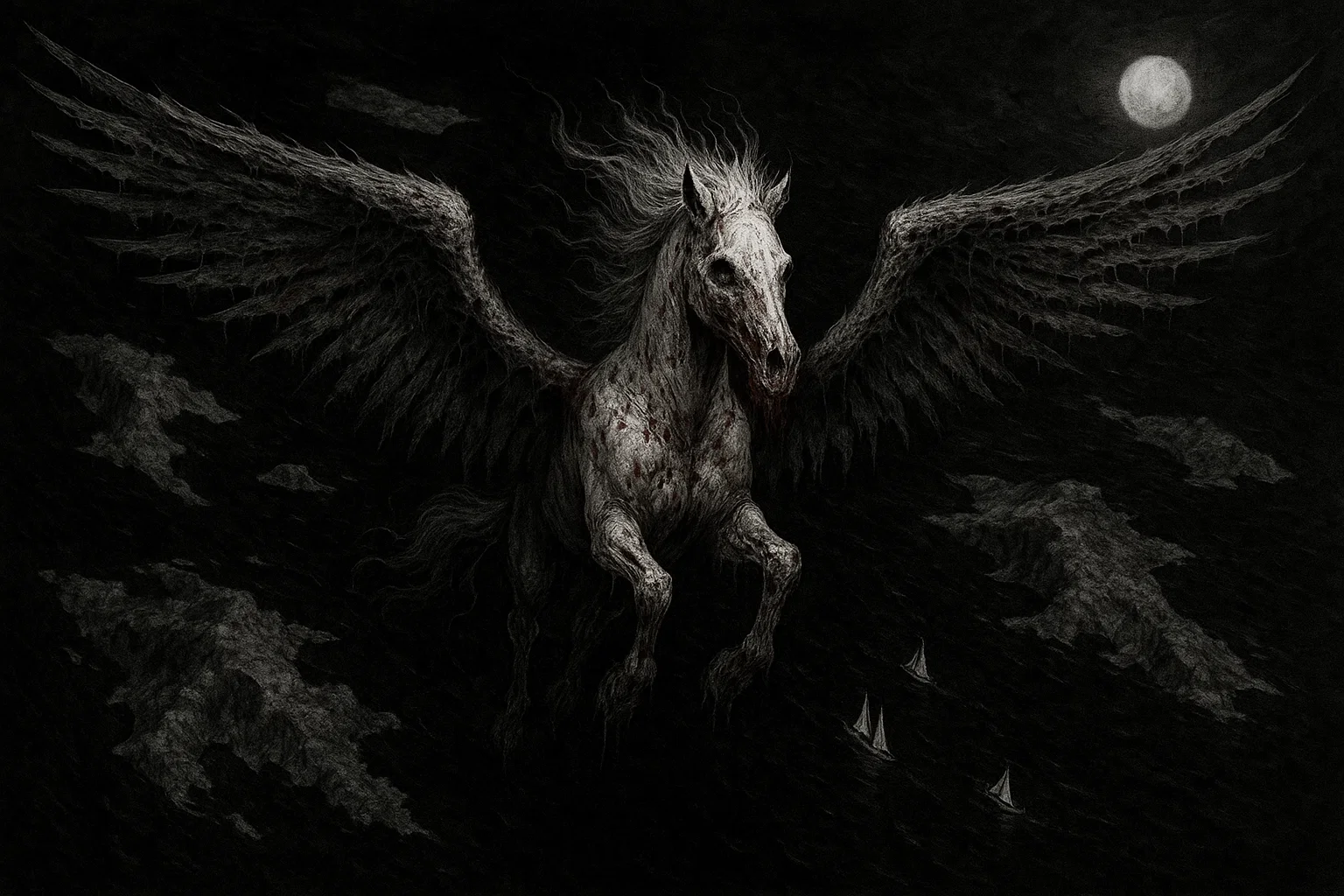
Pegasus is a creature in Greek mythology, recognized as a divine winged horse that has captivated storytellers and artists since antiquity. Unlike many mythological beasts born of chaotic forces, Pegasus is intrinsically linked to heroic deeds, associated with figures such as Bellerophon and his triumph over the Chimera.
The existence of Pegasus is often connected to the elements of water and air, as he was born near the ocean and can soar through the skies. Plus, his hoof strikes are said to have created the Hippocrene spring on Mount Helicon, a fountain sacred to the Muses and a traditional source of poetic inspiration.
Summary
Key Takeaways
| Attribute | Details |
| Names | Pegasus; derived from Greek Πηγασoς (Pēgasos), likely related to πηγη (pēgē) meaning ‘spring’ or ‘water source’ |
| Nature | Divine creature; sacred to the Muses |
| Species | Beast; specifically a horse |
| Appearance | A magnificent, pure white horse with large, feathered wings |
| Area | Greece, particularly the Acropolis of Corinth and Mount Helicon (Boeotia) |
| Creation | Born from the sea foam and blood of the Gorgon Medusa after her decapitation by the hero Perseus |
| Weaknesses | No inherent divine weaknesses documented; mortal capture was possible but challenging |
| First Known | Late 8th century BCE, mentioned in Hesiod’s Theogony |
| Myth Origin | Greek mythology, specifically the Gorgon myth and the heroic cycle of Bellerophon |
| Strengths | Flight, super-speed, celestial immortality (catasterism) |
| Associated Creatures | His twin brother Chrysaor, the Gorgon Medusa (mother), Poseidon (father), and the hero Bellerophon |
| Lifespan | Immortal; ascended to the heavens as a constellation |
| Habitat | The heavens, Mount Helicon, Mount Parnassus (where the Muses resided) |
Who or What Is Pegasus?
Pegasus is one of the most identifiable creatures in Greek mythology. He is universally described as an immaculate, majestic white horse distinguished by a pair of large, feathered wings extending from his back. His lineage is divine, born from the union of the Olympian god of the sea, Poseidon, and the mortal Gorgon, Medusa. This parentage ties him to both the primordial forces of the sea and the monstrous, chthonic world.
The creature’s birth is unique and dramatic, occurring immediately after the hero Perseus decapitated Medusa. Pegasus sprang forth from Medusa’s neck, either from the blood that spilled onto the earth or emerging fully formed from the wound itself, sometimes alongside his twin, the golden giant Chrysaor.
When it comes to mythology, Pegasus is often a symbol of divine inspiration and the transcendence of the mortal world, due to his ability to fly and his association with the Muses. His main role in the most famous myths is as the devoted steed of the Corinthian hero Bellerophon, aiding the mortal in his impossible task of defeating the Chimera.
The Forbidden Encyclopedia That Makes Every Ouija Session Ten Times More Dangerous
Limited-Time: Up to 49% OFF!
Angels, devils, nature spirits, ancestors, tricksters, and creator gods – all catalogued with their true names, powers, and protocols. Judika Illes created the definitive directory of the spirit realm that practitioners around the world swear by when they need to know exactly who (or what) just answered.
Genealogy
| Relationship | Figure |
| Father | Poseidon (God of the Sea and Horses) |
| Mother | Medusa (The Gorgon) |
| Sibling | Chrysaor (The Golden Giant) |
| Master | Bellerophon (Corinthian Hero) |
| Rider/Wielder | Zeus (After Bellerophon’s fall) |
Etymology
The name Pegasus in Greek is Πηγασoς (Pēgasos). The most commonly accepted etymological derivation links the name to the Greek word πηγη (pēgē), which translates to ‘spring’, ‘well’, or ‘water source’. This connection is logical, considering his mythical origins and his association with famous springs.
Pegasus’s birth from the neck of Medusa occurred near the Ókeanos (Oceanus), the world-encircling river, and the name may be interpreted as meaning ‘born near the springs’ or ‘the one from the springs’. This interpretation is reinforced by his role in creating the Hippocrene spring (‘Horse’s Fountain’), a spring on Mount Helicon in Boeotia sacred to the Muses, which reportedly gushed forth where Pegasus struck his hoof.
In some early accounts, the word πηγαi (pēgai), the plural of pēgē, could be used to refer to the springs of the sea or the sources of the Nile, suggesting a primordial, oceanic birth. The link to Poseidon, the god of the sea and horses, further strengthens the aquatic root of the name.
However, some researchers suggest a pre-Greek origin, arguing that the term may have been adopted from an earlier Anatolian or Luwian language, though the evidence for this is less definitive. Regardless of its deepest origins, the name is inseparable from the themes of water, birth, and the source of poetic inspiration in classical Greek tradition.
What Does the Pegasus Look Like?
Pegasus is consistently described across all classical sources as an equine entity of extraordinary beauty and scale. The primary and most defining characteristic is that of a magnificent, large horse possessing a coat of pure, dazzling white. This coloration is often interpreted as symbolizing purity, divinity, and celestial origin.
Extending from his back are two immense, feathered wings similar to those of an eagle or a swan, but of a size capable of propelling the horse through the air at incredible speed. These wings are typically depicted as pure white, the same color as his coat.
Unlike common horses, Pegasus is portrayed as inherently powerful and untamed—a spirited, muscular creature whose divine lineage makes him swift and agile both on land and in the air. His appearance remains remarkably stable throughout Greek and Roman mythology and subsequent artistic interpretations, always maintaining the essential form of a white-winged stallion, free of monstrous features beyond the wings themselves.
You may also enjoy:
What Is the Snallygaster Monster and Why Does It Terrify Maryland?
September 26, 2025
Incubus: Demon of Lust and Nightmares
August 22, 2025
Merihem: The Demon of Pestilence and the Red Death
September 1, 2025
Aeacus the Underworld Judge: Horror Stories from Greek Mythology
September 9, 2025
Jormungandr: The Midgard Serpent Destined to End the Gods
September 12, 2025
Mythology
Pegasus’s mythology begins with his spectacular birth, detailed most especially in Hesiod’s Theogony, which dates to the late 8th century BCE. Hesiod describes how Medusa, pregnant by the god Poseidon, gave birth to both Pegasus and his brother Chrysaor at the moment her head was severed by Perseus: “But when at last his head was severed, out sprang great Chrysaor and the horse Pegasus.”
Following his birth, Pegasus immediately ascended to Mount Helicon. There, one of his most important mythological acts occurred: the creation of the Hippocrene spring.
The Muses, the goddesses of the arts and sciences, asked Pegasus to halt the swelling of Mount Helicon, which was growing too large due to their harmonious singing. Pegasus struck his hoof against the rock, and instantly, the Hippocrene spring—literally the ‘Horse’s Fountain’—gushed forth. This act established Pegasus’s enduring connection to inspiration and poetry.
His second, and perhaps most famous, role involves the hero Bellerophon. The hero, a prince of Corinth, was tasked with defeating the monstrous Chimera, a creature combining the parts of a lion, a goat, and a serpent.5 Realizing the need for a celestial advantage, Bellerophon sought to capture Pegasus. Different accounts suggest he achieved this either through the intervention of the goddess Athena, who gave him a golden bridle, or by finding Pegasus drinking at the spring of Peirene near his home city of Corinth.
Mounted on Pegasus, Bellerophon was able to attack the Chimera from the air, safely avoiding its fiery breath until he was able to slay it. After his victory, Bellerophon’s success led to his downfall. In his hubris, he attempted to ride Pegasus to Mount Olympus to join the gods.
Zeus, the king of the gods, was angered by the mortals’ insolence. Accounts state that Zeus either struck Bellerophon with a thunderbolt or sent a gadfly that stung Pegasus, causing the horse to buck and throw the hero back to Earth.
Pegasus, now riderless, continued his ascent to Olympus, where he was accepted into the service of the gods. He became Zeus’s dedicated steed, carrying the god’s thunderbolts, and later, in his immortality, Pegasus was transformed into a constellation in the night sky, known as Pegasus, securing his legacy as an eternal symbol of celestial flight and divine service.
Why Do So Many Successful People Secretly Wear a Little Blue Eye?
Limited time offer: 28% OFF. For thousands of years, the Turkish Evil Eye has quietly guarded wearers from the unseen effects of jealousy and malice. This authentic blue glass amulet on a soft leather cord is the real thing – beautiful, powerful, and ready for you.

Legends
The Capture of Pegasus by Bellerophon
The tale of Pegasus’s capture is a critical prelude to Bellerophon’s greatest feats. The hero Bellerophon, having fled from his home and found refuge with King Proetus, was later sent on a deadly mission by the king’s jealous wife, Stheneboea (or Anteia), who falsely accused him.
The most famous of these missions was the slaying of the Chimera. Realizing that he needed a formidable ally to defeat the beast, Bellerophon focused on capturing the divine winged horse. The Greek writer Pindar, in his Olympian Ode 13, tells one version of the story: “By Athena’s power, he bound the winged steed to the bridle, and upon his back wrought the death of the fiery-breathing Chimera.”
Bellerophon reportedly went to the fountain of Peirene in Corinth, a place where Pegasus was known to frequent to drink.10 While Bellerophon waited, the goddess Athena appeared before him in a dream or a physical manifestation and presented him with a golden bridle.
After awakening, he found the bridle in his hands. He then waited until Pegasus descended to drink from the spring and was able to easily place the magical bridle on the horse’s head, instantly taming the divine steed and binding it to his will. The swift and successful taming is often attributed entirely to the goddess’s divine intervention, underscoring the impossibility of a mere mortal capturing Pegasus without celestial aid.
The Defeat of the Chimera
The central and most famous legend involving Pegasus is his role in the defeat of the Chimera. This tripartite monster was ravaging the land of Lycia.
The beast was described as having the head of a lion, the body of a goat, and a serpent’s tail, and possessing the terrible ability to breathe fire. King Iobates of Lycia, having received a tablet from Proetus requesting Bellerophon’s death, tasked the hero with this seemingly impossible deed.
Mounted on Pegasus, Bellerophon approached the lair of the Chimera. Crucially, the speed and aerial maneuverability of Pegasus allowed Bellerophon to stay well out of range of the creature’s deadly fire. As the hero flew above the beast, he shot arrows at it, but these were largely ineffective.
A more dramatic version of the legend states that Bellerophon devised a clever plan. He affixed a large lump of lead to the tip of his spear. Flying high and then making a swift, diving pass, Bellerophon drove the lead-tipped spear into the Chimera’s mouth, down its throat.
The fiery breath of the monster melted the lead, which then flowed down into the creature’s body, choking and burning its internal organs until the Chimera was dead. Without the ability to fly and attack from a safe altitude, a feat possible only with Pegasus, Bellerophon would have perished.
You may also enjoy:
Japanese Horror: The Terrifying Ghost of Aka Manto
June 4, 2025
The Japanese Kappa Monster: A Dark Obsession With Humans
September 9, 2025
Malaga Inn Haunting: Why Room 007 Terrifies Guests to This Day
September 22, 2025
The Legend of Umibozu: Japan’s Most Frightening Ocean Yokai
September 10, 2025
What Is a Ghost Orb and Why Do They Appear in Photos?
January 5, 2026
What Is an Afreet? Origins, Powers, and Myths
January 26, 2026
The Catasterism of Pegasus
The final stage of Pegasus’s legend is his apotheosis and transformation into a constellation.
After the successful defeat of the Chimera, Bellerophon’s vanity grew. The hero came to believe that his successes had made him equal to the gods, and he decided to ride Pegasus to the summit of Mount Olympus to claim his place. Zeus, who tolerated no such mortal arrogance, would not permit this ultimate act of impiety.
In most accounts, as Pegasus soared toward the heavens with the brazen hero on his back, Zeus sent a gadfly (oestrus) to sting the divine horse. Stung and driven mad by the pain, Pegasus violently reared and bucked, throwing Bellerophon back to earth.
The fallen hero was crippled or blinded and spent the rest of his life wandering in lonely disgrace, “a miserable and solitary figure,” as Homer describes him in the Iliad.
Pegasus, having shaken off his disrespectful mortal burden, continued his ascent alone and arrived at Olympus. He was immediately taken into the service of Zeus and tasked with carrying the thunderbolts and lightning bolts of the supreme god. Later, to commemorate his service and his unique place in mythology, Zeus honored Pegasus by placing him among the stars.
Pegasus was, as a result, immortalized as a constellation, which can be seen in the northern sky, symbolizing the triumph of the divine and the enduring power of creation.
Warning: Do NOT Read This Collection Alone After Midnight
Limited-Time: Volume 1 for FREE!
Real reader reviews: “Had to sleep with the lights on for a week,” “Story #17 still makes me afraid of the dark,” “I finished Volume 1 and immediately bought the next 20.” Over 30 original short horror masterpieces designed to make you terrified of perfectly ordinary things.

Pegasus vs Other Monsters
| Monster Name | Origin | Key Traits | Weaknesses |
| Pegasus | Greek Mythology | Winged horse, pure white, divine parentage | Tamed by a magical bridle, but otherwise invulnerable |
| Griffin | Greek/Ancient Near East | Body of a lion, head and wings of an eagle, guardian | No specific known weaknesses, strength is their protection |
| Sleipnir | Norse Mythology | Eight-legged horse, steed of Odin, runs on land/sea/air | No specific weaknesses; a horse-spirit and divine vehicle |
| Hippocampus | Greek Mythology | Forequarters of a horse, lower body of a fish/serpent | Cannot survive outside of water, a purely aquatic beast |
| Unicorn | European Folklore | Horse with a single horn, pure white, symbol of purity | Can only be captured by a virgin maiden |
| Chimera | Greek Mythology | Lion, goat, and serpent hybrid, breathes fire | Lead-tipped spear placed in the throat to melt and suffocate it |
| Dragon | Global Mythology | Serpentine or reptilian, wings, fire-breathing, hoard treasure | Heroic figure, magic weapons, specific vulnerabilities depending on the myth |
| Roc | Middle Eastern/Indian | Enormous white bird, size to carry an elephant | No specific weaknesses; only vulnerable to powerful heroes or magic |
Pegasus stands apart from the monsters listed due to its divine nature and non-antagonistic role. Creatures like the Griffin and Dragon are typically guardians or destructive forces, and the Chimera is a primordial horror that must be slain. Pegasus, on the other hand, is a helper, a tool of the gods, and a source of inspiration.
His primary similarity lies with other mythological mounts, such as Sleipnir, which is also a divine, multi-terrain horse, and the Hippocampus, sharing the aquatic father Poseidon. However, Pegasus is unique in combining the pure horse form with avian wings, providing unmatched mastery of the sky.
While the Unicorn shares the attribute of being a pure white, sacred equine, the Pegasus is bound by a godly bridle, not by a maiden. Essentially, Pegasus is a creature of pure celestial power used for heroic and divine purposes, rather than a beast to be feared, overcome, or guarded against.
Powers and Abilities
Pegasus, being the divine offspring of an Olympian god, possessed powers and abilities far beyond those of any ordinary horse or mortal creature.
His primary and most defining capability was the power of flight, which he used with exceptional speed and grace, allowing him to travel effortlessly between the earth and the world of the gods on Mount Olympus.
His second key power was the ability to create springs through the strike of his hoof. The most important instance is the Hippocrene spring, which made him a direct conduit for poetic and artistic inspiration. What’s more, after his ascension to Olympus, he became the bearer of Zeus’s thunder and lightning, demonstrating an ability to persist and handle the immense cosmic energy of the supreme god.
Eventually, his destiny as a constellation indicates the supreme power of immortality and catasterism, a rare and ultimate form of divine honoring.
- Flight (Pterokinesis): Can fly at extraordinary speeds, traversing vast distances and ascending to the celestial realm of Olympus.
- Spring Creation (Hippocrene): The strike of his hoof can cause a spring of fresh water to burst forth from the ground; this water is typically associated with inspiration.
- Divine Speed: The ability to move with super-speed, both on the ground and in the air, allowing him to evade attacks and carry out urgent divine tasks.
- Thunderbolt Bearer: Served Zeus by carrying his thunderbolts and lightning bolts, indicating an innate ability to withstand and transport immense divine power.
- Immortality: As a divine being, he did not die but was granted eternal existence by being transformed into the Pegasus constellation.
You may also enjoy:
Who or What Is the Owlman of Mawnan Church?
November 5, 2025
What are Pisachas, the Demons of Possession and Decay?
February 12, 2026
What Is A Paranormal Cold Spot and Why Does It Happen?
January 7, 2026
Koolakamba: History, Sightings, and Scientific Explanations
February 4, 2026
Can You Defeat a Pegasus?
The concept of “defeating” Pegasus when it comes to classical mythology is complex, as he is generally not a malevolent creature or a typical monster to be overcome through violence.
As a divine creature, he has inherent protection and immortality granted by Zeus and his parentage. The legends offer no clear method for killing or repelling him, nor does he possess typical monster weaknesses like silver or sunlight.
Instead of defeat, the key to interacting with Pegasus is taming or capturing him. The hero Bellerophon did not fight Pegasus; he captured him. This was accomplished only through the intervention of a powerful deity, Athena, who provided the golden bridle.
That’s why the most effective “weapon” against Pegasus’s freedom is a magical artifact bestowed by a god. Once captured and bound, his powers were used for the hero’s purpose.
After he rejected Bellerophon, the horse became a servant of Zeus, making him invulnerable and unassailable by mortal means. Any attempt to harm him would be seen as an act of impiety against the king of the gods.
Conclusion
Pegasus remains a foundational figure in classical Greek mythology, far surpassing the common definition of a mere creature or monster. Born from the dramatic, bloody end of the Gorgon Medusa and sired by the powerful god Poseidon, he was of celestial origin, establishing him as a being of divine grace and power.
His creation of the Hippocrene spring indelibly linked him to the Muses, cementing his status as an emblem of poetic inspiration and artistic endeavor that has persisted for millennia.
His service to the hero Bellerophon represents a critical junction between the mortal and the divine, enabling the hero to achieve the impossible feat of slaying the Chimera.
In the end, Pegasus transcended his role as a heroic steed to become a loyal servant of Zeus himself. His final transformation into a constellation is a permanent, visible reminder of the creature’s purity, nobility, and the ultimate triumph of the divine will. He is not defined by any weaknesses or monstrous malice but by the purity of his lineage and the significance of his deeds.