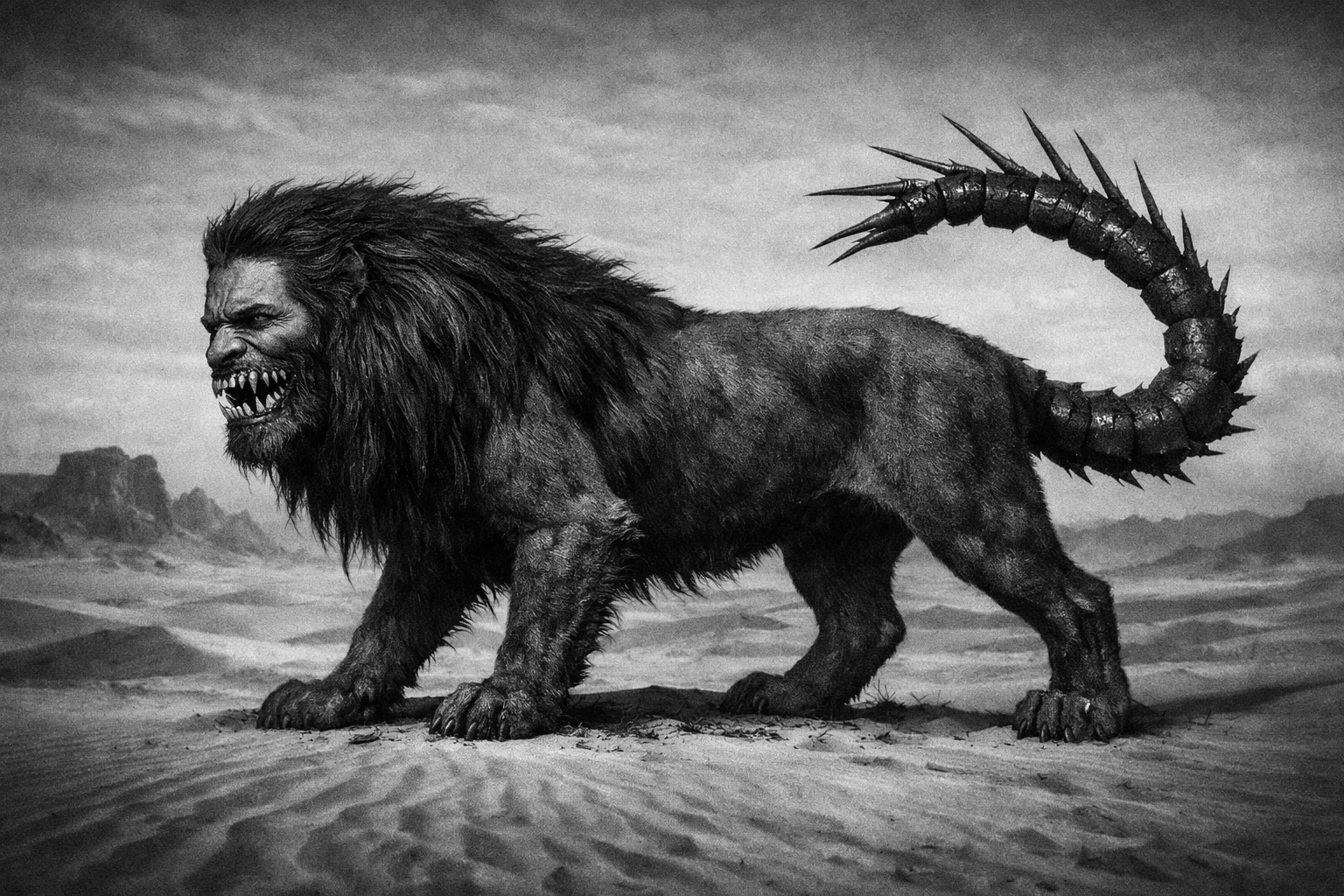
The Manticore is a fearsome creature from ancient Persian mythology that later appeared in Greek and European bestiaries. With its mix of animal and human features and its reputation for hunting people, it has long symbolized the dangers of the wild.
Summary
Key Takeaways
| Attribute | Details |
| Names | Manticore, Martichoras; from Old Persian ‘mardya’ (man) and ‘khwar’ (to eat). |
| Nature | Legendary beast and predatory chimera. |
| Species | Beast. |
| Appearance | Red lion body, human face with three rows of teeth, and a scorpion-like tail. |
| Area | Persia, India, and Ethiopia (according to Greek naturalists). |
| Creation | Spontaneous biological entity in ancient zoological accounts. |
| Weaknesses | Vulnerable in infancy (tail can be crushed); distance and heavy armor. |
| First Known | 5th Century BCE; Ctesias’s ‘Indica’. |
| Myth Origin | Persian folklore and Greek natural history. |
| Diet | Exclusively human flesh. |
| Strengths | High-speed running, poisonous tail spines, and immense jaw strength. |
| Time Active | Diurnal and nocturnal predator. |
Who or What Is Manticore?
The Manticore is a legendary creature with a strange mix of human and animal features. It is best known as a relentless man-eater.
In classical literature, the Manticore is not seen as a ghost or spirit, but as a rare animal living in the distant jungles of India or the deserts of Persia. What sets it apart is its strong hostility toward humans. Unlike other predators that hunt animals, the Manticore is said to prefer hunting people.
The Manticore has a special place in the history of natural philosophy. Early Greek writers such as Ctesias and Aristotle treated it as a real, though distant, animal rather than a myth.
People often used stories of the Manticore to explain why travelers disappeared in the wild. While it is grouped with other mixed-creature legends, it doesn’t have the religious or sacrificial meanings found in stories about the Sphinx or the Chimera.
Instead, the Manticore symbolizes the wild and unknown dangers beyond civilization. Its voice is said to sound like a mix of a trumpet and a reed flute, which it uses to attract or stun its victims before attacking quickly.
Ever Wondered About the Secret Lives of Greek Gods and Heroines?
Limited-Time: Up to 32% OFF!
The Classical Mythology Encyclopedia: Gods, Heroes, and Heroines – 1,000+ entries • Epic tales of Olympus • Goddesses, monsters, and divine intrigues • Ancient rituals & timeless legends. This is Nancy LoCicero’s ultimate guide to the myths that inspired Western civilization.
Genealogy
| Relation | Identity |
| Ancestry | Commonly regarded as a natural species rather than a descendant of gods. |
| Related Entities | Often associated with the Persian ‘Simurgh’ or the Greek ‘Sphinx’ in artistic motifs. |
Etymology
The name Manticore comes from the Middle Persian word merthykhuwar or the Old Persian mardya-khwara. The first part, mardya, means “man,” and the second part, khwara, means “eat” or “devourer.” So, the name literally means “man-eater.” This shows what the creature was known for even before people described what it looked like.
When the Greek doctor Ctesias worked at the Persian court in the 5th century BCE, he wrote down the name as martichoras. He even claimed to have seen the creature himself when it was given as a gift to the Persian King.
Later, Latin writers changed the name to manticora, and from there it made its way into Old French and Middle English. Even as the name changed, its meaning stayed the same. In some medieval texts, the name was confused with Mantichora or Mantygera. Still, Mantygera usually described a creature with more monkey-like features.
The continued use of the Persian root shows that, unlike many Greek mythical creatures, the Manticore was always seen as an exotic creature from the East. It kept its reputation as a foreign and unstoppable predator from the edges of the known world.
You may also enjoy:
Orobas: The Demon Who Corrupts With Truth, Not Lies
May 29, 2025
Eliza Battle Haunting: Alabama’s Most Infamous River Ghost Story
September 18, 2025
Who Is Flauros, the Demon Duke of Fire?
August 29, 2025
The Dark Story Behind the Boyington Oak Haunting
September 18, 2025
Complete Guide to Wisconsin Bigfoot Sightings (1867–2025)
August 10, 2025
What Does the Manticore Look Like?
The Manticore is said to have the body of a big lion, often with bright red fur. Its most disturbing feature is its head, which looks like a human man’s face with blue or grey eyes. Inside its mouth, it has three rows of teeth on both the top and bottom jaws that fit together like a comb, making it almost impossible for prey to escape once bitten.
Its tail is its deadliest weapon, looking like that of a scorpion or a stingray. The tail has poisonous quills or spines that the Manticore can shoot at its targets like arrows. These spines are said to be about a foot long and can grow back right away.
Although it has a human face, the Manticore cannot speak. Instead, it makes a haunting sound that is said to be a mix between a pipe and a trumpet. It can also leap long distances and run as fast as a deer.
Mythology
Stories about the Manticore started as reports of natural history, not as religious myths. Ctesias, a Greek doctor who worked for the Persian King Artaxerxes II, wrote the first detailed account in his book Indica.
He described the Manticore as a real animal from India, known for its fierceness and taste for human flesh. He said that people in India hunted Manticores by riding elephants and attacking them from far away.
Later, Aristotle mentioned the Manticore in his book History of Animals. Still, he was doubtful and said he was just repeating what Ctesias had reported. The Roman writer Pliny the Elder also included the Manticore in his Natural History, which helped make the creature well known in Western stories.
Pliny described the Manticore alongside real animals like elephants and lions, which led many medieval scholars to believe it had existed for centuries. In the Middle Ages, the Manticore showed up in Bestiaries as a symbol of the devil or a sign of tyranny. It was often drawn with a Phrygian cap or a beard to highlight its ‘Eastern’ or ‘human-like’ face. The Manticore was also used in heraldry to stand for power and unpredictability.
The One Book That Turned “Monster Hunting” From Joke to Actual Science
Limited-Time: Up to 46% OFF!
Bigfoot, Loch Ness, Chupacabras, Mothman, Yeti, and dozens more – the original A-to-Z encyclopedia with 100+ fully researched cryptids, eyewitness accounts, expedition histories, and the evidence that made skeptics sweat. Loren Coleman and Jerome Clark’s 1999 classic that launched a thousand investigations.
Legends
The Account of Ctesias at the Persian Court
According to later historians’ writings, Ctesias claimed that the Manticore was brought to the Persian King as a curiosity from the eastern provinces.
In his story, the Manticore’s face was not just human-like but actually quite handsome, except for its frightening triple row of teeth. He described the tail as a natural weapon that could shoot stings, not just from the tip but also from the sides. According to the account, “It can shoot its stings to a distance of a hundred feet,” and “whatever it hits, it kills, with the exception of the elephant.”
Ctesias said that once the Manticore reached adulthood, it was almost impossible to catch. Local people tried to find the dens of young Manticores and crush their tails before the poisonous barbs grew in, making them less dangerous.
Philostratus and the Life of Apollonius
In the Life of Apollonius of Tyana, the protagonist journeys through India and engages in a dialogue regarding the existence of the Manticore.
Apollonius asks his guide about the creature that “has four feet, a head like a man’s, but is as big as a lion, while the tail of this animal puts out hairs a cubit long and sharp as thorns, which it shoots like arrows at those who hunt it.” The guide confirms the existence of the beast. Still, it expresses doubt about some of the more fantastical claims regarding its speed.
This legend connects the more scientific stories from naturalists with the philosophical questions of later Roman times. It shows the Manticore as a creature from the deep wilderness, marking the edge between the world people knew and the wild places they could not control.
The Medieval Bestiary Moralizations
In the 12th and 13th centuries, the Manticore showed up in many European Bestiaries. These books did not add new stories about the creature, but instead examined it from a moral perspective. The legend changed to describe the Manticore as a master of trickery.
Because it had a human face, people said the Manticore could copy the sounds of human speech—not to talk, but to trick travelers into the tall grass. When someone got close, thinking they had found another person, the Manticore would attack.
During this time, people started to believe that the Manticore swallowed its victims whole, leaving behind no clothes, bones, or belongings. Since nothing was ever found, missing travelers in the woods were often said to have been taken by a roaming Manticore.
You may also enjoy:
Resurrection Mary: Chicago’s Most Famous Ghost
May 5, 2025
The Nimerigar: Cannibalistic Little People of the Rocky Mountains
November 4, 2025
Inside the Lizzie Borden House Haunting: Real Ghost Encounters?
October 22, 2025
Manticore vs Other Monsters
| Monster Name | Origin | Key Traits | Weaknesses |
| Sphinx | Egypt/Greece | Human head, lion body, wings, riddles. | Knowledge/Logic. |
| Chimera | Greece | Lion, goat, and serpent heads; fire-breathing. | Lead-tipped spears. |
| Griffin | Scythia/Greece | Eagle head/wings, lion body. | Distraction by gold. |
| Lamassu | Mesopotamia | Human head, bull/lion body, wings. | Protective deity (non-hostile). |
| Leucrotta | India/Ethiopia | Stag hindquarters, lion neck, badger head. | Inability to turn quickly. |
| Questing Beast | Britain | Snake head, leopard body, lion feet. | Destined hunters. |
| Nemean Lion | Greece | Immense lion with impenetrable fur. | Strangulation. |
| Peryton | Atlantis/Europe | Deer with bird wings and a human shadow. | Light/Sunlight exposure. |
The Manticore is different from the Sphinx and Chimera because it does not have wings in the original stories and has a unique diet. The Sphinx guards knowledge, and the Chimera is a sign of destruction from the gods. Still, the Manticore is simply a top predator.
Unlike the Griffin, which guards treasure, the Manticore only wants to hunt and eat humans.
The Forbidden Encyclopedia That Makes Every Ouija Session Ten Times More Dangerous
Limited-Time: Up to 49% OFF!
Angels, devils, nature spirits, ancestors, tricksters, and creator gods – all catalogued with their true names, powers, and protocols. Judika Illes created the definitive directory of the spirit realm that practitioners around the world swear by when they need to know exactly who (or what) just answered.
Powers and Abilities
The Manticore is extremely dangerous because it combines human-like cleverness with animal ferocity. It does not use magic, but instead relies on natural abilities that are stronger than any known predator.
Its main strength is its versatility. The Manticore is just as deadly from far away as it is up close.
- Projectile Quills: The ability to launch venomous spines from its tail like arrows. These spines are described as being capable of killing almost any living creature instantly.
- Triple-Row Jaws: Three rows of interlocking teeth that function like a serrated trap, allowing the creature to crush bone and flesh with minimal effort.
- Acoustic Luring: A voice that sounds like a musical instrument, used to confuse or attract prey in dense vegetation.
- Extreme Locomotion: The power to leap over obstacles and run at speeds that outpace the fastest horses.
- Venomous Sting: A potent toxin delivered through its tail spine, which is its primary method of subduing larger threats.
Can You Defeat a Manticore?
Defeating a Manticore is a task of extreme difficulty, as the creature has no known supernatural vulnerabilities like silver or cold iron.
Historically, the most effective method of defense was prevention. Ancient accounts suggest that the only way to truly “defeat” the species was to hunt them while they were still cubs.
Hunters would locate the dens and use heavy stones to crush the tails of the young. Without the ability to grow or use their poisonous spines, the creatures lost their primary long-range advantage.
For an adult Manticore, the best defense is distance and heavy armor. Because the creature fires its spines in a straight trajectory, thick shields and stone fortifications provide the only reliable protection.
In many legends, the creature is said to be wary of elephants, which are the only animals it cannot kill with its venom. That’s why travelers in Manticore-infested regions often traveled in large groups on elephants’ backs to deter attacks.
Conclusion
The Manticore shows how much people in the ancient world feared the unknown. Unlike other mythical creatures with deep moral meanings, the Manticore simply represents the idea of a ‘man-eater’—a predator made by nature or legend to hunt humans. Because respected writers like Aristotle and Pliny wrote about it, the Manticore remained in people’s imaginations for more than 2,000 years.
Today, science considers the Manticore a fantasy, but its influence can still be seen in stories and heraldry. It reminds us of a time when people believed the unknown parts of the world were filled with monsters that looked human but had no human soul.