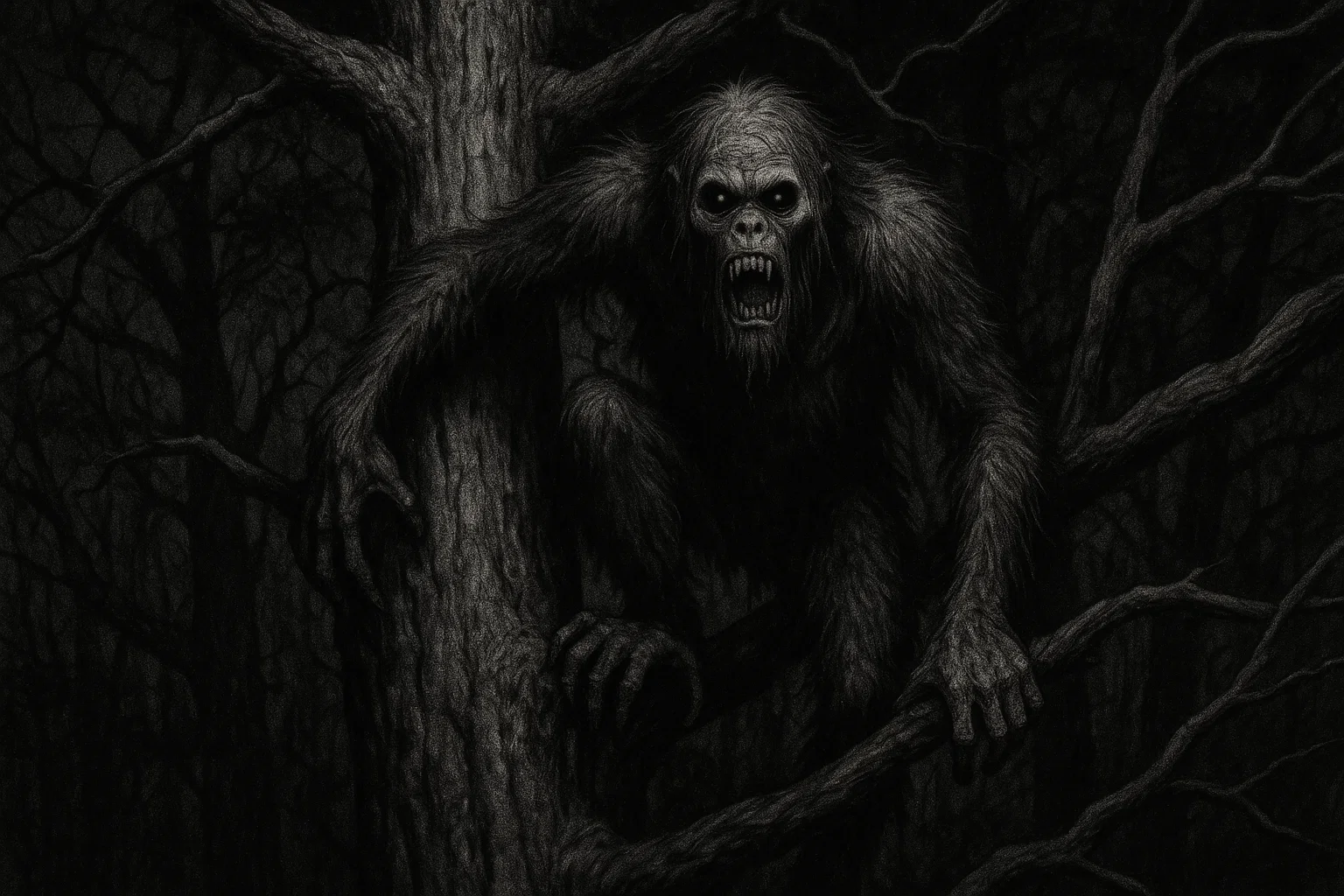
The Alabama Sasquatch (Alabama Bigfoot) is the regional term for a large, bipedal, hairy humanoid creature reported throughout Alabama.
Like the better-known Bigfoot or Sasquatch of the Pacific Northwest, the Alabama Sasquatch is typically classified as an unknown primate or hominid.
However, sightings in Alabama feature notable regional variations, including descriptions of a distinct white-furred variant known locally as the White Thang or Slough Thing.
Sightings, documented since at least the mid-20th century, primarily occur in the state’s dense forests and swampy regions.
Summary
Overview
| Attribute | Details |
| Name | Alabama Sasquatch |
| Aliases | Bigfoot, Southern Sasquatch, White Thang, Slough Thing, Little Foot |
| Threat Level | Elusive, generally benign; occasional reports of territorial displays |
| Habitat | Dense forests, swamps, deep canyons, and remote wilderness areas |
| Physical Traits | 6–9 feet (1.8–2.7 m) tall; bipedal, muscular build; covered in long, shaggy hair (typically black/dark brown, but white/albino in the ‘White Thang’ variant); wide, flat nose; some reports mention red or yellow glowing eyes |
| Reported Sightings | Tuscaloosa County (Bone Camp Road), Conecuh County, Monroe County, Etowah County (White Thang), Cleburne County (Heflin), Little River Canyon National Preserve (Little Foot) |
| First Documented Sighting | Alleged sightings of the White Thang date back to the 1930s and 1940s |
| Species Classification | Hominid or unknown primate |
| Type | Terrestrial |
| Behavior & Traits | Nocturnal or crepuscular; elusive; emits high-pitched screams, whoops, or wood knocks; reported to have a foul odor |
| Evidence | Eyewitness accounts, purported footprints, alleged audio recordings, questionable video footage, possible structures made from twisted branches |
| Possible Explanations | Misidentified black bears standing upright, hoaxes, local folklore, remnant population of Gigantopithecus or other extinct hominids |
| Status | Ongoing mystery; actively reported in specific regional hotspots |
Who or What Is Alabama Sasquatch?
The term “Alabama Sasquatch” is a broad designation for the ape-like, bipedal creatures encountered in Alabama. Unlike the beast commonly associated with the Pacific Northwest, the Alabama variant exhibits diverse characteristics and regional names.
It is considered part of the larger North American Sasquatch phenomenon. Still, it is particularly associated with the Deep South’s unique ecosystems. In its most common form, the creature is described as a large, powerfully built hominid that moves upright on two legs.
One of the most notable local iterations is the White Thang—a creature predominantly reported in the northern regions of the state, such as Etowah, Morgan, and Blount Counties.
This variant is specifically described as having shaggy, white fur. It is sometimes said to possess glowing red eyes and an unnerving, high-pitched scream.
Another local designation is “Little Foot,” a smaller alleged hominid reported in the Little River Canyon National Preserve, noted for its diminutive height of 3 to 4 feet. These variations indicate a collection of cryptid reports within Alabama’s folklore, all generally falling under the umbrella of a hairy, bipedal “wild man.”
This Book Turns the Entire United States Into One Giant X-Files Map
Limited-Time: Up to 38% OFF!
J.W. Ocker traveled the country collecting the weirdest local legends and marks the real-world locations where the Beast of Bray Road, the Dover Demon, the Wendigo, and hundreds more have been spotted. Part travel guide, part bestiary, 100% nightmare fuel.

What Does Alabama Sasquatch Look Like?
Descriptions of the Alabama Sasquatch generally align with the North American Sasquatch prototype, but with specific regional details. The creature is consistently described as a large, muscular, bipedal figure covered in hair.
The overall estimated height typically falls between 6 and 9 feet (1.8–2.7 m), with reports of the White Thang variant reaching up to 9 or 10 feet. Standard sightings often describe the creature’s hair as dark brown or black.
Distinctive features reported in Alabama include a wide, flat nose and an overall imposing, muscular build. Some witnesses describe long arms that swing at its sides as it walks with a slight forward slump. The eyes are sometimes reported to glow red or reddish-yellow during nighttime encounters, a trait also associated with the White Thang.
In the case of the White Thang, the creature is defined by its distinctive thick, shaggy white fur, leading some to speculate it is an albino Sasquatch. Conversely, the smaller Little Foot of Little River Canyon is described as a small, hairy being that is only about 3 to 4 feet tall.
Habitat
The Alabama Sasquatch is allegedly distributed across Alabama’s varied habitats, suggesting a high degree of adaptability. The state’s geography ranges from the rugged peaks of the Appalachian foothills in the north to the lush coastal plains and river swamps in the south.
The dense, mountainous forests of North Alabama, including areas around Lookout Mountain and the Little River Canyon National Preserve, are cited as prime locations.
The canyon, often called the “Grand Canyon of the East,” provides remote, deeply forested terrain with numerous ravines and caves that could offer concealment.
The White Thang variant is particularly associated with the forests and hills of the Etowah County region and the marshy areas near Big Nance Creek in Courtland, which is the purported habitat of the Slough Thing variant.
Moving south, Sasquatch activity has also been reported in the rural countryside of Conecuh and Monroe Counties, where the environment transitions into extensive pine forests and swampy lowlands. Witnesses often report sightings near waterways and creeks, indicating the creature may prefer habitats with access to water.
The remote nature of these habitats—combined with their dense vegetation and low human population density in many areas—is considered a factor in the creature’s reported elusiveness.
You may also enjoy:
Satanachia: Demon General of Hell’s Legions
August 28, 2025
Redmont Hotel Haunting: Stories of Ghosts, Gunfire, and Lost Souls
September 19, 2025
What Is an Edimmu? The Ancient Demon of the Unburied Dead
October 1, 2025
Alabama Sasquatch Sightings
Reported sightings of the Alabama Sasquatch span several decades and locations, with activity concentrated in various counties across the state:
| Date | Place | Witness Details | Description | Reliability |
| 1930s-1940s | Etowah County, Walnut Grove | Multiple local residents and a couple | First major reports of the White Thang: a massive, white-furred humanoid, over 7 feet tall, with a blood-curdling scream; couple reported its glowing red eyes. | Medium: Historical folklore, numerous early reports of a distinct cryptid. |
| 1978 (Apr) | Limestone County, near Athens | Person fishing | Encountered a large, bipedal creature near a wooded area. | Medium: Class A BFRO report, but single witness. |
| 1979 (Sept) | Baldwin County, north of Mobile | Man recalling a sighting after Hurricane Frederic | Creature seen during the aftermath of the storm. | Medium: Class A BFRO report, but recollection. |
| 1980 (Nov) | Pickens County, Gordo | Witnesses | Spotted a tall, brown object moving on a hill, accompanied by moans and a sighing sound. | Medium: Class A BFRO report, multiple sensory details. |
| 1996 (Dec) | Clarke County | Motorist | Saw a Sasquatch-like creature and heard a scream. | Medium: Class A BFRO report, multiple sensory details. |
| 1997 (Jan) | Washington County | Motorist | Confronted by a hairy, man-like creature on the roadside. | Medium: Class A BFRO report, close-range encounter. |
| 1999 (Nov) | Lauderdale County, near Florence | Man at a family farm | Reported repeated visits of the creature to the property. | Medium: Class A BFRO report, repeated encounters over time. |
| 2000 (Feb) | Conecuh County | Two teenagers at night | Nighttime sighting of a large, hairy creature. | Medium: Class A BFRO report, corroborating witnesses. |
| 2000 (Oct) | Morgan County, Valhermosa Springs | Husband and wife near home | Daylight sighting of the creature. | High: Class A BFRO report, multiple daylight witnesses. |
| 2001 (Oct) | Limestone County | Man on his way to work | Saw a Sasquatch crossing the road in his headlights. | Medium: Class A BFRO report, specific time and place. |
| 2003 (Jun) | Tuscaloosa County | Lady driving | Saw a large hairy creature on the side of the road. | Medium: Class A BFRO report. |
| 2003 (Aug) | Tuscaloosa County, near Northport | Hunter | Found tracks and feces in a freshly turned field. | Low: Physical evidence reported, but tracks are often inconclusive. |
| 2004 (May) | Madison County, Green Mountain | Witness recollection | Afternoon sighting on Green Mountain. | Low: Class A BFRO report, but recollection. |
| 2007 (Sept) | Pickens County, Aliceville | Witness | Daylight sighting at the eastern dike of East Lagoon. | Medium: Class A BFRO report, daylight sighting. |
| 2016 | Wilcox County, near Annemanie | Motorist | Reported a large, black-haired creature crossing the road; estimated 8 feet tall with reddish-yellow, round eyes. | Medium: Single adult witness, highly specific details. |
| 2020 (Dec) | Clay County, Talladega NF | Camper | Awakened by loud wood knocks in the Talladega National Forest. | Low: Audio evidence (wood knocks) attributed to the cryptid. |
The White Thang (Etowah County, 1930s–Present)
The White Thang represents one of the most prominent regional legends of the Alabama Sasquatch. Reports of this creature are alleged to have begun in the 1930s and 1940s, primarily in Etowah County.
The descriptions are distinct from the typical dark-furred Sasquatch, portraying a massive, bipedal being covered in shaggy, white fur.18 The creature is said to stand over 7 feet tall and is known for its chilling scream, which has been compared to a cross between a woman’s cry and a panther’s roar.
Some reports specify that the creature possesses glowing red eyes. The White Thang is sometimes speculated to be an albino variant of Sasquatch, given its white coloration and humanoid form. However, other local descriptions have compared it to a large cat or a kangaroo with a cat’s head.
The creature has been reported to frequent peach orchards, suggesting an omnivorous diet.
The One Book That Turned “Monster Hunting” From Joke to Actual Science
Limited-Time: Up to 46% OFF!
Bigfoot, Loch Ness, Chupacabras, Mothman, Yeti, and dozens more – the original A-to-Z encyclopedia with 100+ fully researched cryptids, eyewitness accounts, expedition histories, and the evidence that made skeptics sweat. Loren Coleman and Jerome Clark’s 1999 classic that launched a thousand investigations.
The Bone Camp Bigfoot (Tuscaloosa County, 1999–2014)
A series of sightings occurred along Bone Camp Road in northern Tuscaloosa County, with documented reports from July 1999 through April 2014.
These accounts typically describe a large, dark-colored bipedal figure seen near the wood line. A specific string of instances involved a mother and son.
A 2011 sighting at noon involved both witnesses observing the creature from their car. The son, driving alone in April 2014, later saw a similar figure at night near the same location.
Investigators from the Bigfoot Field Researchers Organization (BFRO) interviewed the witnesses and found their accounts consistent and believable. Following the sightings, the witnesses reported seeing and photographing possible structures made from twisted and broken branches in the area.
You may also enjoy:
Complete Guide to Nevada Bigfoot Sightings (1970–2025)
August 4, 2025
Vepar in the Ars Goetia: The Mermaid Duchess of Hell
August 28, 2025
Who Is Abaddon and Why Is He Called the Destroyer?
May 27, 2025
Balberith: The Infernal Scribe Who Tempts Humanity
August 16, 2025
Evidence & Investigations
The evidence supporting the existence of the Alabama Sasquatch consists primarily of eyewitness accounts and purported footprints. Unlike the numerous clear plaster casts reported in the Pacific Northwest, physical evidence in Alabama is often limited or inconclusive.
Footprints are reported across the state, consistent with the cryptid’s name. In one instance in Conecuh and Monroe Counties, a set of massive, 17-inch footprints was allegedly discovered near a hunting cabin.
Reports from the Etowah County area often mention large, mysterious footprints left in the soft soil of peach orchards, attributed to the White Thang.
However, skeptics argue that these prints could be misidentified as bear tracks or intentional hoaxes. Black bears, which are native to Alabama and walk plantigrade (flat-footed), can leave tracks that are easily mistaken for large, human-like prints, especially when standing upright.
Cryptozoological investigations, often conducted by amateur researchers and organizations such as the BFRO, have included collecting anecdotal evidence and searching for additional signs of the creature.
Reports have included audio recordings of alleged Sasquatch vocalizations, described as whoops or high-pitched screams, and the discovery of possible nesting sites or territorial markings, such as small trees that have been observed bent, uprooted, or stacked in patterns.
Theories
Several theories are proposed to explain the phenomenon of the Alabama Sasquatch, ranging from conventional biological misidentification to the survival of a prehistoric primate.
Misidentified Fauna (Black Bear Theory)
A prevalent theory is that many sightings of the Alabama Sasquatch, particularly the dark-furred descriptions, are the result of misidentified known animals, specifically the American black bear (Ursus americanus).
Black bears are common throughout Alabama, can stand and walk short distances on their hind legs, and have a bulky, hairy body. When viewed from a distance or in poor lighting, a large bear standing upright, especially one with mange, could easily be mistaken for a bipedal, ape-like creature.
The broad shoulders, lack of a visible neck, and long arms noted in some Sasquatch descriptions also align with the bear’s anatomy when viewed from certain perspectives.
Regional Albino Variant (The White Thang)
The distinct, recurring sightings of the White Thang suggest a sub-theory specific to the Alabama region. Some researchers propose that the White Thang is an albino or leucistic variant of the North American Sasquatch.
While albinism is rare, it does occur in many mammal species, and an all-white Sasquatch would be highly noticeable and generate unique local folklore.
Alternatively, the White Thang could be a unique, previously unknown species of primate or hominid that has adapted a light coat for its specific environment, or it could simply be a wholly separate cryptid with a unique local mythology.
People Swore They Saw Something Impossible… This Book Shows You the Photos, Tracks, and DNA
Limited-Time: Up to 18% OFF!
Gorgeous full-color illustrations meet hard evidence: hair samples that don’t match any known animal, sonar hits in Loch Ness, night-vision footage, and survivor testimonies. Kelly Milner Halls separates hoax from holy-crap-this-might-be-real for every major cryptid still out there.
Relict Hominid Population
A long-standing theory of the general Sasquatch phenomenon holds that the creature is a surviving member of a relict hominid population.
One popular candidate is Gigantopithecus blacki, an enormous, extinct great ape. Proponents suggest that a population of these large primates could have migrated across the Bering Land Bridge into North America and survived in isolated areas, such as the dense forests and mountains of the Southeast.
However, most scientists consider this highly unlikely, as the fossil evidence for Gigantopithecus indicates its existence was confined to Asia, and there is no conclusive evidence of its migration to the Americas.
Comparison with Other Similar Cryptids
The Alabama Sasquatch is one of many hairy, bipedal humanoid cryptids reported globally:
| Cryptid Name | Location | Primary Hair/Fur Color | Distinctive Traits |
| Bigfoot/Sasquatch | Pacific Northwest, USA/Canada | Dark brown, black, reddish-brown | Extremely large footprints (up to 24 inches), foul odor. |
| Yeti | Himalayas, Asia | White or grey | High-altitude habitat, adapted to snow, often described as larger and more muscular than Sasquatch. |
| Skunk Ape | Florida Everglades, USA | Dark brown, reddish-brown | Swamp habitat, intensely foul odor often compared to rotting garbage or skunk. |
| Yowie | New South Wales, Australia | Dark brown, black | Hominid reported to be more ape-like or sometimes smaller than Sasquatch. |
| Orang Pendek | Sumatra, Indonesia | Brown, reddish-brown | Small stature (3 to 5 feet tall), lives in mountainous forests, noted for bipedal gait. |
| Fouke Monster | Fouke, Arkansas, USA | Dark brown, black | Associated with the Boggy Creek area, allegedly has three toes, known for a horrific odor. |
| Almas | Caucasus Mountains, Central Asia | Reddish-brown, dark brown | Considered a relict hominin, possibly Neanderthal, more human-like in facial features than Sasquatch. |
| Wood Booger | Appalachian Mountains, USA | Dark brown | A common term for a regional Sasquatch variant throughout the Appalachian region. |
| Wendigo | Northern Forests (Algonquin regions), USA/Canada | Various, sometimes skeletal/gaunt | Often linked to cannibalism or spiritual possession, not a traditional hominid. |
| Michigan Dogman | Wexford County, Michigan, USA | Grey or reddish-grey | Distinctly canine/lupine head, but walks on two legs; differs significantly from the hominid type. |
You may also enjoy:
Who Is the Demon Amaimon, the Powerful King of Hell?
April 24, 2025
Rokurokubi Legends: Women Who Transformed Into Night Demons
September 9, 2025
Semyaza: The Fallen Angel Suspended Between Heaven and Earth
September 29, 2025
Auvergne Werewolf: Real Curse or Witch Hunt?
June 19, 2025
Is Alabama Sasquatch Real?
The question of the Alabama Sasquatch’s reality remains unresolved. Reports spanning many decades and across numerous counties, along with distinct regional lore such as the White Thang and Little Foot, confirm the entity’s secure place in Alabama’s cultural and cryptozoological landscape.
The consistency of some eyewitness accounts, describing a large, bipedal, hairy primate, aligns with the broader Sasquatch phenomenon across North America.
However, the lack of definitive, scientifically verifiable physical evidence is a critical factor preventing its recognition as a biological species.
While footprints and alleged structures are occasionally reported, most scientific evaluations suggest that the most plausible explanations involve misidentification of large mammals—particularly the native black bear—or intentional hoaxes, or the influence of established folklore.
The creature persists as an ongoing mystery, a subject of fascination that exists in the narrative space between regional myth and cryptozoological speculation.