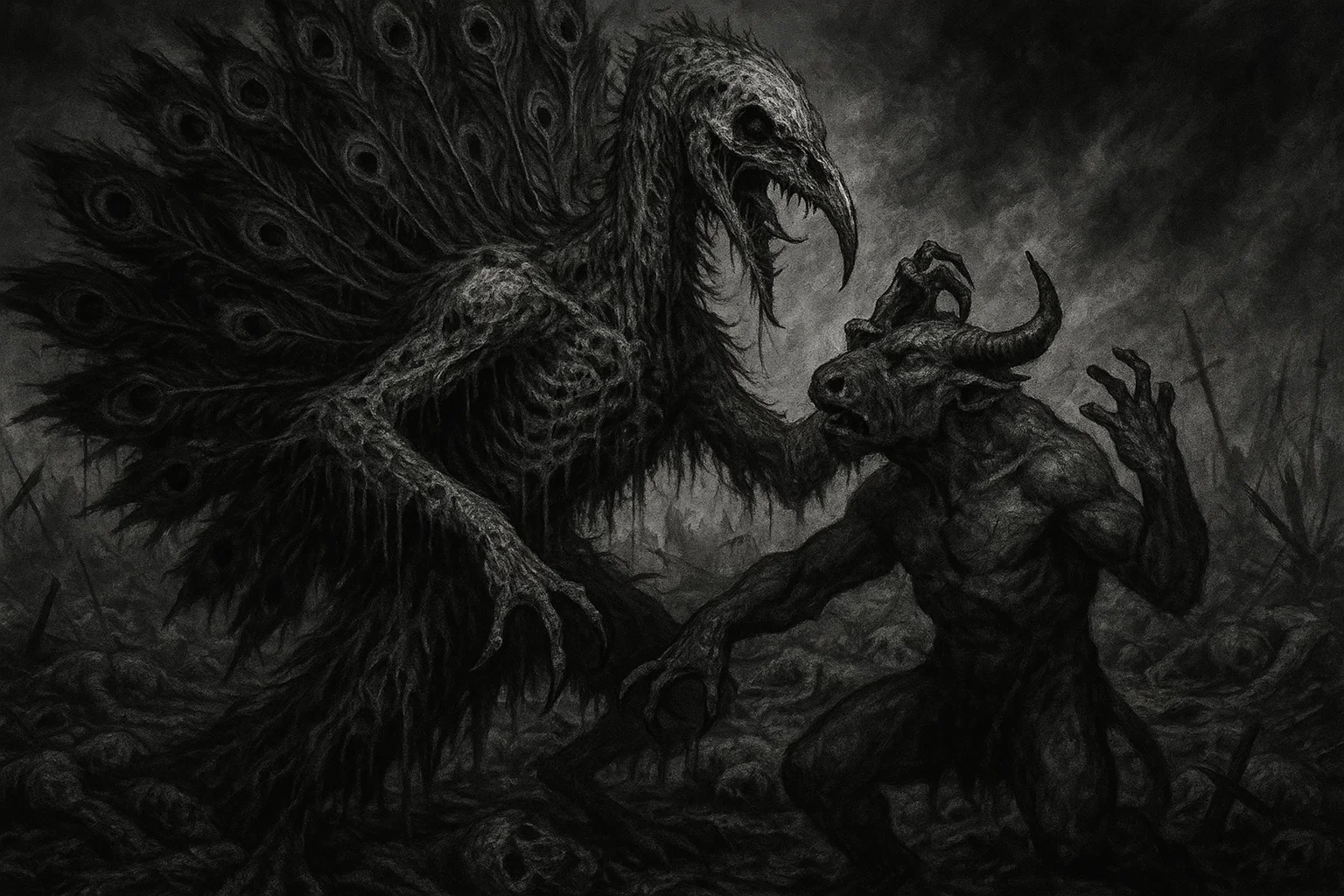
Andrealphus is a powerful demon mentioned in several old texts about magic, especially in the Lesser Key of Solomon. He is known as the Thirty-Seventh Spirit and holds a high position, being a Great Marquis in the spirit world. He has control over thirty groups of lesser spirits.
Andrealphus is known for his skills in mathematics and astronomy. He has a deep understanding of shapes, stars, and measurements. Additionally, he can change his appearance, which allows him to trick those who try to summon him.
Summary
Key Takeaways
| Attribute | Details |
| Name | Andrealphus, Androalphus |
| Title | Great Marquis of Hell |
| Gender | Male (typically depicted) |
| Origin | Fallen Angel, as listed in the Ars Goetia |
| Appearance | Initially a Noisy Peacock, transforming into a man |
| Hierarchy | Marquis |
| Superior Demon | Lucifer (as the supreme ruler of Hell); no immediate superior specified in primary sources |
| Servitors | Thirty Legions of Spirits (lesser demons) |
| Associated Figures | King Solomon (as the alleged original binder of the 72 spirits), Vassago (also associated with knowledge and future prediction) |
| Powers | Teaches perfect and complete geometry and mensuration; teaches astronomy; can turn men into birds; causes clamor and noise |
| Weaknesses | Subordinate to the power of the Divine; vulnerable to the Divine Seal of Solomon or other ritual authority used by the conjurer |
| Opposing Angel/Saint | No specific opposing angel or saint is commonly named in the primary source texts |
| Equipment/Tools | None specified; his knowledge is his primary tool |
| Pantheon | Christian Demonology, Solomonic Magic |
| Notable Myths | The Lesser Key of Solomon (Ars Goetia) |
Etymology
The name Andrealphus doesn’t have a clear origin or direct connection to ancient Semitic languages, like many other demons found in traditional texts. It seems to have been created or altered over time in medieval magical writings, possibly as a unique name or a variant of an older name that isn’t European.
The suffixes’—us’ or ‘—phus’ are commonly used in Latin names, especially in writings from the Renaissance period focused on magic. However, the first part of the name, “Andre-,” doesn’t seem to relate directly to his claimed powers in mathematics or astronomy. The name appears consistently in early texts, indicating that it became established early on in this tradition.
When it comes to the Ars Goetia, the name serves as the Word of Power required to address and compel the spirit, regardless of its original linguistic derivation. The primary focus of the name within the texts is its function as an identifier for the specific entity holding the title of Marquis and commanding thirty legions.
Ever Wonder What a Demon’s Real Name Is… and Why Saying It Is Dangerous?
Limited-Time: Up to 25% OFF!
The Encyclopedia of Demons & Demonology 400+ entries • Real history • Exorcisms & Ancient Evils • Possession • Terrifying photos. This is Rosemary Ellen Guiley’s masterpiece of the occult.
What Does the Demon Andrealphus Look Like?
Andrealphus is described in the foundational texts with a distinct and specific appearance that involves a shapeshifting element. His initial manifestation, when he is first evoked, is consistently stated to be that of a Noisy Peacock.
The description focuses on the clamor or noise associated with this form, linking his initial presence to the bird’s vibrant, loud, and potentially distracting display. This form is his demonic guise or his preferred monstrous appearance.
On the command of the Master of the Art, Andrealphus is required to take on a human shape. After this transformation, he appears as a man. However, the specific details of his human form, such as his clothing and facial features, are not consistently elaborated.
The key element is the contrast between the extravagant, noisy, avian form of the peacock, symbolizing perhaps vanity or celestial beauty perverted, and the simpler, more relatable form of a man, which facilitates communication and the transfer of his specified knowledge.
Historical and Mythological Background
The primary and most consistent source for the description and lore of Andrealphus is the Solomonic magical tradition, which reached its peak in documentation during the Renaissance.
You may also enjoy:
Is Cadborosaurus the Real Sea Serpent of the Pacific Northwest?
November 6, 2025
Sabnock in Demonology: Powers, Legends, and Rituals
August 27, 2025
Is the George Wythe House Haunted by Multiple Spirits?
January 8, 2026
Andrealphus in the Ars Goetia
The earliest known text describing Andrealphus is the Lesser Key of Solomon, specifically the first book, the Ars Goetia, where the demon is classified as a Great Marquis, and appeareth at first in the form of a Noisy Peacock. After a while, at the Master’s command, he changeth into a Human shape.
Andrealphus in the Pseudomonarchia Daemonum
The spirit Andrealphus is also documented in the Pseudomonarchia Daemonum by Johann Weyer, an appendix to his 1563 work, De praestigiis daemonum. Weyer’s text serves as a parallel source to the Ars Goetia, and its descriptions are largely consistent, though sometimes slightly abbreviated or varied in the order of the spirits.
In Weyer’s catalog, the spirit is identified, and his title and rank are confirmed. Weyer states that “Androalphus, a great marques, appeareth in the likenesse of a peacocke, and with a great noise.”
Andrealphus in Subsequent Grimoires
Andrealphus’s description, rank, and powers remain highly consistent across later magical texts and grimoires that were inspired by the Solomonic tradition, such as Reginald Scot’s The Discoverie of Witchcraft (1584), which reproduced Weyer’s list, and later compilations.
Historical Mentions
The Lesser Key of Solomon (Ars Goetia):
“The Thirty-seventh Spirit is Andrealphus. He is a Great Marquis, and appeareth at first in the form of a Noisy Peacock: but after a while, at the command of the Master, he changeth into a Human Shape. He can teach perfect and complete Geometry, and Astronomy, and the true measure of everything. He can make a Man to be like a Bird in all respects. He governeth 30 Legions of Spirits. His Seal is this, which wear thou as aforesaid.”
Pseudomonarchia Daemonum by Johann Weyer (1563), Latin original:
“Androalphus, marchio magnus, apparet in effigie pavonis, & cum magno strepitu. Hic quando assumit humanam formam, geometriam, & Astronomiam perfecte docet: redditque hominem aptum, ut in avem transmutetur. Praeest triginta legionibus.”
Pseudomonarchia Daemonum by Johann Weyer (1563), English translation (as found in The Discoverie of Witchcraft by Reginald Scot):
“Androalphus, a great marques, appeareth in the likenesse of a peacocke, and with a great noise. When he taketh humane shape, he instructeth diligently in geometrie and astronomie: he maketh a man able to transforme himselfe into a bird. He governeth thirtie legions.”
This Book Contains Over 1,600 Reasons to Never Say “I Don’t Believe in Demons”
Limited-Time: Up to 33% OFF!
The most complete dictionary of demon names ever compiled – from Abbadon to Zyzyl – spanning medieval grimoires, ancient mythology, and modern occult sources. Tenth Anniversary Edition with new entries, corrected pronunciations, and the hidden meanings most books are afraid to print.
Andrealphus’s Powers and Abilities
The powers of Andrealphus are highly specialized, focusing on complex mathematical, celestial, and dimensional concepts, making him a demonic entity of profound, albeit corrupted, intellect and precision. His primary ability is to impart perfect and complete knowledge. This is not merely the transmission of information but the installation of an absolute and true understanding of the subject matter.
His teaching of Geometry and Mensuration allows the conjurer to fully grasp the dimensions and true measure of all things, both physical and conceptual. This knowledge can be used malevolently to create flawed designs, cunning traps, or geometrically perfect schemes that corrupt nature or deceive man.
His expertise in Astronomy extends beyond simple star-gazing to the true understanding of celestial mechanics and influence. This knowledge could tempt a mortal to believe they hold the key to cosmic fate or allow them to misappropriate celestial alignments for nefarious workings.
The most overtly malevolent of his powers is the ability to transform a man into a bird in all respects. This is a corrupting physical and spiritual change, stripping the human of their form and rationality, subjecting them to a lesser, non-sapient state.
He also causes clamor and noise on his initial appearance, which can be seen as a form of spiritual distraction or a technique to unnerving the summoner.
Powers and Abilities Breakdown
| Power/Ability | Description | Source | How It Tempts/Corrupts Humans |
| Complete Geometry | Imparts a perfect and full understanding of geometry and the measurement of all things. | Ars Goetia | Tempts mortals with absolute power over design and dimension, leading to the creation of deceptive or unstable structures. |
| Astronomy Knowledge | Teaches the art and science of astronomy with precision and completeness. | Ars Goetia | Allows the mortal to believe they can manipulate fate and celestial influence, fostering hubris and a rejection of divine providence. |
| Avian Transformation | Ability to transform a man to be fully like a bird, both physically and spiritually. | Ars Goetia | Corrupts the human form and soul by stripping the individual of sapience and subjecting them to a lower, bestial nature. |
| Noisy Manifestation | Appears initially in a loud, clamorous, peacock form. | Ars Goetia | Creates distraction and discord during the ritual, potentially undermining the purity of the conjurer’s intent. |
Why Do So Many Successful People Secretly Wear a Little Blue Eye?
Limited time offer: 28% OFF. For thousands of years, the Turkish Evil Eye has quietly guarded wearers from the unseen effects of jealousy and malice. This authentic blue glass amulet on a soft leather cord is the real thing – beautiful, powerful, and ready for you.
How to Counter Andrealphus’s Powers
To counter the influences and potential deceptions of Andrealphus, individuals must rely on traditional spiritual and ritual protections, as his powers are embedded in infernal manipulation.
A primary defense against any spirit from the Ars Goetia is the Divine Seal of Solomon. This physical talisman must be properly consecrated and worn. This seal, bearing the Divine Name, imposes hierarchical authority over the spirit.
For a non-magician, a strong faith-based approach is paramount, using prayer and righteous living to establish a spiritual barrier that Andrealphus’s corrupted knowledge cannot penetrate.
Protective items include Holy Water (blessed by a recognized religious authority) sprinkled throughout the area, and salt, particularly blessed salt, placed at thresholds to impede the entry of malevolent spiritual energy.
Incense, such as frankincense or myrrh, used in a traditional religious context, can help cleanse the atmosphere. The involvement of a priest or religious professional is the recommended course of action for individuals experiencing persistent or overwhelming spiritual attacks, as they possess the necessary formal authority and tools for exorcism and cleansing.
You may also enjoy:
Samigina: The Demon Who Speaks With the Dead
August 27, 2025
Nuckelavee: The Skinless Sea Demon That Brings Plague
February 10, 2026
Who Is Lucifuge Rofocale in Demonology?
August 25, 2025
Hell’s Gate Bridge Haunting: From Tragic Deaths to Demonic Portals
September 23, 2025
Andrealphus’s Role in the Hierarchy of Hell
Andrealphus is a Great Marquis of Hell, a high-ranking demon in the hierarchy of demons. This title gives him a lot of power and the ability to lead a large group of spirits. According to ancient texts on spiritual beings, he is the 37th of 72 recognized spirits.
As a Marquis, he serves as a powerful military leader or governor in Hell. His rank places him above certain other ranks, such as Counts and Presidents, but below higher titles, such as Kings and Dukes.
His authority is further demonstrated by the significant number of spirits he commands—thirty legions, which is a vast army in this context. This shows just how influential he is and how many supernatural beings he can mobilize.
As one of the 72 spirits, he is considered to be subservient to Lucifer, the supreme ruler of Hell, and eventually to the authority of the Divine Name, as invoked through the Solomonic seals and triangular brass vessels. His specialized role as a teacher of complex sciences suggests a focus on intellectual corruption and the manipulation of fundamental cosmic laws, rather than on raw physical warfare.
Astrological Associations and Symbolism
When it comes to the Solomonic tradition, each of the 72 spirits is typically associated with specific astrological, elemental, and numerological correspondences. However, these are sometimes debated or vary across grimoires. Andrealphus’s association with Astronomy suggests a direct link to the celestial spheres and the specific planets or zodiac signs that govern intellectual learning and transformation.
The rank of Marquis often correlates with the element of Air and specific astrological signs. His form as a peacock connects him to the concept of celestial bodies and vanity. The number of legions he commands, thirty, is numerically significant, linking to the lunar cycle and certain divisions of the zodiac.
What If 72 Demons, Hundreds of Angels, and the Secret of Instant Genius Were Hidden in a Single Book?
Limited-Time: Up to 10% OFF!
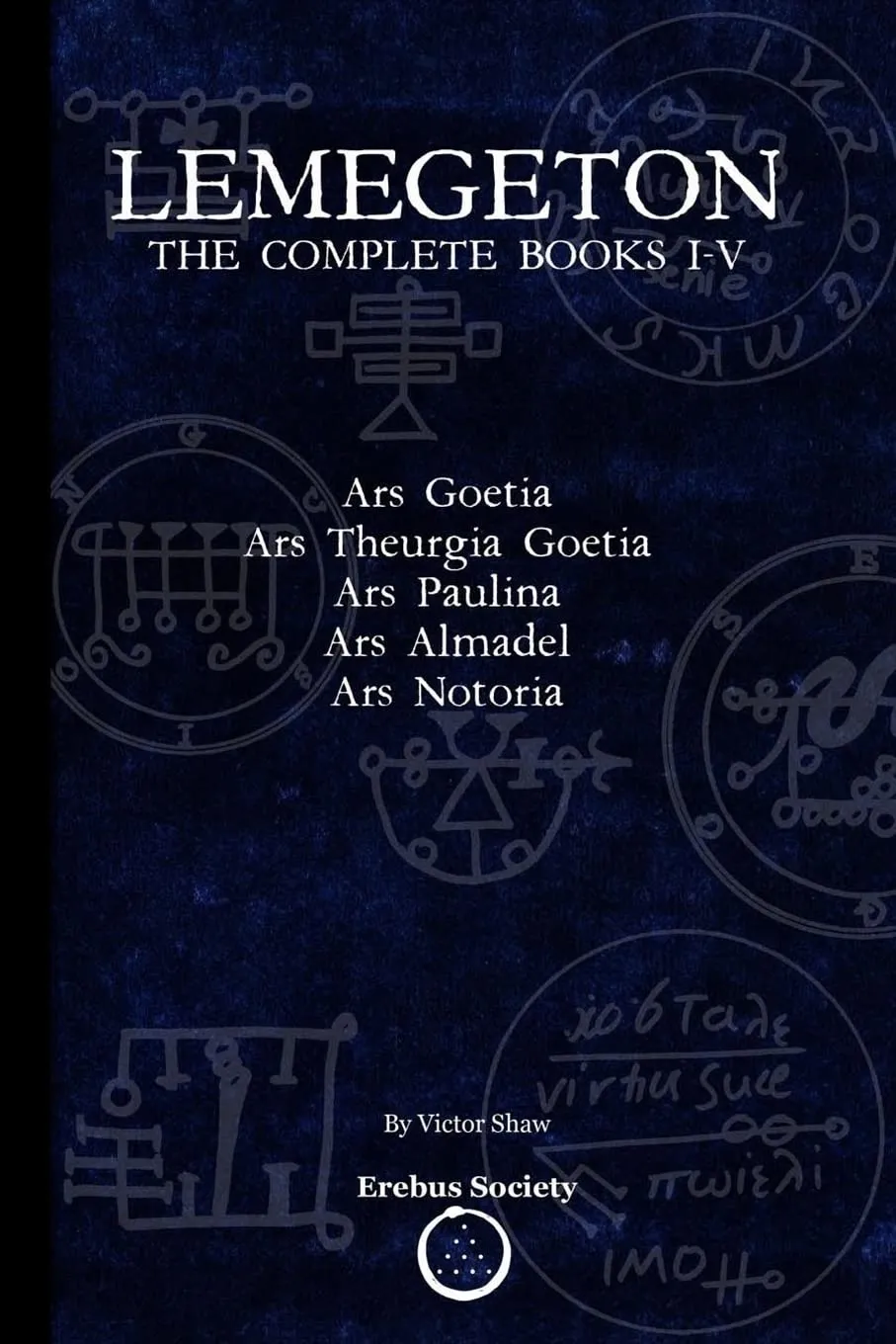
For the first time in centuries, all five books of the Lemegeton fully restored and translated – 72 Goetic demons with their seals, the aerial spirits of Theurgia-Goetia, the planetary angels of Ars Paulina, the Almadel’s wax tablet ritual, and the divine Ars Notoria for instant knowledge. The Teitan Press edition occultists call “the most dangerous book you can own.”
Astrological and Symbolic Associations
| Category | Symbol/Association |
| Element | Air (often associated with the rank of Marquis and intellectual pursuits) |
| Planet | Mercury or Jupiter (for knowledge, travel, and high rank) |
| Zodiac Sign | Gemini (associated with learning, communication, and duality/shapeshifting) |
| Metal | Mercury/Quicksilver (due to association with knowledge and mutability) |
| Tarot Card | The Chariot or The Star (ambition, celestial knowledge) |
| Color | Blue/Gold (as relates to the peacock and the sky) |
| Number | 37 (his sequence number), 30 (legions) |
Andrealphus’s Sigil
The Sigil of Andrealphus is the magical glyph or seal that is central to his evocation in the Solomonic tradition. In the Ars Goetia, the conjurer is specifically instructed to wear this sigil, made from the metal corresponding to the demon’s planetary association (though not always specified for Andrealphus), or to draw it on parchment.
The sigil is not a representation of his form, but rather a symbol of his essence and authority within the hierarchy of Hell. It functions as a binding force, compelling the spirit to appear, take human shape, and perform the services requested, while simultaneously offering the conjurer a degree of protection and control.
The visual complexity of the sigil often incorporates various lines, symbols, and geometric shapes, reflecting his mastery over geometry and mensuration.
Associated Symbols and Offerings
| Symbol/Item | Association/Meaning | Use in Rituals |
| Peacock Feathers | His initial form, vanity, celestial beauty, and noise | Used as an offering to attract his presence or to symbolize his authority during evocation. |
| Geometric Instruments | His power over Geometry and Mensuration | Placed within the magical circle to facilitate the transfer of his knowledge. |
| Aromatic Incense | Sandalwood or Frankincense (for intellectual/celestial operations) | Used to create a conducive atmosphere for the working, associated with Air and intellect. |
| Amulets of Protection | The Divine Seal of Solomon, Pentacles | Used by the conjurer for protection and control to ensure the spirit is obedient and does not harm the operator. |
Similar Demonic Entities
| Demon Name | Gender | Primary Religion | Type / Class | Sphere of Influence | Weaknesses |
| Agares / Agreas | Male | Christian Demonology | Duke | Causes earthquakes, teaches languages, finds runaway people | Solomonic Seals, Divine Authority, Holy Name |
| Vassago / Ipos | Male | Christian Demonology | Prince / Earl | Divination, knowledge of past/future, finding lost items | Solomonic Authority, use of magical tools |
| Amon | Male | Christian Demonology | Marquis | Reconciliation, love, future, wrath | Exorcism prayers, Holy Water, Solomonic Pentacle |
| Bune / Bime | Male | Christian Demonology | Duke | Raises the dead, provides riches, teaches wisdom, changes places of the dead | Vulnerability to binding seals, specific conjuration names |
| Gaap / Tap | Male | Christian Demonology | President / Prince | Teaches philosophy, love/hate, war, carries people to other places | The Holy Name of the Divine, consecrated circle |
| Furfur | Male | Christian Demonology | Earl | Love, thunder and lightning, war, lies until constrained | Specific Truth Constellation ritual elements |
| Malphas | Male | Christian Demonology | President | Building houses/fortresses, destroying enemies’ desires, provides good Familiars | Holy Authority, binding words, and seals |
| Phenex / Pheynix | Male | Christian Demonology | Marquis | Poetry, science, answers questions about all sciences, appears as a Phoenix | Power of God, being forced to take human shape |
You may also enjoy:
Is the Kali Oka Plantation Haunting Real?
May 13, 2025
Eloko: The Tiny Forest Cryptids That Kill Without Warning
February 3, 2026
What Is an Androsphinx and Why Was It Feared in Ancient Egypt?
January 27, 2026
What Is Átahsaia, the Cannibal Demon of Zuni Mythology?
November 4, 2025
Conclusion
Andrealphus is clearly defined in the corpus of Solomonic literature as a Great Marquis of Hell, primarily concerned with the corruption of the transmission of precise, high-level knowledge.
His specialization in Geometry, Mensuration, and Astronomy distinguishes him as a demonic intellect. At the same time, his initial appearance as a Noisy Peacock and his ability to effect avian transformation point out his link to both vanity and physical perversion.
His role is consistently detailed across seminal grimoires like the Ars Goetia and the Pseudomonarchia Daemonum, cementing his position as the Thirty-Seventh Spirit commanding thirty legions.
His function as a provider of absolute truth in specific sciences serves to tempt humans toward intellectual hubris, offering a power over dimensions and the cosmos that is fundamentally a rejection of divine ordering.