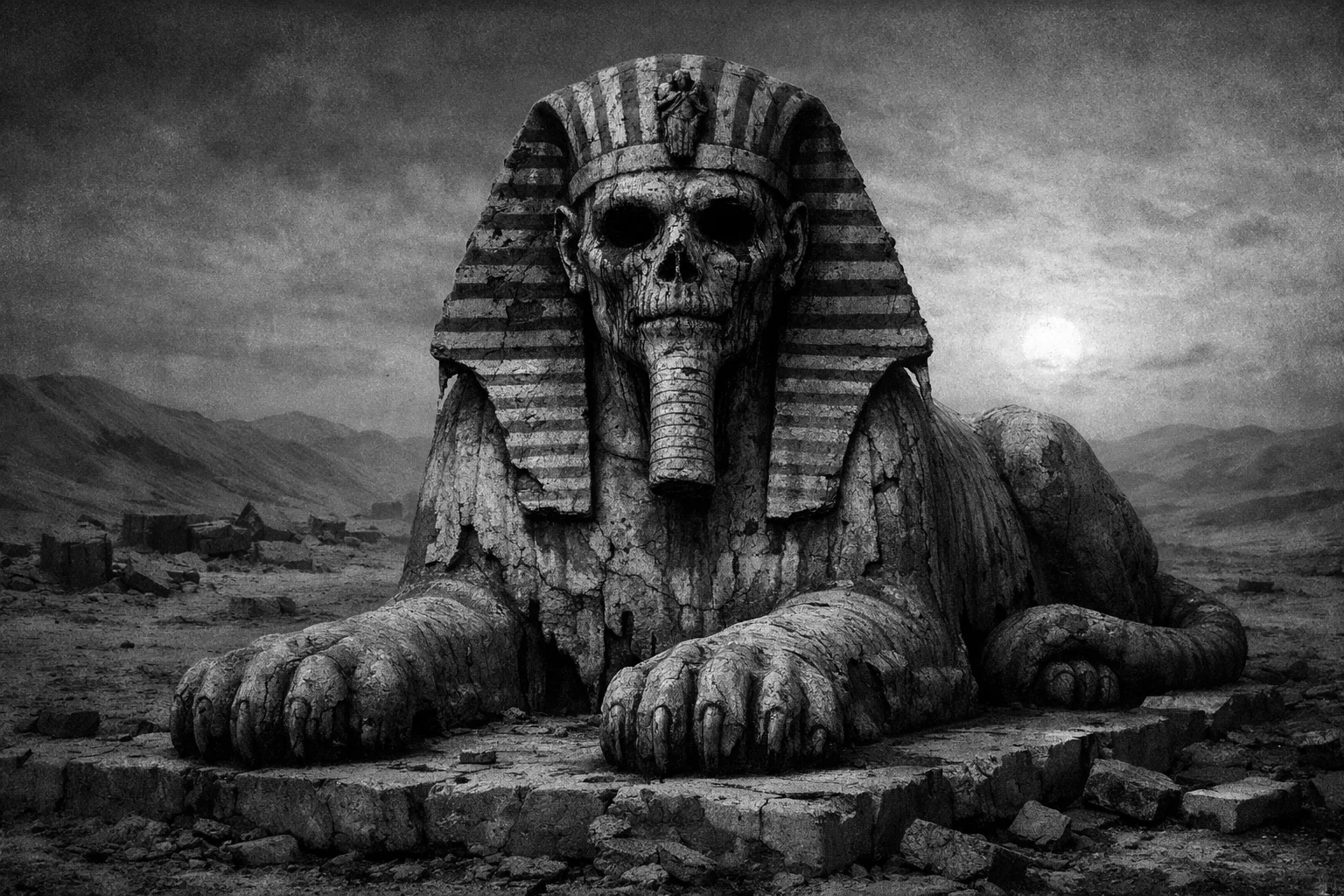
The androsphinx is a mythical creature with the body of a lion and the head of a human man. It first appeared in Old Kingdom Egypt, where it symbolized the pharaoh’s power and divine right to rule. Unlike the female sphinxes in Greek myths, androsphinxes mainly served as guardians of temples and tombs. They are portrayed as both physically strong and wiseleaders in historical accounts.
Summary
Key Takeaways
| Attribute | Details |
| Names | Androsphinx |
| Nature | Supernatural guardian and royal manifestation. |
| Species | Hybrid Beast. |
| Appearance | Lion body, human male head, typically wearing a nemes headdress and a false beard. |
| Area | Ancient Egypt, specifically Giza and Luxor; later adopted in Persian and Greek art. |
| Creation | Created by divine will or carved as a manifestation of the Pharaoh’s spirit. |
| Weaknesses | Physical erosion, sand burial, or the cessation of religious rituals. |
| First Known | c. 2500 BCE, Great Sphinx of Giza, 4th Dynasty of Egypt. |
| Myth Origin | Ancient Egyptian religion. |
| Strengths | Immense physical power, solar protection, and divine wisdom. |
| Time Active | Diurnal; primarily associated with the rising and setting sun. |
| Diet | There is no record of the androsphinx consuming food; it is sustained by divine energy. |
| Habitat | Deserts, temple entrances, and sacred necropolises. |
Who or What Is the Androsphinx?
The androsphinx is a type of sphinx with a human male head. In Ancient Egyptian archaeology and mythology, it is the most common version of this creature. It is different from the criosphinx, which has a ram’s head, and the hieracosphinx, which has a hawk’s head. The best-known androsphinx is the Great Sphinx of Giza, thought to represent Pharaoh Khafre.
In mythology, the androsphinx is seen as a sacred protector rather than a monster. Statues of androsphinxes were often placed in pairs at temple entrances and along ceremonial paths to keep away evil spirits and chaos. Their presence showed that the king and the sun god protected the area. Many Egyptian texts link the androsphinx to Horemakhet, a solar god whose name means “Horus in the Horizon.”
The Greek sphinx is usually shown as a winged, dangerous creature that asks riddles and punishes those who fail. In contrast, the Egyptian androsphinx has no wings and is kind to the good. It symbolizes the king’s connection to the sun and is a silent guardian over the sacred lands along the Nile.
Ever Wondered About the Secret Lives of Greek Gods and Heroines?
Limited-Time: Up to 32% OFF!
The Classical Mythology Encyclopedia: Gods, Heroes, and Heroines – 1,000+ entries • Epic tales of Olympus • Goddesses, monsters, and divine intrigues • Ancient rituals & timeless legends. This is Nancy LoCicero’s ultimate guide to the myths that inspired Western civilization.
Genealogy
| Relation | Identity |
| Father | Atum or Ra (Symbolic solar progenitors). |
| Mother | Sekhmet or Mehit (Associated leonine deities). |
| Siblings | Other manifestations of the royal ka or solar deities. |
| Associated Figures | Pharaoh Khafre, Pharaoh Thutmose IV, and the god Horemakhet. |
Etymology
The word androsphinx comes from Ancient Greek. The prefix andro- is from the Greek word aner, meaning “man,” and sphinx comes from the verb sphingein, which means “to bind” or “to squeeze.” The Greeks used this name for the Egyptian statues they saw, even though Egyptians had their own names for these creatures.
In Ancient Egyptian, the creature was often called shesep-ankh, which means “living image.” This name shows that the statue was seen as more than just a likeness; it was thought to hold the spirit of the king or a god. Another name was hu, a word linked to authority and divine speech.
In the New Kingdom, the androsphinx was closely connected to the god Horus. It was called Hor-em-akhet, meaning “Horus of the Horizon.” The Greeks later changed this name to Harmakhis. Much later, in Arabic tradition, the Great Sphinx was called Abul-Hul, which means “Father of Terror” or “The Dreadful One.” This later name did not match the original religious purpose of the Old Kingdom builders.
Some records from Japan’s Edo and Meiji periods mention the androsphinx as part of world mythology. However, the word’s main roots are still Egyptian and Greek.
You may also enjoy:
Minotaur: Half Man, Half Bull—The Monster Born of Divine Punishment
October 28, 2025
Bryce Hospital Haunting: Alabama’s Most Haunted Asylum
September 19, 2025
Is the Kali Oka Plantation Haunting Real?
May 13, 2025
Dingonek: The Mysetrious Predator That Terrified East Africa
November 10, 2025
What Does the Androsphinx Look Like?
An androsphinx has the strong body of a lion and the head of a human man. In Egyptian art, the face usually shows the current pharaoh. The creature is most often shown lying down, with its front paws stretched out.
The androsphinx often wears the nemes headdress, a striped cloth worn by Egyptian rulers. It has a fake ceremonial beard on its chin. Unlike the Greek sphinx, it has no wings and does not have the cat-like ears seen in later art. Its tail is usually curled to the right.
Androsphinx statues are usually huge, often carved straight from limestone or large granite blocks. Some old reports say the faces were once painted with red ochre, and the headdresses had yellow and blue stripes.
Mythology
The androsphinx’s mythology focuses on its role as a solar being. In early Egypt, lions stood for the sun because of their strength and golden manes. By joining a lion’s body to a pharaoh’s head, the Egyptians created a symbol of the king as the sun god’s representative on earth.
People believed the androsphinx guarded the gates to the underworld and watched over the sun’s path in the sky. Since it faced east, it greeted the sunrise every morning. In the New Kingdom, the Giza androsphinx became a place of pilgrimage. It was worshipped as Ra-Horakhty, the sun god of the horizons.
Pharaohs often ordered rows of sphinx statues, like the avenue between the Temples of Luxor and Karnak. These lines of androsphinxes were meant to protect the statues of gods during ceremonies. The androsphinx was seen as a steady, eternal force that kept Ma’at, or cosmic order, safe from the chaos of the desert.
Demons, Ghosts, and Vengeful Spirits
Limited-Time: Up to 22% OFF!
Something Wicked from Japan – 150+ haunting ukiyo-e masterpieces • Yūrei, yōkai, and oni • Blood-soaked legends • Severed heads • Demonic seduction • Erotic horrors & grotesque beauty. The most terrifying (and beautiful) book of Japanese art ever printed.
Legends
The Dream Stele of Thutmose IV
The most famous story about an androsphinx is found on the Dream Stele, a big granite slab between the paws of the Great Sphinx of Giza. The story says that before he became pharaoh, young Thutmose IV went hunting in the desert. At noon, he rested in the shade of the Great Sphinx, which was then buried up to its neck in sand.
As the prince slept, the androsphinx spoke to him in a dream. The creature identified itself as Horemakhet-Khepri-Re-Atum and addressed Thutmose as his son. The sphinx spoke the following words: “Look at me, behold me, my son Thutmose. I am your father, Horemakhet-Khepri-Re-Atum. I shall give to you the kingdom upon earth before the living. You shall wear the white crown and the red crown upon the throne of Geb, the hereditary prince. The land shall be yours in its length and its breadth, that which the eye of the All-Lord illuminates.”
In exchange for the throne, the androsphinx made a specific request: “The sand of the desert, that on which I am, has reached me. I have waited for you to do what is in my heart, for I know that you are my son and my protector.”
The sphinx asked Thutmose to remove the sand covering its body. Thutmose IV woke up and promised to do so. After he became pharaoh, he cleared the sand. He set up the Dream Stele to remember the event, making the androsphinx known as a king-maker and divine father.
The Father of Terror and the Hidden Chambers
In later times, local legends grew about the mysterious side of the androsphinx. Medieval Arab travelers and historians, such as Al-Maqrizi, wrote that the creature was a talisman meant to prevent the desert sands from covering the Nile’s farmland. Some stories said the androsphinx had a voice that could be heard at night, warning the people of Egypt.
Another long-lasting legend, mentioned by writers like Pliny the Elder, claimed the androsphinx was more than just a statue and actually held the tomb of a great king. Pliny said Egyptians believed a king named Amasis was buried inside it.
No archaeological proof has been found for a tomb inside the Great Sphinx. Still, stories about hidden chambers and tunnels under it have lasted for almost two thousand years. These tales often say the androsphinx guards a “Hall of Records” filled with the lost knowledge of an ancient civilization.
You may also enjoy:
What Is a Banshee and Why Does It Scream Before Death?
December 9, 2025
Is the Drish House the Most Haunted Mansion in Alabama?
September 3, 2025
Proctor Valley Monster: Is the San Diego Bigfoot a Minotaur?
September 24, 2025
Why Gusion Is Feared in Demonology
August 21, 2025
The Mutilation of the Face
A well-known legend explains how the Giza androsphinx lost its nose. One popular but false story blames Napoleon’s troops during their time in Egypt. However, drawings from earlier explorers show the nose was already missing before the 1700s.
A more believable story, written by the 15th-century historian Al-Maqrizi, says a Sufi Muslim zealot named Sa’im al-Dahr caused the damage. The story goes that al-Dahr was angry when he saw local farmers giving offerings to the androsphinx for better crops. To show the creature had no power, he broke off its nose.
The legend says that soon after this act, the sand started to cover the fields more quickly. Locals saw this as punishment for damaging the guardian.
Androsphinx vs Other Monsters
| Monster Name | Origin | Key Traits | Weaknesses |
| Gynosphinx | Greece | Woman’s head, lion body, wings, riddle-maker. | Correct answers to riddles. |
| Criosphinx | Egypt | Ram’s head, lion body, linked to Amun. | Destruction of cult site. |
| Hieracosphinx | Egypt | Hawk’s head, lion body, linked to Horus. | Physical damage. |
| Lamassu | Assyria | Human head, bull or lion body, eagle wings. | None specified in myth. |
| Manticore | Persia | Human head, lion body, scorpion tail, man-eater. | Ranged weapons. |
| Narasimha | India | Lion head, human body, divine avatar. | None; he is a god. |
| Shedu | Sumeria | Male human head, winged bull body. | Demonic counter-magic. |
| Gryphon | Greece | Eagle head and wings, lion body. | Greed for gold. |
The androsphinx is different from other similar creatures mainly because of its role and purpose. The Gynosphinx in Greek myths is a dangerous monster that kills anyone who cannot solve her riddles, but the androsphinx is a steady protector.
The Manticore is a flesh-eating beast with a human face used to trick people, but the androsphinx’s human head stands for royal power. Unlike the Lamassu, which often has wings and protects cities, the androsphinx is usually wingless and is more connected to sun worship.
People Swore They Saw Something Impossible… This Book Shows You the Photos, Tracks, and DNA
Limited-Time: Up to 18% OFF!
Gorgeous full-color illustrations meet hard evidence: hair samples that don’t match any known animal, sonar hits in Loch Ness, night-vision footage, and survivor testimonies. Kelly Milner Halls separates hoax from holy-crap-this-might-be-real for every major cryptid still out there.
Powers and Abilities
The androsphinx is usually seen as a creature of steady power, not one that fights. Its main strength is serving as a spiritual anchor, keeping chaos (Isfet) at bay. In myths, its power comes from its link to the sun god, giving it control over the desert and the dead.
In some stories and later legends, the androsphinx has additional powers, such as speaking to people in dreams or scaring grave robbers away with its presence. Its roar is said to sound like desert winds, and its steady gaze is believed to see through lies.
- Divine Protection: The ability to ward off evil spirits and chaotic entities from sacred grounds.
- Solar Communion: A connection to the sun that allows the creature to act as a conduit for divine energy.
- Oneiric Communication: The power to speak to humans through their dreams, as seen in the legend of Thutmose IV.
- Superhuman Durability: As a creature often made of stone or divine essence, it is impervious to standard mortal weapons.
- Aura of Terror: A psychological effect (known as Abul-Hul) that instils fear in those with impure intentions.
You may also enjoy:
Ronové in Demonology: Appearance, Powers, and Lore
August 27, 2025
Koolakamba: History, Sightings, and Scientific Explanations
February 4, 2026
Scylla: The Ancient Sea Monster That Haunted the Strait of Messina
November 17, 2025
Lilith: First Wife of Adam, Queen of Hell
August 22, 2025
Can You Defeat an Androsphinx?
Ancient texts rarely discuss fighting an androsphinx, as it is seen as a holy being. Still, there are ways to weaken its power. The most common weakness is neglect. If people stop performing rituals and making offerings, the androsphinx is believed to lose its protective strength.
Physically, the androsphinx’s main enemy is the shifting desert sand. The Great Sphinx was once buried, making it hidden and powerless for centuries. Only vandalism and erosion have damaged its body. In myths, an androsphinx can only be overcome by someone pure of heart or chosen by the gods, since it harms no one who belongs is the divine order.
Conclusion
The androsphinx is one of the most lasting symbols of ancient times, showing the mix of human intelligence and animal strength. As a sphinx with a man’s head, it was a monument to the pharaoh’s divinity and guarded Egypt’s most sacred places. Its purpose was to protect the balance of the world, not to frighten people.
Over time, the androsphinx changed from being seen as a living image of a king to being misunderstood as a “monster” by outsiders. Even as language and religion changed, the lion with a human face has stayed a strong symbol of watchfulness.
Whether seen as a sun god like Horemakhet or as a quiet guardian on the Giza plateau, the androsphinx remains the subject is study by archaeologists and mythologists. Its stories, especially the Dream Stele legend, show a special bond between the creature and Egypt’s rulers, hinting that its power depends on the respect and care it receives.