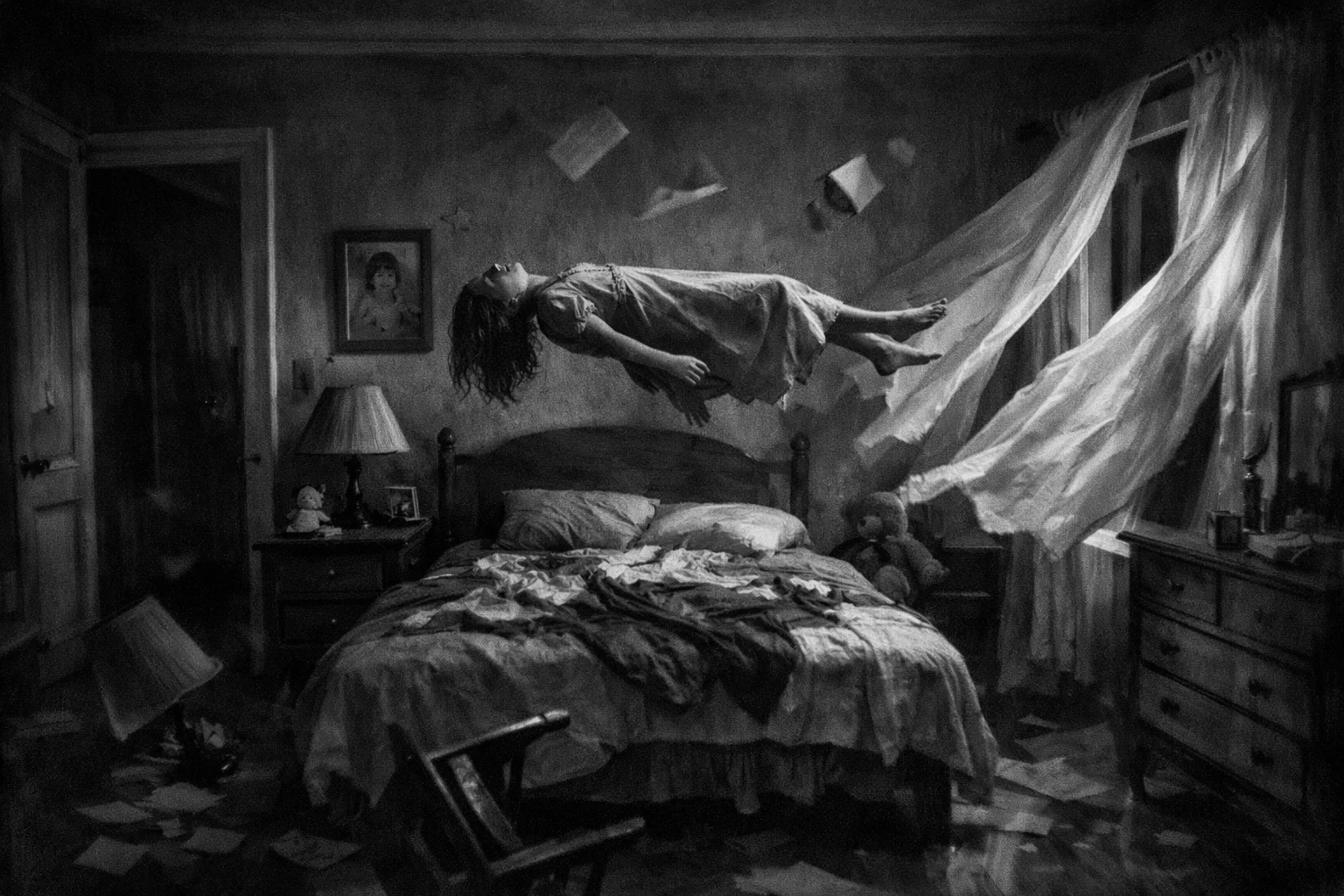
The word poltergeist refers to a type of paranormal event where something physically interacts with the environment. Unlike other ghost sightings, a poltergeist is mainly known for moving objects and making noises.
Summary
What Is a Poltergeist?
A poltergeist is a type of ghost or spirit responsible for physical disturbances, such as loud noises and the movement or destruction of objects. The term originates from the German words poltern, meaning “to make noise” or “to rumble,” and Geist, meaning “ghost” or “spirit.” Consequently, the literal translation is “noisy ghost” or “rumbling spirit.”
Traditional ghost sightings usually involve seeing apparitions, but poltergeist activity is mostly about sounds and movement. In occult studies, poltergeists are described as unpredictable and random. Reports of these events go back to the 1st century and appear in many cultures, such as Ancient Rome, Japan, and several European countries.
In the middle of the 19th century, the word entered the English language as researchers began to document cases systematically. A common theory among parapsychologists, such as Frank Podmore, is the “agent theory,” which suggests that the activity centers around a specific individual, often an adolescent experiencing emotional or psychological stress. This theory suggests that the phenomena may be a form of subconscious telekinesis rather than the work of a mysterious entity.
However, there are other explanations. Skeptics often think poltergeist events are caused by fraud or psychological reasons. They suggest that people might fake the activity or cause it themselves without realizing it, through suggestion or manipulation.
What If One Crystal Tower Could Flush Out Spirits, Bad Vibes, and Years of Bad Luck?
Limited-Time: Up to 12% OFF!
Purification Black Tourmaline Crystal Tower – Authentic raw black tourmaline obelisk • Neutralizes harmful ghosts & jinxes • Clears emotional & energetic blockages for prosperity • Root-strengthening ally in crystal grids. From ancient earth veins, designed for modern metaphysical warriors.

What Is a “Poltergeist Agent?”
In parapsychology, a poltergeist is often seen not as a separate spirit but as something that occurs around a living person, called the ‘agent’ or ‘focus.’ Researchers like William G. Roll believe these events are caused by Recurrent Spontaneous Psychokinesis (RSPK). In this view, the agent unknowingly releases energy that moves objects or makes sounds without touching anything.
Poltergeist agents often share certain psychological and physical traits. Most cases involve teenagers, especially those going through puberty and its emotional changes. However, an agent can also be an adult dealing with strong emotional repression, high stress, or unresolved trauma.
Parapsychologists have noticed that these people often have ‘thin’ mental boundaries, which makes them more likely to enter dissociative states. The activity is often seen as a way to express inner conflict. For example, if an agent cannot show anger toward someone in authority, the poltergeist might throw objects or make loud noises as a stand-in for that hidden emotion.
When the agent leaves the area, the activity usually stops or follows them to a new place. This suggests the energy is linked to the person, not the location. Some scientific studies have found unusual brain activity in these agents, especially in the temporal lobes. Because of this, some researchers think poltergeist events might be rare physical reactions to stress or environment factors, rather than being caused by a ghost.
You may also enjoy:
The Rocky Hill Castle Haunting: Ghosts, Chains, and Curses
September 18, 2025
Ronové in Demonology: Appearance, Powers, and Lore
August 27, 2025
The Tallman House Haunting: One of America’s Real Poltergeist Cases?
January 19, 2026
Who Is Kimaris, the 66th Demon in Ars Goetia?
August 29, 2025
The Dark History Behind the Dump Road Haunting in Alabama
September 17, 2025
What Is the Difference Between a Ghost and a Poltergeist?
The main difference between a ghost and a poltergeist is how they interact with people and the physical world. A ghost, also called a ‘spectre’ or ‘apparition,’ is usually seen as the image of a dead person. It often seems to replay past events or to stay in one place for emotional reasons. Ghosts typically do not interact with people or move things.
A poltergeist, on the other hand, is known for its physical activity. While a ghost might just appear and ignore people, a poltergeist moves furniture, throws objects, or makes loud knocking sounds. Ghost hauntings can last for many years and are usually tied to a single place.
Poltergeist activity usually lasts only a few weeks or months and often follows a person instead of staying in one place. For example, if a family moves, a ghost would remain in the old house, but a poltergeist might go with the person it is connected to.
What Is the Difference Between Demonic Possession and a Poltergeist?
Demonic possession and poltergeist activity are very different in where they come from and who they affect.
In religious and occult studies, a demon is seen as a being that was never human, often called a fallen angel or a force of evil. In possession cases, the demon tries to take over a person’s body by breaking their will. This can cause personality changes, speaking unknown languages, and suddenly avoiding religious symbols.
A poltergeist, on the other hand, is usually an outside force. It can be scary or even cause harm, but it does not take over a person’s mind. Poltergeist activity is about things happening in the environment, like knocking on doors or making objects float, not about changing a person’s inner state.
Some researchers think that very intense poltergeist cases can be mistaken for or lead to demonic activity. Still, the main difference is that a poltergeist affects the physical world, while possession affects a person’s soul and body.
Demons, Ghosts, and Vengeful Spirits
Limited-Time: Up to 22% OFF!
Something Wicked from Japan – 150+ haunting ukiyo-e masterpieces • Yūrei, yōkai, and oni • Blood-soaked legends • Severed heads • Demonic seduction • Erotic horrors & grotesque beauty. The most terrifying (and beautiful) book of Japanese art ever printed.

How does a poltergeist manifest?
Poltergeist activity often starts with small, easy-to-miss events and then becomes more obvious or violent. Noticing these signs is important to tell them apart from normal house noises or broken equipment.
- Sounds: The most common sign is unexplained noises, such as rapping, thumping, or knocking on walls and floors. Sometimes, these sounds seem to answer people; for example, if someone knocks twice, they might hear two knocks back.
- Movement of Objects: Small things like keys or phones might go missing and turn up in odd places. This is called the ‘Disappearing Object Phenomenon.’ Sometimes, it gets worse, with furniture sliding across the floor or objects being thrown by invisible forces.
- Electrical Interference: Lights might flicker, and devices like radios or TVs can turn on loudly, even when unplugged or without batteries.
- Physical Attacks: In rare and severe cases, people report being pinched, bitten, or pushed.
- Odors: Strong smells, like tobacco smoke or floral perfume, can suddenly appear in homes where no one smokes or keeps flowers. This can be a sign of activity.
These signs often mean there is a ‘focus’ or ‘agent’ in the house. This is usually a person whose presence starts the events, and when they leave, the activity stops.
Most Documented Poltergeists in History
The Enfield Poltergeist
In August 1977, the Hodgson family of Enfield, North London, began reporting phenomena that would lead to one of the most prolonged investigations in paranormal history. The activity centered on two sisters, Janet and Margaret.
It started with reports of furniture sliding across floors and knocking sounds emanating from within the walls. The Society for Psychical Research (SPR) sent investigators Maurice Grosse and Guy Lyon Playfair, who spent over a year inside the home documenting more than 2,000 separate incidents.
The disturbances escalated to include the levitation of the children, the spontaneous ignition of small fires, and the materialization of objects. One of the most famous aspects of the case involved Janet speaking in a “gravelly” male voice that identified itself as “Bill Wilkins,” a man who had died in the house years prior. This voice was recorded extensively and appeared to originate from the back of the throat without the girl moving her lips.
While skeptics, including members of the Committee for the Scientific Investigation of Claims of the Paranormal, suggested the girls used ventriloquism and hidden props, the investigators and several police witnesses maintained they saw objects move in ways that defied mechanical explanation.
You may also enjoy:
Complete Guide to Tennessee Bigfoot Sightings (1871–2025)
August 8, 2025
The True Horror Behind Medusa: Greece’s Most Terrifying Monster
October 30, 2025
Complete Guide to Oregon Bigfoot Sightings (1904–2025)
August 6, 2025
Is the Lukwata Real or Just an African Legend?
November 11, 2025
The Bell Witch
The “Bell Witch” haunting of Adams, Tennessee, remains a singular case in American history, occurring between 1817 and 1821. John Bell and his family were targeted by an entity that initially manifested as strange animals—such as a dog with a rabbit’s head—and evolved into physical assaults.
Betsy Bell, John’s daughter, was frequently pinched, slapped, and had her hair pulled by an invisible force. The entity eventually gained a vocal presence, becoming known as “Kate,” and demonstrated an uncanny ability to be in two places at once or quote sermons from miles away.
The haunting’s severity drew the attention of General Andrew Jackson, who reportedly fled the property after his own party encountered the entity’s power. Unlike most poltergeists that are indifferent to the fate of the “agent,” this entity specifically stated its intent to kill John Bell. Bell suffered from facial tics and seizures that the entity mocked.
In December 1820, Bell fell into a stupor; a mysterious vial of liquid was found in the medicine cabinet, which the entity claimed to have placed there. When the liquid was fed to a cat, the animal died instantly. John Bell died the following day, and the entity reportedly sang bawdy songs during his funeral.
The Forbidden Encyclopedia That Makes Every Ouija Session Ten Times More Dangerous
Limited-Time: Up to 49% OFF!
Angels, devils, nature spirits, ancestors, tricksters, and creator gods – all catalogued with their true names, powers, and protocols. Judika Illes created the definitive directory of the spirit realm that practitioners around the world swear by when they need to know exactly who (or what) just answered.

The Rosenheim Poltergeist
In 1967, the law firm of Sigmund Adam in Rosenheim, Germany, became the site of a rare poltergeist case that focused on modern technology.
Fluorescent light tubes rotated in their sockets until they fell, all the office telephones rang simultaneously, and the firm’s monthly phone bills showed hundreds of calls to the “time of day” service that no one had made. The intensity was so high that technicians from the local power company and the post office installed voltage monitors to detect surges. Still, they found no technical explanation for the spikes.
Professor Hans Bender, a parapsychologist from the University of Freiburg, was called to investigate. He discovered that the events only took place when a young clerk named Annemarie Schaberl was present. Using high-speed cameras, Bender’s team captured images of paintings on the walls as they rotated 360 degrees.
When Schaberl walked down the hallways, the light fixtures would swing behind her. The case is highly regarded in the scientific study of the paranormal because the disturbances were monitored by professional equipment that recorded physical movement and electrical pulses that could not be attributed to human fraud.
The Thornton Heath Poltergeist
The Thornton Heath disturbances in Greater London began in 1970. They focused on a family who had moved into a house with a history of tragedy. The manifestation was unusually aggressive, starting with a bedside radio that would turn itself on and switch stations to blaring music in the middle of the night.
This progressed to “teleportation” of household items and the heavy vibration of the floorboards. On one occasion, a heavy chest of drawers was seen to lift several inches off the floor and tilt toward the family.
A medium who visited the house claimed the entity was a man named “Chatterton,” who had lived in the house during the 18th century. The family reported seeing a “grey, cloud-like form” that would manifest in the living room.
Physical violence was also reported, including a family member being thrown out of bed. The haunting ended after the family moved out. Still, the case remains documented due to the consistency of the family’s testimony over several years and reports from multiple visitors who claimed to have witnessed the objects moving on their own.
The Jaboticabal Poltergeist
In 1965, the Ferreira family in Jaboticabal, Brazil, experienced one of the most violent poltergeist outbreaks on record, centered on their 11-year-old daughter, Maria.
The “stones” in this case were not just small pebbles but large rocks, some weighing up to 4 kilograms, which would materialize in the air and smash through windows or strike Maria. The local police were unable to find anyone throwing the rocks, as they often appeared to be thrown from inside closed rooms.
As the activity progressed, the physical attacks on Maria became life-threatening. She was allegedly struck by invisible objects that left deep bruises. On several occasions, her clothes caught fire while she was wearing them. Most disturbingly, pins and needles were found embedded in her skin by doctors, despite Maria being under constant observation.
The case ended in tragedy when Maria, unable to cope with the relentless physical and psychological trauma of the manifestations, took her own life at the age of 16. The documentation for this case includes medical records and police statements regarding the spontaneous appearance of the stones and fire.
You may also enjoy:
Likho: The One-Eyed Crone Who Brings Death and Bad Luck
September 11, 2025
What Is the Nurikabe Yokai? The Haunted Barrier That Traps Travelers
September 9, 2025
Andromalius in the Ars Goetia: The Great Earl of Hell
April 29, 2025
Abalam: Demon of Sorrow and Knowledge
August 13, 2025
Can a poltergeist kill you?
Poltergeist activity is usually seen as annoying rather than deadly. However, there is still a risk of physical harm in some cases. Most reports mention minor injuries like scratches, bruises, or tripping. The risk is higher when moving heavy or sharp objects.
A poltergeist can be dangerous because its movements are sudden and unpredictable. For example, if a heavy appliance like a fridge or wardrobe floats and falls, it could cause serious injury or death. There are also stories of ‘ghost hands’ interfering with machines or vehicles, which could lead to accidents.
Beyond direct physical impact, the psychological toll of a poltergeist manifestation—including sleep deprivation and extreme terror—can lead to secondary health issues like heart stress or psychiatric crises. While documented deaths directly caused by poltergeists are extremely rare in historical records, the Bell Witch case remains a prominent example of an entity being held responsible for a person’s demise.
How to Mitigate or Stop Poltergeist Activity
Dealing with a poltergeist usually means focusing on both the person involved and the environment. Since these events are often connected to stress, the best way to stop them is to lower emotional tension in the home.
- Psychological Intervention: If the agent is found, parapsychologists suggest counseling or therapy to help them deal with hidden emotions. When the agent finds a healthy way to handle stress or anger, the activity often stops on its own. In many cases, just recognizing the emotional cause was enough to end the events.
- The ‘Ignore’ Method: Many investigators say that showing too much fear or curiosity can make the events worse. Staying calm and treating the activity as a small annoyance, not a big threat, can help reduce the energy that keeps it going.
- Environmental Stabilization: It’s important to check for and fix natural causes that might seem like paranormal events. High Electromagnetic Fields (EMF) from bad wiring or big appliances can make people feel like they’re hallucinating or being watched. Infrasound from things like industrial fans or wind in pipes can also cause anxiety and discomfort. Fixing electrical problems and using soundproofing can help make the environment more stable.
- Scientific Documentation: Writing down details of each event can help spot patterns. If the activity happens at certain times or only when some people are present, the family can find the ‘focus’ and work on the specific causes.
When the activity seems harmful, some cultures use traditional or religious rituals to ‘clear’ the space. Parapsychologists see these rituals as ways to help the agent feel more in control and safe. This often lowers stress and can stop the poltergeist activity for good.