The Banshee, or bean sídhe, is a chilling yet protective female spirit originating in Irish folklore. She is a harbinger of death, foretelling the imminent passing of a member of certain ancient Gaelic families through mournful, high-pitched wailing, shrieking, or keening—a cry so distinct and sorrowful that it is unmistakable.
While often associated with terror, her presence is fundamentally a supernatural warning, embedded in ancient Irish mourning practices, connecting prominent families to the enigmatic world of the Aos Sí, or “people of the mounds.”
Summary
Key Takeaways
| Attribute | Details |
| Names | Banshee, Bean Sí, Bean Sídhe (Irish for ‘woman of the fairy mound’ or ‘fairy woman’), Bean Chaointe (‘crying woman’), Caoineag (Scottish variant). |
| Nature | Female spirit, Fairy (specifically a member of the Aos Sí or sídhe), or Ghost (sometimes a specific murdered woman or mother who died in childbirth). |
| Species | Spectral or Humanoid. |
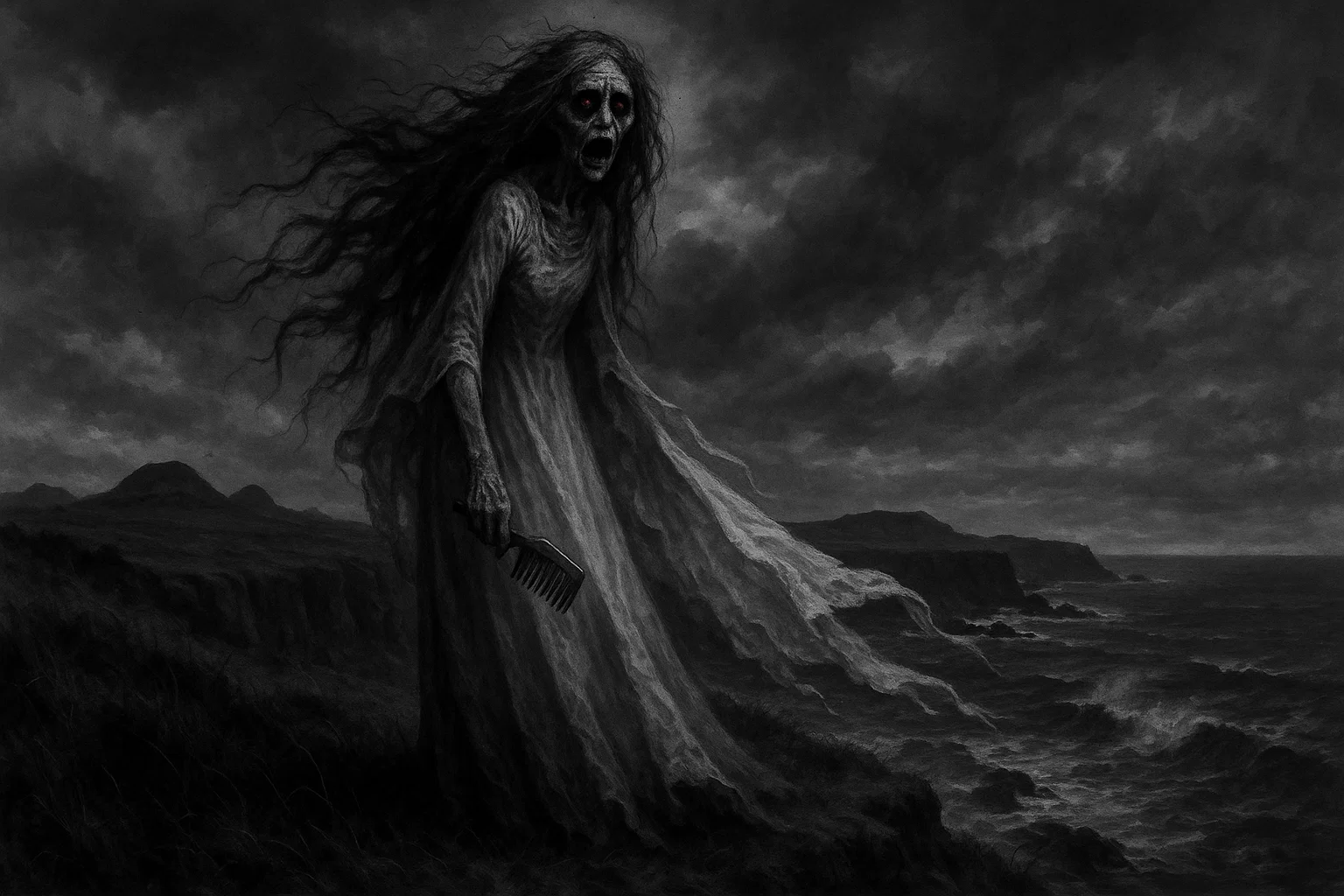
| Appearance | Varies widely: A beautiful young woman, a stately matron, or a withered, terrifying hag. Often has long, streaming hair (which she may comb with a silver comb), eyes red from continual weeping, and wears a white, grey, or green hooded cloak or shroud. May also appear unnaturally small (one to four feet tall). |
| Area | Ireland (primarily attached to prominent Gaelic families), Scotland (where a related creature is the bean nighe), and Wales (related to the cyhyraeth). |
| Creation | Evolved from the goddess Brigid, A specific murdered woman, A mother who died in childbirth, or A former keening woman (a professional mourner) possibly banished or sinful. |
| Weaknesses | None explicitly stated in traditional folklore that repel or defeat her; her power is generally limited to predicting death and not causing it. She is bound to the bloodlines of certain families. |
| First Known | Earliest mentions trace back to the 8th century, though the first known written record is often cited as Sean MacCraith’s Cathreim Thoirdhealbhaigh (Triumphs of Turlough) around 1380. |
| Myth Origin | Gaelic/Celtic folklore (specifically Irish), rooted in the indigenous practice of keening (ritual funeral lamentation) and the Tuatha Dé Danann (pre-Christian deities who became the sídhe). |
| Strengths | Prophecy (foretelling death), Shapeshifting (into various forms, including animals like a crow, stoat, or hare), Intangibility and Invisibility. |
| Associated Creatures | Bean Nighe (Scottish ‘little washerwoman’), Cyhyraeth (Welsh spirit). |
| Time Active | Predominantly nocturnal (heard wailing at night). |
| Habitat | Near the dwellings or travel routes of her designated family. |
| Protection | Acknowledging her cry and preparing for the inevitable death. |
Who or What Is Banshee?
The Banshee, known in Irish Gaelic as the Bean Sídhe (meaning ‘woman of the fairy mound’), is a supernatural female entity in Irish mythology and folklore whose sole traditional function is to announce the imminent death of a member of a select family.
She is generally considered a type of fairy or female spirit connected to the Aos Sí—the “people of the mounds” or the Irish fairy folk who inhabit the ancient earthwork mounds known as sídhe.
The concept of the Banshee is inextricably linked to the ancient Gaelic clans of Ireland, where it is a supernatural retainer. According to tradition, she is not a random omen of death, but rather an entity bound to a specific noble lineage, typically those with names prefixed by O’ or Mac.
The lore is particularly focused on the Five Major Families—the O’Briens, the O’Neills, the O’Connors, the O’Gradys, and the Kavanaghs—though her duty expanded to other prominent clans over time. Her mournful cry, called a keen (from the Irish word caoineadh, meaning ‘to weep’), is a supernatural lament.
It is heard by those connected to the family, serving as a chilling, definitive warning of a death that will occur soon, often even if the person is dying in a distant land. While modern interpretations sometimes portray her as malicious, the original Banshee is an omen, a messenger of fate, and an entity of intense, sorrowful mourning.
Tired of Bad Luck, Dark Spirits, and Toxic Vibes Draining Your Life?
Limited-Time: Up to 25% OFF!
Natural Black Tourmaline Crystal Healing Pendant – Genuine raw tourmaline • Absorbs & transmutes negativity • Guards against psychic attacks & hauntings • Deep spiritual cleansing for home & body • Purifies chakras & spaces from bad vibes. A portable force field—essential for sensitive souls in chaotic times.

Genealogy
The Banshee’s origin is generally considered complex and individual, so a traditional family tree or ‘genealogy’ in the human sense does not exist. However, the various legends and theories about her origin or identity can be cataloged as ‘genealogical’ connections to her nature.
| Ancestral or Associated Figure | Kinship/Role |
| Aos Sí (Sídhe) | Fairy Kin (The Banshee is classified as a Bean Sídhe—a ‘fairy woman’ and one of the Aos Sí). |
| Tuatha Dé Danann | Mythological Precursor (As the ancient race that retreated into the sídhe mounds to become the Aos Sí, they are the mythological basis for her existence). |
| Brigid | Possible Divine Precursor (Some scholars link her to the Irish goddess Brigid, a figure associated with lament music (goltraí) and life/death transitions). |
| The Morrígan | Mythological Parallel (The war goddess, sometimes depicted as a hag washing the bloody armor of a fated warrior, showing a conceptual link to a female death-foreteller). |
| Professional Keening Women | Mortal Parallel (The professional mourners, bean chaointe, whose practice of lamentation at funerals is the direct cultural root of the Banshee’s wail). |
| Specific Murdered Women | Origin Variant (Some legends suggest she is the ghost of a woman who died a violent or untimely death, bound to warn her descendants). |
Etymology
The name Banshee is an anglicization derived directly from the Irish Gaelic phrase bean sídhe or bean sí, which translates literally to “woman of the fairy mound” or “fairy woman.” This etymology is fundamental to understanding the creature, as it ties her directly to the Irish supernatural realm of the sídhe.
The word bean is the straightforward Irish word for “woman.” The term sídhe (or sí in Modern Irish) is more complex. It originates from the Old Irish word síde, referring to the ancient earthwork mounds—tumuli—that dot the Irish environment.
In pre-Christian Gaelic tradition, these mounds, or sídhe (singular síd), were revered as the access points to the Otherworld. They were believed to be inhabited by the Aos Sí (“people of the mounds”), the supernatural race often equated with the fairies, who are themselves considered the descendants or a later mythological form of the Tuatha Dé Danann, a race of divine beings.
As a result, a bean sídhe is inherently a female spirit who belongs to this world and acts as a messenger between the Otherworld and the human world.
The term underwent phonetic adaptation during the 18th century in Anglo-Irish contexts to become the recognizable “Banshee.” In some regions, she is also known as the Bean Chaointe (“crying woman”), a reference to her primary action, the mournful cry known as keening (caoineadh).
This dual naming reflects her origins: the supernatural fairy status (bean sídhe) combined with the cultural practice of lamentation (bean chaointe).
The Scottish Gaelic folklore has a related term, bean nighe (“washerwoman”), which describes a spirit with a similar death-foretelling function but a different primary activity, reinforcing the widespread cultural roots in Celtic tradition.
You may also enjoy:
The Complete List of All Haunted Places in Arkansas
October 8, 2025
Empusa: The Seductive Demon That Devoured Men
October 3, 2025
Top 13 Most Haunted Houses in Connecticut
December 2, 2025
What Does the Banshee Look Like?
The physical description of the Banshee is not singular; rather, she is an entity with the ability to appear in one of three distinct forms, sometimes interpreted as a form of metamorphosis. These images reflect the three ages of womanhood, or a spectrum from beauty to terror.
One primary manifestation is that of a beautiful young woman with long, flowing hair, which is often described as golden or raven-black. In this form, she may be seen wearing a white, silver, or green dress, the traditional color of the Irish fairy folk.
A second common form is that of a stately matron or a rich middle-aged lady, embodying an air of sorrowful dignity. The third, and often most terrifying, appearance is that of a withered hag or frail old woman with a dreadful complexion.
Her hair in this disguise is often described as long, grey, or wildly disheveled. She may wear a shroud or ragged, dark clothing—frequently white (symbolizing death) or grey (symbolizing the Otherworld mist).
Regardless of the form, a common regular feature is that her eyes are often red from continual weeping or keening. In some traditions, she is seen combing her long, streaming hair with a silver comb. This act reinforces her connection to the wealth and power of the families she serves.
Regional accounts also differ on her size: while some report her as unnaturally tall, other tales state her stature is quite short, sometimes as little as one to four feet, a characteristic used to focus on her link to the fairy folk (sídhe).
Demons, Ghosts, and Vengeful Spirits
Limited-Time: Up to 22% OFF!
Something Wicked from Japan – 150+ haunting ukiyo-e masterpieces • Yūrei, yōkai, and oni • Blood-soaked legends • Severed heads • Demonic seduction • Erotic horrors & grotesque beauty. The most terrifying (and beautiful) book of Japanese art ever printed.
Mythology
The mythology of the Banshee is deeply embedded in the Gaelic world’s concept of death, fate, and the supernatural world of the fairies. Her existence is often traced back conceptually to two main roots: ancient Celtic deities and medieval Irish social practices.
In the most ancient mythological context, the Banshee is linked to the Tuatha Dé Danann, the divine race of pre-Christian Ireland who, after being defeated, retreated underground to become the Aos Sí or fairies. This positions the Banshee as an intrinsic member of the supernatural folk, serving as a death omen for the descendants of Ireland’s original inhabitants—the Milesian stock.
Some researchers draw a parallel between the Banshee’s function and the mythological role of the Morrígan, the Irish goddess of war, fate, and death, who appears in the epic tale of Cúchulainn before his demise, washing his bloody armor at a ford. This entity, often called the Washing Woman (bean nighe in Scottish Gaelic), symbolically foretells the hero’s doom, much like the Banshee.
The more direct origin theory connects the Banshee to the keening women (bean chaointe) of medieval and early modern Ireland. Keening was a highly stylized and emotional vocal lamentation performed ritually by women at wakes and funerals.
These women were often professional mourners, and the most talented were hired by prominent families. The belief arose that for the most noble or ancient families, a supernatural bean sídhe—a fairy woman—would attend to keen over the impending death, being a more powerful and sorrowful singer than any human.
Over time, the folklore solidified, transforming this idealized fairy presence into the specific solitary spirit, the Banshee, whose wail precedes the death rather than accompanies the funeral.
The earliest known written record mentioning a bean sídhe is often cited in the 14th-century text Cathreim Thoirdhealbhaigh (Triumphs of Turlough) by Sean MacCraith. This account details the wars of the O’Briens of Thomond, suggesting that her association with powerful clans dates back to the earliest documented history.
The Banshee’s devotion was strictly to the bloodline of her designated family. This meant she would follow the descendants of these families—such as the O’Neills, O’Briens, O’Gradys, O’Connors, and Kavanaghs—even if they emigrated to other continents. She is not bound to a specific location, but rather to the fate of her people.
Legends
The Warning of King James I of Scotland (1437)
The prophetic function of the Banshee archetype is illustrated in the account of King James I of Scotland. In the winter of 1437, as the King resided in a monastery near Perth, a supernatural woman, sometimes identified as a Highland seeress or Banshee, sought audience with him.
She was described as a haggard crone with the appearance of a person who had undergone great suffering, and she delivered a specific prophecy of murder awaiting the King. She warned him explicitly of the plot conceived by his uncle, the Earl of Atholl, and his grandson, Sir Robert Graham.
James I, believing his defenses and guards were sufficient, dismissed the strange woman’s dire warning. Shortly thereafter, the conspirators broke into the royal apartments. The King was pursued into the sewer beneath the rooms, where he was found and brutally assassinated.
The spirit’s appearance and the delivery of a clear, ignored death omen align her function squarely with that of the Banshee, serving as an unheeded messenger of doom to a figure of great nobility.
Lady Fanshawe’s Terrifying Witness in Tipperary (1642)
One of the most famous written descriptions of a Banshee comes from the detailed Memoirs of Lady Ann Fanshawe, recounting a night in 1642 at a castle near Clonmel, County Tipperary.
Lady Fanshawe and her husband, Sir Richard Fanshawe, were guests in a house where the hostess lay ill. In the deep hours of the night, Lady Fanshawe was jolted awake by a sound so unnerving that it defied earthly description.
As she cautiously drew the curtain, she saw in the moonlight a woman leaning into the window with a vile, unsettling appearance: “in white, with red hair and pale and horrid complexion.”
The spectral creature let out a cry that was not human, uttering the word “A horse,” three distinct times, before departing with a sigh that sounded “more like the wind than any thing.”
Sir Richard, woken by the commotion, sought to rationalize the sound as a cat or a fox. However, the event was confirmed that morning when they received the news that the lady of the house had died during the night.
The Forbidden Encyclopedia That Makes Every Ouija Session Ten Times More Dangerous
Limited-Time: Up to 49% OFF!
Angels, devils, nature spirits, ancestors, tricksters, and creator gods – all catalogued with their true names, powers, and protocols. Judika Illes created the definitive directory of the spirit realm that practitioners around the world swear by when they need to know exactly who (or what) just answered.
The O’Brien Banshee and the Silver Comb
Legends associated with the O’Brien clan of Thomond, one of the five major families, often depict their ancestral Banshee with a unique characteristic: a silver comb.
This spirit, usually taking the form of a woman with spectacularly long hair, is often seen by a stream or lake at midnight, combing her luminous silver hair with the precious implement. The comb is not merely a grooming tool; it is a fairy token, a piece of sí-fhraígh (fairy silver) that shines with an unearthly glow.
In a prominent tale, a young O’Brien man who had heard the wailing the previous night stumbled on the Banshee by a riverbank. She left the silver comb unattended as she vanished for a moment. The man, tempted by the valuable object, reached to pick it up.
As his hand closed around the cold metal, the Banshee suddenly reappeared. She did not harm him, but spoke a chilling warning, or in some variants, whisked him away to the Otherworld, never to be seen again.
The Collective Keen of the Nobility
A significant aspect of the Banshee myth is the phenomenon known as the collective keen. It is told in the ancient histories that when a chieftain or a person of extraordinary nobility or sanctity was about to die, the omen was not announced by one lone Banshee, but by several together.
This collective sound, known as the fairies’ lament, was said to be so overwhelming that it was heard across entire villages, signifying a loss that affected the whole country or a great spiritual community.
This mass lamentation was considered the ultimate sign of a predetermined, momentous death. It was a source of great terror, as it implied an event far beyond the scope of a common family passing.
The lore has it that the death of a revered king, a great saint, or a prominent high-king would be preceded by this united, shattering wail of the Aos Sí, confirming the deceased’s high standing in both the human and supernatural worlds.
You may also enjoy:
The Loveland Frog Mystery: Real Cryptid or Local Hoax?
September 25, 2025
Is Cadborosaurus the Real Sea Serpent of the Pacific Northwest?
November 6, 2025
Complete Guide to Mississippi Bigfoot Sightings (1721–2025)
August 1, 2025
The Terrifying Face of Tisiphone, Avenger of Blood Crimes
September 1, 2025
Banshee vs Other Monsters
The Banshee (as a harbinger of death) has parallels in other mythologies, particularly in Celtic and European traditions concerning female figures associated with fate and doom.
| Monster Name | Origin | Key Traits | Weaknesses |
| Bean Nighe | Scottish Gaelic Folklore | Washing Woman who cleans the bloodstained clothes of those soon to die; usually ugly, with one large tooth and sagging breasts. | Being interrupted; sometimes the inquirer can gain a wish if clever. |
| Cyhyraeth | Welsh Folklore | A mournful, groaning spirit (not a scream) heard before death, often near rivers; cries are louder for prominent people. | None mentioned in folklore; is simply a sound omen. |
| Morrígan | Irish Mythology | Goddess of war, fate, and death; often appears as a crow/raven or a hag washing armor at a ford before a warrior’s death. | No specific weaknesses; is a powerful deity/force of nature. |
| La Llorona | Mexican Folklore | The Wailing Woman ghost of a mother who drowned her children; her cry is a lament, and she is often seen near rivers, sometimes abducting children. | No specific weaknesses; cannot find her own children to rest. |
| Huldra | Scandinavian Folklore | A beautiful forest spirit, often luring men to their deaths; has a hollow back or cow’s tail. | Can be defeated by making the sign of the cross or speaking Christian words. |
| Valkyrie | Norse Mythology | Female figures who choose those who die in battle and escort them to Valhalla; harbingers of death for warriors. | No recorded weaknesses; they are divine or semi-divine beings. |
| Strix | Greco-Roman Mythology | A nocturnal bird that fed on human flesh and blood; later incorporated as a type of monstrous hag/owl. | Certain amulets or herbs to ward off nocturnal attacks. |
| Yamauba | Japanese Folklore | A mountain hag/witch with an unsettling large mouth; lures travelers with deceptive appearances before consuming them. | Requires physical force or magical seals; not a spirit. |
| Banshee | Irish Folklore | Spectral female who wails or keens to announce the imminent death of a member of a specific family line. | Bound to bloodlines; cannot cause death. |
The Banshee’s similarities with other monsters, particularly the Bean Nighe and the Cyhyraeth, highlight a common Celtic mythological archetype: the female spirit who foretells death through sound or a specific mournful action.
The Banshee is unique in that her primary action is the piercing vocal lament (keen or wail), which is both her warning and her sorrowful function, and she is exclusively attached to familial bloodlines. By contrast, the Bean Nighe is seen washing the clothes of the fated. At the same time, the Cyhyraeth is simply an acoustic omen.
Unlike malevolent figures such as the La Llorona or Yamauba, the traditional Banshee is not inherently dangerous and does not cause the death she announces. Her power is a passive form of prophecy, separating her from the active, life-claiming powers of entities like the Morrígan or the Valkyries.
Powers and Abilities
The Banshee’s powers are primarily prognostic and spectral, focusing on her role as an unearthly harbinger rather than an active combatant in the mortal world. Her most defining ability is her supernatural voice. Still, as a member of the Aos Sí or a spectre, she has other ethereal qualities.
Her central power is supernatural foresight, specifically the ability to foretell death. Her terrifying cry is not merely a scream; it is a prophetic lament that announces a family member’s impending demise, regardless of their location.
The acoustic manifestation of this cry varies: some hear a low, sorrowful humming or hissing (sídh), while others experience a piercing, shattering shriek capable of physical disturbance. This distinction often relates to the closeness of the omen and the status of the person dying.
What’s more, as a spirit tied to the supernatural world, she has powers of concealment and immateriality, allowing her to appear and disappear at will. While modern fiction sometimes attributes to her the power of a sonic weapon that kills on impact, in traditional folklore, her role is limited to announcing fate, which she neither alters nor causes.
The appearance variations suggest a limited form of shapeshifting, allowing her to manifest in various disguises.
The Banshee’s powers:
- Foresight/Prophecy of Death: The ability to sense and announce the imminent passing of a specific family member, regardless of their location. This power is restricted to the bloodline she is bound to.
- Wail/Keen (Variations): The Sídh: A low, mournful, and sometimes hissing sound that is a subtle, often personal omen. The Shriek: A high-pitched, shattering scream that signifies an unavoidable and immediate death, sometimes heard collectively.
- Intangibility: As a spectre, she can move through solid objects, such as walls or windows, and is unaffected by physical obstacles.
- Invisibility: The Banshee is primarily an acoustic phenomenon; she can conceal her form from mortal sight, choosing when and to whom she reveals herself.
- Metamorphosis: The ability to alter her physical form to appear as a beautiful maiden, a stately matron, or a withered hag.
You may also enjoy:
Swiatek: Murder, Cannibalism, and a Wolf’s Curse
June 18, 2025
What Is a Satyr, the Lust-Driven Monster of the Wild?
November 14, 2025
What Is a Selkie and Why Is Its Seal Skin So Dangerous?
January 29, 2026
Complete Guide to Georgia Bigfoot Sightings (1957–2025)
July 22, 2025
Decarabia: Pentagram Spirit of the Ars Goetia
August 20, 2025
Can You Defeat a Banshee?
When it comes to traditional Irish folklore, the concept of defeating a Banshee is not applicable, as her nature is that of an omen of fate rather than a monster to be vanquished. She is not typically an evil or malicious entity; she does not cause the death she announces, nor does she physically attack or harm those who hear her.
Her power is passive—she merely is a messenger. As such, there are no traditional methods for destroying or warding her off in the same manner as a malicious creature.
Her inherent weakness or limitation is her inability to interfere with mortal life beyond her warning. She is bound to the bloodlines of certain families, which restricts her activity to announcing their deaths. Trying to fight a Banshee is generally considered futile because she is often intangible and invisible and is merely announcing a fate that is already sealed.
The appropriate response after hearing the keen is not to seek a weapon, but to prepare for the loss of a family member. Her presence is a final, sorrowful sign of the deep ties between the human world and the Otherworld.
The only known vulnerability in the lore relates to her fairy possessions, such as the silver comb; attempts to seize such an item are met not with destruction, but with the Banshee’s swift, supernatural reprisal, potentially resulting in the mortal being taken to the sídhe.
Conclusion
The Banshee remains one of the most powerful and resonant figures in Irish mythological heritage, embodying the complex interplay between ancestral pride, ritual grief, and supernatural fate.
Originating from the bean sídhe and ingrained in the practice of keening, she is not a random monster but a supernatural retainer whose duty is fixed to the O’ and Mac bloodlines of the ancient aristocracy. Her power is not destructive in its original form, but purely prognostic, lending a chilling dignity to the inevitable transition of life into death.
Her distinct mythological function, which is to announce, not cause, death, sets her apart from more actively malevolent spectral creatures globally. Whether she appears as a radiant maiden or a terrifying hag, her message is singular and unchanging.
Her cry—be it the soft humming of a subtle omen or the shattering shriek of a great, collective lament—is the ultimate sign that a member of the bloodline is crossing the final threshold, reinforcing the deep, abiding connection between the noble families of Ireland and the long-lasting power of the Otherworld.