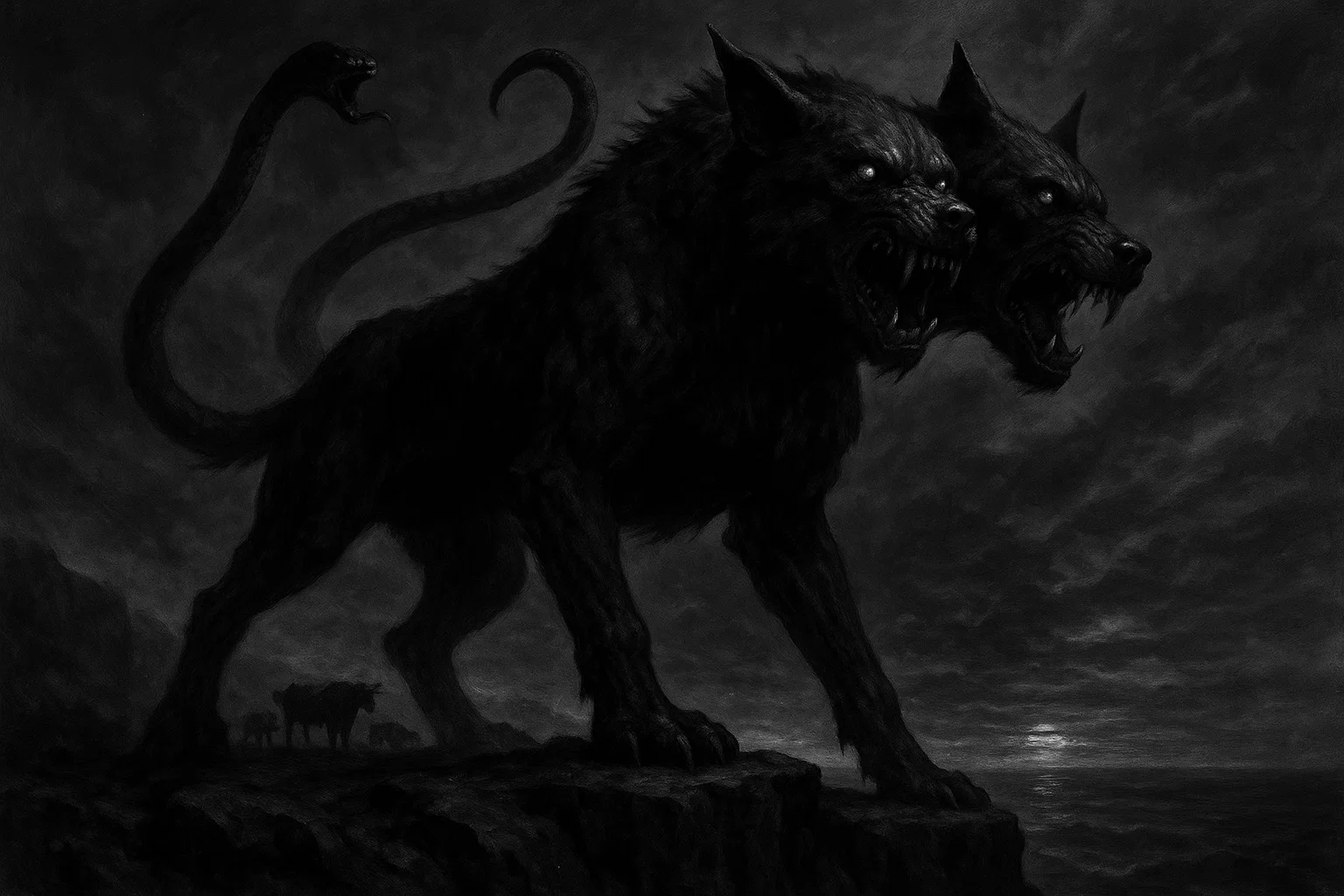
Orthrus (or Orthus) is a monstrous two-headed dog from Greek mythology, primarily known for his role in the Twelve Labors of Heracles. Born from the primordial monsters Typhon and Echidna, this fierce hound was tasked with guarding the immense herd of red cattle owned by the giant Geryon on the remote western island of Erytheia.
Though his tale is short, culminating in a violent encounter with the hero Heracles, Orthrus is a key figure in the lineage of Greek monsters, being the brother of Cerberus and the sire of other famous beasts.
Summary
Key Takeaways
| Attribute | Details |
| Names | Orthrus, Orthus; from Ancient Greek Ὄρθρος (Orthros), meaning ‘dawn’ or ‘daybreak’. |
| Nature | Chthonic monster. |
| Species | Canine/Beast (monstrous hound). |
| Appearance | A large, fearsome dog, usually depicted with two heads. Sometimes shown with a snake tail. |
| Area | Erytheia (‘red one’)—a mythical island in the far west, associated with the sunset. |
| Creation | Born from the monstrous union of Typhon and Echidna. |
| Weaknesses | Vulnerability to a single, powerful physical blow (as demonstrated by Heracles’ club). |
| First Known | c. 8th–7th century BC, in Hesiod’s Theogony. |
| Myth Origin | Ancient Greek mythology, specifically the tradition surrounding the Labors of Heracles. |
| Associated Creatures | His monstrous siblings Cerberus, the Lernaean Hydra, the Chimera, and his offspring the Sphinx and the Nemean Lion. |
| Diet | Not explicitly stated, but his role as a guard dog implies a diet consistent with a large, ferocious predator. |
| Time Active | His name, Orthros (‘dawn’ or ‘daybreak’), may subtly suggest early morning vigilance. |
Who or What Is Orthrus?
Orthrus is a lesser-known monster hound among the vast array of creatures in Greek mythology. He is consistently identified as a two-headed dog, serving as the loyal, formidable sentinel for the giant Geryon on the remote island of Erytheia. His sole mythological function is directly tied to the tenth of Heracles’ Twelve Labors: the quest to steal Geryon’s prized red cattle.
Born to the monstrous parents Typhon and Echidna, Orthrus belongs to a lineage infamous for producing many of the greatest threats to the Olympian gods and human heroes.
This shared monstrous parentage makes him the brother of the three-headed hound Cerberus, who guards the entrance to the Underworld, as well as of other chimeric beasts such as the Lernaean Hydra and the Chimera.
Orthrus’s existence and violent end point out the hero Heracles’ capacity to overcome not only human adversaries but also the very elemental forces of monstrosity represented by the offspring of Typhon. Although his role is that of a guard dog, his size, nature, and lineage raise him far beyond a common animal, positioning him as a fearsome, chthonic beast—a primal manifestation of wild, untamed nature.
This Book Turns the Entire United States Into One Giant X-Files Map
Limited-Time: Up to 38% OFF!
J.W. Ocker traveled the country collecting the weirdest local legends and marks the real-world locations where the Beast of Bray Road, the Dover Demon, the Wendigo, and hundreds more have been spotted. Part travel guide, part bestiary, 100% nightmare fuel.

Genealogy
Orthrus is part of one of the most significant monstrous family lines in Greek mythology:
| Relation | Name |
| Father | Typhon (A gigantic serpentine monster and father of all monsters) |
| Mother | Echidna (A half-woman, half-snake monster) |
| Siblings | – Cerberus (Three-headed dog, guardian of the Underworld) – Lernaean Hydra (Many-headed serpent) – Chimera (Fire-breathing composite monster) – Ladon (Dragon guarding the golden apples of the Hesperides) |
| Consort | Echidna (His own mother, in some accounts) or The Chimera (In some accounts) |
| Offspring | The Sphinx (Winged, riddle-asking monster) |
| The Nemean Lion (Enormous lion with impenetrable hide) | |
| Master | Geryon (Three-bodied giant) |
Etymology
The name Orthrus (Ancient Greek: Ὄρθρος, Orthros) or Orthus (Ὄρθος, Orthos) is deeply ingrained in ancient Greek terminology for the morning hours.
The primary interpretation connects Orthrus to the noun meaning ‘dawn‘ or ‘early morning twilight‘ (the period just before sunrise). This etymological root traces back to the Proto-Indo-European root herd- meaning ‘to rise’ or ‘to grow upright’.
This linguistic origin is important when considering the setting of the monster’s myth. Orthrus guarded Geryon’s red cattle on the island of Erytheia (‘the red one’), which was located in the far West, at the edge of the known world, often associated with the place where the Sun set.
The monster’s name, meaning ‘dawn’, standing watch in the land of the ‘sunset’, may carry symbolic weight related to transition or vigilance—the brief, dangerous time between darkness and full daylight.
Plus, his alternative name, Orthus (Ὄρθος), is closely related to the Greek adjective ὀρθός (orthos), which translates to ‘straight‘ or ‘upright‘. This may be a subtle reference to the creature’s unwavering and resolute stance in its duty as a guardian, always standing straight and vigilant against intruders, or it may simply be a common phonetic or dialectical variant used by different Greek poets and mythographers.
You may also enjoy:
Is Detroit Cursed by the Nain Rouge?
May 20, 2025
Top 13 Most Haunted Houses in Connecticut
December 2, 2025
Ose: The Insanity Inducing Demon of the Ars Goetia
September 1, 2025
What Does Orthrus Look Like?
Orthrus is primarily and consistently described as a monstrous dog possessing two heads. Ancient literary sources and artistic depictions from the Archaic and Classical periods focus on this defining trait to signify his status as a heightened, vigilant guardian. The mythographer Pseudo-Apollodorus, for example, explicitly names Orthrus as a ‘hound with two heads’.
While the number of heads is usually fixed at two in the literature, artistic representations sometimes show variation. Though two heads are the norm on black-figure and red-figure vase paintings, some extremely rare depictions present him with only one head, or, in some cases, with three heads in the manner of his more famous brother, Cerberus, suggesting a degree of artistic fluidity in the monster’s characteristics.
Beyond the heads, the descriptions of his tail are also variable. Like Cerberus, Orthrus is sometimes depicted with a serpent tail, emphasizing his monstrous, snake-like parentage (Echidna was half-snake).
However, other works of art, such as the Swing Painter’s amphora, show him with a more common dog tail. Descriptions often imply immense stature and a fierce, muscular body, commensurate with his role as a guard of a giant’s prized herd in a remote, dangerous location.
Mythology
Orthrus’s place in Greek mythology is firmly established by his lineage and his central, if brief, role in the epic cycle of the Twelve Labors of Heracles.
His earliest known literary appearance is in Hesiod’s Theogony (c.25 8th–7th century BC), which is the foundational source for his family tree. Hesiod names Typhon and Echidna as the parents of a terrifying brood, listing Orthus first, followed by Cerberus and the Lernaean Hydra.
Hesiod is also the source for Orthrus’s unique role as a progenitor, stating that Orthrus (Orthus) and a partner (possibly Echidna or the Chimera) fathered the Sphinx and the Nemean Lion. This detail establishes Orthrus as a central figure in the creation of subsequent monstrous threats encountered by heroes.
The key narrative involving Orthrus is his role in Heracles’ Tenth Labor: the quest to acquire the Cattle of Geryon. The monster was a fixture on the island of Erytheia (‘Red One’), a distant, sunset land beyond the Mediterranean, often located near the Iberian Peninsula. Orthrus was tasked by the three-bodied giant Geryon to guard his legendary herd of red cattle, a duty he performed alongside the herdsman Eurytion.
His ultimate significance in myth lies in his encounter with Heracles. As the first line of defense encountered by the hero after he arrived in Erytheia, Orthrus was swiftly and fatally engaged.
The confrontation is an essential preliminary step toward Heracles’ success, demonstrating the hero’s strength and ability to defeat formidable chthonic guardians before facing the final master.
Why Do So Many Successful People Secretly Wear a Little Blue Eye?
Limited time offer: 28% OFF. For thousands of years, the Turkish Evil Eye has quietly guarded wearers from the unseen effects of jealousy and malice. This authentic blue glass amulet on a soft leather cord is the real thing – beautiful, powerful, and ready for you.
Legends
The definitive and practically sole legend in which Orthrus plays a direct role is the account of Heracles’ Tenth Labor.
The Theft of Geryon’s Cattle
The legendary task, assigned to Heracles by King Eurystheus of Tiryns, required the hero to bring back the renowned red cattle of the giant Geryon. The herd was located on the distant island of Erytheia (‘Red One’), situated at the very western edge of the world, often described as near the stream of the great river Okeanos that encircled the earth.
After a long and arduous journey to reach the remote location, Heracles arrived on the island and, according to the account in Pseudo-Apollodorus’s Bibliotheca, his first confrontation was with the cattle’s guardian dog, Orthrus.
Orthrus, described as the two-headed hound of Geryon, was extremely vigilant. He sensed the intrusion of the powerful hero and immediately charged to confront the interloper. The monster was swift and ferocious, committed to his duty of protecting his master’s possessions.
However, the attack was not stealthy, and Heracles was prepared. The hero, known for his tremendous strength, swiftly sent the monstrous dog.
According to Apollodorus, Heracles slew Orthrus with his club. Other accounts or artistic depictions show the monster pierced by arrows, suggesting minor variations in the method of his defeat. Regardless of the weapon used, the confrontation was brief and conclusive: Orthrus was killed immediately and was unable to inflict any harm on Heracles.
Immediately following the dog’s death, the herdsman Eurytion appeared, having rushed in to aid the slain guard dog. Heracles also swiftly sent Eurytion, leaving the cattle herd unprotected. News of the deaths was quickly carried to the master, Geryon, who then charged the hero.
Geryon was eventually defeated and killed by Heracles, who then gathered the red cattle and began the long journey to transport them back to King Eurystheus to complete the labor.
The swift defeat of Orthrus is noteworthy, as he, along with Eurytion, represented a necessary preliminary challenge to be overcome before the hero could engage the greater threat of the three-bodied giant Geryon.
You may also enjoy:
What Is a Marid? The Demon That Defies Heaven
October 3, 2025
Who Is the Demon Amy (Avnas) in the Ars Goetia?
April 28, 2025
The Sire of Monsters
Another significant element of Orthrus’s legend involves his role as a progenitor, as recorded in Hesiod’s Theogony.
Hesiod states that Orthus was the father of two great monsters who would, in turn, become famous challenges to heroes: the Sphinx and the Nemean Lion. The mother of these creatures is not definitively named by Hesiod, who refers to an ambiguous ‘she’ that could be his own mother, Echidna, or perhaps the Chimera, another monstrous sibling.
The Nemean Lion was an enormous beast whose hide was impervious to weapons and whose defeat constituted Heracles’s First Labor. The Sphinx was a winged creature that terrorized Thebes by posing a deadly riddle to travelers, a monster eventually defeated by the hero Oedipus.
So, through his offspring, Orthrus’s lineage extends to and influences other monumental hero-monster conflicts in Greek mythology, establishing him as an ancestor of formidable, world-threatening chthonic beasts.
The One Book They Took Out of Your Bible
Limited-Time: Up to 90% OFF!
Banned for centuries, now fully restored with the real names of the fallen angels intact. Discover why 200 Watchers descended, taught forbidden knowledge, created the Nephilim giants, and triggered the Flood – the missing scripture that changes everything you thought you knew about Genesis.
Orthrus vs Other Monsters
Orthrus is typically compared to his immediate siblings and other guardians of myth:
| Monster Name | Origin | Key Traits | Weaknesses |
| Cerberus | Greek Mythology | Three-headed (or multi-headed) dog; serpent’s mane and tail; guardian of the Underworld entrance. | Music/Lyre; a strong, decisive grip (Heracles). |
| Lernaean Hydra | Greek Mythology | Serpentine body; numerous heads that regenerate two for every one cut off; venomous. | Cutting heads and immediately cauterizing the neck stumps with fire. |
| Chimera | Greek Mythology | Hybrid: lion forepart, goat hindpart, snake tail; breathes fire. | A lead-tipped lance thrust into its throat (Bellerophon). |
| Ladon | Greek Mythology | A hundred-headed serpentine dragon; immortal; guarded the Golden Apples. | The arrow of Heracles. |
| Argus Panoptes | Greek Mythology | Giant with one hundred eyes covering his body; never all slept at once; hyper-vigilance. | Being lulled to sleep by the music and stories of Hermes, allowing his eyes to close simultaneously. |
| Nemean Lion | Greek Mythology | Enormous lion with an impenetrable hide; Orthrus’s offspring. | Strangulation or suffocation (Heracles); its own claws used to cut the hide. |
| Sphinx | Greek Mythology | Human-headed, lion-bodied, winged creature; posed a fatal riddle. | The correct answer to its riddle (Oedipus), leading to its self-destruction. |
| Garmr | Norse Mythology | Giant, bloody dog; bound in Gnipahellir; guardian of the entrance to the realm of the dead. | Not known to have one; will be freed and killed by Týr during Ragnarök. |
Orthrus is most structurally similar to his brother, Cerberus. Both are multi-headed canine offspring of Typhon and Echidna, and both serve as unwavering guardians in remote, perilous locations—Orthrus over the cattle of the sunset-land, and Cerberus over the dead in the Underworld.
The main difference lies in their domain and the number of heads (typically two for Orthrus, three or more for Cerberus). Compared to creatures like the Hydra or Ladon, Orthrus has neither the regenerative ability nor the snake-like length, making him vulnerable to a single, direct application of force.
While monsters like the Nemean Lion and the Sphinx (his offspring) posed complex, multi-stage challenges for their respective heroes (impenetrable hide or a deadly riddle), Orthrus’s threat was simpler and more direct: a fierce, head-on attack met and instantly countered by the sheer brute force of Heracles.
Powers and Abilities
Orthrus is primarily defined by his physical prowess and his role as a tireless, formidable sentinel. His monstrous lineage suggests an inherent resistance and ferocity far exceeding that of a natural animal. His primary power is his capacity for unyielding, aggressive guardianship, which made Geryon’s cattle nearly impossible to approach.
The most evident ability is the bi-cephalic vigilance. Having two heads allows Orthrus to maintain a heightened state of watchfulness, covering multiple directions simultaneously and presumably coordinating their senses to detect any sign of intrusion.
His sheer size, implicitly likened to that of his enormous siblings, would translate to immense strength and a capacity for a ferocious physical attack, which is the immediate threat he posed to Heracles.
- Bi-cephalic Vigilance: The possession of two heads, enabling constant, multi-directional observation and heightened sensory perception for guarding his domain.
- Immense Strength and Ferocity: His monstrous nature as the child of Typhon and Echidna indicates a massive physical form, capable of an extremely powerful and aggressive attack.
- Sense of Smell/Detection: Implied by the myth, the dog’s ability to smell the intruder, Heracles, from a distance across the island of Erytheia, signaling the imminent threat to Eurytion and Geryon.
You may also enjoy:
Hell’s Gate Bridge Haunting: From Tragic Deaths to Demonic Portals
September 23, 2025
The Conjured Chest: 17 Victims, One Sinister Curse
May 27, 2025
The Strange Hodag Monster: Wisconsin’s Fearsome Cryptid
September 26, 2025
Who Is Mammon, the Demon of Greed?
August 29, 2025
Sabnock in Demonology: Powers, Legends, and Rituals
August 27, 2025
Can You Defeat Orthrus?
Based on the primary mythological narrative, Orthrus is defeated by a single, decisive physical attack employing overwhelming strength.
The legendary hero Heracles was successful in slaying the beast, using either his famed olive-wood club or a well-placed arrow, according to different accounts. The key factor in his success was the speed and finality of the blow.
Unlike his brother, Cerberus, whom Heracles merely subdued (either by wrestling him or, in other tales, by charming him), or the Hydra, which required a complex strategy of cutting and cauterizing, Orthrus possessed no regenerative powers or other magical defenses.
The lack of any specialized defense means that a confrontation with Orthrus demands a hero with superior physical strength and courage who can land a mortal blow before the beast can use its inherent ferocity and two heads to attack.
Historically, there are no recorded preventative measures or amulets used to ward off Orthrus, as his existence was tied to a remote and specific location. The only documented method of ending his threat is a swift, fatal application of force.
Conclusion
Orthrus is a fundamental yet contained figure in the picture of Greek mythological creatures. As an offspring of the primordial monsters Typhon and Echidna, he represents the chthonic element that challenged the Olympian order, securing his place within a notorious lineage that includes Cerberus and the Chimera.
His primary narrative function is tied directly to the Tenth Labor of Heracles, where he served as the vigilant, two-headed guardian of Geryon’s prized red cattle on the remote western island of Erytheia.
While his role in the central legend is brief, culminating in a swift, violent defeat at the hands of Heracles, Orthrus’s influence extends beyond his death. By being named in some sources as the father of both the Sphinx and the Nemean Lion, he is established as a progenitor of key adversaries in other famous heroic narratives.
as a result, Orthrus is not merely a monstrous hound, but a necessary symbol of resistance and territorial integrity, whose swift overcoming by Heracles both signifies the hero’s formidable strength and confirms the monster’s symbolic role as an essential, albeit transient, obstacle on the path of an epic quest.