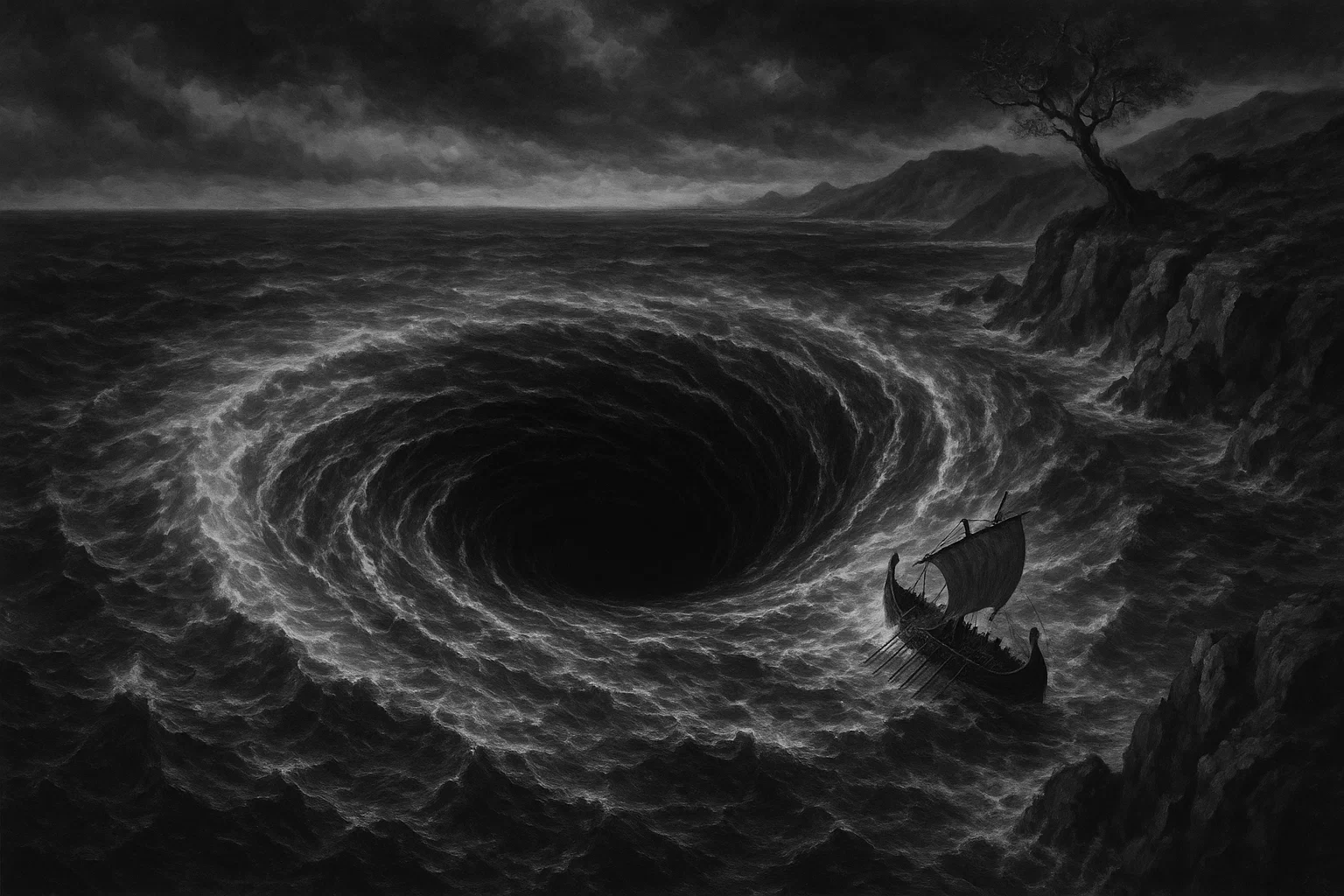
Charybdis is a monstrous marine entity in Greek mythology, known primarily as the personification of a massive, destructive whirlpool.
According to legends, the creature lived in a narrow strait, typically identified by classical writers as the Strait of Messina. In ancient tales, this creature was recognized as one half of an inescapable nautical hazard, positioned directly opposite the sea monster Scylla.
The entity functioned by ritually swallowing and then violently expelling vast quantities of seawater three times each day, a natural phenomenon the Greeks interpreted as a titanic, cyclical act of devouring and regurgitation. This process created a colossal maelstrom capable of sucking entire ships into the depths.
Summary
Key Takeaways
| Attribute | Details |
| Names: | Kharybdis; Latin: Charybdis. Derived from Greek Χαρυβδις, meaning “gulp” or “suck down.” |
| Nature: | Supernatural entity; Force of nature (whirlpool personification); Cursed Nymph. |
| Species: | Marine/Aquatic Monster; Elemental Force (Vortex). |
| Appearance: | Varies: Described by Homer as a “bladder-like” creature with flippers, or most commonly, as a massive gaping maw or swirling vortex in the sea. |
| Area: | The Strait of Messina, located between Sicily and the Italian mainland (Calabria). |
| Creation: | Originally a nymph, she was cursed and transformed by Zeus’s thunderbolt and chained to the seabed for helping Poseidon flood lands. |
| Weaknesses: | Cannot be defeated. Only circumvented by precise timing and avoidance of her cyclical swallowing/expulsion schedule. |
| First Known: | 8th century BCE, Homer’s Odyssey (Book XII). |
| Myth Origin: | Classical Greek Mythology; likely a personification of the dangerous tidal currents and whirlpools in the Strait of Messina. |
| Strengths: | Relentless swallowing and spitting of the sea, creating an inescapable whirlpool capable of dragging large ships to destruction. |
| Habitat: | Beneath a rock on one side of a narrow strait, often under a wild fig tree. |
| Associated Creatures: | Scylla (sea monster opposite her); Poseidon (father). |
Who or What Is the Charybdis?
Charybdis is a formidable sea hazard in Greek mythology, initially conceived as a monstrous entity and later rationalized as the personification of a whirlpool. Her primary function is to serve as a perpetual, immense maelstrom located in a confined waterway, typically recognized as the Strait of Messina.
This passage was considered extremely dangerous by ancient mariners because they had to choose between the dual threats: the monstrous whirlpool of Charybdis on one side and the rock-dwelling, multi-headed monster Scylla on the other.
The entity’s operation is strictly cyclical and mechanical, involving the thrice-daily act of drawing in vast volumes of water, followed by a violent eruption. This cycle is explicitly linked to the region’s high and low tides.
As a mythological figure, Charybdis is a permanent fixture of her specific location, fixed and condemned by divine decree. She represents an abstract, relentless force of nature that cannot be fought or negotiated with, demanding instead skillful navigation and the painful choice of incurring a lesser, more predictable loss when attempting passage.
Warning: Do NOT Read This Collection Alone After Midnight
Limited-Time: Volume 1 for FREE!
Real reader reviews: “Had to sleep with the lights on for a week,” “Story #17 still makes me afraid of the dark,” “I finished Volume 1 and immediately bought the next 20.” Over 30 original short horror masterpieces designed to make you terrified of perfectly ordinary things.

Genealogy
Charybdis’s most commonly cited genealogy establishes her as a divine, if low-ranking, oceanic figure before her transformation.
| Relationship | Figure |
| Father | Poseidon (God of the Sea) |
| Mother | Gaia (Primordial Goddess of the Earth) |
| Paternal Uncle | Zeus (King of the Gods) |
| Alternate Father | Pontos (Primordial God of the Sea) |
You may also enjoy:
Phenex: The Fiery Demon Marquis of Hell
August 26, 2025
Cadborosaurus: Is the Pacific Northwest Hiding a Sea Serpent?
September 25, 2025
Villisca Axe Murder House Haunting—A Chilling True Story
October 22, 2025
The Conjured Chest: 17 Victims, One Sinister Curse
May 27, 2025
Etymology
The name Charybdis originates from the Ancient Greek term Khárybdis (Χάρυσβδις), which linguistically relates to the actions central to the monster’s identity. The name is derived from the Greek verb ekcha rubdizô or similar root forms, meaning “to swallow down,” “gulp,” or “suck down entirely.”
The phrase ekcha rubdizô itself may have been popularized by the monster’s myth, with sources like Hesychius noting that the verb was invented by the mythographer Pherecydes to describe individuals demonstrating gluttony. This use solidifies Charybdis’s portrayal as a monster of voracious appetite, a trait emphasized in the variant myth where her crime was the theft of Heracles’s cattle.
What Does Charybdis Look Like?
The physical description of this sea creature is inconsistent across historical texts.
The most famous depiction, provided in Homer’s Odyssey, describes her primarily as a sound and an action: a hidden, awesome entity under a shaggy-leaved fig tree that thrice a day gulps down the dark water. When she spits out the water, the resulting foam and spray cover the tops of the opposite cliffs.
In physical form, Homer offered a vague description, sometimes referring to her as a massive, “bladder-like” creature possessing flippers for limbs, or simply an insatiable, destructive force.
Later writers and artists who sought to visualize the entity often depicted her as a massive, serpent-like creature with an enormous, gaping maw surrounded by sharp teeth.
However, her most common and enduring image is that of the swirling vortex itself—a massive, circular chasm in the sea that sucks down all objects and water into its depths, thereby having a form that is fluid and defined only by the terrible action of her consumption.
Mythology
Charybdis is a major figure in Greek mythology associated with maritime hazards, first appearing in Homer’s epic poem The Odyssey, written around the 8th century BCE.
In Book XII of the epic, the sorceress Circe provides a detailed warning to the hero Odysseus about the unavoidable strait. In this early account, Charybdis is presented not with a detailed origin story but as an immortal force of nature, a ceaseless threat existing alongside Scylla.
Later Greek and Roman writers developed concrete origin narratives to explain the monster’s existence and permanent state. The most common tradition established Charybdis as the offspring of Poseidon and Gaia.
In this version, Charybdis initially served her father by helping him expand his dominion over the earth, specifically by flooding vast tracts of land and, as a result, robbing Zeus, the ruler of the skies and land, of his terrestrial domain.
This act of divine transgression and gluttonous expansion angered Zeus, who then punished Charybdis by hurling a thunderbolt at her. This divine intervention transformed her from a nymph-like figure into a massive, insatiable force, binding her to the seabed, where she was forced to continually swallow and expel the ocean’s waters.
A less frequent account, documented by sources like Servius in his commentary on Virgil’s Aeneid, depicts Charybdis as originally a voracious mortal woman of immense greed. Her final act of excessive consumption was the theft of oxen belonging to Heracles.
This trespass against the favored son of Zeus resulted in the same punishment: Zeus hurled her into the sea with a thunderbolt, where her insatiable nature was retained and amplified in her monstrous, whirlpool form.
This Book Turns the Entire United States Into One Giant X-Files Map
Limited-Time: Up to 38% OFF!
J.W. Ocker traveled the country collecting the weirdest local legends and marks the real-world locations where the Beast of Bray Road, the Dover Demon, the Wendigo, and hundreds more have been spotted. Part travel guide, part bestiary, 100% nightmare fuel.

Legends
The legends about Charybdis primarily center on the difficulties heroes face as they get through the perilous strait she shares with Scylla.
The Passage of Odysseus
The most detailed and critical encounter with Charybdis is found in Homer’s Odyssey. After visiting the underworld, the hero Odysseus and his crew received counsel from the sorceress Circe regarding the dangers ahead.
Circe explicitly warned Odysseus that he would have to choose between two evils: navigating near the six-headed Scylla or venturing near the deadly whirlpool of Charybdis. Circe advised that Charybdis was the greater threat, as she could swallow an entire ship, leading to the loss of all men.
Following Circe’s instruction, Odysseus steered his ship closer to Scylla’s cliff, opting for the known loss of a few men over the certain destruction of the entire vessel. As the ship passed the strait, Charybdis was engaged in her swallowing phase, the water rushing inward with a terrifying sound.
While the ship was momentarily safe from the whirlpool, Scylla lunged from her cave. She snatched six of Odysseus’s best crew members, devouring them as the ship rapidly rowed to safety.
Odysseus’s Return
The second, more personal encounter with Charybdis occurred much later in the narrative, after Odysseus’s men perished for desecrating the cattle of the Sun God Helios. Odysseus alone survived the subsequent shipwreck, clinging to a makeshift raft composed of the mast and keel of his broken vessel. The violent storm drove him back through the strait.
As Odysseus approached the passage, Charybdis was again drawing the dark water down into her maw. The maelstrom consumed his entire raft. Odysseus rapidly reacted to the immediate threat by leaping up and grasping the low-hanging branches of a massive, shaggy-leaved wild fig tree that grew directly over Charybdis’s cavern.
The hero hung precariously from the tree, unable to gain a foothold or climb higher, waiting in suspense for the monster’s cyclic expulsion.
He remained suspended there until the mast and keel of his raft were violently regurgitated by Charybdis in the subsequent expulsion phase. After enduring the danger for a long time, the hero dropped onto the floating debris. He used his hands as paddles to propel himself away from the perilous strait. He drifted safely past Scylla, who did not perceive him, and continued his solitary journey.
You may also enjoy:
Likho: The One-Eyed Crone Who Brings Death and Bad Luck
September 11, 2025
Villisca Axe Murder House Haunting—A Chilling True Story
October 22, 2025
St. James Hotel Haunting: Civil War Ghosts, Outlaws, and Tragic Spirits
September 22, 2025
Proctor Valley Monster: Is the San Diego Bigfoot a Minotaur?
September 24, 2025
Complete Guide to Rhode Island Bigfoot Sightings (1974–2025)
August 6, 2025
Who Is Zagan, Hell’s Great Transformer?
May 28, 2025
Jason and the Argonauts
In the account of the journey of the Argonauts following their quest for the Golden Fleece, the heroes were also required to pass through the strait. However, in this version, the goddess Hera intervened on behalf of the hero Jason.
Hera sent a group of Nereids (sea nymphs), led by the minor deity Thetis, to guide the ship Argo through the perilous passage. The nymphs carefully steered the vessel, managing to handle successfully between the dual threats of Scylla and Charybdis, with the aid of a swift current and the Argonauts’ coordinated rowing.
The Argo was one of the few ships recorded in myth to pass through the strait without suffering damage or loss of life, a feat attributed solely to divine assistance rather than human skill in facing the monsters.
The Warning to Aeneas
The hero Aeneas and the surviving Trojans encountered the danger of Scylla and Charybdis during their flight from Troy, as recounted in Virgil’s Roman epic, the Aeneid. Aeneas was warned by the seer Helenus of the absolute peril of attempting to sail between the two monsters.
Helenus advised Aeneas to avoid the strait entirely by taking a vastly longer, alternative route around the coast of Sicily, past Pachynus Point, despite the time and effort this detour would require.
This counsel highlighted the widespread understanding in classical antiquity that the combined threat of Scylla and Charybdis was an irresistible and catastrophic force, best handled through complete avoidance.
The One Book They Took Out of Your Bible
Limited-Time: Up to 90% OFF!
Banned for centuries, now fully restored with the real names of the fallen angels intact. Discover why 200 Watchers descended, taught forbidden knowledge, created the Nephilim giants, and triggered the Flood – the missing scripture that changes everything you thought you knew about Genesis.
Charybdis vs Other Monsters
| Monster Name | Origin | Key Traits | Weaknesses |
| Scylla | Greek Mythology (Nymph cursed by Circe) | Six heads, twelve feet, three rows of teeth in each mouth | None in the context of the strait; limited range |
| Kraken | Scandinavian Folklore | Giant squid/octopus, capable of destroying ships | Vulnerable to whale sound (in some tales); highly localized |
| Lernaean Hydra | Greek Mythology (Born from Typhon and Echidna) | Multi-headed serpent, heads regenerate when cut, poisonous breath | Cauterization of severed neck stumps |
| Tiamat | Mesopotamian Mythology | Primordial goddess of the salt sea, serpentine or dragon-like form, creator of monsters | Defeated and split in two by the god Marduk |
| Typhon | Greek Mythology (Born from Gaia and Tartarus) | Gigantic winged monster, father of many monsters, fire and storm manifestation | Imprisoned under Mount Etna by Zeus’s thunderbolts |
| Sirens | Greek Mythology (Daughters of a river god/muse) | Bird-women who lure sailors to death with irresistible song | Crew members plugging their ears with wax; hero being tied to the mast |
| Cetos | Greek Mythology (Sea monsters or whales) | Vast marine beasts sent by Poseidon to ravage coasts | Vanquished by heroes like Heracles or Perseus |
| Leviathan | Hebrew Mythology/Biblical | Colossal sea serpent/dragon, embodying primeval chaos | Only God (Yahweh) is capable of defeating it |
Charybdis, while often paired with Scylla, is fundamentally distinct in her nature. Scylla is a discrete, anthropomorphic monster that actively hunts and plucks individual sailors, possessing defined physical characteristics and a tragic backstory embedded in a curse.
Charybdis, on the other hand, is less a predatory creature and more a personified force of nature—an immense, cyclical engine of destruction defined by her location and function.
When compared to other massive oceanic or snake-like threats like the Kraken, Tiamat, or Leviathan, Charybdis shares the characteristic of representing cosmic chaos and the overwhelming danger of the deep.
However, while most giants and dragons of myth (like the Hydra or Typhon) are capable of being defeated or slain by a hero through cunning or strength, Charybdis is unique in that she is immortal, fixed, and cannot be fought.
Her only vulnerability is the predictability of her three-times-daily cycle, allowing a skilled mariner to attempt to time a passage, emphasizing avoidance over confrontation.
Powers and Abilities
Charybdis is granted with a single, overwhelming power that defines her existence: the ability to generate a colossal, inescapable whirlpool. This power is executed in a relentless, mechanical cycle: the sudden, massive intake of ocean water, followed by its violent, explosive expulsion.
The force of this tidal suction is so profound that it can drag down not only individuals but entire ships and their cargo into the abyssal depths in a matter of moments.
Her power is not only destructive but also cyclical and predictable. It manifested three times every twenty-four hours, a feature interpreted by ancient commentators as a mythological explanation for the high and low tides experienced in the Strait of Messina.
As a monster transformed by a thunderbolt from Zeus and chained to the seabed, her ability to create this maelstrom is a divinely mandated curse, ensuring her eternal role as a fixed, localized engine of maritime destruction.
You may also enjoy:
The Manticore: Origins, Myths, and Symbolism
February 17, 2026
Complete Guide to Missouri Bigfoot Sightings (1960–2025)
August 1, 2025
Naamah: The Seductive Demon Queen of Infernal Desires
September 30, 2025
The Dark Haunting of Fort Morgan: Soldiers, Spirits, and Tragedy
September 3, 2025
Can You Defeat a Charybdis?
The lore surrounding Charybdis consistently claims that the entity cannot be defeated or destroyed by mortal or heroic means.
She is not a living creature that can be slain with a weapon, but a cursed, powerful force of nature, placed and maintained by the will of Zeus. Because of that, the established method of survival is avoidance and strategic navigation, not confrontation.
The most essential strategy is to use the entity’s own predictability. The cyclical nature of her action—swallowing and expelling water three times a day—provides a brief window of opportunity between the phases.
A mariner must accurately calculate and time the passage to sail through the strait when Charybdis is either sated (having just swallowed the water) or just beginning her inhalation. If caught, there is no defense against the full power of the maelstrom.
In the case of Odysseus, the only method of survival after being caught was purely reactive: clinging to the overhead fig tree until the mast of his destroyed raft was violently regurgitated in the subsequent expulsion. This required immense endurance and timing.
For large-scale efforts, like that of the Argonauts, only divine intervention (guidance by the Nereids sent by Hera) could ensure a successful passage without loss, emphasizing the overwhelming, inescapable nature of the hazard she represents.
Conclusion
Charybdis persists as a key figure in classical Greek and Roman literature, fundamentally symbolizing the inescapable dangers of the sea and the difficult choices inherent in life.
Initially appearing in the Odyssey as a perpetual, formless threat, she later received a concrete divine origin as the daughter of Poseidon and Gaia, transformed by Zeus’s wrath for her greed and transgression.
Her transformation into a cyclical whirlpool served the dual purpose of explaining a real-world tidal phenomenon in the Strait of Messina while simultaneously providing a moral lesson on the consequences of hubris and gluttony.