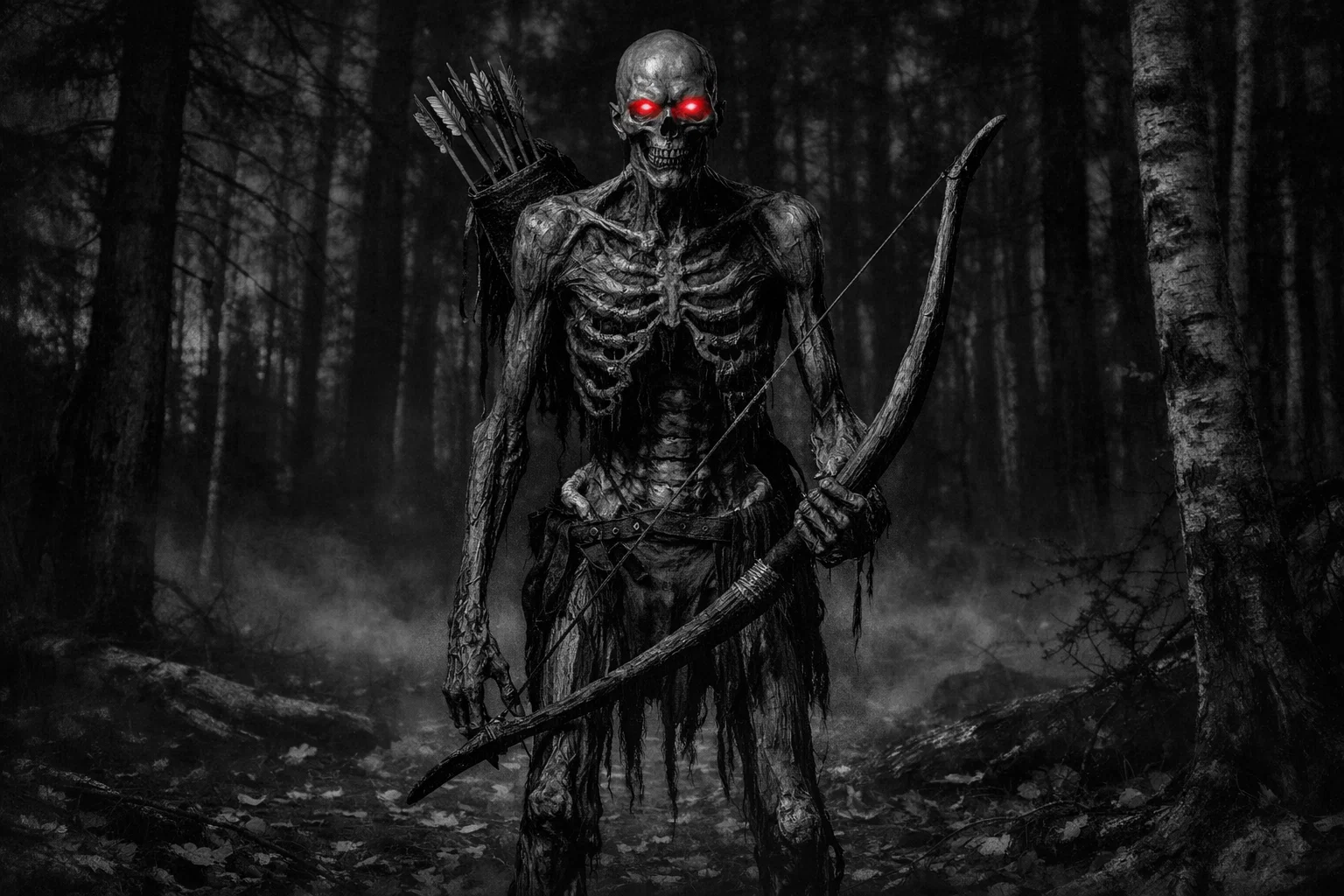
The Baykok is a sinister, skeletal creature from the indigenous traditions of the Great Lakes, especially in Anishinaabe (Ojibwe) mythology.
Famous for its sharp cries and unseen movements, it is a relentless hunter that targets only warriors. The Baykok is a symbol of lost honor and endless hunger, said to roam the thick forests of North America.
Summary
Key Takeaways
| Attribute | Details |
| Names | Baykok, Beigwak; derived from the Ojibwe word bakaak, meaning “bones”. |
| Nature | Malevolent undead spirit / Revenant. |
| Species | Humanoid Spectral. |
| Appearance | Skeletal frame, translucent skin stretched over bone, glowing red eyes. |
| Area | Great Lakes region, North America (United States and Canada). |
| Creation | The result of a warrior dying from hunger or neglect of his duties. |
| Weaknesses | Fire, specific spiritual rituals, or being put to rest through proper burial. |
| First Known | Oral traditions of the Anishinaabe people; documented in 19th-century ethnographies. |
| Myth Origin | Algonquian / Ojibwe folklore. |
| Diet | The livers of seasoned warriors. |
| Time Active | Nocturnal; primarily active during the night. |
Who or What Is Baykok?
The Baykok is a frightening character in Anishinaabe folklore, often seen as a spirit of death that roams the northern forests. Unlike other spirits that serve as omens or protect nature, the Baykok actively hunts its victims.
The Baykok is considered an undead being, a revenant that came back to the world because of how it died. Stories say it was once a hunter or warrior who committed a serious wrong, such as letting himself starve or failing to care for his people.
Among Algonquian monsters, the Baykok is somewhat like the Windigo but stands out for its mode of operation. The Windigo is known for gluttony and cannibalism, while the Baykok is a focused hunter.
The Baykok hunts other warriors, using stealth and magical weapons to catch them. People say you can hear its bones clattering together, a sound that warns anyone walking in the woods after dark.
Tired of Bad Luck, Dark Spirits, and Toxic Vibes Draining Your Life?
Limited-Time: Up to 25% OFF!
Natural Black Tourmaline Crystal Healing Pendant – Genuine raw tourmaline • Absorbs & transmutes negativity • Guards against psychic attacks & hauntings • Deep spiritual cleansing for home & body • Purifies chakras & spaces from bad vibes. A portable force field—essential for sensitive souls in chaotic times.

Etymology
The name Baykok (also spelled Bakaak, Beigwak, or Pakaak) comes from the Ojibwe language. The root word, bakaak, means “bones” or “skeleton.” This highlights the creature’s most obvious feature: its lack of flesh. In stories, the name is more of a description than a personal name.
In different Great Lakes dialects, the word came to mean a certain kind of “living bone” spirit. The sharp, punchy sound of the word is said to copy the dry clicking noise the Baykok’s joints make as it moves through the woods.
In the early 1800s, ethnographers like Henry Rowe Schoolcraft wrote the name in English, which set the spelling we use today. Some experts think the name also hints at “starkness” or “emptiness,” showing the Baykok’s empty nature and its restless spirit. Unlike other spirits with names linked to places or elements, Baykok’s name is all about its skeletal form.
What Does the Baykok Look Like?
The Baykok is always described as a very thin, skeletal monster. Its skin is usually shown as thin and see-through, stretched tightly over its bones like old parchment or dry leather. In some stories, it has no skin at all and looks like a walking skeleton.
Its most noticeable feature is its eyes, which are said to glow bright red, like embers in deep, empty sockets. Even though it looks weak, the Baykok is very strong. It often carries a big bow and a quiver of invisible or silver-tipped arrows. When it moves, you can hear its dry bones clattering together.
You may also enjoy:
Rahab: Leviathan’s Twin and the Forgotten Demon Prince
September 30, 2025
The Werewolf of Morbach: Truth or Terrifying Legend?
June 25, 2025
The Strange Hodag Monster: Wisconsin’s Fearsome Cryptid
September 26, 2025
What Is an Afreet? Origins, Powers, and Myths
January 26, 2026
What Is a Vila? The Beautiful Yet Deadly Spirit of Slavic Myth
September 11, 2025
Mythology
Stories about the Baykok are closely tied to Anishinaabe beliefs about survival and community care.
In oral traditions, the Baykok is a warning. People believe it is the spirit of a skilled hunter who became too proud or died shamefully. For example, if a hunter starved even when food was nearby, or if he died with hatred for others, he could become this skeletal creature.
The Baykok is not from the “Underworld.” Instead, it lives in the space between life and death. It is stuck in the forests where it once hunted, unable to move on until it satisfies a hunger that never goes away. People often link it to winter, when food is hard to find, and hope is low.
Old records show that people used the Baykok to explain why experienced hunters sometimes vanished in the woods. This suggests that even the best could fall victim to this unseen archer.
Legends
The Invisible Archer of the Woods
In many old stories, the Baykok is known for being sneaky and invisible. One legend tells of warriors resting by a fire after a long journey. Suddenly, the most skilled one would fall, holding his chest. No one saw an enemy, and the only sound was the soft “clack-clack” of bones far away.
The story says the Baykok shoots invisible arrows to bring down its victims. After the warrior is paralyzed or killed, the Baykok comes down from the trees. It uses a silver knife to open the victim’s chest and carefully take out the liver.
According to legend, the Baykok eats the liver to temporarily gain the warrior’s strength and memories. It then puts a stone in place of the organ and sews the wound so well that no scar is left. Sometimes, the victim wakes up for a while, not knowing what happened, but soon grows weak and dies.
Demons, Ghosts, and Vengeful Spirits
Limited-Time: Up to 22% OFF!
Something Wicked from Japan – 150+ haunting ukiyo-e masterpieces • Yūrei, yōkai, and oni • Blood-soaked legends • Severed heads • Demonic seduction • Erotic horrors & grotesque beauty. The most terrifying (and beautiful) book of Japanese art ever printed.
The Cry of the Bone-Spirit
Another well-known story is about the Baykok’s voice. People say it has a sharp, high-pitched scream that can freeze someone with fear. In one tale, a hunter hears a sound like a “whistling wind” that slowly becomes a steady chant.
As the hunter tried to escape, the sound stayed exactly twenty steps behind him, no matter how fast he ran. He realized the Baykok was after him when he saw its red eyes reflected in a stream.
In this story, the hunter survived by climbing a sacred cedar tree and saying protective prayers until sunrise, since the Baykok cannot stand daylight.
Baykok vs Other Monsters
| Monster Name | Origin | Key Traits | Weaknesses |
| Windigo | Algonquian | Giant, cannibalistic, ice-heart. | Fire, melting the heart. |
| Draugr | Norse | Undead, super strength, guards graves. | Decapitation, burning. |
| Ghul | Arabian | Metamorph, eats the dead. | One single blow. |
| Jiangshi | Chinese | Hopping corpse, drains Qi. | Taoist talismans, mirrors. |
| Nachzehrer | German | Devours own shroud, spreads plague. | Coin in mouth, decapitation. |
| Strigoi | Romanian | Blood-drinker, invisible, shapeshifter. | Garlic, staking, sunlight. |
| Yamauba | Japanese | Mountain hag, eats travelers. | Specific charms, fire. |
| Camazotz | Mayan | Bat-like, decapitates victims. | Sunlight. |
The Baykok is considered “undead,” like the Draugr and Jiangshi, but it stands out for hunting specific targets. Most undead creatures attack anyone or guard their territory, but the Baykok is more focused.
Like the Windigo, the Baykok is a twisted version of a human caused by starvation. But it is not as big as the Windigo and is not linked to cold weather.
Instead, it relies on stealth and accuracy. Its habit of taking organs is similar to some vampire stories, but its use of a bow makes it more of a hunter than a scavenger.
You may also enjoy:
Who Is Marbas? The Demon of the Ars Goetia
August 25, 2025
Is Busby’s Stoop Chair Curse Really Deadly?
May 26, 2025
Beast of Bray Road: Wisconsin Creepiest Cryptid?
September 24, 2025
Powers and Abilities
The Baykok has many supernatural powers that make it hard to fight. Its ghostly form lets it move through thick forests without making a sound or leaving tracks. It can also turn completely invisible, showing itself only when it is about to attack or when its red eyes shine in the dark.
- Invisibility: The ability to remain unseen by humans, even in direct line of sight.
- Paralyzing Shriek: A high-pitched cry that causes victims to freeze in place with terror.
- Expert Archery: Mastery over a supernatural bow that fires invisible or magical arrows.
- Surgical Precision: The ability to remove a victim’s liver and replace it with a stone without leaving a visible wound.
- Supernatural Strength: Despite its skeletal frame, it can overpower seasoned warriors with ease.
- Flight/Levitation: Some accounts suggest it can glide through the air or walk among the treetops.
This Book Turns the Entire United States Into One Giant X-Files Map
Limited-Time: Up to 38% OFF!
J.W. Ocker traveled the country collecting the weirdest local legends and marks the real-world locations where the Beast of Bray Road, the Dover Demon, the Wendigo, and hundreds more have been spotted. Part travel guide, part bestiary, 100% nightmare fuel.

Can You Defeat a Baykok?
It is very hard to defeat a Baykok because it is already dead. Regular weapons like clubs or arrows usually go right through its bones or do little harm. But fire is often said to work well against it. The Baykok’s dry skin and brittle bones burn easily, and fire stands for the warmth and community the creature has lost.
Spiritual help is the best way to get rid of a Baykok. Medicine men or shamans can perform special rituals to send the spirit away or make it move on to the afterlife.
Some stories say that giving the Baykok a proper burial, making up for the neglect it faced when it died, can help it rest. People also avoid deep woods at night and carry sacred tobacco or other protective herbs to keep the Baykok away.
Conclusion
The Baykok is one of the most frightening figures in North American indigenous stories. It comes from failure and lives for a dark purpose. By going after the strongest people in a group—the warriors—it threatens the tribe’s safety. It reminds everyone how fragile life is and how important it is to keep your honor and duties, even when facing death.
Unlike other well-known monsters that stand for chaos, the Baykok is careful and cruel. Its skeleton body and invisible arrows show the hidden dangers in the wild.
For the Anishinaabe, the sound of bones clicking at night is not just the wind—it means a hunter is near, one who never rests and never misses.