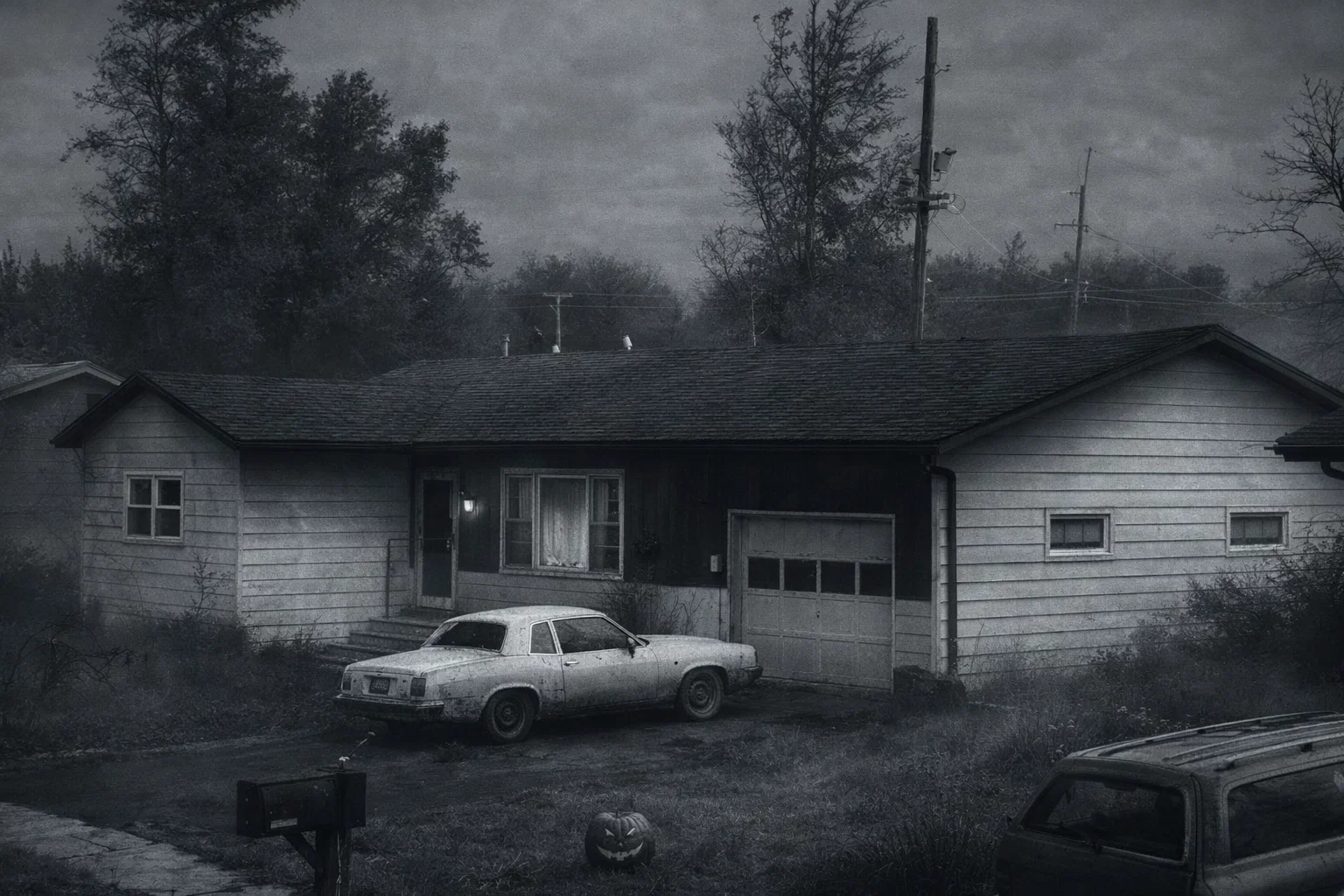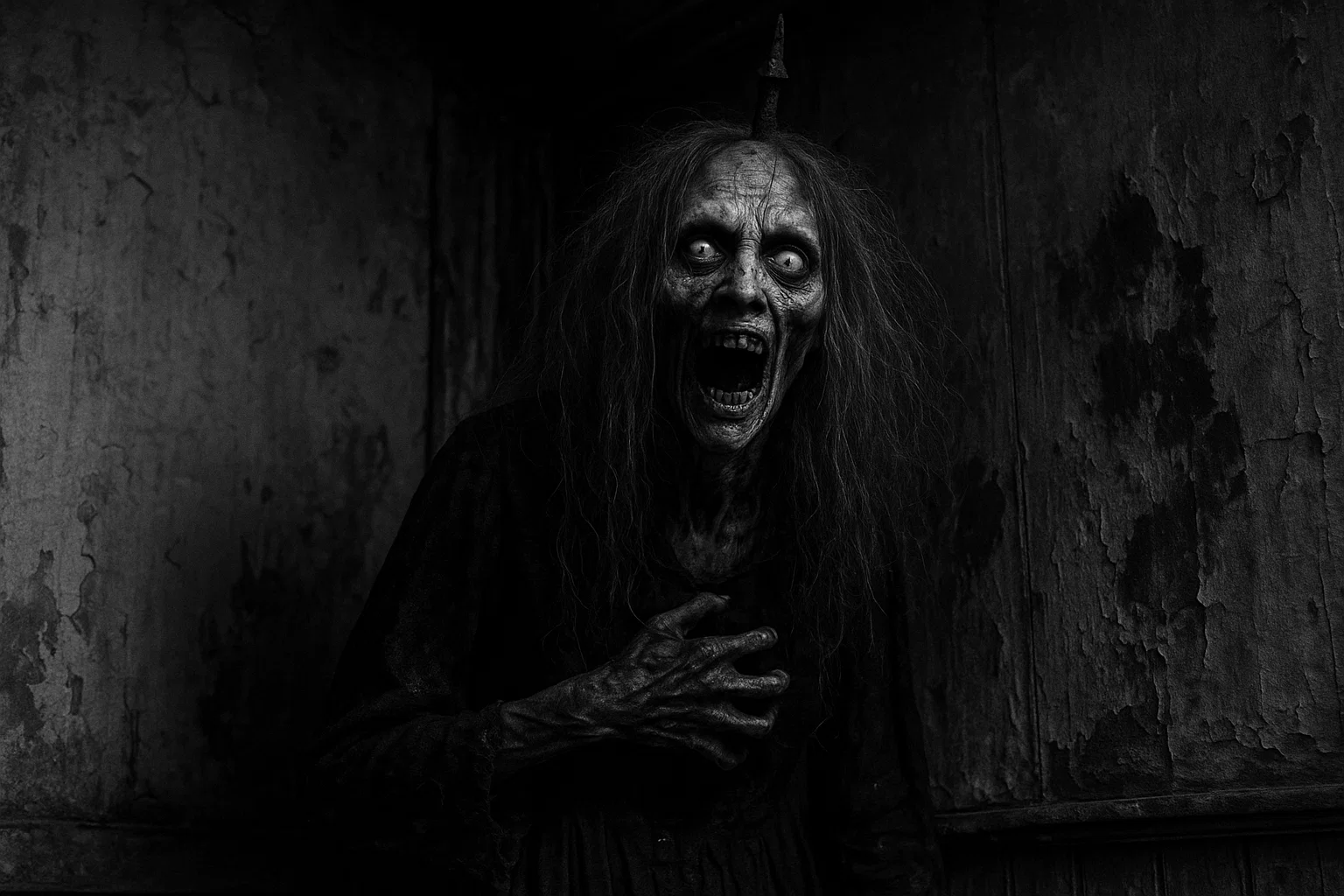
Bathsheba Sherman became widely recognized as the primary antagonist in the 2013 film The Conjuring. However, this modern depiction contrasts sharply with available historical records, positioning a documented 19th-century New England farm wife as a satanic entity responsible for an alleged haunting nearly a century after her death.
To understand who the real Bathsheba Sherman was, we need to look beyond the layers of local legend, folklore, and film narrative.
Summary
Overview
| Attribute | Details |
| Name | Bathsheba Sherman (nee Thayer), The Witch, Mistress, The Conjuring Witch |
| Location | Old Arnold Estate (The Conjuring House), Harrisville, Rhode Island, USA |
| Longland Scale | This entity is not rated on the Longland Scale [See the Longland Scale Explanation] |
| History | The alleged haunting entity’s lore: Born 1812, married Judson Sherman in 1863. Allegedly attempted to sacrifice her week-old baby to the Devil. Hanged herself in 1863, proclaiming her love for Satan and cursing all who would take the land. Her spirit would possess mothers in the home to kill their children and commit suicide. In 1971, the Perron family moved in and experienced severe paranormal activity, leading to an investigation by Ed and Lorraine Warren. |
| Death Toll | Several victims killed by mothers possessed by Bathsheba (prior families) + one infant allegedly sacrificed by Bathsheba while alive + family dog killed (Sadie) + Ed Warren nearly died during an exorcism attempt. The context states she has a “Kill Count: Several” and committed “Serial murder” and “Filicide.” |
| Type of Haunting | Demonic, Possession, Poltergeist, Apparitions, Curse, Ghosts (General) (due to victims’ spirits) |
| Lunar / Seasonal Pattern | No specific lunar or seasonal pattern |
| Entities | Bathsheba Sherman (main antagonist/demon), Malthus (Ally), Satan (Follower of), Spirits of her victims (forced to live in the house in constant fear), Rory (a little boy spirit encountered by the Perrons). |
| Manifestations | Possession (of mothers, including Carolyn Perron), Haunting, Telekinesis (moving objects/furniture, nearly killing Ed Warren with a shotgun), Biokinesis (causing searing pain/burning on Carolyn Perron’s body, biting), Cryptically having all the clocks stop at 3:07 AM, Shadowy figures, Unexplained noises, Sense of dread, Killing the family dog, Tugging on Christine’s leg, Attacking children, Psychological torment. |
| First reported sighting | The haunting is alleged to have begun after her suicide in 1863. The major events described in the context started with the Perron family moving in 1971. |
| Recent activity | Activity in the 1970s with the Perron family and the Warrens. Later reports indicate that visitors to the house today claim to feel her presence, especially in the basement and artifact room, and some have reported being touched by unseen forces. |
| Threat Level | 10/10 (life-threatening/demonic) [See the Threat Level Explanation] |
| Hoax Confidence Rating | 9/10 (Confirmed hoax with lingering legend) [See the Hoax Confidence Rating Explanation] |
| Open to the public? | Yes, the house has become a pilgrimage site for ghost hunters and curious visitors alike. |
Who Was Bathsheba Thayer Sherman?
The documented life of Bathsheba Sherman is fundamentally that of a typical rural New Englander in the 19th century. Her identity as a suspected witch is embedded in persistent local gossip and a singular, tragic event, rather than any formal legal documentation or established history of maleficence.
| Date | Event | Key Figures | Location | Details |
| March 10, 1812 | Birth | Bathsheba Thayer | Burrillville, Rhode Island | Born to Ephraim and Hannah Thayer; raised in the Harrisville area. |
| March 10, 1844 | Marriage | Bathsheba, Judson Sherman | Thompson, Connecticut | Married by Justice Vernon Stiles; relocated to the adjacent Sherman Farm. |
| April 1849 | Infant Death | Bathsheba | Sherman Farm | Neighbor’s four-month-old infant died while in her care; a needle was reportedly found in the skull; no charges were filed. |
| July 4, 1852 | Community Involvement | Bathsheba | Harrisville Fair | Won an award ribbon for her apple pie; noted in local town logs by neighbor Sarah Arnold. |
| April 12, 1881 | Judson’s Death | Judson Sherman | Sherman Farm | Died at the age of 70; Bathsheba inherited the farm property. |
| May 25, 1885 | Death | Bathsheba Sherman | Harrisville, Rhode Island | Died at age 73 from paralysis (likely a stroke); buried in Harrisville Cemetery. |
| January 11, 1971 | Perron Move-In | Perron Family | Arnold Estate | Move into the nearby farmhouse that became the subject of the modern haunting narrative. |
| August 3, 1973 | Warren Séance | Carolyn Perron, Warrens | Arnold Estate | Reported possession of Carolyn Perron; séance was halted by Roger Perron. |
| June 1980 | Departure | Perron Family | Arnold Estate | Family sold the home after nine years of reported paranormal activity. |
Bathsheba Thayer was born in the town of Burrillville, Rhode Island, on March 10, 1812. Her parents, Ephraim Thayer and Hannah Taft, were established in the small, close-knit Harrisville community.
This region, like much of New England, retained a residue of the puritanical paranoia regarding witchcraft. This cultural artifact would later contribute to the development of the Bathsheba myth. Available records indicate a life consistent with the era: farm labor, community involvement, and adherence to religious practice.
Church documents confirm her baptism in 1820 at the local Baptist Meeting House, and she remained an active participant, serving as a Sunday school instructor and contributing funds to the church throughout the mid-19th century.
On her thirty-second birthday, March 10, 1844, she was married to Judson Sherman, who was one year her senior. The ceremony was conducted in Thompson, Connecticut, by a local Justice of the Peace, Vernon Stiles. The couple established their residence on a large, roughly 200-acre farm near the current Harrisville area.
This farm, known as the Sherman Farm, was entirely separate from the house later occupied by the Perron family, the structure known historically as the Arnold Estate. Census data from 1860 valued the Sherman farm at $3,000, which confirmed the Shermans as a reasonably prosperous farm family.
What Actually Happens Inside a Real Exorcism?
Limited-Time: Up to 30% OFF!
Demons speaking Latin, levitating bodies, violent outbursts, sudden healings – Fr. Amorth documented it all. This book is his step-by-step explanation of how Satan’s army operates, how ordinary people open doors, and the astonishingly simple Catholic remedies that still work today.
Marriage and Family Struggles
The Shermans had a challenging familial history, marked by the high rates of infant mortality common to the 19th century. Historical and census records confirm the existence of at least four children, though only one survived to adulthood:
- Julia Sherman (born 1845): Died of a reported fever in 1846.
- Edward Sherman (born 1847): Passed away in 1850.
- Herbert Leander Sherman (born March 1849): The only child who survived and lived a long life as a farmer, eventually marrying and having his own family.
- George Sherman (born 1853): Succumbed to diphtheria in 1855.
These losses, while tragic, were statistically consistent with the period; up to 30% of children in the Burrillville area failed to reach the age of five in the 1850s. However, the lore would recontextualize these natural deaths, alleging that Bathsheba was directly responsible for the murder of her children as part of a ritualistic practice.
Judson Sherman died on April 12, 1881, at the age of 70. Bathsheba continued to operate the farm with the assistance of her son, Herbert.
Death and Burial
The true cause and date of Bathsheba’s death stand in direct contradiction to the sensationalized accounts of the 20th century. Bathsheba Sherman died on May 25, 1885, at the age of 73. The Burrillville Gazette noted her passing, and the recorded cause was paralysis, medically presumed to be a stroke or related complication common to the elderly at the time. There was no official suspicion of foul play and no suggestion of suicide.
Her will was notarized, proving her continued presence in civic life, and she left a bequest of $200 to her grandson, Edgar. The notion that she hanged herself from a tree or that her body literally turned to stone are documented exaggerations that appeared in the local folklore and were later amplified by modern media.
Bathsheba Sherman’s grave is located in the Harrisville Cemetery on Callahan School Street. Her headstone is a plain granite marker that reads “Bathsheba, wife of Judson Sherman, died May 25, 1885, aged 73.”
The grave has been repeatedly vandalized in the 21st century following the release of the film The Conjuring, prompting the local community to install additional security and repair the historical marker.
You may also enjoy:
Demon Valac Explained: Origins, Powers, and Lore
August 28, 2025
Who Was Qingu in Babylonian Mythology?
August 27, 2025
Rusalka: The Haunting Water Spirit That Lures Victims to Their Death
September 11, 2025
Who Is the Demon Amaimon, the Powerful King of Hell?
April 24, 2025
19th-Century Accusations
The transformation of Bathsheba Sherman from a historical farm wife into a figure of malevolence is primarily attributable to a single, important incident in 1849 and the later proliferation of local gossip and superstitious belief that marked the surrounding decades. This period established the framework after which later paranormal investigators would build their narrative.
The 1849 Infant Death Incident
The central claim that propelled Bathsheba into infamy was her alleged involvement in the death of an infant in April 1849:
- The Victim: The victim was a four-month-old child belonging to a neighboring family. The specific identity of the infant and the family is generally absent from documentation.
- The Circumstance: The child was in Bathsheba’s care at the Sherman Farm when the death took place.
- The Instrument: During the post-mortem examination, a small, sharp object—commonly specified as a knitting or sewing needle—was reportedly found to have been inserted into the infant’s skull, resulting in death.
Following this discovery, the local community immediately turned against Bathsheba. The prevailing superstition led townspeople to conclude that the death was an act of ritual sacrifice, where the infant was offered to Satan to ensure Bathsheba’s perpetual youth or power.
This interpretation was consistent with lingering fears embedded in the aftermath of the Salem Witch Trials of the 1690s, where any unexplainable death or misfortune could be attributed to a pact with the Devil.
Despite the intensity of the accusations, a critical historical fact remains: a comprehensive search of Burrillville town records for 1849 revealed no warrants, arrests, or court proceedings against Bathsheba Sherman.
This lack of legal action implies that the authorities, likely due to insufficient evidence or conflicting testimony, declined to prosecute. However, in a community governed by intense social pressures, the legal acquittal was secondary to the damage inflicted on her reputation.
Why Do So Many Successful People Secretly Wear a Little Blue Eye?
Limited time offer: 28% OFF. For thousands of years, the Turkish Evil Eye has quietly guarded wearers from the unseen effects of jealousy and malice. This authentic blue glass amulet on a soft leather cord is the real thing – beautiful, powerful, and ready for you.

Post-Incident Social Ostracism
The aftermath of the 1849 incident constituted a form of social and economic censure. Neighbors ceased inviting her to social and religious gatherings. Economic activities were also affected; a farmer in 1862 publicly blamed Bathsheba for the sour milk from his cows, an accusation later attributed to a severe heatwave that year. Such occurrences, ingrained in superstition, solidified her reputation in local memory as someone capable of inflicting minor curses and misfortune.
The allegations were further fueled by unverified claims that Bathsheba mistreated or starved her farmhands. These details were later repeated in the Perron family’s account.
One local story alleged that an unofficial historian, Mr. McKeachern, told Carolyn Perron that Bathsheba was known for starving and beating her staff. Later research by skeptics found no substantial evidence for this claim and further suggested that Mr. McKeachern may have been a person born after Bathsheba’s death, making his first-hand knowledge impossible.
The pervasive and unsubstantiated nature of these 19th-century rumors proves how local folklore can coalesce around an individual who is perceived as a social outsider or who is simply present during a tragedy. This framework of suspicion became the latent material that was later activated during the 1970s haunting.
The Arnold Estate
The house later associated with Bathsheba Sherman’s spirit, located at 1677 Round Top Road, was historically the Arnold Estate. This large farmhouse had a documented and unverified history of tragedy and death long before the Perron family moved in, suggesting that the area itself was associated with misfortune.
Architectural History and Ownership
The house was constructed around 1736, making it nearly 150 years old at the time of Bathsheba’s death. It featured a sprawling 14-room layout and was situated on approximately 8.5 acres. Before the Perrons purchased it, the property had exchanged hands through eight generations of a single family.
In her book House of Darkness, House of Light, Andrea Perron recounted her mother Carolyn’s alleged discovery that the land had been the site of a long succession of horrific deaths. These included:
- Drowning: Several children were reported to have drowned in a nearby creek on the property.
- Suicide: Several documented instances of residents hanging themselves in the attic or barn.
- Murder: At least one example of a resident being murdered on the premises.
These preceding events contributed to the atmosphere of the house, indicating that the land possessed a long-standing association with misfortune, independent of the figure of Bathsheba Sherman.
The Prudence Arnold Theory (1797)
An important element of the Arnold Estate’s history and a counter-theory to the Bathsheba haunting concerns Prudence Arnold. This entity is cited by Andrea Perron as a possible, and more plausible, candidate for the malevolent spirit they encountered.
According to this account, Prudence Arnold lived on the property in the late 18th century. The legend states that in 1797, at the age of 93, she tragically hanged herself in the barn of the estate.
Andrea Perron later publicly theorized that the spirit that violently targeted her mother, Carolyn, was not Bathsheba, who merely lived next door, but rather Prudence Arnold, who had a more direct claim to the house. The entity encountered by the family was described as having a broken neck, a detail consistent with death by hanging.
Andrea Perron’s spectral identification of Prudence Arnold suggests that the later attribution of the haunting to Bathsheba Sherman may have been a misidentification or an assumption based on the more sensational local gossip associated with Bathsheba’s name.
You may also enjoy:
Rokurokubi Legends: Women Who Transformed Into Night Demons
September 9, 2025
What Is the Stone Tape Theory?
September 5, 2025
100 Years of Sightings—But What Is Ogopogo Really?
May 19, 2025
Complete Guide to Alaska Bigfoot Sightings (1985–2025)
July 21, 2025
Buné: Demon King of Riches and Necromancy
August 12, 2025
Werewolves: Myths, Madness, or Monsters?
June 10, 2025
The Perron Family Haunting (1971–1980)
The actual paranormal events that form the basis of the modern narrative began when the Perron family—parents Roger and Carolyn and their five daughters Andrea, Nancy, Christine, Cindy, and April—moved into the Arnold Estate on January 11, 1971. Their residency spanned nine years, during which they reported an increasing intensity of phenomena.
Initial Phenomena (1971)
The initial disturbances were subtle and attributed to the natural aging of a 235-year-old house:
- Moving Objects: Carolyn Perron frequently noted that objects, such as brooms, would move across the kitchen floor seemingly on their own. She also reported finding small, unexplained piles of dirt on newly cleaned kitchen tiles.
- Aural Disturbances: The family began hearing strange, scraping noises in the kitchen, often near the kettle, when no one was present.
- Benign Spirits: According to Andrea Perron’s account, the family initially encountered several spirits that were perceived as benign or friendly, including a young boy named Oliver Richardson, who spoke with the youngest daughter, April.
Escalation and Physical Contact (1971–1972)
The activity quickly progressed from minor environmental disturbances to direct, malevolent interaction, primarily targeting Carolyn Perron:
- The Needle Wound: On March 3, 1971, Carolyn Perron reported feeling a sharp, piercing pain in her calf, which left a needle-like mark on her leg. This incident immediately echoed the historical allegations against Bathsheba Sherman involving the sewing needle and the infant death of 1849, linking the spirit to the old folklore.
- Time and Temperature Anomalies: The family reported that clocks in the house would frequently stop at precisely 3:07 a.m., an hour later enshrined in the cinematic version as the witching hour. Unexplained cold spots were also reported, with one parlor registering 48°F while the outside temperature was 70°F.
- Apparitional Sightings: The five daughters experienced various forms of contact. On April 10, 1971, nine-year-old Cindy Perron reportedly saw a misty entity in her bedroom that whispered her name.
- Physical Harassment: The entity began exerting physical force against the family, especially the daughters. In June 1972, Nancy Perron reported her hair being violently yanked with no one nearby. Christine, then 11, witnessed furniture, particularly her bed, shaking violently in September 1972.
The intensity of the phenomena reached a point at which local residents, including a neighbor named John Smith, reported hearing screams emanating from the house more than a mile away in October 1972.
However, he declined to investigate the property directly. Roger Perron, the father, initially maintained a skeptical stance. Still, the cumulative and persistent nature of the events eventually forced him to accept the reality of a spectral presence.
Was It Bathsheba Sherman?
As the haunting intensified, Carolyn Perron began researching the deep history of the Arnold Estate, seeking to identify the source of the torment. Her research, combined with the Warrens’ intervention, solidified the entity’s identity as Bathsheba Sherman.
The spirit was described by the Perron family as a possessive and highly territorial presence that directed its most severe aggression toward Carolyn.
Andrea Perron wrote that the entity “perceived herself to be the mistress of the house and resented the competition my mother posed for that position.” This rivalry was perceived as the primary motive for the relentless harassment and attempts to seize control.
Ever Walk Into a Room and Instantly Feel Something Watching You?
Millions have used burning sage to force out unwanted energies and ghosts. This concentrated White Sage & Palo Santo spray does the same job in seconds – just a few spritzes instantly lifts stagnation, breaks attachments, and restores peace most people feel immediately.

The Intervention of Ed and Lorraine Warren
The involvement of Ed and Lorraine Warren, the founders of the New England Society for Psychic Research (NESPR), provided documentation and an authoritative narrative that brought the Perron family’s story to global attention.
The Warrens characterized the haunting as an infestation by an inhuman, demonic entity, specifically identifying it with the folkloric version of Bathsheba Sherman.
The Investigation (July 1973)
Carolyn Perron contacted the Warrens in July 1973 to seek assistance. The Warrens arrived on July 15, 1973, and immediately began their investigation:
- Lorraine’s Clairvoyance: Lorraine Warren, a self-professed clairvoyant and medium, claimed to have sensed an extremely malevolent presence after entering the home. She was the first to name the entity Bathsheba. She also claimed to have experienced a vision of a woman who had hanged herself, possibly reinforcing the connection to the property’s tragic history, even if the person was not Bathsheba.
- Physical Evidence Collection: Ed Warren used instrumentation to record environmental anomalies, confirming the existence of cold spots and capturing photographs that allegedly showed orbs of light near the main staircase, which they classified as evidence of spiritual activity.
- Aural Events: On July 18, 1973, the Warrens and the Perron family documented a series of twelve consecutive and distinct bangs emanating from the dirt-floored cellar, a location the family generally avoided but one that held historical significance due to the estate’s age.
The Warrens concluded that the infestation was not merely a residual haunting but a full-fledged demonic attachment that had latched onto Carolyn Perron and was capable of physical manipulation of both objects and persons.
The Failed Séance (August 1973)
The most dramatic event documented during the Warrens’ intervention was the séance they conducted on August 3, 1973, in the dining room. This event, which was witnessed in secret by the eldest daughter, Andrea Perron, became the climax of the Warrens’ account.
During the séance, Carolyn Perron reportedly entered a trance-like state. Andrea Perron stated that her mother began speaking in a language not of this world, using a voice not her own. The event culminated when Carolyn’s chair allegedly levitated six inches off the floor, and she was violently thrown across the room.
Witnessing the extreme violence and fearing for his wife’s life, Roger Perron abruptly halted the séance. He demanded that the Warrens immediately leave his property and cease all further intervention. This forced expulsion marked the end of the official Warren investigation at the Arnold Estate.
It is an essential factual distinction that the Warrens conducted a séance, not an exorcism, at the house. What’s more, the Catholic Church refused to authorize an exorcism, as the Perron family was not Catholic. The following film, The Conjuring, dramatically altered this reality, depicting Ed Warren successfully performing an unsanctioned exorcism to save Carolyn, as a result, providing a fictionalized resolution.
Despite the Warrens’ departure, the family could not afford to move, so they endured the remaining years of the haunting. The intensity of the activity reportedly diminished after 1976. Still, it did not entirely cease until the family finally moved out in June 1980.
The Bathsheba Sherman Case File
The modern “Bathsheba Sherman” narrative is a case study in folklore transplantation, in which a historically innocuous figure is retroactively cast as a malevolent entity on the basis of local gossip, high infant mortality rates, and, later, cinematic requirements.
The Translocation of the Entity’s Residence
The core factual conflict in the case is the location. The article establishes that Bathsheba Sherman lived on the Sherman Farm, an adjacent property, and not the Arnold Estate (the Perron family house).
The spirit alleged to have attacked the Perrons displayed the characteristics of a genius loci (spirit tied to the place), yet the name attached to it belongs to a historical resident of a neighboring plot.
This suggests that the entity is either a distinct, genuine spirit (such as Prudence Arnold, as theorized by Andrea Perron) or a psychological construct formed by the Perrons, who, after moving in, simply attributed the known local “witch” entity (Bathsheba) to the unknown entity causing the trouble.
Satanic Witch vs. Church Member
A critical analytical point is the contradiction between the legendary crimes and Bathsheba’s confirmed historical life. The folkloric account accuses her of being a Satanist, sacrificing a child, and committing suicide by hanging.
On the other hand, records confirm she was an active member of the First Baptist Church, died in 1885 from natural causes (paralysis/stroke), and was buried civilly. The single, defining historical event—the 1849 death of a neighbor’s infant while in her care—was subject to intense community suspicion but never resulted in legal charges.
This suggests that Bathsheba’s infamy comes not from verifiable crimes but from post-mortem social ostracism and 19th-century superstition regarding unexplainable tragedy.
The “Satanic” Assignment
The modern classification of the haunting as “Demonic” or “Satanic” is directly attributable to the 1973 intervention by Ed and Lorraine Warren. The Warrens are known for their strong religious perspective, often defaulting to a demonic classification when confronted with aggressive poltergeist phenomena.
Interestingly, the Warrens focused on the most violent aspect of the haunting (the alleged possession of Carolyn Perron during a séance), leading them to identify the entity as a powerful, non-human spirit tied to evil. As a result, it solidifies the legendary, non-historical “witch” character of Bathsheba.
This classification, which dramatically escalated the case’s threat level, was controversial, especially since the Catholic Church declined to authorize an exorcism due to the family’s non-Catholic background, casting doubt on the officially “demonic” assignment.
Analysis and Contradictions
The narrative of Bathsheba Sherman is a rare convergence of historical documentation, unverifiable local superstition, and dramatic media interpretation. The long-lasting legacy rests on a foundation of documented fact (Bathsheba’s existence, the Perrons’ belief in a haunting) overlaid with significant historical inaccuracy and embellishment.
Historical Inaccuracies vs. Verifiable Facts
The major discrepancies between the Bathsheba of folklore and the Bathsheba of history include:
- Suicide: The legend claims Bathsheba hanged herself in the mid-19th century after sacrificing her child. Historical records confirm she died on May 25, 1885, at age 73 from natural causes (paralysis/stroke).
- Satanism: The cinematic and folkloric character is a confirmed Satanist and child killer. Historical records show she was an active, contributing member of the First Baptist Church and had no documented history of crime or Satanic worship.
- Residence: The legend connects Bathsheba directly to the Arnold Estate. Historical records show she lived on the adjacent Sherman Farm, approximately one mile from the Arnold Estate.
Many modern historians and skeptical researchers, such as Kenny Biddle and Kent Spottswood, have conducted extensive archival searches that consistently conclude that there is no contemporary evidence that Bathsheba Sherman committed any criminal act, engaged in witchcraft, or was even formally charged with a crime.
The claims against her are dismissed as originating from local lore, amplified by the high rate of child mortality and the cultural environment of 19th-century New England.
The Alternative Theory
Persistent doubt regarding the entity’s identity is a key feature of contemporary discourse. As noted, Andrea Perron later stated her belief that the malevolent entity was not Bathsheba Sherman but the far earlier resident, Prudence Arnold, who may have hanged herself in the barn in 1797.
This alternative theory is more structurally consistent with the family’s physical evidence—an entity with a broken neck and a spirit exhibiting a deep-seated territorial attachment to the specific structures of the Arnold Estate.
Regardless of their identity, the Perron family maintains that they experienced numerous unexplainable phenomena, claiming that over 3,000 specific events took place during their nine-year residency.
You may also enjoy:
Who Is Aka Manah? The Terrifying Demon of Wicked Intention
October 2, 2025
Who Is Alloces in Ars Goetia? The Lion-Faced Duke of Hell
April 22, 2025
Who Is Lucifer? Names, Myths, Titles, and Powers
August 25, 2025
Who or What Is the Owlman of Mawnan Church?
November 5, 2025
Legacy
The story of the Perron family and the figure of Bathsheba Sherman has had a profound cultural impact, transforming a local historical footnote into a global horror icon.
Andrea Perron’s House of Darkness, House of Light trilogy, published in 2011, detailed the family’s account. This was followed by the release of The Conjuring in 2013, which achieved massive commercial success and launched a multi-billion-dollar cinematic franchise. The popularity of the narrative directly contributed to the spread of the historically inaccurate account of Bathsheba Sherman.
The farmhouse itself became a major destination for paranormal tourists and investigators.
In 2022, the property was sold for $1.525 million, a lot above the local market rate, to new owners who operate it as a tourist attraction. This continued public interest has also led to repeated acts of vandalism at Bathsheba Sherman’s grave in Harrisville Cemetery, forcing the local preservation society to install monitoring and make repairs.
Bottom line, the story of Bathsheba Sherman is not a perfect example to the life of a documented witch, but rather an instance of how a confluence of historical tragedy, persistent community rumor, and modern media adaptation can construct a powerful, globally recognized mythological antagonist from the life of an ordinary, documented person.
The historical facts of her life and death remain overshadowed by the compelling, albeit fictionalized, account of a New England spectral curse.