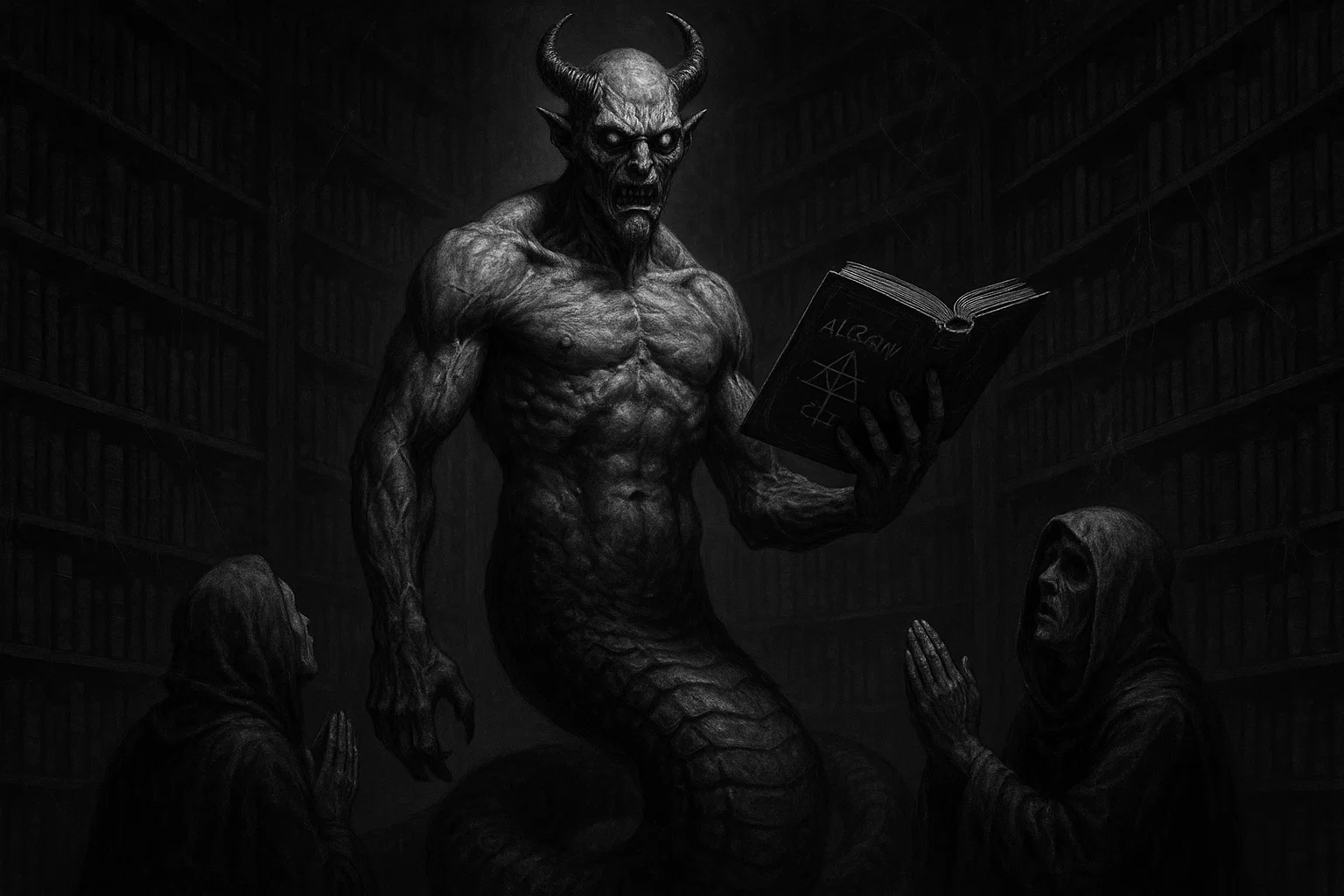
Bathin is the eighteenth spirit in the Ars Goetia. He is a strong Duke with authority over many infernal legions. Bathin is swift and has special knowledge of nature’s hidden properties, which he uses to move quickly and to change physical distances.
As a high-ranking demonic entity in the infernal hierarchy, Bathin is linked to crossing boundaries and moving people across great distances. He appears both noble and monstrous, with a snake-like side that shows the dark duality found in many Goetic spirits.
Summary
Key Takeaways
| Attribute | Details |
| Name | Bathin, Batin, Bathym, Marthim |
| Title | Great and Strong Duke of Hell |
| Gender | Male |
| Origin | First detailed in 16th-century grimoires like the Pseudomonarchia Daemonum and the Lesser Key of Solomon. |
| Appearance | A strong man with the tail of a serpent, riding on a pale horse. |
| Hierarchy | Duke |
| Superior Demon | Subordinate to the four Great Kings of the Directions (often Amaymon in Goetic tradition). |
| Servitors | Commands thirty legions of spirits. |
| Associated Figures | King Solomon (who supposedly bound him). |
| Powers | Granting the ability to travel instantly from one country to another; knowledge of the virtues of herbs and precious stones. |
| Weaknesses | The use of the Seal of Solomon and the invocation of divine names. |
| Opposing Angel/Saint | Caliel |
| Equipment/Tools | None specifically mentioned, though he is always depicted with a pale horse. |
| Pantheon | Christian Demonology / Goetic Tradition |
| Notable Myths | The binding of the 72 spirits by King Solomon into a brass vessel. |
Etymology
The name Bathin (also spelled Bathym or Marthim) has several possible origins. One main theory links it to the Arabic word Batin, meaning “inner,” “hidden,” or “secret.”
In Islamic theology, Al-Batin is one of God’s names and means the “Hidden One.” In a demonic context, the name likely alludes to Bathin’s control over hidden or magical qualities in nature, such as the secret powers of herbs and stones.
Another theory is that the name comes from Marthim, found in older manuscripts. In different versions of the Pseudomonarchia Daemonum, the name changes between these forms. The shift from Marthim to Bathin may be due to changes in pronunciation or to mistakes in translating Latin texts into English during the Renaissance.
Despite these differences, the name always refers to a being linked to revealing hidden knowledge and moving instantly between faraway places.
The Only Medal Officially Recognized for Driving Out Demons
Limited-Time: Up to 25% OFF!
U7 St. Benedict Medal Necklace • Full ritual inscription in Latin • Instant shield against Satan & fallen angels • Stops nightmares, bad luck & spiritual attacks • Matte black steel for everyday concealed carry. The most powerful Catholic talisman you can legally own.
What Does the Demon Bathin Look Like?
Bathin is usually shown in grimoires as a strong man with a commanding presence, fitting his rank as a Duke. However, he also has a serpent’s tail, a common symbol in demonology for deceit, ancient wisdom, and ties to the underworld.
The demon is almost always shown riding a pale horse, which often stands for speed and change, similar to the pale horse of Death in the Bible. He is always in motion, highlighting his role as a spirit of travel. Unlike other Goetic spirits who change forms, Bathin’s look stays the same, combining man, serpent, and horse to show his quick and adaptable nature.
Historical Mentions
Livre des Esperitz (15th-century manuscript):
Machin est un grant duc et a xxxvij legions de esperitz sour luy. Il scet la vertu des herbes et des pierres precieuses et porte les hommes d’une terre en l’autre.
Livre des Esperitz (15th-century manuscript, English translation):
Machin is a great duke and has 37 legions of spirits under him. He knows the virtue of herbs and precious stones and carries men from one land to another.
Pseudomonarchia Daemonum (Johann Weyer, 1577):
Bathin, alias Marthim, dux est magnus & fortis: Visitur in persona viri fortissimi, habens caudam serpentinam, equitans in equo pallido. Hic herbarum vires & lapidum pretiosorum intelligit. Cito hominem de regione in regionem transfert. Huic subjacent legiones triginta.
Pseudomonarchia Daemonum (Johann Weyer, 1577, English translation):
Bathin, otherwise called Marthim, is a great and strong duke: he is seen in the shape of a very strong man, having a serpent’s tail, riding on a pale horse. He understands the virtues of herbs and precious stones. He quickly transfers a man from region to region. Under him are thirty legions.
The Discoverie of Witchcraft (Reginald Scot, 1584):
Bathin, alias Marthim, is a great duke and a strong, he is seene in the shape of a verie strong man, with a serpents taile, sitting on a pale horsse, understanding the vertues of hearbs and pretious stones, transferring men suddenlie from countrie to countrie, and ruleth thirtie legions of divels.
The Lesser Key of Solomon (S.L. MacGregor Mathers, 1904):
The Eighteenth Spirit is Bathin. He is a Mighty and Strong Duke, and appeareth like a Strong Man with the tail of a Serpent, sitting upon a Pale-Coloured Horse. He knoweth the Virtues of Herbs and Precious Stones, and can transport men suddenly from one country to another. He ruleth over 30 Legions of Spirits.
You may also enjoy:
Complete Guide to Virginia Bigfoot Sightings (1879–2025)
August 8, 2025
Futakuchi-onna: The Terrifying Two-Mouthed Woman of Japanese Folklore
September 10, 2025
The Enfield Poltergeist Case: Fact, Hoax, or Something More?
October 21, 2025
What Is a Pukwudgie? Spirit, Cryptid, or Something Worse?
November 5, 2025
The Winchester Mystery House Haunting: The Real Story
October 23, 2025
The Grimoire of Pope Honorius (German Edition):
Machin (Bathin) lehret die Kräfte der Kräuter und Edelsteine und kann Menschen in kurzer Zeit von einem Land in das andere bringen.
The Grimoire of Pope Honorius (German Edition, English translation):
Machin (Bathin) teaches the powers of herbs and gemstones and can bring people from one country to another in a short time.
Dictionnaire Infernal (Jacques Collin de Plancy, 1863 edition):
Bathin, duc aux enfers, grand et puissant. Il a la figure d’un homme robuste; mais son corps se termine en queue de serpent. Il monte un cheval d’une blancheur livide. Il connaît les vertus des herbes et des pierres précieuses. Il transporte les hommes d’un pays dans un autre avec une rapidité merveilleuse. Trente légions lui obéissent.
Dictionnaire Infernal (Jacques Collin de Plancy, 1863 edition, English translation):
Bathin, duke of Hell, great and powerful. He has the figure of a strong man, but his body ends in a serpent’s tail. He mounts a horse of a livid whiteness. He knows the virtues of herbs and precious stones. He transports men from one country to another with marvelous rapidity. Thirty legions obey him.
The Grand Grimoire (Red Dragon):
Bathim is a subordinate of Fleurety, a Lieutenant General of the infernal armies.
Why Do Some Prayers Work Instantly While Others Bounce Off?
Limited-Time: Up to 40% OFF!
Deliverance explodes when you stop praying generally and start commanding specifically. This book hands you the master list of demonic names and functions used by apostles and exorcists worldwide – Jezebel, Python, Death, Antichrist spirits – plus the scriptural authority to make them obey.

Bathin’s Powers and Abilities
Bathin’s powers are focused on using hidden knowledge to change the physical world, especially by bending space. His main ability is to instantly transport people, not just by moving fast, but by supernaturally “teleporting” them from one country to another.
This power can tempt people who want to escape their problems, avoid justice, or get an unfair edge in trade or war by skipping the normal limits of time and distance.
Bathin also knows all about the powers of herbs and precious stones. He understands the secret qualities of plants, which can be used for healing or for darker purposes. By sharing these secrets, he tempts people with promises of power over life and death, or the ability to influence others using plant mixtures and stone charms.
Powers and Abilities Breakdown
| Power/Ability | Description | Source | How It Tempts/Corrupts |
| Instant Transport | Moving individuals across borders in an instant. | Ars Goetia | Encourages sloth and the evasion of consequences. |
| Herbal Mastery | Secret knowledge of plant properties. | Pseudomonarchia Daemonum | Leads to the creation of poisons or mind-altering philters. |
| Lapidary Knowledge | Understanding the magic of stones. | Dictionnaire Infernal | Promotes greed and the pursuit of forbidden power through talismans. |
How to Counter Bathin’s Powers
To protect yourself from Bathin, use items that keep you grounded in the present, both physically and spiritually. Since Bathin is linked to fast movement, salt is a main defense. Salt is known for stopping spirits and keeping things in their natural place.
To keep Bathin away, people can use the Pentacle of Solomon made for the Dukes of the Goetia, which should be made of copper. Wearing a protective amulet like the Hamsa or the Saint Benedict Medal also helps provide spiritual protection.
If you suddenly feel the urge to run away or notice lost time (which could be Bathin’s influence), it’s best to cleanse your home with holy water and ask a priest for a blessing to restore spiritual boundaries.
Bathin’s Role in the Hierarchy of Hell
In the infernal order, Bathin is a Duke. This means he is a high-level leader and commands thirty legions of spirits, which is a large force. He ranks below the Kings of Hell but is equal to other powerful Dukes like Agares or Eligos.
Bathin’s role in the hierarchy is mostly practical. He acts as a courier or guide for the infernal hosts. Though he serves higher powers, he has his own court and authority. Being the 18th spirit in the Goetic list shows he is a key entity in Solomon’s system.
Astrological Associations and Symbolism
Bathin is closely linked to astrological signs and elements connected to travel and the earth’s hidden treasures.
| Association | Details |
| Zodiac Sign | Virgo (specifically 25-29 degrees) |
| Element | Earth |
| Planet | Venus (as a Duke) |
| Metal | Copper |
| Color | Green or Pale White |
| Plant | Mistletoe |
| Stone | Diamond or Malachite |
You may also enjoy:
The Winchester Mystery House Haunting: The Real Story
October 23, 2025
Stanley Hotel Haunting: What Really Inspired The Shining?
October 21, 2025
What Is the Black Shuck? History, Legends, and Belief
February 9, 2026
Bathin’s Sigil
Bathin’s sigil is a complex geometric symbol used in Goetic tradition to represent him. People believe the sigil acts as a calling card or focus for his energy. Its sharp angles and flowing lines may show the quick paths he travels.
Associated Symbols and Offerings
| Symbol/Item | Association/Meaning | Use in Rituals |
| Snake Tail | Chthonic wisdom/Deceit | Symbol of his true nature. |
| Pale Horse | Swiftness/Death | Representation of his transit. |
| Copper | Venusian energy | Used to construct his protective lamen. |
What If 72 Demons, Hundreds of Angels, and the Secret of Instant Genius Were Hidden in a Single Book?
Limited-Time: Up to 10% OFF!
For the first time in centuries, all five books of the Lemegeton fully restored and translated – 72 Goetic demons with their seals, the aerial spirits of Theurgia-Goetia, the planetary angels of Ars Paulina, the Almadel’s wax tablet ritual, and the divine Ars Notoria for instant knowledge. The Teitan Press edition occultists call “the most dangerous book you can own.”
Similar Demonic Entities
| Demon Name | Gender | Primary Religion | Type / Class | Sphere of Influence | Weaknesses |
| Agares | Male | Christian | Duke | Earthquakes, runaway languages | Holy Names |
| Gaap | Male | Christian | President/Prince | Philosophy, quick travel | Consecrated Water |
| Forcas | Male | Christian | Knight | Logic, herbalism | Iron |
| Stolas | Male | Christian | Prince | Astronomy, precious stones | Blessed Salt |
| Bechard | Male | European Folklore | Demon | Wind, storms, travel | Silver |
| Pazuzu | Male | Mesopotamian | Demon | Wind, famine, locusts | Own image (Amulets) |
| Marax | Male | Christian | Earl/President | Astronomy, herbs | Exorcism |
| Raum | Male | Christian | Earl | Theft, destruction of cities | Holy Ground |
| Valac | Male | Christian | President | Finding serpents, treasures | Divine Prayer |
| Gusion | Male | Christian | Duke | Answering the past/future | Pentacle of Solomon |
Conclusion
Bathin stands out in the Goetic tradition because he focuses on travel and the secrets of nature. As the eighteenth spirit and a Duke, his role shows how the infernal hierarchy is organized, with each powerful spirit having a special job.
To understand Bathin, you need to see both his human-like rank and his monstrous, serpent side. Whether he is seen as a keeper of plant secrets or a master of moving through space, Bathin represents the tempting appeal of shortcuts and hidden knowledge that avoid the normal human effort.