Anne Boleyn’s ghost refers to the alleged spectral presence of the executed second queen consort of King Henry VIII of England, Anne Boleyn (c. 1501/1507 – 1536).
Her spirit is reported to wander various locations significant to her life and death, particularly in England. These hauntings often feature her apparition appearing either as a dignified queen or as a headless figure, reflecting the violent nature of her execution by beheading at the Tower of London.
Summary
Key Takeaways
| Attribute | Details |
| Name | Anne Boleyn’s ghost, The Headless Queen, The Most Traveled Ghost in Britain |
| Location | Multiple locations in England, including the Tower of London, Hampton Court Palace, Windsor Castle (Dean’s Cloister), Blickling Hall (Norfolk), Hever Castle (Kent), Marwell Hall, Rochford Hall, and Salle Church. |
| Longland Scale | Class L-4 [See the Longland Scale Explanation] |
| History | Anne Boleyn was executed by beheading on May 19, 1536, at the Tower of London on charges of treason, adultery, and incest. |
| Death Toll | 1 confirmed historical death (Anne Boleyn); 1 attributed paranormal death (1817 sentry heart attack). |
| Type of Haunting | Apparitions, Ghost (General), Residual, Crisis Apparitions |
| Lunar / Seasonal Pattern | Recurrence is common on the anniversary of her execution (May 19) and around Christmas Eve, the latter being linked to her childhood home. |
| Entities | Anne Boleyn’s ghost (often headless), a phantom carriage with headless coachmen (Blickling Hall), the ghost of her brother George Boleyn. |
| Manifestations | Visual apparitions (full-bodied in blue/white/grey or headless), feelings of extreme cold, unexplained light flickering, and the screams of a woman in distress. |
| First reported sighting | The first widely documented sighting occurred in 1817 at the Tower of London. |
| Recent activity | Sightings and reported impressions persist to the present day across her associated locations, such as the reported ‘impressions’ at Hever Castle in 1976. |
| Threat Level | 2/10 (harmless) [See the Threat Level Explanation] |
| Hoax Confidence Rating | 5/10 (Neutral / Inconclusive) [See the Hoax Confidence Rating Explanation] |
| Open to the public? | Yes, many of the locations, such as the Tower of London, Hampton Court Palace, Blickling Hall, and Hever Castle, are historical properties open to visitors. |
Who Is Anne Boleyn’s Ghost?
Anne Boleyn’s ghost is one of the most famous spectral presences associated with the English monarchy. The alleged haunting is not tied to a single location. Still, it is reported across multiple historical sites that played a role in her life, especially those linked to her political ascent and tragic downfall.
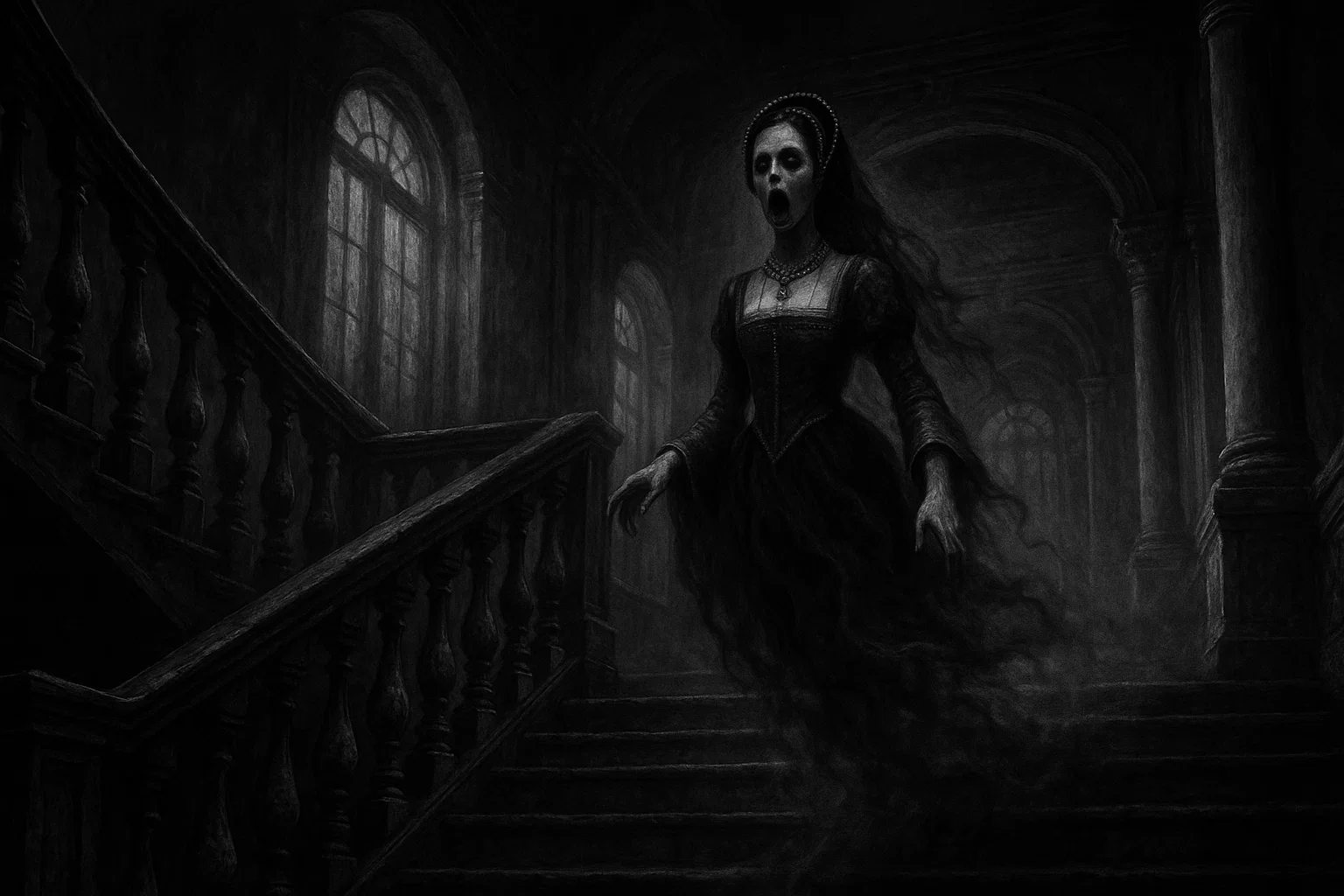
The manifestations typically take the form of an intelligent or residual haunting apparition, with reports often describing her as either a full-bodied Queen in blue, black, or white Tudor dress or as a headless entity clutching her severed head.
The sheer number of reported locations, including royal residences, her childhood home, and the site of her execution, has led to her spirit being referred to as “the most traveled ghost in Britain.” The frequent motif of the headless apparition is a direct link to the manner of her death, suggesting a spirit unable to find rest due to the trauma of her beheading and the injustice of her trial.
What If the Scariest Children’s Book Ever Written Was Never Meant for Children?
Limited-Time: Up to 51% OFF!
Alvin Schwartz collected these stories from graveyards, backroads, and old people who swore they were true – then paired them with Stephen Gammell’s grotesque, dripping, eyeless illustrations that look like they crawled off the page. Three complete books of pure nightmare fuel in one volume.
Anne Boleyn’s Dark History
The historical basis for the haunting lies in the life and brutal execution of Anne Boleyn, the second wife of King Henry VIII. Anne’s marriage to Henry and the following break with the Roman Catholic Church fundamentally changed the course of English history.
She was arrested on May 2, 1536, and taken to the Tower of London on charges of high treason, adultery, and incest, all believed to be fabricated by her enemies and the King.
Specific locations tied to her alleged haunting include sites of her political triumph, her childhood, and her betrayal:
- The Tower of London: The site of her imprisonment in the Queen’s House, her trial in the Great Hall, and her execution by a specialized French swordsman on May 19, 1536. Her body was buried under the altar of the Chapel Royal of St Peter ad Vincula. This site is the nexus of her most violent and macabre spectral reports.
- Blickling Hall (Norfolk): The alleged birthplace of Anne Boleyn. Reports here focus on the traumatic anniversary of her death, May 19, where a headless carriage is seen arriving, reflecting the pain of her execution at a place representing her earliest life. Her brother, George Boleyn, also allegedly haunts the grounds on this date, being dragged by four headless horses as a result of his own execution two days prior.
- Hever Castle (Kent): Anne’s beloved childhood home. Hauntings here are often reported around Christmas Eve, suggesting a return to a time of happiness and love, possibly at the great oak tree where King Henry VIII courted her.
- Marwell Hall (Hampshire): This location is linked to Henry VIII’s ultimate betrayal. While Anne was awaiting execution, Henry and Jane Seymour were rumored to have been guests at Marwell Hall, possibly solidifying their plans for marriage shortly after Anne’s death. The apparition seen here is often linked to the betrayal she suffered.
- Salle Church (Norfolk): A less frequent but significant report suggests Anne’s body was secretly moved from the Tower of London and reburied here under a black slab near her Boleyn ancestors. This rumor may explain the sporadic ghost sightings at this church.
The perceived injustice of her trial and the rapidity of her fall from Queen to condemned prisoner—only three years after her coronation—are cited as the primary reasons her spirit remains restless across multiple historic locations.
You may also enjoy:
Is Mothman Real? The Eerie Sightings That Say Yes
June 25, 2025
The Dark Demon Seth: God of Chaos in Egyptian Mythology
October 2, 2025
Naamah: The Seductive Demon Queen of Infernal Desires
September 30, 2025
What Is a Poltergeist? Definition, Manifestations, and History
January 20, 2026
Classification of Manifestations
The alleged paranormal activity associated with Anne Boleyn’s ghost falls into three distinct classifications based on how witnesses have experienced the phenomena across various locations.
Strange Sounds
Reports of bizarre sounds are less common than visual sightings but are often highly traumatic. These include:
- Screams and Cries: Witnesses at the Tower of London and sometimes Windsor Castle report hearing the faint, distant cries or screams of a woman in distress, often interpreted as Anne’s suffering during her final days or moments of death.
- Footsteps: At Blickling Hall, especially around the May 19th anniversary, staff have reported hearing clear footsteps moving through locked rooms or corridors, sometimes coinciding with a sense of presence.
- Phantom Coach Sounds: Although the Blickling Hall carriage is primarily a visual sight, the lack of sound from such a large vehicle when it should be audible adds to the event’s eerie, supernatural quality.
Visual Apparitions
Visual sightings are the most dominant type of manifestation and fall into two primary forms:
- The Headless Specter: This manifestation, most frequent at the Tower of London (Chapel Royal and White Tower) and Blickling Hall, depicts Anne as a figure clutching her severed head or appearing completely headless. This is directly linked to the physical trauma of her execution. She is often described as wearing white or grey Tudor gowns.
- The Full-Bodied Queen: This appears more frequently at her residences, such as Hampton Court Palace and Hever Castle. Here, she is seen as an elegant, sad woman in Tudor dress (sometimes in peacock blue or black) and is usually intact, symbolizing her life before her downfall. The sighting at the Dean’s Cloister in Windsor Castle also falls into this category, characterized by a melancholic air of reflection.
Environmental/Tactile
These are manifestations that affect the physical environment or the witness’s body:
- Temperature Drops: Parapsychological investigators and witnesses at locations such as Rochford Hall and the Tower of London have reported sudden, sharp drops in ambient temperature in specific, localized areas, often preceding or following a sense of presence.
- Light Anomalies: The sighting in the Chapel Royal at the Tower of London began with a flickering, unexplained light visible through the chapel window late at night.
- Fatal Physical Reaction: The most severe effect was the 1817 incident, where a sentry at the White Tower suffered a fatal heart attack after encountering the apparition, proving a potential, albeit extremely rare, physical danger associated with the haunting.
The Forbidden Encyclopedia That Makes Every Ouija Session Ten Times More Dangerous
Limited-Time: Up to 49% OFF!
Angels, devils, nature spirits, ancestors, tricksters, and creator gods – all catalogued with their true names, powers, and protocols. Judika Illes created the definitive directory of the spirit realm that practitioners around the world swear by when they need to know exactly who (or what) just answered.
Anne Boleyn’s Ghost Sightings
Documented reports of Anne Boleyn’s ghost cover centuries and multiple locations, suggesting a widespread and long-lasting phenomenon.
| Date/Era | Location | Manifestation Type | Details |
| 1817 | White Tower, Tower of London | Apparition, Fatal Crisis Apparition | A sentry patrolling a staircase encountered a veiled, white figure believed to be Anne’s ghost. The shock was so profound that the sentry suffered a fatal heart attack. |
| Late 19th Century | Chapel Royal, Tower of London | Apparition, Spectral Procession | A Captain of the Guard saw a mysterious light and, peering in, witnessed a procession of knights and ladies led by an ethereal woman recognized as Anne Boleyn by her likeness to portraits. |
| 1864 | Queen’s House, Tower of London | Apparition | General Dundas and a sentry saw a ‘moving white figure’ or a faceless white figure dressed in Tudor clothes near the Queen’s House. The sentry charged the apparition with his bayonet, which passed straight through it, causing the guard to faint. |
| 1976 | Anne Boleyn’s Bedroom, Hever Castle | Impression | C.W. Bamford reported receiving strong ‘impressions’ of a young woman in distress, aged about 25, beating her fists on the window sill. |
| 1977 | Hever Castle | Apparition | A 12-year-old visitor reportedly saw Anne Boleyn looking out of a window, dressed in a peacock blue and gold dress and appearing sad. |
| 1979 | Long Gallery Library, Blickling Hall | Apparition | A member of the National Trust library staff witnessed a ‘grey lady’ looking at books. The figure slowly faded away, leaving a book open at a picture of Anne Boleyn. |
| 1985 | Employee Quarters, Blickling Hall | Auditory, Manifestation | On the anniversary of Anne’s execution, a Blickling employee was woken by the sound of footsteps entering his bedroom. |
| Sporadic (All Eras) | Dean’s Cloister, Windsor Castle | Apparition | Anne’s ghostly form has been seen standing at a window in the Dean’s Cloister, often described as sad or weeping. |
| Christmas Eve | Bridge over River Eden, Hever Castle | Apparition | Recurring annual sighting of a pale, elegant female slowly drifting over the bridge or standing beneath the Great Oak. |
| May 19th (Annual) | Driveway and Great Wood, Blickling Hall | Apparition, Residual | The most notorious annual sighting of the headless carriage, often drawn by six headless horses, carrying Anne in a white or grey dress, clutching her severed head. |
| Sporadic (All Eras) | Rochford Hall, Essex | Manifestation | Reports of a headless lady and isolated feelings of extreme, unexplained cold in certain areas of the house. |
You may also enjoy:
The Whaley House Haunting: America’s Most Terrifying Ghost Story
October 23, 2025
Who Was Qingu in Babylonian Mythology?
August 27, 2025
Why the Kitsune Is the Most Dangerous Yokai in Japanese Folklore
September 10, 2025
White Tower (1817)
One of the earliest documented and most tragic accounts of Anne Boleyn’s ghost dates to 1817, at the Tower of London, near the White Tower. A sentry, while on duty, reportedly encountered the spectre of a woman on a staircase. The shock was so profound and immediate that the soldier collapsed at his post.
The sentry later suffered a fatal heart attack attributed directly to the spectral encounter, making this one of the few instances where the encounter with Anne Boleyn’s ghost has been linked to an actual death.
Blickling Hall (Periodic)
The reports at Blickling Hall in Norfolk are intrinsically linked to the date of her death. Every year on May 19, at midnight, the ghost of Anne Boleyn is allegedly seen arriving at the Hall.
She is said to be seated in a phantom coach drawn by either four or six spectral horses and driven by a headless coachman. Anne herself is reported to be dressed in white or grey and has her decapitated head on her lap.
The coach is said to travel silently up the driveway before vanishing at the Hall’s entrance. This event represents a highly specific, repetitive, and deeply traumatic residual manifestation.
Dean’s Cloister
Sightings of Anne Boleyn’s ghost at Windsor Castle often concentrate on the Dean’s Cloister. Her ghostly form is frequently described as standing at a window overlooking the cloister, usually appearing sad, weeping, or looking distressed.
This contrasts with the headless terror reported elsewhere, showing a more sorrowful, full-bodied apparition, possibly linked to her periods of anxiety and unhappiness during her time as Queen.
Curiously, reports also suggest that the ghost of Queen Elizabeth I has been seen at the same window, potentially indicating a connection between mother and daughter in the castle’s spectral world.
Ever Walk Into a Room and Instantly Feel Something Watching You?
Millions have used burning sage to force out unwanted energies and ghosts. This concentrated White Sage & Palo Santo spray does the same job in seconds – just a few spritzes instantly lifts stagnation, breaks attachments, and restores peace most people feel immediately.

Theories
The consistent and long-standing nature of the reports regarding Anne Boleyn’s ghost has prompted several attempts to explain the phenomenon, ranging from paranormal classifications to psychological and historical interpretations.
The Traumatic Imprint and Residual Energy Theory
This theory claims that the haunting is a form of residual haunting, meaning the spirit is not an intelligent, conscious entity but rather an emotional energy imprint of a tragic or traumatic event.
Since Anne Boleyn’s execution was a highly traumatic and unjust public death, the energy of her final moments—especially at the Tower of London and the raw emotional distress—may have been imprinted on the physical locations.
This would explain the highly specific and repetitive nature of sightings like the headless carriage at Blickling Hall, which occurs precisely on the anniversary of her execution. The event is a cosmic recording of the emotional pain of the day she died.
The Psychological Projection and Cultural Memory Theory
This explanation suggests that the sightings are a form of mass suggestion, delusion, or psychological projection embedded in the intense cultural memory of Anne Boleyn’s story.
Anne Boleyn is a tragic and romanticized character in English history, particularly popularized during the Victorian period when many of the documented reports began to proliferate.
The highly charged narrative of her life and death may cause individuals prone to suggestion, or those deeply immersed in the lore, to experience delusions or hallucinations that manifest as her ghost, often with details reflecting her known fate (e.g., headless).
The Intelligent Post-Mortem Survival Theory
This traditional paranormal theory claims that the ghost is the conscious, persistent spirit of Anne Boleyn. Because she died violently and unjustly, her spirit is believed to be restless and unable to cross over. Reports of the ghost being seen in multiple, distant locations, such as Hampton Court Palace and Hever Castle—places she loved—suggest a degree of intelligent agency and free movement that is inconsistent with a purely residual haunting.
On top of that, the 1864 account, in which the guard was forced to engage with the apparition, and the reported weeping entity at Windsor, suggest an awareness and emotional state characteristic of an intelligent haunting.
Anne Boleyn’s Ghost vs Other Similar Ghosts
| Name | Location | Type of Haunting | Activity Level |
| Catherine Howard’s Ghost | Hampton Court Palace, UK | Apparitions, Residual | 8 (very active) |
| Jane Seymour’s Ghost | Hampton Court Palace, UK | Apparitions | 5 (occasional) |
| The Grey Lady of Chillingham | Chillingham Castle, UK | Apparitions | 7 (very active) |
| The Headless Horseman | Sleepy Hollow, New York, USA | Wraiths, Curse | 6 (occasional) |
| The Drummer Boy of Gettysburg | Gettysburg Battlefield, Pennsylvania, USA | Apparitions, Auditory | 9 (very active) |
| Mary, Queen of Scots’ Ghost | Fotheringhay Castle, UK | Apparitions | 3 (dormant) |
| Lady Jane Grey’s Ghost | Tower of London, UK | Apparitions | 5 (occasional) |
| The Ghost of Henry VIII | Windsor Castle, UK | Apparitions, Auditory | 7 (very active) |
| Headless Lady of Wentworth | Wentworth Woodhouse, UK | Apparitions, Ghost (General) | 4 (occasional) |
| Brown Lady of Raynham Hall | Raynham Hall, Norfolk, UK | Apparitions | 8 (very active) |
| Ghost Piper of Edinburgh | Edinburgh Castle, Scotland, UK | Auditory, Residual | 6 (occasional) |
| Elizabeth I’s Ghost | Windsor Castle, UK | Apparitions | 7 (very active) |
You may also enjoy:
Likho: The One-Eyed Crone Who Brings Death and Bad Luck
September 11, 2025
The Loveland Frog Mystery: Real Cryptid or Local Hoax?
September 25, 2025
Naamah: The Seductive Demon Queen of Infernal Desires
September 30, 2025
Is Anne Boleyn’s Ghost Haunting Real?
Whether Anne Boleyn’s ghost is a genuine paranormal phenomenon is still a mystery. The sheer volume of sightings over centuries and across numerous, historically significant locations suggests a long-lasting cultural and, possibly, supernatural presence.
The regular nature of the most dramatic reports—the headless procession at Blickling Hall on May 19 and the fatal encounter at the Tower of London—suggests that, at a minimum, the story has become an entrenched piece of the folklore and history of these places.
The reports are compelling due to the historical context of her violent death; the concept of a spirit remaining due to trauma aligns with many ghost theories. On the other hand, the discrepancies in the apparition’s appearance—sometimes headless and macabre, sometimes a serene, full-bodied Queen—could indicate cultural storytelling and the evolution of a legend rather than a unified paranormal entity.
The widespread reverence for her story since the Victorian era provides a framework for how suggestible witnesses might unconsciously manifest or interpret historical details into a supernatural encounter.
When all is said and done, the verifiable evidence of a spirit is not available. Anne Boleyn’s ghost is a powerful cultural symbol of injustice, female agency, and historical tragedy. Whether a genuine spirit or a deeply embedded psychological imprint, the continued reports attest to the specter of the executed queen remaining a potent and fascinating element of British history and paranormal lore.