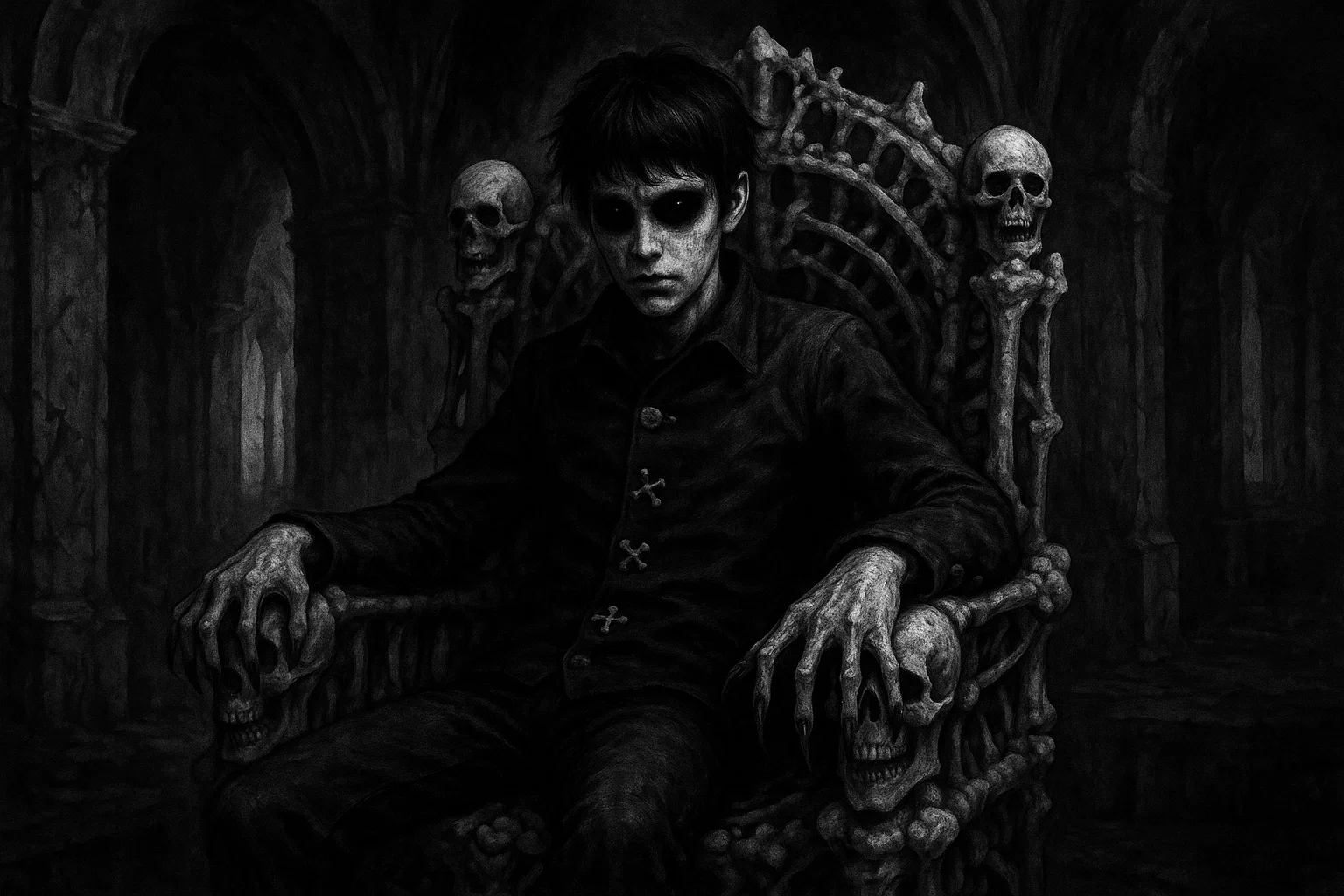
Amaimon, also known as Amaymon, is a powerful figure in classical demonology, primarily appearing as one of the principal kings or emperors of Hell in grimoires of the Solomonic tradition.
He is widely recognized as the King of the East and holds authority over numerous lesser spirits. Amaimon’s significance is not derived from a specific creation myth or epic narrative but from his position in the infernal hierarchy, which demands extreme caution and the use of special protections during conjuration.
His role is that of a powerful monarch who commands a vast legion of the 72 spirits listed in the Lesser Key of Solomon. He is primarily known for his immense power to control and be controlled by other entities.
Summary
Key Takeaways
| Attribute | Details |
| Name | Amaimon, Amaymon. |
| Title | King of the East, One of the Four Great Kings (or Emperors) of Hell, Sub-Prince (in some traditions). |
| Gender | Male (implied by the title “King”). |
| Origin | First appears in European occult traditions, specifically the Solomonic grimoires of the Middle Ages and Renaissance. |
| Appearance | No specific physical description is provided in primary texts; associated with a form so terrible that direct viewing is considered dangerous. |
| Hierarchy | King/Emperor, one of the four kings of the cardinal directions, commanding many lesser spirits. |
| Superior Demon | Only ultimately subject to the Divine will or the authority of the principal four rulers of the world (Lucifer, Oriens, Paimon, Ariton) in the Abramelin tradition. |
| Servitors | Commands many of the 72 spirits of the Ars Goetia, including Bael (as a subordinate king in some accounts) and Paimon (as a subordinate in some accounts). |
| Associated Figures | King Solomon (legendary binder of all demons); Oriens, Paimon, Ariton, and Magot (co-rulers in some texts). |
| Powers | Absolute command over vast legions of lesser demons, the ability to grant knowledge and cause harm to the exorcist if proper protection is not used. |
| Weaknesses | Repelled and bound by a ring of silver (or gold/other metal in some variations) held before the face of the magician; controlled by a specific Divine Name; his power is thwarted if he is prevented from inhaling the smoke/perfumes of the conjuration. |
| Opposing Angel/Saint | None specified; controlled by the Divine Name and the power of God invoked by the magician. |
| Equipment/Tools | None specified; the Ring of Exorcism or Ring of Solomon is the essential tool needed to control him. |
| Pantheon | Christian Demonology, Solomonic Magic, Occultism. |
| Notable Myths | Primarily mentioned in the Ars Goetia (Lesser Key of Solomon) and the Book of the Sacred Magic of Abramelin the Mage for his role in the infernal hierarchy. |
Etymology
The etymology of the name Amaimon (Amaymon) is uncertain. It has no definitive, universally accepted derivation from Hebrew, Greek, or Latin in scholarly texts. However, several theories have been proposed, often linking him to other prominent demonic or religious concepts.
One speculative interpretation attempts to link Amaimon to Mammon. This term originally meant ‘money‘ or ‘wealth‘ in Aramaic and Hebrew. It was later personified in Christian tradition as a demonic entity representing greed, material wealth, or covetousness. This proposed link suggests that Amaimon’s power might extend to worldly riches. However, this is not explicitly stated in primary texts such as the Ars Goetia.
Another possible, though less common, interpretation suggests a link to the Greek word amaimos (ἀμάιμος), meaning blameless or excellent, which might have been corrupted or deliberately inverted to subvert a divine or positive title into a demonic one. However, this is largely conjecture.
Given his rank as a King in the grimoires, the name’s meaning likely conveys a sense of authority and terrible power, even if the literal roots are lost or obscured by scribal variations and deliberate enciphering common in occult manuscripts.
Ever Wonder What a Demon’s Real Name Is… and Why Saying It Is Dangerous?
Limited-Time: Up to 25% OFF!
The Encyclopedia of Demons & Demonology 400+ entries • Real history • Exorcisms & Ancient Evils • Possession • Terrifying photos. This is Rosemary Ellen Guiley’s masterpiece of the occult.
What Does the Demon Amaimon Look Like?
Amaimon’s physical appearance is one of the most mysterious aspects of the entity, as the primary source texts, such as the Lesser Key of Solomon, provide no specific physical description of the King of the East. Unlike many other high-ranking demons who are described with multiple animal heads, specific weapons, or unique chimeric forms, Amaimon is left undescribed.
The texts focus instead on the immensity of his power and the danger of his presence. His form is often implied to be terrible and dangerous simply by the extreme caution the conjuring texts demand. The Lesser Key of Solomon stresses that the magician must not look directly at the demon without the protection of the Magical Ring (often described as a silver ring or a ring of exorcism).
The most important detail regarding his presence is the crucial instruction that the exorcist must prevent him from inhaling the smoke or perfumes burned during the ritual, as the texts imply that if he does, the exorcist will be slain.
This focuses the description on the effect of his presence—the potential for immediate death—rather than his physical form. Later occult traditions have sometimes assigned him various formidable forms, but these lack the authority of the original Solomonic grimoires.
You may also enjoy:
What Is an Androsphinx and Why Was It Feared in Ancient Egypt?
January 27, 2026
Who Is Abezethibou? The Fallen Angel of the Red Sea
August 13, 2025
Who Is Flauros, the Demon Duke of Fire?
August 29, 2025
Historical and Mythological Background
Amaimon’s role is almost entirely defined by his presence within the Solomonic cycle of grimoires, texts believed to contain the magical system used by the biblical King Solomon to bind and control demons. He does not feature in canonical religious literature, such as the Bible, or in apocryphal works, such as the Book of Enoch. His history is thus the history of the grimoires that mention him.
Amaimon’s Role in the Ars Goetia (Lesser Key of Solomon)
In the Lesser Key of Solomon, Amaimon is established as one of the four Great Kings who rule over the 72 spirits. These kings—along with the other three (often given as Corson, Ziminiar, and Gaap/Goap)—rule over the cardinal directions of the world. Amaimon is consistently designated as the powerful king of the East. His power is such that he must be acknowledged and referenced when summoning any of the spirits under his command.
The text focuses on the danger of summoning any spirit under his control. For example, when invoking a spirit, the magician is commanded to stand within the Pentagram and hold the Ring of Exorcism (often called the Ring of Solomon) before his face, stating: “Behold Amaimon, thy King, which ruleth upon thee, and all the Spirits of Infernall fire doe owne allegiance unto him.” This establishes Amaimon as a potent intermediary between the magician and the desired spirit.
Furthermore, the ritual for commanding the Great Demon King Paimon explicitly states that Paimon is “subject to AMAIMON”. This provides a clear structural element to the hierarchy, showing that Amaimon has powerful spirits serving him who are themselves Kings. The magician must be ready with the Ring and “hold it before his face, for Amaimon will strive to deceive him in the operation.”
This Book Contains Over 1,600 Reasons to Never Say “I Don’t Believe in Demons”
Limited-Time: Up to 33% OFF!
The most complete dictionary of demon names ever compiled – from Abbadon to Zyzyl – spanning medieval grimoires, ancient mythology, and modern occult sources. Tenth Anniversary Edition with new entries, corrected pronunciations, and the hidden meanings most books are afraid to print.
The King of the North in the Book of Abramelin
In The Book of the Sacred Magic of Abramelin the Mage, an earlier grimoire dating to the 15th century, Amaimon’s position is slightly altered. However, he remains a key figure of authority. This text posits four Supreme Princes who govern the world (Lucifer, Oriens, Paimon, and Ariton). Under these four are eight Sub-Princes, and Amaimon is one of these eight.
In the Abramelin tradition, Amaimon is specifically associated with the North (in contradiction to his role as King of the East in the Goetia). His role is to command vast legions of lesser spirits, who are all meticulously listed in the manuscript.
His placement as a Sub-Prince under the four primary rulers, rather than as one of the primary rulers himself, demonstrates the lack of complete standardization in the infernal demonological hierarchy across different grimoire traditions.
Historical Mentions
| Text/Grimoire | Year (Approx.) | Excerpt |
| The Lesser Key of Solomon (Ars Goetia) | 17th Century (Compiled) | “Thou must know that Paimon is subject unto AMAIMON, his King, and doth obey him. The King of the East is AMAIMON.” and “The exorcist must take great care, that he be not deceived by him, but let him hold the Ring of Exorcism before his face, for Amaimon will strive to deceive him in the operation.” |
| Pseudomonarchia Daemonum (Weyer) | 1577 (Published) | “He also hath an absolute rule over the other Kings, which are Corson, Ziminiar, and Gaap, who are called the Kings of the East, West, North, and South.” (Amaimon is commonly implied to be the King of the East in this sequence). |
| The Book of the Sacred Magic of Abramelin the Mage | 15th Century (Manuscript) | “The Eight Sub-Princes: Amaimon, Ebalid, Magot, Asmoday, Paimon, Oriens, Pasamon, Ariton, and their Dukes.” |
| The Discoverie of Witchcraft (Reginald Scot) | 1584 (Published) | “He also hath an absolute rule over the other Kings, which are Corson, Ziminiar, and Gaap, who are called the Kings of the East, West, North, and South.” |
Amaimon’s Powers and Abilities
Amaimon’s powers come almost entirely from his position as a Great King within the infernal hierarchy. His abilities are less about personal, active skills like prophecy or metamorph (though his subjects possess these) and more about absolute, unyielding authority over a massive host of lesser demonic entities.
His primary power is his ability to command and authorize the appearance of many of the 72 spirits of the Ars Goetia. A magician must invoke Amaimon’s authority to successfully bind his subordinates. This power allows him to intervene in the conjuration process—not to directly grant a wish, but to either permit or prevent the manifestation of the desired lesser demon.
His most malevolent power lies in his ability to cause physical harm to the exorcist. The grimoires explicitly warn that Amaimon is so terrible that if the magician fails to use the correct protections (the Ring of Exorcism and the Divine Name), he will slay the exorcist by inhaling the smoke/perfumes of the ritual.
This is a unique and specific threat, showing his power is immediate, lethal, and tied to the ritual environment itself. The corruption is not a subtle temptation but a lethal retribution for an inadequately performed or unprotected ritual.
| Power/Ability | Description | Source | How It Tempts/Corrupts Humans |
| Kingly Authority | Absolute power to command and bind many of the 72 spirits of the Goetia, authorizing their appearance to the conjurer. | Ars Goetia | Allows humans to command powerful demons (his subjects), tempting them with easy access to dark powers and forbidden knowledge. |
| Lethal Inhalation | The ability to slay the exorcist by drawing in the smoke/perfumes of the conjuration, used as punishment for inadequate protection. | Ars Goetia | Corrupts by punishing weakness and promoting fear, ensuring only the most arrogant or well-protected dare to engage in dark magic. |
| Deception | A tendency to try and deceive the magician during the operation, presumably to lure the conjurer into dropping their guard or abandoning their protective ring. | Ars Goetia | Corrupts by undermining the trust in protective measures, leading to fatal overconfidence or the abandonment of ritual safeguards. |
You may also enjoy:
What Is the Mazomba—Africa’s Lost Dinosaur or an Unknown Rhino?
November 11, 2025
Ose: The Insanity Inducing Demon of the Ars Goetia
September 1, 2025
Is My Home Haunted or Just Old? How to Tell the Difference
September 5, 2025
How to Counter Amaimon’s Powers
Countering Amaimon’s terrible power relies entirely on strict adherence to ritual protocol and the use of a specific, tangible protective item. Since his power is largely reactive—a punishment for the magician’s error—the counter-measures are primarily protective and preventative.
The essential item is the Ring of Exorcism, often described as a silver or gold/electrum ring. The grimoires state that the magician “must hold it before his face” while addressing Amaimon or any of his subordinates. The ring acts as a Divine shield, protecting the magician from the demon’s harmful countenance or influence.
Furthermore, the magician must use a specific Divine Name or Phrase to bind the King and his subjects, such as “IEHSU CHRISTO” or the name of the Divine power that created them. This invocation of a higher power is what truly controls the demon.
Critically, the magician must take special care to ensure the smoke or perfumes used in the ritual do not rise towards Amaimon or his subordinates, as inhaling the smoke allows him to immediately act upon his intent to slay the exorcist.
What If 72 Demons, Hundreds of Angels, and the Secret of Instant Genius Were Hidden in a Single Book?
Limited-Time: Up to 10% OFF!
For the first time in centuries, all five books of the Lemegeton fully restored and translated – 72 Goetic demons with their seals, the aerial spirits of Theurgia-Goetia, the planetary angels of Ars Paulina, the Almadel’s wax tablet ritual, and the divine Ars Notoria for instant knowledge. The Teitan Press edition occultists call “the most dangerous book you can own.”
Amaimon’s Role in the Hierarchy of Hell
Amaimon occupies one of the highest possible ranks in the infernal hierarchy, specifically within the system defined by the Lesser Key of Solomon and related grimoires. His title as King of the East places him among the four governing monarchs of Hell, with authority over one of the four cardinal directions of the world.
In this system, the four Kings (Amaimon, Corson, Ziminiar, and Gaap) are the ultimate superiors to the 72 named spirits. He is responsible for commanding legions of these spirits, including other entities who themselves bear the title of King, such as Bael (in some interpretations) and the mighty King Paimon, who is explicitly noted to be “subject unto AMAIMON.”
His position is therefore that of an Emperor or Chief Monarch in his dominion, ultimately subservient only to the supreme power (often implied to be God) that allows him to be bound by King Solomon’s art.
The slightly different hierarchy presented in the Book of Abramelin places him among the Eight Sub-Princes serving under the four main rulers (Lucifer, Oriens, Paimon, Ariton).
Even in this context, the title of Sub-Prince grants him authority over extensive armies of lesser demons. Regardless of the minor structural variance between grimoires, Amaimon’s rank is consistently high, placing him above the vast majority of infernal spirits and establishing him as a potent figure of supreme authority in his allotted quarter of the world.
Astrological Associations and Symbolism
Amaimon’s associations within astrological magic are derived from his position as the King of the East, which connects him to the rising Sun and the general symbolism of that direction, as well as to specific planetary and elemental influences.
The East is traditionally associated with the element of Air or Fire in various occult traditions, suggesting an airy or fiery temperament. Due to his immense authority and serious, punishing nature, he is often linked to the planet Saturn in later astrological magic, which governs structure, authority, time, and darkness.
The association with Saturn suggests a potential connection to the color Black and the metal Lead. However, these are not explicitly named in primary texts. His association with the East links him to the zodiac signs that are traditionally oriental or rising at the time of the ritual.
| Association | Detail |
| Cardinal Direction | East (most commonly) or North (in the Abramelin tradition). |
| Element | Air or Fire (associated with the East). |
| Planet | Saturn (associated with authority, time, and structure). |
| Metal | Lead (associated with Saturn). |
| Color | Black or Deep Red. |
| Zodiac | Aries, Leo, or Sagittarius (Fiery signs associated with Kings and the East). |
| Protective Material | Silver (for the Ring of Exorcism). |
You may also enjoy:
Demon Naberius Explained: Origins, Powers, and Myths
August 26, 2025
Who Is Malphas? The Great President of Hell
August 25, 2025
Is the Kali Oka Plantation Haunting Real?
May 13, 2025
Proctor Valley Monster: Is the San Diego Bigfoot a Minotaur?
September 24, 2025
Amaimon’s Sigil
A sigil is a unique, often geometric symbol used in magic for the invocation or binding of a specific entity.
For Amaimon, the primary sources, such as the Lesser Key of Solomon, do not provide a unique sigil for the King himself. The Ars Goetia provides sigils for the 72 lesser spirits but not for the four ruling Kings, as they are rarely intended to be summoned directly, only acknowledged and commanded in the service of summoning their subjects.
In some later occult traditions and modern practices, a sigil may be used that is a variant of a seal for his subordinates, or a new composite symbol is created to represent his Dominion of the East and his rank as a King. The key symbol associated with Amaimon is the Ring of Exorcism, which is not his sigil but the essential tool used to counter his terrifying presence and authority.
What Actually Happens Inside a Real Exorcism?
Limited-Time: Up to 30% OFF!
Demons speaking Latin, levitating bodies, violent outbursts, sudden healings – Fr. Amorth documented it all. This book is his step-by-step explanation of how Satan’s army operates, how ordinary people open doors, and the astonishingly simple Catholic remedies that still work today.
Similar Demonic Entities
Amaimon’s defining characteristic is his role as a directional, ruling King. The following demons share similar high rank, directional rule, or supreme command over lesser spirits:
| Demon Name | Rank/Title in Hierarchy | Primary Direction/Domain | Key Area of Influence/Power |
| Paimon | Mighty King | West (often) | Arts, Sciences, knowledge of the Earth’s secrets; commands vast legions. |
| Gaap (Goap) | Great President & Prince | South, West | Causing love or hatred, making men insensible, delivering familiars. |
| Ziminiar | King | North | Ruler over northern spirits; rarely summoned directly. |
| Corson | King | West (also mentioned as North) | Ruler over western spirits; also rarely summoned directly. |
| Oriens | Supreme King/Prince | East (Abramelin tradition) | General worldly authority, controls legions of inferior spirits (alongside Lucifer). |
| Ariton | Supreme King/Prince | West (Abramelin tradition) | General worldly authority, controls legions (co-ruler with Lucifer, Paimon, Oriens). |
| Bael | King | East (sometimes) | Granting invisibility; appears with three heads (man, toad, cat). |
| Asmoday | King/Prince of Hell | N/A | Lust, gambling, debauchery; associated with wrath and lust. |
| Belial | Mighty King | South | Distributing Senate dignities, causing favor of friends/foes, powerful liar. |
| Focalor | Duke | Sea | Power over winds and sea; drowning men (if not restrained by the Exorcist). |
Conclusion
Amaimon is a formidable and essential figure within the highly structured world of Solomonic demonology. While lacking a colorful mythology or detailed physical description, his significance is derived entirely from his supreme rank as the King of the East and his absolute command over a vast number of the seventy-two Goetic spirits.
His presence in texts like the Lesser Key of Solomon serves less as a cautionary tale and more as a strict procedural warning, emphasizing the deadly seriousness of engaging with the infernal hierarchy. Amaimon is the personification of unyielding, lethal authority, whose power can only be controlled through the protective shield of a consecrated ring and the invocation of the Divine.