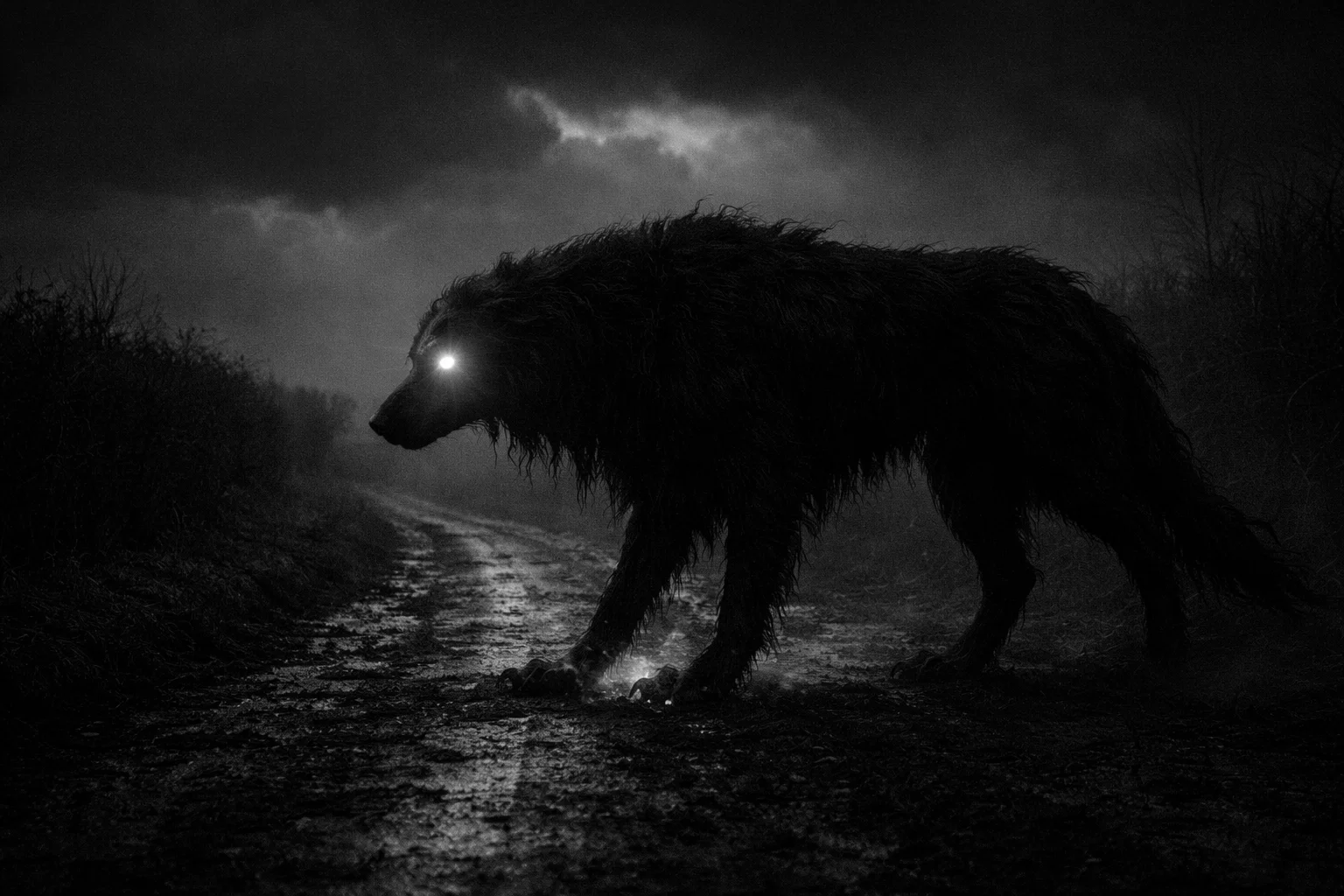
Black Shuck is a famous ghost monster from English folklore, mostly seen in East Anglia. People describe it as a huge black dog with glowing eyes, often seen as a sign of death or an evil spirit.
Many ghost dogs are said to haunt the British Isles. Still, stories about Black Shuck, especially those involving violent events in churches, have made it one of the most feared creatures in local legends.
Summary
Key Takeaways
| Attribute | Details |
| Names | Black Shuck, Old Shuck, Shuck; derived from the Old English word ‘scucca’ meaning ‘demon’ or ‘devil’. |
| Nature | Supernatural entity, ghost, or demonic manifestation. |
| Species | Spectral Beast. |
| Appearance | Large black dog, often the size of a calf, with shaggy fur and a single or pair of glowing red/fiery eyes. |
| Area | England; specifically Norfolk, Suffolk, Essex, and Cambridgeshire. |
| Creation | Unknown; often associated with local hauntings or manifestations of the Devil. |
| Weaknesses | Religious intervention, avoiding eye contact, or remaining indoors during storms. |
| First Known | 1577; recorded in the pamphlet ‘A Straunge and Terrible Wunder’ by Abraham Fleming. |
| Myth Origin | English folklore with potential Norse or Anglo-Saxon roots. |
| Time Active | Nocturnal; frequently sighted during thunderstorms or dark nights. |
| Habitat | Churchyards, coastlines, dark lanes, and fens. |
Who or What Is Black Shuck?
Black Shuck is a ghostly black dog that has been part of East Anglian folklore for hundreds of years. Unlike ordinary stray dogs, it is seen as a hellhound or a supernatural warning.
People say it is much bigger than any normal dog, sometimes as large as a calf or a small horse. When it appears, you might hear heavy footsteps or a chilling howl echoing across the flat fens and marshes.
Locals see the creature in two ways. Some stories say it quietly protects lonely travelers, but most famous tales describe it as dangerous. The scariest part of the legend is the idea that seeing Black Shuck, or having it cross your path, means you or someone in your family will die before the year ends.
Black Shuck stands out from other ghost dogs in Britain, like the Barghest of Yorkshire or the Cu Sith of Scotland, because, according to lore, the creature has left physical marks during its most famous appearances in the 1500s.
The One Book That Turned “Monster Hunting” From Joke to Actual Science
Limited-Time: Up to 46% OFF!
Bigfoot, Loch Ness, Chupacabras, Mothman, Yeti, and dozens more – the original A-to-Z encyclopedia with 100+ fully researched cryptids, eyewitness accounts, expedition histories, and the evidence that made skeptics sweat. Loren Coleman and Jerome Clark’s 1999 classic that launched a thousand investigations.
Etymology
The name Black Shuck comes from Anglo-Saxon language roots. Experts think ‘Shuck’ comes from the Old English word ‘scucca,’ meaning ‘demon,’ ‘devil,’ or ‘evil spirit.’ This shows that people in England have long seen the creature as more than just a ghost dog, but as a symbol of evil itself.
In Norfolk and Suffolk, ‘shuck’ also came to mean something shaggy or hairy, matching how people describe the creature’s fur. Some researchers think there may be a link to the Norse god Odin, who was often seen with wolves or dogs. Because Vikings once lived in East Anglia, it’s possible the idea of Black Shuck came from old Germanic myths like the Wild Hunt.
By the late 1800s, the name Black Shuck was used in local books, though people often just called it Old Shuck. The word ‘Black’ describes its fur and connects it to the ‘Black Dog’ theme found in many European stories, where black stands for darkness, death, and the underworld.
What Does Black Shuck Look Like?
Descriptions of Black Shuck vary slightly, but some features remain the same. It is almost always seen as a huge black dog with rough, shaggy fur. Most people say it is at least as tall as a big calf.
The hardest to ignore and most frightening thing about Black Shuck is its eyes. In many stories, it has one bright, fiery eye in the middle of its forehead, glowing red or yellow. Other stories say it has two eyes that shine like saucers in the dark.
People often say Black Shuck moves without making a sound, even though it is so big. Some stories mention hearing a clanking chain behind it. Sometimes, according to stories, the beast can appear without a head or to float just above the ground, leaving no paw prints. When it does leave a trace, it is usually in the form of scorch marks or claw scars burned into wood or stone.
Mythology
The story of Black Shuck is closely tied to the land of East Anglia. While ghostly black dogs are found in legends across the UK, Black Shuck to associated with the eastern counties. Its main role in myths is to guard the border between life and death. Many people see it near places in between, like coastlines, graveyards, and crossroads.
Early records suggest that Black Shuck may come from Norse mythology, where a black dog guards the gates of the underworld. By the Middle Ages, the story changed, and people saw the dog as a servant of the Devil sent to scare sinners.
Unlike the Gwyllgi of Wales, which is just a scary ghost, Black Shuck is said to interact with the real world, especially during thunderstorms. These storms are thought to be their favorite time to appear.
People Swore They Saw Something Impossible… This Book Shows You the Photos, Tracks, and DNA
Limited-Time: Up to 18% OFF!
Gorgeous full-color illustrations meet hard evidence: hair samples that don’t match any known animal, sonar hits in Loch Ness, night-vision footage, and survivor testimonies. Kelly Milner Halls separates hoax from holy-crap-this-might-be-real for every major cryptid still out there.
Legends
The Storm of 1577: Bungay
The most well-known story about Black Shuck happened on August 4, 1577, in Bungay, Suffolk. During a wild and unexpected thunderstorm, a ‘terrible wunder’ is said to have entered St. Mary’s Church. As people prayed, a huge black dog appeared in the lightning.
According to the accounts recorded by Abraham Fleming, the beast ran down the body of the church with great swiftness. It passed between two people who were kneeling at worship and “wrung the necks of them bothe at one instant clene backward, in somuch that even at a momet where they kneeled, they strageley dyed.”
The dog is also said to have attacked another man, leaving his skin shriveled as if burned, though he lived. Before disappearing, the creature left marks behind. Even now, the north door of St. Mary’s Church has scorch marks called the ‘Devil’s finger marks,’ which locals say were made by the dog’s claws as it ran away.
The Attack at Blythburgh
Later that same day in 1577, a similar creature was seen at Holy Trinity Church in Blythburgh, about twelve miles from Bungay. The storm was so strong that the church steeple is said to have crashed through the roof.
Amid the chaos, the black dog ran through the church aisles. It attacked several people, killing two men and a boy. The heat from the creature was so strong that it burned claw marks into the north door. These marks are still there today and are shown to visitors as ‘proof’ of the legend.
The Coastal Guardian
In Norfolk, especially near Overstrand, Black Shuck is seen as a ghost by the sea. There is a path called Shuck’s Lane where the dog is said to walk every night. Unlike the violent stories from 1577, these tales show the dog as a quiet, shadowy presence. Travelers say it would walk beside them in complete silence.
If a traveler ignored the dog and kept walking, they would arrive safely. But if they tried to hit the dog or talk to it, the creature would disappear, and the traveler would soon face bad luck or sudden illness.
Black Shuck vs Other Monsters
| Monster Name | Origin | Key Traits | Weaknesses |
| Barghest | England (Yorkshire) | Chain-rattling, shapeshifter, horns/claws. | Running water. |
| Gytrash | Northern England | Appears as a horse, mule, or dog; leads travelers astray. | Staying on the path. |
| Cu Sith | Scotland | Green fur, large paws, silent hunter. | Reaching safety before the third bark. |
| Gwyllgi | Wales | The “Dog of Darkness,” baleful breath. | Iron, dawn/sunlight. |
| Cadejo | Central America | White (good) or Black (evil) variants, goat hooves. | Religious symbols. |
| Church Grim | Scandinavia/England | Protects graveyards from grave robbers. | None (usually benevolent). |
| Moddey Dhoo | Isle of Man | Large black spaniel, haunts Peel Castle. | Silence (not speaking to it). |
| Hellhound | Global Myth | Fire-breathing, red eyes, guards the underworld. | Holy water, silver. |
The Barghest and Gytrash are often seen as shapeshifters or tricksters, but Black Shuck is more of a warning sign. It is different from the Cu Sith or Cadejo, which stay in the wild, because Black Shuck has appeared inside churches. Unlike the Church Grim, which protects people, Black Shuck is almost always feared as a sign of bad things to come.
Ever Wondered About the Secret Lives of Greek Gods and Heroines?
Limited-Time: Up to 32% OFF!
The Classical Mythology Encyclopedia: Gods, Heroes, and Heroines – 1,000+ entries • Epic tales of Olympus • Goddesses, monsters, and divine intrigues • Ancient rituals & timeless legends. This is Nancy LoCicero’s ultimate guide to the myths that inspired Western civilization.
Powers and Abilities
Black Shuck has many supernatural powers that set it apart from normal animals. Its main power is a sense of fear that can freeze anyone who sees it. It is also connected to lightning and storms, often showing up during the worst weather.
- Death Omen: The ability to portend the death of the witness or their kin within a year of the sighting.
- Intense Heat: Capable of scorching wood, stone, and human flesh on contact.
- Intangibility: The ability to pass through solid objects, such as locked church doors.
- Silent Movement: Moving without sound regardless of the terrain or its physical size.
- Atmospheric Manipulation: His appearances are frequently preceded by sudden, violent thunderstorms.
Can You Defeat a Black Shuck?
In old stories, Black Shuck cannot be killed like a normal animal because it is a ghost or demon. Most say the best way to stay safe is to avoid it. Local advice warns that if you hear paws behind you, do not turn around to look.
The most common way to drive away Black Shuck is through religion. In the 1577 stories, the creature left the churches, which suggests that holy ground or strong prayer can keep it away. People also believe that carrying a crucifix or using holy water helps. Those who believe in the legend try to stay inside during storms and avoid ‘shuck lanes’ at night.
Conclusion
The story of Black Shuck is still one of the most lasting and frightening tales in English folklore.
From its possible roots in the Anglo-Saxon’ scucca’ to the violent events of the 1500s, the creature shows a deep fear of the unknown. The marks left in churches like Blythburgh give people a real connection to a legend that might otherwise be seen as just a superstition.
In the end, Black Shuck is more than just a ghost dog story. It reflects the mysterious and in-between nature of the East Anglian landscape. Whether people see it as a demon or a sad protector, its legend still haunts the marshes and roads of the east, warning everyone to watch the path ahead and never look back into the stormy darkness.