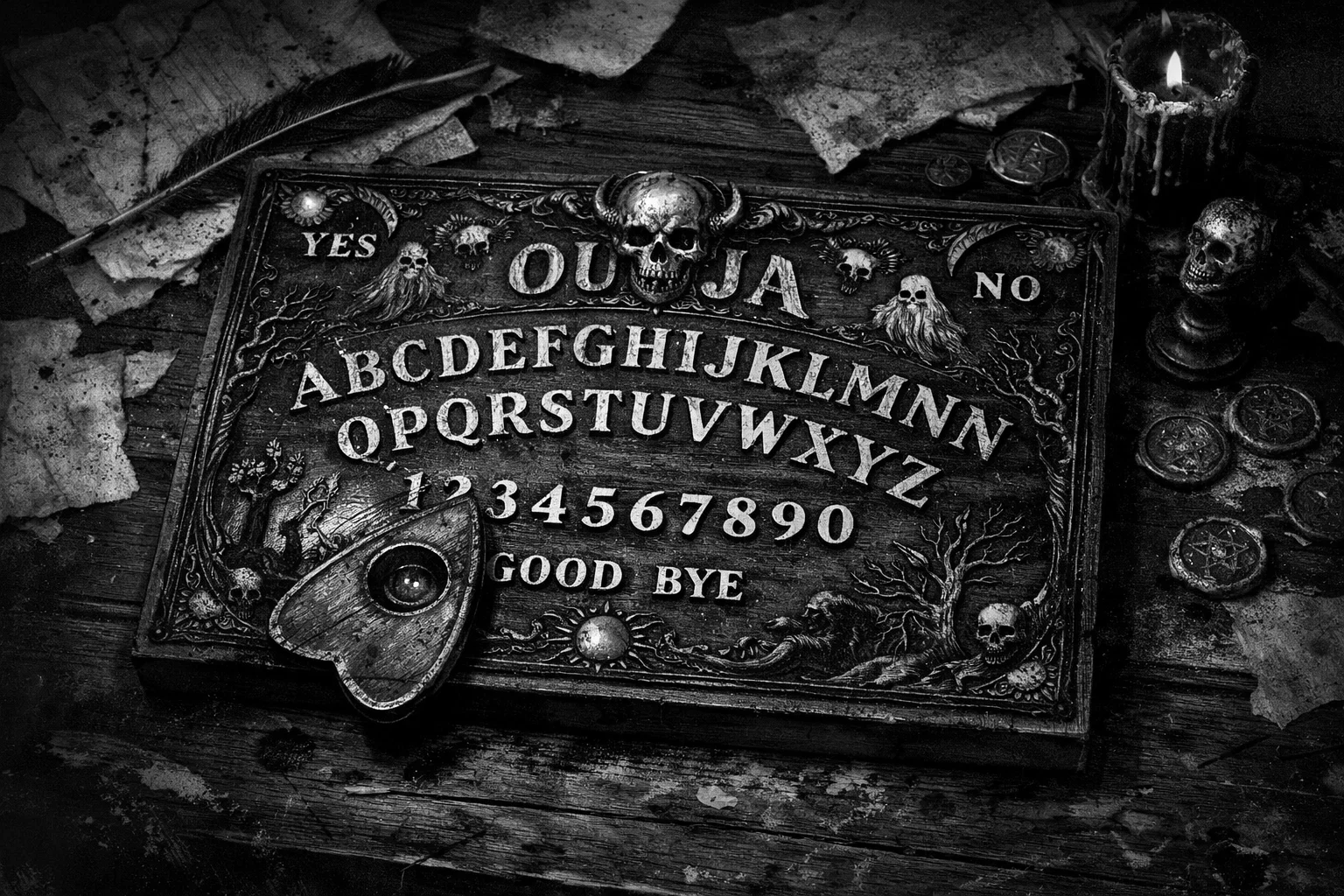
What is an Ouija Board? Well, the Ouija Board is a flat, rectangular board with the alphabet, the numbers 0 to 9, and the words “yes,” “no,” and “goodbye.” People use it with a heart-shaped pointer called a planchette. Players rest their fingertips on the planchette, which moves to spell out messages.
Summary
What Is an Ouija Board?
The Ouija Board is usually made of wood or sturdy cardboard and is used in “talking board” sessions. Its surface shows the English alphabet in two curved rows, numbers zero to nine, “yes” and “no” in the top corners, and “goodbye” at the bottom. The board is meant to spell out messages, supposedly from spirits, using a planchette.
A planchette is a small, heart-shaped or triangular pointer, often supported by three legs or smooth felt pads that allow it to glide across the board’s surface. Many modern planchettes feature a circular “viewing window” or a central aperture through which the selected letters are revealed.
In a typical session, two or more people gently place their fingertips on the planchette. The pointer then moves across the board, stopping at different letters to spell out words or sentences in response to the group’s questions, often without the users feeling as if they are moving it themselves.
Even though the Ouija Board is simple, it has a special place in modern culture as both a popular toy and a mysterious, sometimes feared, object. People usually use the Ouija Board in a quiet setting, focusing together on the board. The board is based on the idea of ‘automatic writing’ or ‘spirit communication.’
‘Automatic writing’ means people appear to write messages without controlling their hand movements, often thinking the messages come from spirits or from their own minds working automatically. This process credits the movement to an external force rather than to the users’ own muscles.
Ever Walk Into a Room and Instantly Feel Something Watching You?
Millions have used burning sage to force out unwanted energies and ghosts. This concentrated White Sage & Palo Santo spray does the same job in seconds – just a few spritzes instantly lifts stagnation, breaks attachments, and restores peace most people feel immediately.

The Origins and Commercial Patent of the Talking Board
The Ouija Board, as we know it, appeared in the late 1800s, during the American Spiritualist movement. This trend began earlier, in 1848, when the Fox sisters claimed they could talk to spirits by hearing mysterious “rappings.”
After the American Civil War, many people were grieving and looked for comfort in the idea that they could still connect with loved ones who had died.
At first, spiritualists used slow methods like “alphabet rapping,” in which a medium would say each letter and wait for a spirit to knock on the right one. This took a long time. By the mid-1880s, people in Ohio started talking about a “new talking board” that could answer questions much faster. These early boards were usually homemade, with a simple board and a small pointer.
In 1890, Charles Kennard from Baltimore saw that these boards could be a big business. He founded the Kennard Novelty Company with several investors, including lawyer Elijah Bond and a young employee, William Fuld. While spiritualists saw the board as a sacred tool, these men mainly wanted to make money from it.
The Famous Patent Demonstration
The first patent for the Ouija Board was granted on February 10, 1891. The story of how this patent was approved is one of the board’s most famous legends.
The chief patent officer in Washington, D.C., was said to be doubtful and asked for proof that the board worked. He told the group that if the board could spell out his name, which Elijah Bond and his sister-in-law Helen Peters supposedly did not know, he would approve the patent.
Bond and Peters, a well-known medium, sat with the officer and placed their hands on the board. To the officer’s surprise, the planchette spelled out his name correctly. People still debate whether this was due to mystical powers or Peter’s research. Still, the result was the official registration of Patent US446054.
You may also enjoy:
Is Maple Hill Cemetery Really Haunted at Night?
May 12, 2025
Zmeya: The Multi-Headed Dragon of Slavic Nightmares
September 11, 2025
Fresno Nightcrawler: Real Cryptid or Clever Hoax?
September 25, 2025
Focalor: Ancient Myths and Goetic Origins
August 11, 2025
A Comprehensive Timeline of the Ouija Board
Here is a timeline showing how the board changed from a spiritualist tool to a worldwide commercial product:
- 1100 AD: Early records from the Song Dynasty in China describe “fuji” or planchette writing in sand as a method of communicating with the spirit world.
- 1848: The Fox sisters in Hydesville, New York, launch the Modern Spiritualist movement through mysterious raps heard in their home.
- 1886: The Associated Press picks up a story about “talking boards” taking over spiritualist camps in Ohio, describing them as a “new craze.”
- 1890: The “Kennard Novelty Company” is incorporated on October 30. Helen Peters reportedly “receives” the name “Ouija” from the board during a session.
- 1891: Elijah Bond is granted the first patent for the “Ouija Board” on February 10.
- 1901: Following a series of internal disputes, William Fuld takes over production and begins marketing the boards under his own name.
- 1917: The book “Jap Herron” is published, allegedly dictated by the spirit of Mark Twain via a board session.
- 1920: Norman Rockwell illustrates a couple using the board for the cover of “The Saturday Evening Post,” cementing its image as a romantic parlor game.
- 1927: William Fuld dies after a tragic fall from his factory roof; his children continue the family business.
- 1941: The Fuld company introduces a new box design featuring a blue ghost, which becomes an iconic visual for the brand.
- 1966: The Fuld family sells the rights to the “Ouija Board” to “Parker Brothers” for approximately $975,000.
- 1967: In its first year under “Parker Brothers”, the board sells two million units, outselling the game “Monopoly”.
- 1973: The release of the film “The Exorcist” fundamentally changes the board’s reputation from a harmless toy to a dangerous occult object.
- 1991: “Hasbro” acquires “Parker Brothers” and remains the current owner of the trademark and patent rights.
The Influence of William Fuld and the Fuld Family Feud
Elijah Bond had the first patent, but William Fuld made the Ouija Board famous. Fuld started as a foreman at the Kennard Novelty Company and was known for his ambition and business sense. After Charles Kennard left the company, Fuld took full control.
Fuld was very skilled at marketing. He often called himself the “inventor” of the board in ads, even though he was just an early investor. To keep his monopoly, Fuld was quick to sue anyone who tried to sell a similar board. He even took his own brother, Isaac Fuld, to court in a long legal fight that lasted until 1919.
Isaac Fuld was once William’s partner, but they had a major argument in 1901. After being pushed out of the business, Isaac started making his own board called “Oriole.” William got a court order to stop him, which caused a family feud that lasted for generations. Some say one side of the family even moved a relative’s grave to avoid being buried near the other Fulds.
Tired of Bad Luck, Dark Spirits, and Toxic Vibes Draining Your Life?
Limited-Time: Up to 25% OFF!
Natural Black Tourmaline Crystal Healing Pendant – Genuine raw tourmaline • Absorbs & transmutes negativity • Guards against psychic attacks & hauntings • Deep spiritual cleansing for home & body • Purifies chakras & spaces from bad vibes. A portable force field—essential for sensitive souls in chaotic times.

The Factory and the Fatal Fall
William Fuld had a personal connection to the board. He often said he didn’t believe in spirits, but he still used the Ouija board for business advice. In 1917, Fuld claimed the board told him to get ready for big business by building a large new factory on Harford Avenue in Baltimore.
The factory was three stories tall and built just for making Ouija Boards. Sadly, in February 1927, while Fuld was on the roof watching a flagpole being replaced, a support wire broke, and he fell off the roof.
Although he survived the initial impact, a broken rib pierced his heart while he was being transported to the hospital. On his deathbed, he reportedly made his children promise never to sell the “Ouija Board” business outside of the family—a promise they kept for nearly forty years.
The Ideomotor Effect
Many people think spirits or supernatural forces move the planchette, but scientists explain it as the ideomotor effect. This idea was first described by Dr. William Benjamin Carpenter in 1852, who studied how the mind affects muscle movement.
The ideomotor effect refers to people making small, unconscious muscle movements in response to their thoughts or expectations. When people put their hands on the planchette, their subconscious can cause tiny movements that make it slide across the board.
Since the participants don’t realize they are moving the planchette, it feels to them like an outside, invisible force is at work.
Modern psychological studies have further illuminated this phenomenon:
- Implicit Cooperation: Research at Aarhus University using eye-tracking showed that people often take turns, without realizing it, in guiding the planchette. As a word starts to form, there are fewer possible letters, so it becomes easier for the group to guess and help move to the next letter.
- Subconscious Retrieval: Studies show the board can sometimes answer questions that players think they don’t know. This suggests the board is using memories the person has but can’t actively remember. For example, someone might ask about a historical fact and get the right answer, only to realize later they had read or heard it before, even if they didn’t remember at the time.
- The Power of Suggestion: The setting of a session, like dim lights, quiet voices, and the expectation of something spooky, makes the ideomotor effect stronger. This can make the planchette’s movement feel more real and alive.
You may also enjoy:
What Is a Harpy, The Winged Horror That Tormented Kings?
October 31, 2025
Complete Guide to Arizona Bigfoot Sightings (1942—2025)
July 14, 2025
Ose: The Insanity Inducing Demon of the Ars Goetia
September 1, 2025
Zmeya: The Multi-Headed Dragon of Slavic Nightmares
September 11, 2025
Complete Guide to Mississippi Bigfoot Sightings (1721–2025)
August 1, 2025
Is the Gaineswood Plantation Haunting Real or Just Southern Folklore?
September 18, 2025
From Parlor Game to Horror Icon
For its first eighty years, the Ouija Board was mostly sold as a fun family game. It was a regular item in toy stores, often found next to puzzles and board games. In the 1920s and 1930s, it was even considered a romantic activity, with young couples sitting close together and asking the board about their future.
This innocent image changed in 1973, when the movie “The Exorcist” was released. Early in the film, the main character, Regan, is seen playing with a Ouija Board she found in the basement. She says she’s talking to a “friend” named Captain Howdy. Soon after, she becomes possessed by a demon.
The film had a huge effect on how Americans saw the Ouija Board. Almost overnight, people started to think of it as a “gateway to Hell.” Religious groups, especially in the Catholic Church and among evangelicals, began calling it a tool of the devil. Later horror movies like “Witchboard” (1986) and “Ouija” (2014) reinforced this idea.
Today, the Ouija Board still divides opinion. Some people see it as an interesting part of American culture and a way to explore the mind. In contrast, others think it’s dangerous and should be avoided. Whether because of these fears or despite them, the Ouija Board is still one of the most successful and lasting toys ever made.