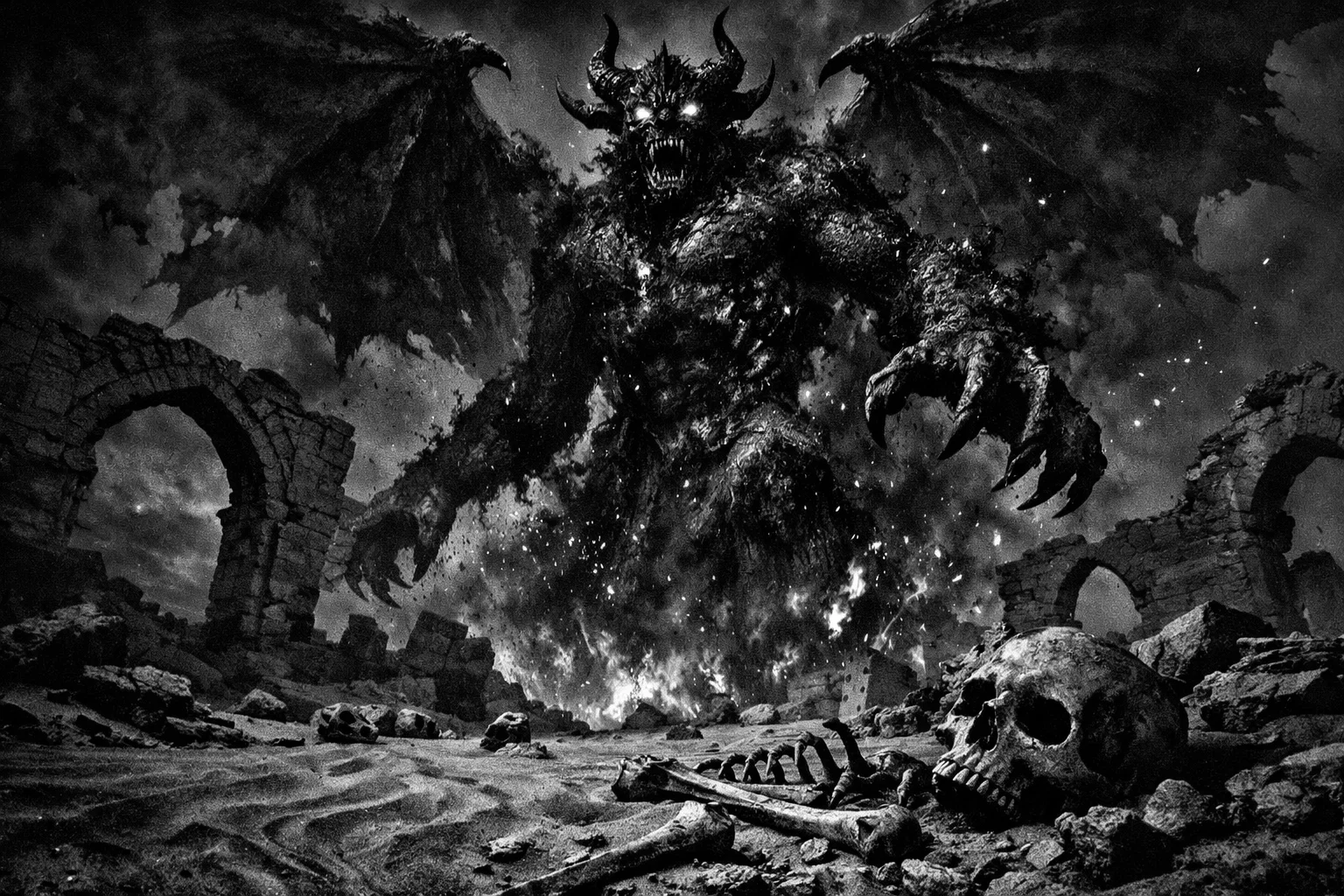
The Afreet, sometimes spelled Afrit or Ifrit, is a powerful and often dangerous type of Jinn found in Middle Eastern folklore and Islamic tradition. They are usually shown as huge, winged beings made of smokeless fire, famous for their strength, cleverness, and complex societies.
While modern stories often show them as simple fire demons, the original Afreet is a much more complex entity, capable of both harm and, at times, good deeds.
Summary
Key Takeaways
| Attribute | Details |
| Names | Afreet, Afrit, Ifrit; Arabic for “the powerful” or “the rebellious” |
| Nature | Supernatural spirit, specifically a high-ranking class of Jinn |
| Species | Elemental/Spectral |
| Appearance | Giant, humanoid or monstrous, often composed of fire or smoke, frequently winged |
| Area | Middle East, North Africa, Arabian Peninsula |
| Creation | Created by Allah from “smokeless fire” (marigin min narin) |
| Weaknesses | Iron, salt, certain Quranic verses, magical seals (such as the Seal of Solomon) |
| First Known | 7th Century, Mentioned in the Quran (Surah An-Naml 27:39) |
| Myth Origin | Islamic theology and pre-Islamic Arabian folklore |
| Strengths | Immense physical strength, pyrokinesis, flight, metamorphosis, longevity |
| Habitat | Underworld, ruins, caves, and desolate desert regions |
| Diet | Varies; often described as consuming odors, marrow, or the life force of humans |
| Time Active | Primarily nocturnal, though capable of appearing at any time |
Who or What Is Afreet?
The Afreet is seen as one of the most powerful and dangerous supernatural beings in Islamic tradition. In the ranking of Jinn, the Afreet is near the top, with only the Marid sometimes considered stronger.
Afreet are spirits made from fire who live in a world separate from humans, but they can appear in our world. Unlike angels, who lack free will, Afreet can choose to do good or evil. However, they are usually shown as rebellious and hostile to people.
In old stories, Afreet are said to live underground, often in ruins or deep caves. Their society is similar to human civilization, with kings, tribes, and even religions. While many are seen as evil or demonic, some legends tell of Afreet who became Muslim and did good deeds.
Most often, Afreet are shown as huge, vengeful spirits that are very hard to control or destroy. In some Egyptian stories, they are linked to the afterlife and the souls of the dead, which makes them even more frightening.
Ever Wondered About the Secret Lives of Greek Gods and Heroines?
Limited-Time: Up to 32% OFF!
The Classical Mythology Encyclopedia: Gods, Heroes, and Heroines – 1,000+ entries • Epic tales of Olympus • Goddesses, monsters, and divine intrigues • Ancient rituals & timeless legends. This is Nancy LoCicero’s ultimate guide to the myths that inspired Western civilization.
Genealogy
| Relation | Family Members / Origins |
| Creator | Allah (God) |
| Progenitor | Iblis (Shaytan) is often cited as the father of all rebellious Jinn |
| Classification | One of the five classes of Jinn (alongside Jinn, Jann, Shaitans, and Marids) |
| Social Structure | Organized into tribes, often led by a King or Malik |
Etymology
The word Afreet (Arabic: عفريت, plural Afareet) suggests power and defiance. It comes from the Arabic root ‘-f-r, which is linked to strength, cleverness, and rebellion.
In old Arabic, calling someone an ‘ifreet meant they were very clever or powerful, sometimes with a hint of evil. Some experts think the word is also related to ‘afar, which means “dust” or “rubbing in the dust,” suggesting a being that can crush enemies or is tied to the earth’s hidden places.
In the Quran, the word is used to describe a very powerful being. The phrase “‘Ifrit of the Jinn” shows that Afreet is a title for a certain level of power among Jinn, not a different kind of creature.
Over time, especially in Egyptian stories, the word Afreet started to mean the ghost of someone who was murdered, called the habal. In these tales, an Afreet is the angry spirit of a person who died violently and haunts the place where they died. Still, the main idea is that an Afreet is a powerful and unpredictable spirit.
You may also enjoy:
Children Vanished: The Werewolf of Eschenbach Case
June 18, 2025
Complete Guide to Oregon Bigfoot Sightings (1904–2025)
August 6, 2025
The Complete List of All Haunted Places in Alabama
October 6, 2025
The Lobizon Legend: Werewolf, Curse, or Cryptid?
May 17, 2025
What Does the Afreet Look Like?
Afreet are usually described as huge and frightening. They often look like giant humans with skin as dark as soot or as bright as burning embers. Old stories say they are made of “smokeless fire,” which can look like shimmering heat or a dark cloud of smoke.
Many stories say Afreet have big wings that let them travel quickly. Their eyes are said to glow like hot coals, and they might have horns or claws. In many legends, Afreet can change shape, often into black dogs, cats, or snakes. When they appear to people, they usually show up in a whirlwind of sand or fire, looking huge and powerful.
Mythology
Stories about Afreet come from both pre-Islamic Arabian beliefs and later Islamic teachings. Before Islam, people thought the desert was full of spirits that could help or harm travelers. Afreet were the most feared, often blamed for sandstorms and people going missing in the desert.
When Islam began in the 7th century, these spirits became part of religious stories. The most famous mention is in Surah An-Naml, where an Afreet works in King Solomon’s court. Solomon had the power to control all Jinn and used the Afreet for hard labor and to bring distant things to him.
These stories show that Afreet are not just wild monsters, but can also follow rules and be part of a divine order, even if they do so unwillingly. Later tales, like those in The Thousand and One Nights, added to their legend by showing them trapped in lamps or bottles, waiting for someone to let them out and cause trouble.
The Forbidden Encyclopedia That Makes Every Ouija Session Ten Times More Dangerous
Limited-Time: Up to 49% OFF!
Angels, devils, nature spirits, ancestors, tricksters, and creator gods – all catalogued with their true names, powers, and protocols. Judika Illes created the definitive directory of the spirit realm that practitioners around the world swear by when they need to know exactly who (or what) just answered.
Legends
The Afreet and the Throne of Sheba
The most definitive legend regarding the Afreet is found in the religious accounts of King Solomon. According to the narrative, Solomon desired to bring the throne of the Queen of Sheba (Bilqis) to his palace before she arrived in person. He addressed his council of men and Jinn, asking who could perform the feat. An Afreet among the Jinn stepped forward and declared, “I will bring it to thee before thou rise from thy council: for I am indeed strong and trusty.”
Solomon’s meetings usually lasted until noon, so the Afreet promised to move a huge, decorated throne over hundreds of miles in only a few hours. This story shows how fast and strong the Afreet is.
But in the end, Solomon picked a man with “knowledge of the Book,” who brought the throne instantly. This shows that even though the Afreet is very strong, spiritual wisdom is even greater.
The Tale of the Second Kalandar
In The Thousand and One Nights, there is a well-known story about an Afreet who learns that his wife has been unfaithful to him with a human prince. The Afreet, who is very jealous and cruel, turns the prince into an ape and punishes his wife harshly.
This story shows that Afreet are skilled in magic that can change forms and often react with extreme revenge. It also points out that they live underground, since the prince finds the Afreet’s wife in a hidden palace below the forest.
The Fisherman and the Jinni
Although often called a “Jinni,” the evil spirit in this famous story is usually seen as an Afreet because of his great power and size. King Solomon trapped him in a copper jar sealed with lead for 1,800 years, and a poor fisherman later pulled the jar from the sea. After so long in darkness, the Afreet is angry and promises to kill whoever sets him free.
In the story, the Afreet appears as a huge column of smoke that turns into a monster with “legs like masts and a mouth like a cave.” The fisherman beats the Afreet not with force, but by tricking him into showing he can fit back into the small jar. This tale warns about how clever and dangerous Afreet can be.
Afreet vs Other Monsters
| Monster Name | Origin | Key Traits | Weaknesses |
| Afreet | Middle East | Fire-based, immense strength, winged | Iron, religious seals |
| Marid | Middle East | Water-based, highest rank, arrogant | Magic, divine names |
| Ghoul | Arabia | Graveyard dweller, flesh-eating | Single blow (second kills it) |
| Djinn (Standard) | Arabia | Invisible, neutral alignment, shapeshifter | Iron, salt |
| Rakshasa | India | Maneater, illusionist, fangs | Exorcism, holy weapons |
| Oni | Japan | Horns, ogre-like, massive clubs | Soybeans, holy light |
| Demon | Western | Fallen angel, soul corruptor | Holy water, crucifixes |
| Vetala | India | Corpse-possessor, hangs from trees | Mantras, fire |
| Shaitaan | Islam | Purely evil, whispers to hearts | Prayer, faith |
Afreet differ from many Western demons in that they have free will and are not “fallen” but exist naturally. Unlike Ghouls, who scavenge, Afreet are strong builders and fighters. Compared to Marid, Afreet are more likely to meet humans, but these meetings are often dangerous.
Powers and Abilities
Afreet possess great supernatural powers, largely due to their elemental nature. They are not limited by human bodies and are made of energy. This lets them use enough strength to knock down buildings or carry very heavy things over long distances.
Their magic is just as strong. Afreet are experts in the unseen world (Al-Ghaib), so they can stay invisible to people until they want to be seen. They also seem to know things ahead of time or can travel so fast that they can get news from far away in seconds.
The Afreet powers and abilities include:
- Pyrokinesis: Control and generation of fire and heat, reflecting their “smokeless fire” origin.
- Metamorphosis: The ability to take the form of animals or beautiful/terrifying humans.
- Superhuman Strength: Capable of lifting massive structures and defeating entire armies.
- Flight: Using large wings or transforming into a whirlwind to move through the air.
- Immortality/Longevity: They do not age like humans and can live for thousands of years.
- Invisibility: Existing in a state that is hidden from the perception of ordinary mortals.
You may also enjoy:
Nuckelavee: The Skinless Sea Demon That Brings Plague
February 10, 2026
Was Manuel Blanco Romasanta Really a Werewolf?
June 18, 2025
Rahab: Leviathan’s Twin and the Forgotten Demon Prince
September 30, 2025
Can You Defeat an Afreet?
For most people, beating an Afreet in a fight is impossible. But Afreet are still limited by some cosmic and physical rules. The best way to protect yourself is with iron. Like other Jinn, Afreet hate iron, which can stop their magic and hurt them.
In Islamic tradition, reciting certain verses from the Quran, such as Ayat al-Kursi (The Throne Verse), is believed to protect people from Afreet. Old stories also talk about using talismans and seals, especially the Seal of Solomon.
This magic ring gave King Solomon complete control over Afreet, letting him trap them in objects or make them work for him. Truly destroying an Afreet is rare; they are usually locked away or sent off, since their elemental nature makes them hard to kill.
Conclusion
Afreet are still some of the most fascinating figures in world mythology, showing the wild power of fire and the desert. From their beginnings in the Quran to stories in the Arabian Nights, they remind us that the world is bigger and more mysterious than we can see. Their mix of being both dangerous and sometimes helpful makes them different from spirits in other cultures, which are often just good or evil.
To really understand Afreet, we need to look beyond modern ideas of “genies” and see them as ancient, complex beings with their own rules. Whether seen as angry spirits or powerful fire beings from Solomon’s court, Afreet still appear in stories today, showing the lasting strength of Middle Eastern folklore.