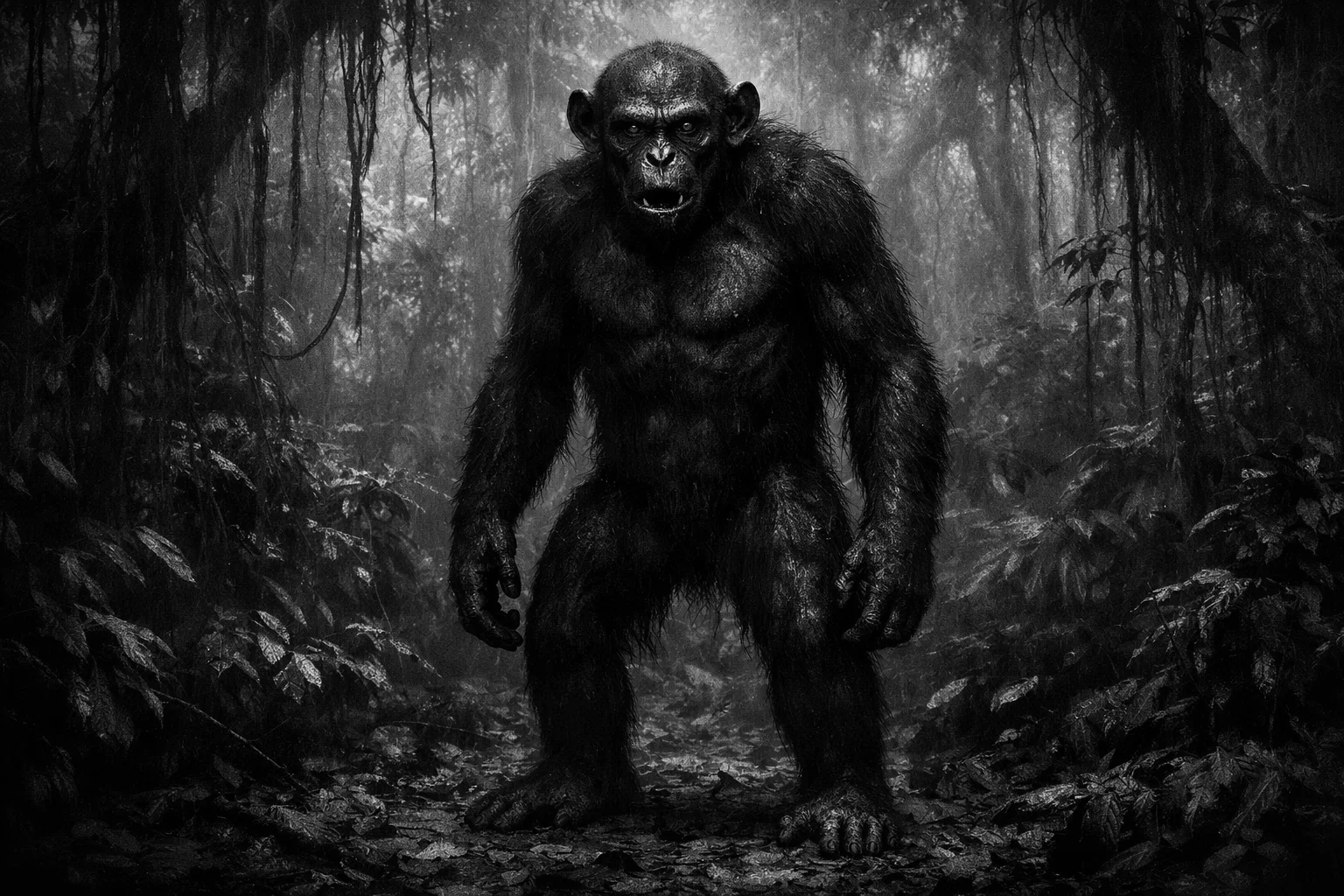
The Koolakamba is a supposed large ape said to lives in the thick jungles of Equatorial Africa. Most reports about it come from the 19th century, describing it as having features intermediate between those of a chimpanzee and a gorilla.
Today, scientists usually think these sightings are just unusual examples of known apes. However, the Koolakamba is still an interesting topic in cryptozoology.
Summary
Overview
| Attribute | Details |
| Name | Koolakamba |
| Aliases | Kooloo-Kamba, Kookalamba, Koola |
| Cryptid Credibility Index | Moderate; historically documented but lacks modern biological confirmation |
| Threat Level | Generally elusive; potentially aggressive if cornered, similar to other great apes |
| Habitat | Tropical rainforests and cloud forests of West and Central Africa |
| Height / Weight Range | 4 ft 3 in to 5 ft (130–152 cm); 150–250 lbs (68–113 kg) |
| Physical Traits | Black “ebony” face, prominent brow ridges, large human-like ears, round skull |
| Core Sighting Corridor | Gabon, Cameroon, and the Ogooué River basin |
| First Sighting | Mid-19th century (specifically documented in 1852 and 1860) |
| Species | Primate (proposed hybrid or subspecies) |
| Type | Terrestrial and arboreal; diurnal; omnivorous |
| Movement | Primarily quadrupedal knuckle-walking; capable of bipedal stances |
| Behavior & Traits | Vocalized “koola-kooloo” calls; noted for a solitary or fringe social nature |
| Evidence | 19th-century specimens, historical sketches, and a 1996 photograph from Yaounde Zoo |
| Possible Explanations | Large male chimpanzees, small female gorillas, or individual genetic variation |
| Status | Actively discussed in cryptozoology; scientifically unverified as a distinct species |
Who or What Is Koolakamba?
The Koolakamba is a mysterious primate from Central Africa that became known through stories from European and American explorers in the 1850s. Its name comes from the Nkomi and Bakalai languages, referring to its unique call. Early reports say it was called “Kooloo” for its cry, and “Kamba” is a Commi word that means “to speak”.
Local tribes saw the Koolakamba as distinct from both chimpanzees and gorillas, treating it as a separate kind. People often described it as having a more human-like face and behavior than other apes.
Some early scientists tried to classify it as a new species, Pan troglodytes koolookamba, but modern biology has not found enough evidence to prove it is a separate species or a true hybrid.
The One Book That Turned “Monster Hunting” From Joke to Actual Science
Limited-Time: Up to 46% OFF!
Bigfoot, Loch Ness, Chupacabras, Mothman, Yeti, and dozens more – the original A-to-Z encyclopedia with 100+ fully researched cryptids, eyewitness accounts, expedition histories, and the evidence that made skeptics sweat. Loren Coleman and Jerome Clark’s 1999 classic that launched a thousand investigations.
What Does Koolakamba Look Like?
People who describe the Koolakamba often focus on its mix of features. They usually say it is bigger than a chimpanzee but smaller and lighter than a gorilla.
One of the Koolakamba’s main features is its very dark, almost black face, which is flatter than a chimpanzee’s. Its skull is round with high cheekbones and hollow cheeks, and some people have even compared its face to those of certain human groups.
The Koolakamba is said to have large, human-like ears and a strong brow ridge. Its body is covered in black hair, and its front teeth meet evenly, making a flat surface for chewing. People also say it has a short, wide pelvis, which might help it walk on two legs more often or more steadily than other African apes.
You may also enjoy:
Who or What Was the Alabama Metal Man: Real Cryptid or Hoax?
April 16, 2025
Complete Guide to Iowa Bigfoot Sightings (1965–2025)
July 28, 2025
The Adjule: Is the Sahara Hiding a Secret Predator?
June 2, 2025
The Complete List of All Haunted Places in Alaska
November 20, 2025
Habitat
People say the Koolakamba lives only in the thick, tropical forests of West Central Africa. Most sightings have happened in what is now Gabon, especially near the Ogooué and Ovenga Rivers. These forests are very humid, get a lot of rain each year, and have a dense canopy that keeps much sunlight from reaching the ground.
The land in these areas is rough, with both low swamps and high cloud forests. There is plenty of fruit, like the tondo, a soft, pear-shaped fruit that many primates in the region eat.
The Koolakamba is believed to live near groups of chimpanzees and gorillas. Still, people often say it stays on the edges of these groups or lives alone in hidden areas. Because these forests are so remote and densely vegetated, it is very hard for scientists to find and study rare primates like these.
Koolakamba Sightings
| Date | Place | Witness Details | Description | Reliability |
| 1852 | Gabon, West Africa | Dr. Franquet (French Army Physician) | Described a specimen that appeared intermediate between a chimp and a gorilla. | Moderate: Early scientific report |
| 1860 | Ovenga River, Gabon | Paul Du Chaillu (Explorer) | Shot a specimen that called “koola-kooloo” from a tree branch. | High: Detailed physical measurements taken |
| 1874 | Dresden Zoo (Origin: Loango Coast) | Zoological Staff | A captive ape named “Mafuca” displayed traits of both species. | High: Documented captive animal |
| 1881 | West Africa | Hugo von Koppenfels (Explorer) | Claimed to have found proof of chimp-gorilla hybridization. | Low: Anecdotal claim without physical proof |
| 1996 | Yaounde Zoo, Cameroon | Peter Jenkins and Liza Gadsby | Photographed a male ape named “Antoine” with a black face and orange eyes. | High: Photographic evidence of a unique individual |
Paul Du Chaillu (Ovenga River, 1860)
The best-known story about the Koolakamba comes from explorer Paul Du Chaillu, who traveled in equatorial Africa. While walking near the Ovenga River, he heard a strange cry he had never heard before.
When he found where the sound was coming from, he saw a large ape sitting high up in a tree. After the animal was shot and brought down, Du Chaillu noticed it looked very different from both chimpanzees and gorillas. He measured it at four feet three inches tall and pointed out its very round head and ears that looked like a human’s. His local guides said right away that it was a Koolakamba.
This Book Turns the Entire United States Into One Giant X-Files Map
Limited-Time: Up to 38% OFF!
J.W. Ocker traveled the country collecting the weirdest local legends and marks the real-world locations where the Beast of Bray Road, the Dover Demon, the Wendigo, and hundreds more have been spotted. Part travel guide, part bestiary, 100% nightmare fuel.

The Case of Mafuca (Dresden, 1874)
In 1874, an ape called Mafuca was brought from the Loango coast to the Dresden Zoo. Mafuca was very large and had a wild, hard-to-control nature. Scientists who studied her could not agree on what species she was. Some thought she was a gorilla, while others said she was a chimpanzee.
Some experts at the time concluded that Mafuca was a genuine Koolakamba. Drawings of her show a black face, a nose like a gorilla’s, and strong brow ridges, matching what Du Chaillu had described before.
Evidence & Investigations
Most of the evidence for the Koolakamba comes from old specimens, reports from 19th-century naturalists, and some recent photos. Paul Du Chaillu gave the first major evidence by bringing back skulls and skins from his hunts, which were later sold to the Natural History Museum in London. Still, many scientists at the time argued that his findings were just unusual examples of known species.
In the 20th century, people started to see the Koolakamba more as a cryptozoological mystery than a real species. In 1929, Dr. Robert Yerkes reported seeing “unclassifiable apes” that seemed to be between chimpanzees and gorillas. In November 1996, a photo of a primate named Antoine at the Yaounde Zoo in Cameroon brought new attention to the topic.
This ape had a much wider face and bigger skull than a normal chimpanzee, so some people thought it might be a modern Koolakamba. However, DNA tests have never shown that a separate hybrid species exists in the wild, and most of these “in-between” apes are now seen as just large male chimpanzees.
You may also enjoy:
Is the Brown Lady of Raynham Hall’s Ghost Real?
May 5, 2025
Strzyga: The Bloodthirsty Demon of Slavic Folklore
September 11, 2025
Is Maple Hill Cemetery Really Haunted at Night?
May 12, 2025
Alkonost: The Bird-Woman Monster That Sings You Into Trance
September 12, 2025
Jorogumo: The Deadly Spider Woman of Japanese Folklore
September 10, 2025
Theories
The Chimpanzee-Gorilla Hybrid Theory
The most common theory among cryptozoologists and early explorers is that the Koolakamba is a natural mix between a male gorilla and a female chimpanzee. People who support this idea say its size and mixed features are proof of cross-breeding.
Even though gorillas and chimpanzees are close genetically, most scientists today think it is very unlikely they would mix in the wild. This is because they have different social lives, mating habits, and belong to different groups (Pan and Gorilla).
Individual Morphological Variation
A more widely accepted scientific idea is that the Koolakamba is not a new species or a hybrid, but just a type of chimpanzee with unusual features.
Like people, chimpanzees can look very different from each other, with things like darker skin, bigger brow ridges, or different ear shapes. This theory says that explorers like Du Chaillu probably just saw a special group of chimpanzees that looked more like gorillas to someone who was not used to them.
The Bili Ape Connection
Some researchers have compared the Koolakamba to the Bili Ape, also called the Bondo Mystery Ape, from northern Congo. Bili apes are a group of chimpanzees known for being large and for building nests on the ground like gorillas.
While the Koolakamba is said to live in West Africa and the Bili ape in Central or North Africa, both are examples of big, gorilla-like chimpanzees that make scientists rethink how they classify these animals.
People Swore They Saw Something Impossible… This Book Shows You the Photos, Tracks, and DNA
Limited-Time: Up to 18% OFF!
Gorgeous full-color illustrations meet hard evidence: hair samples that don’t match any known animal, sonar hits in Loch Ness, night-vision footage, and survivor testimonies. Kelly Milner Halls separates hoax from holy-crap-this-might-be-real for every major cryptid still out there.
Comparison with Other Similar Cryptids
| Cryptid | Region | Traits |
| Bili Ape | Congo | Giant chimp, ground-nesting, gorilla-sized |
| Agogwe | East Africa | Small, bipedal, reddish hair, human-like |
| Orang Pendek | Sumatra | Short, bipedal, powerful build, brown fur |
| Yeti | Himalayas | Large, bipedal, thick fur, elusive |
| Skunk Ape | Florida, USA | Ape-like, foul odor, reddish-brown hair |
| Hibagon | Japan | Black fur, snub nose, human-like face |
| Almas | Central Asia | Wild man, hairy, bipedal, human-like |
| Yowie | Australia | Large, hairy, ape-like, aggressive |
| Mande Barung | India | Large, ape-like, black/grey hair |
| Barmanou | Pakistan | Hairy biped, intermediate between ape/man |
You may also enjoy:
What Are the 14 Types of Hauntings? Everything You Need to Know
September 4, 2025
Jormungandr: The Midgard Serpent Destined to End the Gods
September 12, 2025
The Terrifying Face of Tisiphone, Avenger of Blood Crimes
September 1, 2025
Poludnitsa: The Noon Witch Who Haunts the Fields of Slavic Folklore
September 11, 2025
Werewolves: Myths, Madness, or Monsters?
June 10, 2025
What Is the Mazomba—Africa’s Lost Dinosaur or an Unknown Rhino?
November 11, 2025
Is Koolakamba Real?
Whether the Koolakamba is real depends on how you define it. If you mean a totally new, undiscovered species of great ape, most scientists today think that is very unlikely. Most experts believe that the old reports and specimens are probably just unusual chimpanzees or mistaken gorillas.
Still, the Koolakamba is “real” in the sense that animals with these unusual, mixed traits have been seen and even photographed in recent years. It is still debated whether these animals are rare genetic throwbacks, a special local group, or a true but rare hybrid.
While the Koolakamba is not as famous as cryptids like Bigfoot, it is an interesting mystery that sits right at the edge of what science knows about apes.