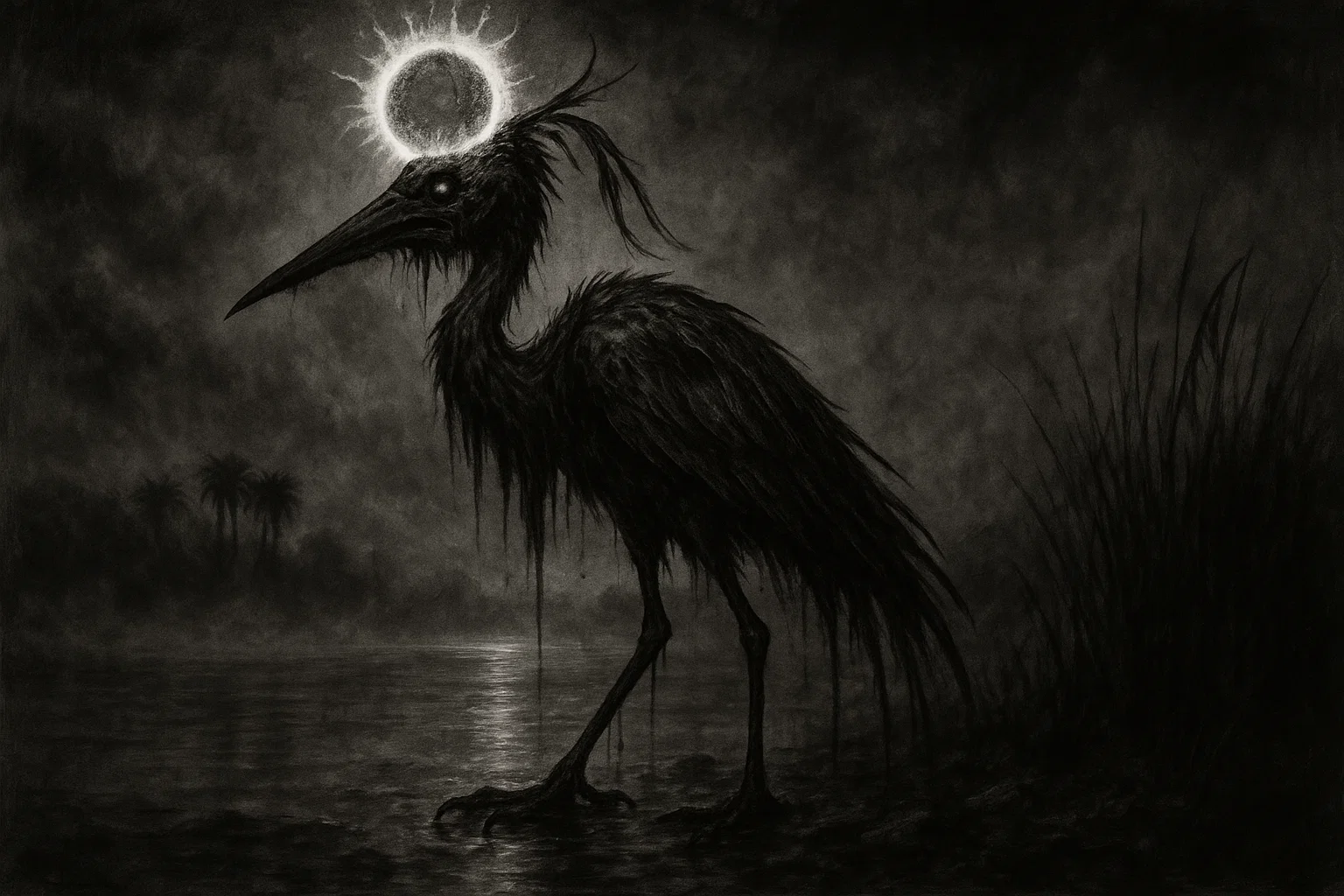
The Bennu is an ancient Egyptian avian deity, closely associated with the sun god Ra and the creation myth. It is best known as the progenitor or Egyptian counterpart of the classical Phoenix.
This creature embodies the concepts of renewal, rebirth, and the rising sun after the primordial darkness. Exploring the Bennu offers deep insight into Egyptian cosmology, particularly its understanding of time, cyclical existence, and the divine nature of the world’s beginning.
Summary
Key Takeaways
| Attribute | Details |
| Names | Bennu; Egyptian bnw (likely related to wbn, ‘to rise’ or ‘to shine’); Greek Phoenix |
| Nature | Divine Creature, Avian Deity, Embodiment of Ra/Atum |
| Species | Bird, Heron-like |
| Appearance | Large heron, often with two long feathers at the back of its head; sometimes depicted with a human-like crown or the Ra sun disk; plumage is generally multi-colored, incorporating gold and red |
| Area | Ancient Egypt, primarily associated with the city of Heliopolis (Iunu) |
| Creation | Self-created from the primordial waters of Nun or the fire/flame of the Ished Tree; appeared atop the Benben stone |
| Weaknesses | No specific weaknesses are documented, as it is a divine, self-renewing entity rather than a monster to be defeated |
| First Known | Old Kingdom of Egypt (c. 2686–2181 BCE), referenced in the Pyramid Texts (e.g., utterance 600) |
| Myth Origin | Ancient Egyptian religion and creation myths, particularly those of the Heliopolitan tradition |
| Associated Creatures | Atum-Ra, Osiris, and the Phoenix (its later Greco-Roman parallel) |
| Habitat | The Benben stone (a cult object in Heliopolis) and the sacred Persea tree or Ished tree (a symbol of life) |
| Diet | Not documented; sustenance appears to be spiritual or derived from its association with the divine and life cycles |
Who or What Is Bennu?
The Bennu is a mythological bird in ancient Egyptian belief, often depicted as a sacred heron and a profound symbol of cosmic creation and perpetual cyclical rebirth.
Primarily revered in the religious center of Heliopolis (Egyptian: Iunu), the city of the sun, the Bennu was intimately linked with the Heliopolitan Ennead, particularly the creator god Atum and the supreme sun god Ra. Its name is thought to be derived from the Egyptian verb “wbn,” meaning ‘to rise’ or ‘to shine,’ directly reflecting its solar nature.
In the foundational creation myths, the Bennu was the first living creature to appear on the Benben stone, the primordial mound (Taten) that appeared from the chaotic, watery void of Nun.
It was the ‘soul’ (Ba) of Ra or Atum that settled on the stone and, by its call, ordered the elements and brought the world into being. Due to its association with the daily cycle of the sun—rising, setting, and rising again—it became the quintessential emblem of neheh (cyclical, repeatable time) and the promise of new life.
The Greeks and Romans later adopted and adapted this figure into their own myth of the Phoenix, focusing on the bird’s famous self-immolation and rebirth, a concept inherent in the Bennu’s original solar and Osirian connections.
Ever Wondered About the Secret Lives of Greek Gods and Heroines?
Limited-Time: Up to 32% OFF!
The Classical Mythology Encyclopedia: Gods, Heroes, and Heroines – 1,000+ entries • Epic tales of Olympus • Goddesses, monsters, and divine intrigues • Ancient rituals & timeless legends. This is Nancy LoCicero’s ultimate guide to the myths that inspired Western civilization.
Genealogy
| Relation | Name |
| Progenitor/Source | Nun (Primordial Waters) |
| Primary Association | Atum-Ra |
| Later Association | Osiris |
| Descendant/Parallel | Phoenix (Greco-Roman Mythology) |
Etymology
The name Bennu originates from the Ancient Egyptian term “bnw.” While often rendered simply as Benu or Bennu, it has is deeply ingrained meaning in the foundational concepts of Egyptian cosmology. The most widely accepted etymological link is to the Egyptian verb wbn, which means ‘to rise,’ ‘to shine,’ or ‘to gleam forth.’ This linguistic connection directly ties the Bennu to the solar cycle and the act of creation, as Ra (the sun) rises each morning.
Regarding the creation myth of Heliopolis, the Bennu’s emergence from the primordial darkness of Nun and its settling on the Benben stone is the original ‘rising’— the beginning of light and order (Ma’at). This ‘rising’ is not a single event but a perpetual, repeatable occurrence, making the Bennu the master of the djet cycle (eternity of cycles).
The Greek name for the bird, Phoenix (Φoιˊνιξ), is generally thought to be a hellenized version of the Egyptian concept, rather than a direct translation of bnw. The Greek word phoenix primarily refers to a dark reddish-purple color, possibly linking the bird’s appearance to the dramatic hues of a sunrise or a fire.
However, the transmission of the myth to the Mediterranean world solidified the image of the Bennu as a bird of spectacular color, fire, and cyclical rebirth. As a result, the Egyptian name “bnw” encapsulates the bird’s function as a solar symbol and a living embodiment of the ‘rise’ of the creator god Ra and the dawn of existence.
What Does the Bennu Look Like?
The physical appearance of the Bennu is consistent across Egyptian depictions, identifying it as a large wading bird of the heron family, specifically the Grey Heron (Ardea cinerea) or the Goliath Heron (Ardea goliath), which were native to the Nile. It is typically shown as a tall, stately heron with long legs and a distinctive profile.
However, its divine nature is indicated by significant embellishments. In many portrayals, it has a crest composed of two long, flowing feathers at the back of its head. Crucially, the Bennu is often crowned with the attributes of its associated deities: a common feature is the Atef crown (the white crown of Upper Egypt flanked by ostrich feathers) or, most commonly, the solar disk of Ra.
Its feathers, though based on the heron, is universally described or inferred to be vibrant and brilliant, incorporating the colors of fire and gold to reflect its solar identity. Later Greco-Roman descriptions amplified these features, characterizing the bird’s colors as a mix of gold, scarlet, and crimson, thereby solidifying its association with fire and the intense, renewing heat of the sun.
The combination of the familiar heron shape and divine regalia visually links the terrestrial bird of the Nile to the transcendent power of the sun god.
You may also enjoy:
Empusa: The Seductive Demon That Devoured Men
October 3, 2025
What Is a Harpy, The Winged Horror That Tormented Kings?
October 31, 2025
What Is the Nurikabe Yokai? The Haunted Barrier That Traps Travelers
September 9, 2025
The Strange Hodag Monster: Wisconsin’s Fearsome Cryptid
September 26, 2025
The Demon Div: The Terrifying Horned Demon of Chaos
October 3, 2025
Mythology
The mythology of the Bennu is central to Ancient Egyptian religious thought, serving as a powerful allegory for creation, death, and resurrection. Its earliest known appearances are in the funerary literature of the Old Kingdom, specifically the Pyramid Texts.
Utterance 600, for example, refers to the deceased king rising up ‘like the Bennu on the Benben-stone in the temple of Ra‘ in Heliopolis. This established the Bennu as a direct model for the rebirth of the deceased and their transformation into an ‘Akh’ (blessed spirit).
The most detailed accounts center the Bennu in Heliopolis (Iunu), the primary cult center of Ra. According to the city’s creation myth, the Benben stone was the first dry land to appear from the chaotic waters of Nun.
The Bennu was the first being to land on this stone. It was understood to be the Ba (soul or divine manifestation) of the creator god, variously Atum or Ra. The Bennu’s Ba was the force that brought light and order to the universe.
In the Middle and New Kingdoms, the Bennu’s role broadened to include a strong link with the god Osiris, the deity of the afterlife and vegetation. Osiris’s cycle of death and resurrection—being slain, dismembered, and then restored to life by Isis—mirrored the Bennu’s own endless cycle of renewal.
As a result, the bird was sometimes referred to as the ‘soul of Ra‘ and the ‘soul of Osiris‘, symbolizing the fusion of the solar and Osirian spheres of eternity. While Ra represented the daily, cyclical time (neheh), Osiris and the Bennu represented the timeless, unchanging eternity (djet) achieved through rebirth.
What’s more, a later version of the myth suggests that the Bennu would periodically return to Ra’s temple in Heliopolis every 500 years (or other long intervals). In this myth, it would appear carrying the ashes or body of its previous incarnation—a nod to the later, more dramatic Greek version of the Phoenix that burns itself.
However, the Egyptian concept was more focused on the bird’s self-renewal and ritualistic return, emphasizing its role as an immortal marker of vast time cycles and a physical manifestation of Ra‘s power to perpetually renew himself.
People Swore They Saw Something Impossible… This Book Shows You the Photos, Tracks, and DNA
Limited-Time: Up to 18% OFF!
Gorgeous full-color illustrations meet hard evidence: hair samples that don’t match any known animal, sonar hits in Loch Ness, night-vision footage, and survivor testimonies. Kelly Milner Halls separates hoax from holy-crap-this-might-be-real for every major cryptid still out there.
Legends
The Birth from the Primordial Mound
In the Heliopolitan creation account, the universe began with the infinite, dark waters of Nun. When the time for creation arrived, the primeval mound of earth, known as the Benben stone or Taten, rose out of the waters.
The very first manifestation of ordered life to settle on this mound was the Bennu bird. As the Ba or soul of the creator god Atum (who later merges with Ra), the Bennu’s initial call or cry was the definitive act that ended the silence and chaos of Nun.
‘The Bennu bird, the one who came into being by himself,’ this first cry ordered the creation. It established the cycle of time and light, becoming the embodiment of the very first sunrise. The Benben stone, because of that, became a powerful cult object in Heliopolis, representing the original source of life and the perch of the divine bird.
The Sacred Tree of Heliopolis
The Bennu is often associated with the sacred Persea tree or Ished tree (sometimes interpreted as a sycamore fig) that grew within the precinct of the temple of Ra in Heliopolis.
This tree was understood to be a potent symbol of life and longevity, its very leaves recording the years of the Pharaoh‘s reign and, by extension, the long-lasting nature of the cosmos. The Bennu was said to live within this tree, highlighting its connection not only to the immediate solar cycle but also to the eternal, sustainable life granted by the gods.
Plus, some accounts suggest the Bennu would periodically deposit an egg of fire or a new form of itself in the branches of the tree, allowing for its endless self-regeneration and reinforcing the tree’s role as a monument to celestial timekeeping and the bird’s eternal life cycle.
The Solar Ferryman
A further legend connects the Bennu to the dangerous nightly journey of the sun god Ra. Each night, Ra‘s bark, the Ma’at-bark, would sail through the treacherous underworld (Duat), fighting the serpent Apep (the embodiment of chaos).
The Bennu, as the soul of Ra, was sometimes believed to accompany the sun god on this perilous voyage. Its presence guaranteed the rebirth of the sun at dawn, ensuring that Ra would appear from the darkness and rise once again on the eastern horizon.
The Bennu was, because of that, a guarantor of the cosmic order (Ma’at), its cyclical return symbolizing the triumph of light and life over the forces of disorder and death, both in the macrocosm of the universe and the microcosm of the individual deceased.
Bennu vs Other Monsters
The Bennu is unique in that it is a divine symbol of life and creation, and not an antagonistic monster. Comparing it to creatures of chaos or darkness requires focusing on its functional parallels to other mythological figures of rebirth and solar association.
| Monster Name | Origin | Key Traits | Weaknesses |
| Phoenix | Greco-Roman/Mediterranean | Resurrection from fire, self-immolation, solar connection, long lifespan | None; self-renewing |
| Simurgh | Persian Mythology | Immortal bird, large size, purification, wisdom, medicinal properties | None; benevolent/divine |
| Hugin and Munin | Norse Mythology | Two ravens that serve Odin, representing thought and memory | No known weaknesses; function as servants of the divine |
| Garuda | Hindu/Buddhist Mythology | Mount of Vishnu, enemy of Nagas (serpents), solar attribute, bird-man | None; divine/semi-divine |
| Thunderbird | North American Indigenous | Controls weather, creator/destroyer, powerful raptor form | Varied by tribe; often linked to celestial forces |
| Roc | Middle Eastern/Arabian (e.g., Sinbad) | Gigantic predatory bird, capable of lifting elephants | Size/vulnerability to human cunning (e.g., eggs) |
| Anzû | Mesopotamian Mythology | Divine storm-bird and demon, steals the Tablets of Destiny | Defeated by a warrior god (e.g., Ninurta) |
| Harpy | Greek Mythology | Woman-bird hybrid, snatchers, foul-smelling | Repelled by noise or specific heroes (e.g., the Argonauts) |
The Bennu’s most significant parallel is the Phoenix. The two are functionally identical, representing the same idea of cyclical eternity and self-renewal. The key difference is the mode of rebirth: the Bennu’s rebirth is more understated and tied to the Benben stone and the rising sun, while the Phoenix’s is more dramatic, involving death by fire and resurrection from ashes.
Compared to monstrous birds like the Roc or demonic figures like Anzû, the Bennu stands in direct contrast. Where Anzû and Harpies represent chaos and disruption, the Bennu is an intrinsic part of the cosmic order (Ma’at).
It is a benevolent, divine creature that ensures the continuity of life, light, and the cycles of time, aligning it more closely with divine, benevolent figures such as the Simurgh and Garuda.
Warning: Do NOT Read This Collection Alone After Midnight
Limited-Time: Volume 1 for FREE!
Real reader reviews: “Had to sleep with the lights on for a week,” “Story #17 still makes me afraid of the dark,” “I finished Volume 1 and immediately bought the next 20.” Over 30 original short horror masterpieces designed to make you terrified of perfectly ordinary things.

Powers and Abilities
The powers of the Bennu are not those of a destructive monster but of a divine, regenerative entity that embodies the principles of Egyptian cosmology. Its abilities are solely focused on creation, life, and the maintenance of order. As the soul (Ba) of the creator god Ra/Atum, the Bennu has abilities that define fundamental aspects of the universe.
Its primary power is self-creation and cyclical renewal, making it the ultimate symbol of immortality. The Bennu does not need to be resurrected; it is resurrection itself. This capability is tied to the rising sun and the hope of the afterlife for the deceased.
Its initial cry is the act of bringing order from chaos, demonstrating a power over the primordial elements of the cosmos. Its presence guarantees the maintenance of Ma’at (cosmic order).
Its powers and abilities include:
- Autogenesis (Self-Creation): The Bennu is the ‘one who came into being by himself,’ having appeared from the primeval waters of Nun and taken its place on the Benben stone, the first dry land.
- Apotheosis of Ra and Osiris: It functions as the Ba (soul or divine manifestation) of the sun god Ra and, later, the god of the afterlife, Osiris. This allows it to embody the cycle of life, death, and resurrection.
- Solar Incarnation: Directly linked to the sun god, its appearance symbolizes the dawn and the rising sun, representing light, warmth, and the beginning of a new day/cycle.
- Voice of Creation: Its initial cry or call was the sound that organized the elements of the universe, bringing order out of the primordial chaos of Nun.
- Immortality and Renewal: It is the ultimate symbol of perpetual life, representing the djet (cyclical eternity) that guarantees the sun will always return and that life will always continue.
You may also enjoy:
Ronové in Demonology: Appearance, Powers, and Lore
August 27, 2025
Swiatek: Murder, Cannibalism, and a Wolf’s Curse
June 18, 2025
Stanley Hotel Haunting: What Really Inspired The Shining?
October 21, 2025
Who Were the Werewolves of Greifswald?
June 19, 2025
Alastor: Greek Avenger Turned Executioner of Hell
August 13, 2025
Can You Defeat a Bennu?
Given the nature of the Bennu in Ancient Egyptian mythology, the concept of defeating it is entirely irrelevant. The Bennu is not a monster, demon, or antagonistic force to be warded off or destroyed. It is a divine symbol and the embodiment of a fundamental cosmic principle—specifically, the principle of cyclical existence, creation, and eternal renewal.
Since the Bennu represents the Ba (soul) of the sun god Ra and the promise of the afterlife associated with Osiris, its disappearance would imply the cessation of the sun’s daily cycle and the ultimate triumph of chaos (Isfet) over cosmic order (Ma’at). This would equate to the end of the world itself.
That’s why no methods or spells were devised to defeat or ward off the Bennu; rather, Egyptian religion sought to venerate and identify with its symbolism.
The goal for Egyptian priests and common people was to emulate the Bennu’s renewal. The deceased sought to utter spells that would allow them to transform into the Bennu in the afterlife, ensuring their own personal resurrection and eternal life. Artifacts like the Benben stone and the sacred Persea tree were not meant to trap or weaken the bird but to honor the places of its divine manifestation and eternal life.
Conclusion
The Bennu is a foundational figure in Ancient Egyptian mythology, serving not as a monster but as the supreme emblem of autogenesis, cosmic order, and eternal return.
Its identification as a sacred heron residing on the Benben stone at Heliopolis established it as the very first manifestation of life and light to appear from the primordial darkness of Nun. As the Ba (soul) of Ra and Osiris, the Bennu seamlessly merges the daily cycle of the sun with the everlasting promise of the afterlife, embodying the Egyptian concept of djet (cyclical eternity).
Unlike antagonistic figures that require ritualistic defense or confrontation, the Bennu is a deity to be venerated and imitated. Its power lies in its self-renewing nature, a characteristic that was eventually transmitted and transformed into the more fire-centric myth of the Greco-Roman Phoenix.
In the end, Bennu encapsulates the Egyptian worldview, which saw life and existence not as a linear progression but as a perpetual cycle of death, rebirth, and a constant, divine triumph over chaos, making it an indispensable symbol of hope, resurrection, and the long-lasting power of the sacred.