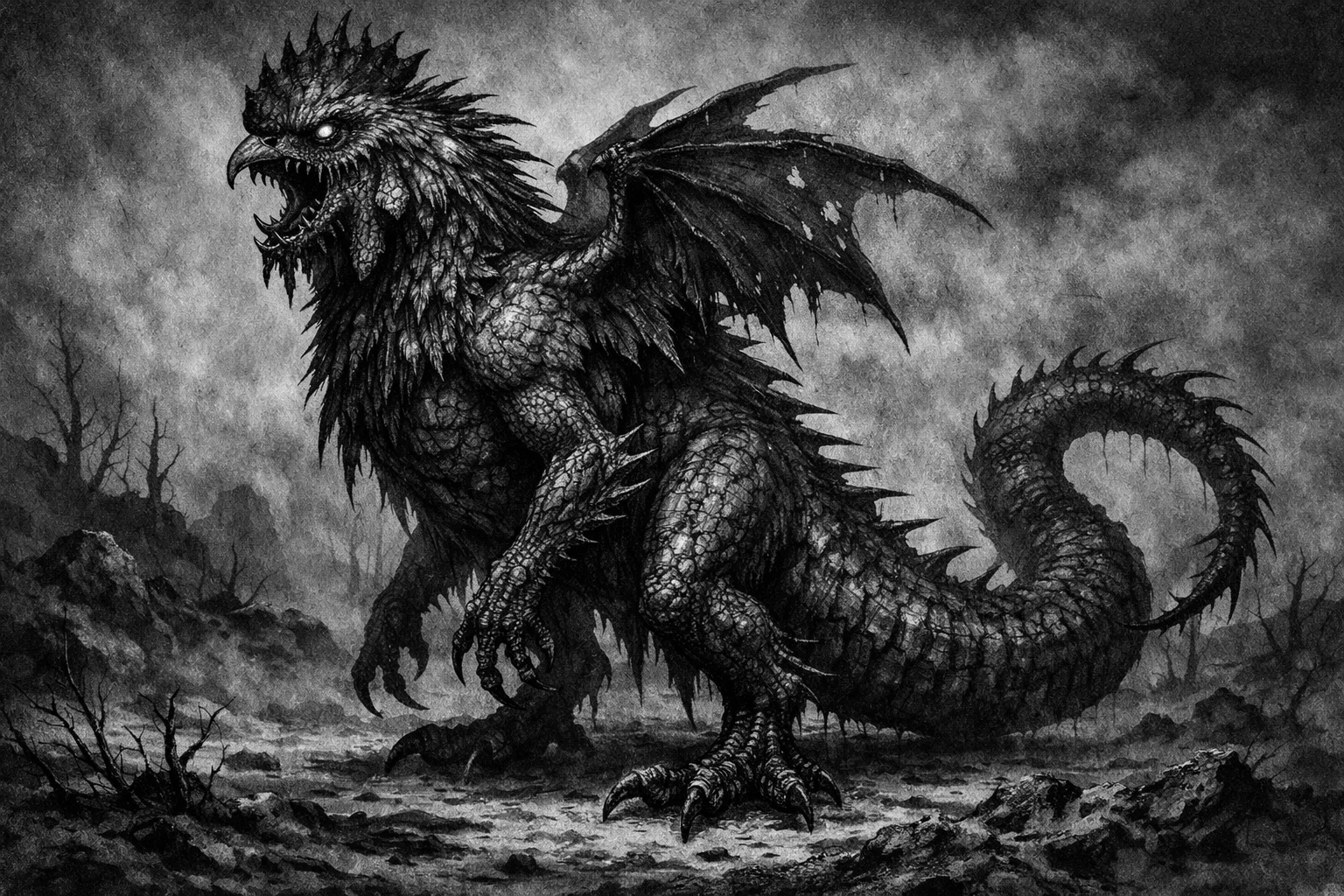
The Basilisk is a legendary reptile known as the king of serpents in European folklore. Famous for its deadly powers, it is said to kill with just a look or its poisonous breath. Although its appearance has changed over time—from a small snake to a creature with a rooster’s head—it has always been seen as a top predator in myths from ancient and medieval times.
Summary
Key Takeaways
| Attribute | Details |
| Names | Basilisk, Basilicok; derived from the Greek “basiliskos,” meaning “little king.” |
| Nature | Supernatural beast / Serpent. |
| Species | Reptilian / Chimeric. |
| Appearance | A serpent with a crown-like crest; later depicted with the body of a cock and the tail of a snake. |
| Area | Cyrene, Libya (North Africa); later all of Europe. |
| Creation | Hatched from a cock’s egg incubated by a toad or serpent. |
| Weaknesses | The odor of a weasel, the crowing of a rooster, or seeing its own reflection. |
| First Known | 1st Century AD, “Naturalis Historia” by Pliny the Elder. |
| Myth Origin | Greek and Roman natural history / European folklore. |
| Strengths | Lethal gaze (venomous sight), toxic breath, and scorched-earth presence. |
| Diet | Carnivorous, though it often kills more than it consumes via passive toxicity. |
| Protection | Mirrors or carrying a weasel or rooster. |
Who or What Is the Basilisk?
The Basilisk is a legendary creature from ancient and medieval times, best known for its extreme deadliness. Early stories describe it as a small snake, usually less than a foot long, but with power far greater than its size. It was marked by a white spot or crest on its head, like a crown, which is why it was called the king of serpents.
Unlike most snakes that move close to the ground, the Basilisk was often described as raising the middle part of its body so it could look its victims in the eye.
As time passed, stories about the Basilisk mixed with those of the Cockatrice, giving it more bird-like features such as wings and claws. No matter how it looked, the Basilisk was known for its deadly effect on the environment. People believed it was so poisonous that it could make plants die, crack rocks, and even poison the air, leaving destruction wherever it went.
Ever Wondered About the Secret Lives of Greek Gods and Heroines?
Limited-Time: Up to 32% OFF!
The Classical Mythology Encyclopedia: Gods, Heroes, and Heroines – 1,000+ entries • Epic tales of Olympus • Goddesses, monsters, and divine intrigues • Ancient rituals & timeless legends. This is Nancy LoCicero’s ultimate guide to the myths that inspired Western civilization.
Genealogy
| Relation | Identity |
| Progenitor | A rooster (specifically a seven-year-old cock). |
| Incubator | A toad or a serpent. |
| Related Entities | The Cockatrice (often considered synonymous in later medieval lore). |
Etymology
The word Basilisk comes from the Greek basiliskos, meaning “little king.” This name refers to the crown-like mark or crest on its head. The Romans later used the Latin word basiliscus. The name shows the creature’s supposed rule over other animals; even though it was small, other snakes and beasts were said to run away from its hiss.
During the Middle Ages, the name changed as the legend spread across Europe. In Old French, it was called basilic, and in Middle English, names like basilicok appeared. These changes show how the creature’s story started to include more rooster-like features.
By the 14th century, people often confused the Basilisk with the Cockatrice, whose name comes from the Old French calcatrix. In some languages, the two names were used for the same creature, and the “cock” part in English made people believe it was born from a rooster’s egg.
The name is also linked to the African region of Cyrene. Early writers thought the name fit because the Basilisk didn’t need to attack to kill; its royal status meant it could kill by will or gaze alone.
What Does the Basilisk Look Like?
Descriptions of the Basilisk have changed a lot over time. In Pliny the Elder’s writings, it was a small snake, less than a foot long, with a white mark on its head like a crown. It had no legs but moved in an upright way.
In the Middle Ages, the Basilisk was described in a much stranger way. It often had the head, chest, and wings of a rooster, sometimes with black or yellow feathers, and the lower body and tail of a big snake or dragon.
Some stories even gave it toad’s feet or extra legs. Still, the Basilisk was almost always described as having sharp yellow eyes, believed to be the source of its deadly stare, and a crown-like crest that set it apart from ordinary snakes.
Mythology
The mythology of the Basilisk began in the 1st century AD with the writings of Roman naturalists. Pliny the Elder, in his Naturalis Historia, recorded the creature as a biological reality living in the deserts of North Africa.
According to Pliny, the Basilisk was so venomous that if a man on horseback stabbed it with a spear, the poison would travel up the shaft and kill not only the rider but the horse as well.
In the 2nd century, the poet Lucan wrote in Pharsalia about the various serpents encountered by Cato the Younger’s army in the Libyan desert, describing the Basilisk as the most dreaded because it could kill without a bite.
As Christianity spread through Europe, the Basilisk was incorporated into the Bestiaries, where it took on symbolic weight. It was frequently used as a metaphor for the devil or the sin of envy, which “withers” what it looks on.
The Basilisk’s creation myth was standardized during the medieval period. It was believed that a seven-year-old rooster would lay a small, leathery egg (a centenine egg).
This egg, which lacked a shell, had to be incubated by a toad or a serpent in a dung heap. This unnatural union of bird and reptilian elements was thought to produce the ultimate monstrosity.
Demons, Ghosts, and Vengeful Spirits
Limited-Time: Up to 22% OFF!
Something Wicked from Japan – 150+ haunting ukiyo-e masterpieces • Yūrei, yōkai, and oni • Blood-soaked legends • Severed heads • Demonic seduction • Erotic horrors & grotesque beauty. The most terrifying (and beautiful) book of Japanese art ever printed.
Legends
The Duel in the Desert: The Weasel’s Sacrifice
In the scorched provinces of Cyrene, the Basilisk was not a myth but a terrifying environmental reality. Roman legionnaires and local nomads spoke of the creature as the desert’s shadow. This beast turned fertile oases into salt flats.
One of the most long-lasting stories from this era involves a village plagued by a Basilisk that had nested in a deep limestone crevice near their only well. The air around the well had grown thick and yellow; birds that flew over the opening dropped mid-flight, their lungs seared by the vapors.
The elders of the village, recalling the natural histories of the time, did not reach for swords or spears. Instead, they sought a common weasel. They captured the small, agile predator and brought it to the mouth of the crevice.
As the legend goes, the villagers stood back as the weasel was released. The Basilisk hissed, a sound like dry autumn leaves scraping on stone, and the other serpents in the area fled in a frantic wave. The weasel, driven by an instinctual, murderous trance, descended into the dark.
Inside the burrow, the Basilisk attempted to strike with its gaze, but the weasel’s movements were a blur of fur and muscle. The creature’s breath, which would have withered an oak tree, seemed only to embolden the small hunter.
The weasel eventually sank its teeth into the serpent’s neck, releasing a musk so pungent and foul that it acted as a counter-venom to the Basilisk’s own toxicity. When the villagers finally ventured near, they found both animals dead.
The Basilisk had been throttled, but the weasel had succumbed to the sheer concentration of poison in the air. This story cemented the idea that nature provides a remedy for every evil, even if that remedy requires a total sacrifice.
The Mirror of Alexander the Great
During his campaigns through the East, Alexander the Great encountered many wonders, but none so deadly as the “Gaze of the Golden Crest.” According to medieval accounts, Alexander’s army was halted at the edge of a narrow mountain pass by an invisible killer.
Soldiers at the front of the line began to drop dead without a mark on their bodies. There were no arrows, no hidden pits, and no sign of an enemy army. The men began to whisper of a curse or a divine wrath.
Alexander summoned his mentor, the philosopher Aristotle, to investigate the phenomenon. Aristotle, observing the way the bodies fell—eyes wide and faces pale—deduced that a Basilisk was perched atop the high rocks overlooking the pass. He knew that to look on the beast was to invite certain death, and to strike it with a spear would only allow the venom to travel up the shaft to the heart of the soldier.
Aristotle’s solution was a masterpiece of tactical logic. He ordered the construction of a massive, polished steel mirror, as tall as a man and twice as wide. He commanded two soldiers to carry the mirror ahead of the phalanx, keeping the reflective surface facing the rocks above. As they moved into the pass, a sudden, piercing shriek echoed off the canyon walls.
The Basilisk, seeing its own lethal image reflected in the polished steel, was struck by the very power it used to dominate others. The soldiers found the beast slumped over a jagged peak, its own eyes turned to stone or clouded by its reflected venom. Alexander marched his army over the carcass, proving that intellect and reflection can overcome even the most absolute of predators.
The Terror of the Warsaw Cellar
In the year 1572, the city of Warsaw was gripped by a panic that originated beneath the “House of the Giant” in the Old Town. Two young girls, the daughters of a prominent smith, had been playing hide-and-seek near an abandoned cellar.
When they failed to return for the evening meal, a search party was formed. A servant woman, carrying a candle, descended into the dark dampness of the basement. She did not scream; she simply ceased to be heard. When the smith followed her, he found all three lying in the dust, their skin turned a sickly, bruised purple, as if they had been strangled by the air itself.
The city’s physicians declared that a Basilisk had hatched in the foundations of the city. No one dared to enter the cellar to retrieve the bodies, let alone kill the beast. Finally, the city magistrates turned to a man named Johann Faurer, a prisoner who had been sentenced to death for a capital crime. They offered him a simple bargain: face the beast and live as a free man, or stay in his cell and wait for the gallows.
Faurer, having nothing to lose, requested a unique set of armor. He asked the city’s tailors to sew dozens of small, hand-sized mirrors onto a suit of thick, black leather. He donned a helmet with a narrow slit that allowed him to see only his feet.
Carrying a long pair of iron tongs and a heavy sack, he descended into the cellar. The townspeople waited in the square in total silence. They heard the sound of glass clinking against stone, then a series of frantic, wet thuds.
Minutes later, Faurer appeared, dragging a heavy sack behind him. He had not looked the beast in the eye, but the mirrors on his suit had done the work for him. Inside the sack was a creature described as a serpent with the comb of a cock and the feet of a toad. Faurer was pardoned, and the story became a grim reminder that redemption often lies in the heart of the most terrifying darkness.
The Judicial Execution of the Basel Rooster
Perhaps the most peculiar legend involving the Basilisk is not one of a hero slaying a dragon, but of a city’s legal system attempting to prevent a monster’s birth.
In August of 1474, in the town of Basel, a dark cloud of superstition descended upon the marketplace. A seven-year-old rooster, owned by a local peasant, was witnessed performing an “unnatural act”: it had laid a small, shell-less egg in a pile of warm dung.
The news spread through the city like a fever. The people believed that if a toad were to find the egg and sit on it, a Basilisk would hatch and destroy the city. The rooster was arrested by the city guards and thrown into a dungeon. A formal trial was convened in the town hall, presided over by the High Judge of Basel. The rooster was brought before the court, and a lawyer was appointed to defend the bird.
The prosecution argued that the rooster had entered into a pact with the devil to produce a “centenine egg,” the seed of a Basilisk. The defense countered that the egg was a freak of nature, a biological error, and that the rooster possessed no “evil intent” or soul capable of making a pact.
The trial lasted for days, with the city’s clergy and scholars debating the nature of spontaneous generation and demonic influence. In the end, the judge ruled that the risk to the public was too great to ignore.
The rooster and the egg were sentenced to death by fire. A great pyre was built in the center of Basel. Before a crowd of thousands, the bird was executed with the same solemnity as a human heretic. The legend of the Basel trial is a historical and perfect example to how deeply the fear of the Basilisk’s birth was woven into the fabric of medieval life.
The Knight of the Saffron Shirt: The Legend of Renward Cysat
In the Swiss mountains near Lucerne, legends persist of a Basilisk that dwelt in a deep well, poisoning the water supply and killing cattle that wandered too close. The local knight, Renward Cysat, was a man of science as much as a man of the sword. He noticed that the Basilisk seemed to avoid certain bright colors, particularly the deep yellow of the saffron flower.
Cysat fashioned a “Saffron Shirt,” a garment dyed in a concentrated extract of the plant, believed to have purifying properties. He also carried a rooster under his arm, veiled in a black cloth. As he approached the well, the air grew cold, and the grass beneath his boots turned to ash.
The Basilisk appeared, its yellow eyes glowing like embers in the gloom. Cysat did not flinch. He whipped the cloth off the rooster, and the bird, startled by the sudden light and the presence of the predator, let out a piercing, triumphant crow.
The sound was like a physical blow to the Basilisk. It recoiled, its body thrashing in agony. The legend states that the high frequency of the rooster’s cry shatters the internal organs of the serpent-king. While the beast was disoriented, Cysat lunged forward and drove a spear through its heart.
To ensure the poison did not claim him, he immediately burned the shirt and the spear in a holy fire. This legend highlights the importance of heraldry and specific natural deterrents in the fight against supernatural threats.
The One Book That Turned “Monster Hunting” From Joke to Actual Science
Limited-Time: Up to 46% OFF!
Bigfoot, Loch Ness, Chupacabras, Mothman, Yeti, and dozens more – the original A-to-Z encyclopedia with 100+ fully researched cryptids, eyewitness accounts, expedition histories, and the evidence that made skeptics sweat. Loren Coleman and Jerome Clark’s 1999 classic that launched a thousand investigations.
The Chronicles of the Vienna Basilisk
In 1212, a similar terror struck Vienna. A servant went to fetch water from a well in the Schönlaterngasse (Beautiful Lantern Lane) and saw a hideous creature at the bottom. The smell was so overwhelming that the servant fainted and nearly drowned. A local scholar was brought to the scene and identified the beast as a Basilisk, born from a rooster’s egg incubated by a toad in the city’s cesspools.
The scholar warned that the creature could not be touched. The townspeople decided to seal the well, but a brave young baker’s apprentice named Hans, who was in love with the daughter of the master baker, volunteered to kill it to prove his worth. Following the scholar’s advice, Hans did not use a sword. He took a large, hand-held mirror and lowered himself into the well on a rope.
The reflection of the lantern light off the mirror and the sight of its own face caused the Basilisk to burst into flames or, as some versions say, simply turn into stone. Hans was hauled back up, a hero.
To this day, a stone statue of the Basilisk remains on the facade of a building in that very street in Vienna, a permanent record of the day the “king of serpents” was defeated by a simple reflection of its own malice.
The Death of the Centurion
One final legend from the Roman occupation of Britain tells of a Centurion who encountered a Basilisk while scouting the marshes of East Anglia. The Centurion, a man of immense strength, spotted the small, crested snake sunning itself on a fallen log. Unaware of the creature’s true nature, he struck it down with his heavy pilum (spear).
The spear pierced the creature cleanly, pinning it to the wood. However, as the Centurion reached out to retrieve his weapon, he felt a sudden, icy chill racing up his arm. The venom, according to the legend, had traveled through the iron tip and up the wooden shaft with the speed of lightning. Within seconds, the Centurion’s arm turned black.
Within minutes, he fell dead beside the creature he had slain. His horse, which stood a few feet away, also collapsed, poisoned by the mere proximity of the dying beast’s final, toxic breath. This story was often told to Roman recruits as a warning: some enemies are more dangerous in death than they are in life.
Basilisk vs Other Monsters
| Monster Name | Origin | Key Traits | Weaknesses |
| Basilisk | Europe/Africa | Lethal gaze, crest/crown. | Weasels, mirrors, roosters. |
| Medusa | Greece | Snake-like hair, petrifying gaze. | Decapitation, mirrors. |
| Gorgon | Greece | Scaly hide, tusks, deadly sight. | Reflective surfaces. |
| Catoblepas | Ethiopia | Heavy head, lethal downward gaze. | Its own physical sluggishness. |
| Cockatrice | Europe | Rooster-serpent hybrid. | Weasels, rooster crows. |
| Culebre | Spain | Large winged serpent/dragon. | Loud noises, honey. |
| Tarasque | France | Six legs, turtle shell, lion head. | Prayer, holy water. |
| Amphisbaena | Greece | Two-headed serpent. | Fire. |
| Nidhogg | Scandinavia | Dragon gnawing at world tree. | The stability of Yggdrasil. |
| Hydra | Greece | Multiple heads, acidic blood. | Cauterization of necks. |
The Basilisk shares a “gaze-based” lethality with creatures like Medusa and the Catoblepas, making them part of a specific class of mythological entities that kill through visual contact. However, the Basilisk is distinct because its toxicity extends beyond its sight; it poisons the air and ground, a trait more common in dragons or the Hydra.
While Medusa is a singular cursed individual, the Basilisk is a species formed through a specific, albeit rare, biological process. Its weaknesses are also more domestic and grounded in natural history—such as the crow of a rooster—compared to the divine or heroic interventions required to slay a Gorgon.
Powers and Abilities
The Basilisk is widely considered one of the most dangerous entities in folklore due to its passive and active offensive capabilities. Its primary power is its deadly gaze, which is described in various texts as being so potent that it can crack rocks and cause birds to fall from the sky. Unlike other predators that must hunt, the Basilisk exerts a constant “aura” of death.
Beyond its sight, its respiratory and physical secretions are incredibly toxic. It does not merely kill prey; it renders the entire environment uninhabitable. Its venom is so concentrated that it can be transmitted through objects, such as a spear or sword used against it.
- Lethal Gaze: The ability to kill any living creature by making eye contact.
- Toxic Breath: Exhaling vapors that wither plants and poison the atmosphere.
- Scorching Presence: Leaving a trail of scorched earth where nothing can grow.
- Transmitted Venom: Poison so potent it can travel up a weapon to kill the wielder.
- Sonic Fear: A hiss so terrifying that all other snakes flee immediately after hearing it.
Can You Defeat a Basilisk?
Defeating a Basilisk requires specific tools or animals, as direct combat is almost certainly fatal. The most effective method documented in folklore is the use of a mirror. By forcing the creature to look at its own image, its gaze is turned inward, resulting in its immediate death.
If a mirror is unavailable, biological deterrents are necessary. The weasel is the only animal cited in classical texts as being immune to the creature’s toxicity or capable of killing it through its scent. Additionally, the crowing of a rooster is said to be fatal to the Basilisk; travelers in regions suspected of harboring the beast were advised to carry a rooster with them for protection.
Finally, some legends suggest that the creature can only be killed from a distance with a projectile, provided the attacker does not look into the creature’s eyes during the attempt.
Conclusion
The Basilisk is a great example of how stories and natural history can mix over time. It began as a small but deadly snake in Pliny the Elder’s writings. It later became a symbol of total destruction in the Middle Ages. Its deadly stare has made it a lasting part of monster legends, seen as both an environmental and a predatory threat.
Stories about the Basilisk’s battles with the weasel and its weakness to its own reflection show the old idea that every powerful creature has a simple flaw. Whether seen as a strange animal from ancient times or a scary monster from the Middle Ages, the Basilisk is still known as the king of serpents.