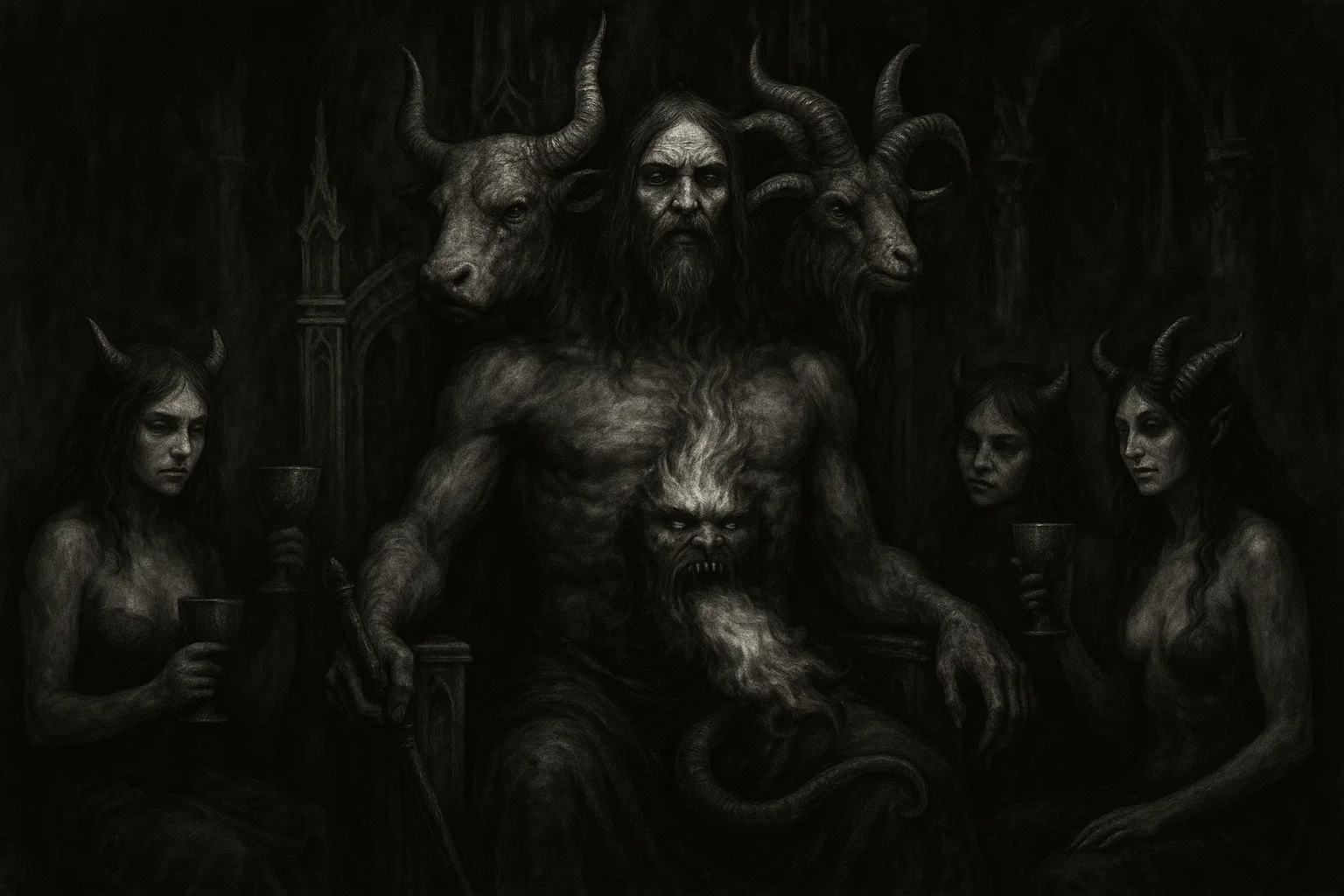
Asmodeus is known as one of the most powerful and infamous figures in Judeo-Christian demonology and Middle Eastern folklore. He is often called a Prince of Hell and is mainly linked to spreading lust, breaking up marriages, and stirring up anger. Stories about him appear throughout history, including in the deuterocanonical books of the Bible, Talmudic legends, and Renaissance-era grimoires.
He is often shown as a clever and cruel demon. Legends say he runs gambling houses in Hell and is the main enemy of marriage. His influence is known for overturning the moral order and causing trouble in both home and spiritual life.
Summary
Key Takeaways
| Attribute | Details |
| Name | Asmodeus, Asmoday, Ashmedai, Asmodee, Sidonay, Asmodaios, Hasmoday. |
| Title | Prince of Hell, King of Lust, Lord of Wrath, The Destroyer, Superintendent of Gambling Houses. |
| Gender | Male. |
| Origin | In Zoroastrianism, he is derived from the demon Aeshma-deva. In Jewish lore, some traditions claim he is the son of Adam and Lilith, or the offspring of a fallen angel and the mortal Naamah. |
| Appearance | Commonly depicted with three heads: a bull, a man, and a ram. He has the tail of a serpent, webbed feet like a goose, and rides on an infernal dragon while holding a lance and banner. |
| Hierarchy | A King or Prince; listed as the 32nd spirit in the Ars Goetia. He is often cited as one of the Seven Princes of Hell. |
| Superior Demon | Usually listed as subordinate to Lucifer or Amaymon, though he has high sovereign status. |
| Servitors | Commands 72 legions of inferior spirits; in some traditions, he rules over various classes of shedim or jinns. |
| Associated Figures | King Solomon, the Archangel Raphael, Sarah (daughter of Raguel), Tobias, and sometimes Lilith as a consort. |
| Powers | Governance over lust and carnal desire, the ability to grant invisibility, teaching geometry and astronomy, discovering treasures, and sowing discord in marriages. |
| Weaknesses | The smoke of a burning fish’s heart and liver (as seen in the Book of Tobit), the Seal of Solomon, and the intervention of the Archangel Raphael. |
| Opposing Angel/Saint | Archangel Raphael; sometimes identified as Saint John the Baptist in specific Christian classifications. |
| Equipment/Tools | A lance and a banner. |
| Pantheon | Jewish Folklore, Christian Demonology, Zoroastrianism. |
| Notable Myths | The Book of Tobit, The Testament of Solomon, and various Midrashic accounts regarding the construction of the First Temple. |
Etymology
Many believe the name Asmodeus comes from the Avestan name Aeshma-deva. In ancient Zoroastrianism, Aeshma means wrath or fury, and deva means a demon or a false god. So, the name is often taken to mean the “Demon of Wrath.” This shows that Asmodeus has roots in Persian beliefs before becoming part of the Hebrew tradition.
In Hebrew, the name appears as Ashmedai. Some researchers link it to the Hebrew word shamad, meaning “to destroy.” In this sense, the demon is seen as “The Destroyer.”
This dual heritage from Persian and Hebrew sources reflects his transition from a general spirit of anger to a more specific personification of lust and marital disruption in later Judeo-Christian literature.
The transition of the name into various European languages—such as Asmodée in French and Asmoday in English grimoires—has maintained these core meanings of destruction and intense passion.
Ever Wonder What This Knowledge Was So Dangerous They Had to Forbid It by Law?
Limited-Time: Up to 71% OFF!
From love-binding spells that never fail to curses that follow bloodlines, from reading death in tea leaves to summoning shadows that answer questions – every forbidden practice they tried to erase is here, raw and unfiltered, exactly as it was whispered in the dark for generations.
What Does the Demon Asmodeus Look Like?
The Ars Goetia describes Asmodeus as having a frightening and unusual appearance meant to scare people. He is said to have three heads: one like a bull, showing strength and stubbornness; one like a man, showing his cleverness; and one like a ram, a symbol of lust and sacrifice.
His body is just as strange as his heads. He has goose feet and a serpent’s tail, which are common features in old drawings of demons. He also holds a lance with a banner in his hands.
Instead of walking, he rides on a dragon from Hell. He can also breathe fire from his mouths. Although he appears terrifying, accounts say he speaks well and is very intelligent, especially when talking to someone brave enough to face him.
You may also enjoy:
Mastema: The Angel of Hostility Who Tested the Faithful
September 29, 2025
The Japanese Kappa Monster: A Dark Obsession With Humans
September 9, 2025
Who Is the Demon Amy (Avnas) in the Ars Goetia?
April 28, 2025
Historical and Mythological Background
The Destruction of the Seven Husbands in the Book of Tobit
The Book of Tobit, a deuterocanonical work, provides one of the most detailed accounts of Asmodeus’s malevolence. The narrative focuses on Sarah, the daughter of Raguel, who lives in Media. Sarah is afflicted by the demon Asmodeus, who has fallen in love with her and refuses to let any mortal man claim her.
Each time Sarah marries, the demon enters the bridal chamber on the wedding night and kills the bridegroom before the marriage can be consummated. This tragedy repeats seven times, leaving Sarah in such deep despair that she contemplates suicide. However, she chooses instead to pray for deliverance.
Simultaneously, the young man Tobias is sent by his blind father, Tobit, to collect a debt in Media. He is accompanied by the Archangel Raphael, who travels in human disguise under the name Azarias.
During their journey, Tobias washes his feet in the Tigris River when a large fish leaps from the water. Raphael instructs Tobias to catch the fish and carefully preserve its heart, liver, and gall. Raphael explains that smoke from the heart and liver can expel a demon or evil spirit.
After arriving in Media, Tobias falls in love with Sarah. Despite his fear of the demon, he follows Raphael’s instructions. On his wedding night, Tobias places the fish’s liver and heart on the embers of the incense. The resulting odor is so repulsive to Asmodeus that he flees from the chamber.
The demon escapes to the remotest parts of Egypt, where Raphael pursues and binds him hand and foot, permanently ending his torment of Sarah.
The Capture of Ashmedai and the Construction of the First Temple
In the Babylonian Talmud, specifically within the tractate Gittin, a legend describes how King Solomon sought to build the Temple without using iron tools, as iron is a metal of war. To do this, he required the Shamir, a mythical worm capable of splitting the hardest stone. Solomon learned that the secret of the shamir was known only to Ashmedai (Asmodeus), the King of the Demons.
Solomon sent his chief officer, Benaiah son of Jehoiada, to capture the demon. Benaiah found the well from which Ashmedai drank, drained the water, and refilled it with strong wine.
After Ashmedai drank and fell into a deep sleep, Benaiah bound him with a chain engraved with the Holy Name of God. When Ashmedai awoke and realized he was trapped, Benaiah led him to Solomon’s court.
Along the way, Ashmedai exhibited strange behavior, such as weeping at a wedding and laughing at a man buying shoes, later explaining that he saw the future: the groom would die in three days, and the man would not live to wear his new shoes.
After meeting Solomon, Ashmedai eventually revealed the location of the shamir. Solomon then kept the demon in his service to assist in the building of the Temple. During this period, Ashmedai remained under the king’s control until he eventually managed to trick Solomon into removing his protective ring, leading to the king’s temporary exile and the demon’s brief usurpation of the throne.
The One Book They Took Out of Your Bible
Limited-Time: Up to 90% OFF!
Banned for centuries, now fully restored with the real names of the fallen angels intact. Discover why 200 Watchers descended, taught forbidden knowledge, created the Nephilim giants, and triggered the Flood – the missing scripture that changes everything you thought you knew about Genesis.
The Usurpation of the Throne of Israel
Following the completion of the Temple, Ashmedai remained in Solomon’s court. One day, the demon challenged Solomon, claiming that the king’s power rested solely on the merit of his magical ring. Ashmedai convinced Solomon to grant him the ring and remove his chains to prove his inherent superiority.
As soon as Solomon complied, Ashmedai grew to gargantuan proportions, stretching from the Earth to the Heavens. He threw Solomon four hundred parasangs away from Jerusalem and swallowed the ring.
Ashmedai then assumed the physical appearance of King Solomon and took his place on the throne. For several years, he ruled Israel, and none of the advisors noticed the change. However, some grew suspicious of the “king’s” increasingly erratic and cruel behavior toward the law and his harem.
Meanwhile, the real Solomon was forced to wander as a beggar, crying out that he was the true king, only to be mocked. Eventually, Solomon found work in a kitchen and discovered his ring inside the belly of a fish he was preparing.
After putting the ring back on, he returned to Jerusalem. When Ashmedai saw the true king entering the palace while wearing the ring, the demon fled in terror, and Solomon was restored to his kingdom.
Asmodeus and the Seduction of Naamah
In certain strands of Zoharic and Kabbalistic lore, Asmodeus’s origin is tied to the generations following the Fall of Man. One myth suggests that Asmodeus was born from the union of a fallen angel (often identified as Shamdon) and Naamah, the sister of Tubal-cain. Naamah was said to be so beautiful that her appearance caused the “sons of God” to fall into sin.
From this union, Asmodeus appeared as a spirit of discord and carnal desire. Unlike other demons who were purely spiritual, this lineage gave Asmodeus a unique connection to the physical world, allowing him to interact more directly with human passions.
He is described in these texts as the king of the shedim (spirits). His role is to test the purity of men, particularly those who are pious, by appearing in various forms to lead them into adultery or ritual impurity.
You may also enjoy:
Who Is Dagon? The Demon That Rose from Ancient Seas
September 29, 2025
Who Is Aka Manah? The Terrifying Demon of Wicked Intention
October 2, 2025
Inside the Lizzie Borden House Haunting: Real Ghost Encounters?
October 22, 2025
Who Is Vual in Demonology? Powers, Lore, and Origins
August 12, 2025
The Binding of Asmodeus in the Testament of Solomon
The Testament of Solomon, a Greek pseudepigraphical text, recounts a different version of the king’s interaction with the demon. In this narrative, Solomon uses a ring with the Pentalpha (Seal of Solomon) to summon Asmodeus.
When the demon appears, he is described as being filled with rage. He tells Solomon that he was born from a human mother and an angel, and that his primary goal is to thwart the happiness of newlyweds.
Solomon interrogates Asmodeus about his future. The demon reveals that his kingdom will one day be destroyed by a king born of a virgin and crucified on a cross.
Enraged by the demon’s arrogance, Solomon commands him to be bound with unbreakable chains. He forces him to perform the grueling task of trampling clay for the Temple’s foundation. Asmodeus is also forced to help move the heavy stones of the Temple, symbolizing the subjugation of carnal wrath to the service of the divine.
Asmodeus and the Rebellion of the Giants
In some versions of the Book of Enoch and associated fragments found in the Dead Sea Scrolls, there are references to spirits corresponding to Asmodeus’s attributes that participate in the corruption of the Earth before the Great Flood. These legends suggest that Asmodeus was among the spirits who taught men the “arts of deception” and the “vanity of the flesh.”
While not always named “Asmodeus” in every fragment, the descriptions of a spirit of fury and lust inciting the Nephilim (the giants) to war and debauchery align with the later established characteristics of the demon. These stories portray him as a catalyst for the divine judgment that eventually led to the destruction of the antediluvian world.
Ever Wonder What a Demon’s Real Name Is… and Why Saying It Is Dangerous?
Limited-Time: Up to 25% OFF!
The Encyclopedia of Demons & Demonology 400+ entries • Real history • Exorcisms & Ancient Evils • Possession • Terrifying photos. This is Rosemary Ellen Guiley’s masterpiece of the occult.
Historical Mentions
Dictionnaire Infernal (1863 edition, original text):
“Asmodée, démon destructeur. Quelques-uns disent qu’il est l’ancien serpent qui séduisit Eve. Les rabbins l’appellent Asmodée ou Schamadaï. Il est, selon eux, le roi des démons. C’est lui qui détrôna Salomon; mais bientôt Salomon le chargea de fers et le força d’aider à bâtir le temple de Jérusalem.”
Dictionnaire Infernal (1863 edition, English translation):
“Asmodeus, destroying demon. Some say he is the ancient serpent who seduced Eve. The rabbis call him Asmodeus or Shamadai. He is, according to them, the king of demons. It is he who dethroned Solomon; but soon Solomon loaded him with irons and forced him to help build the temple of Jerusalem.”
The Lesser Key of Solomon (Ars Goetia, 17th-century text):
“The Thirty-second Spirit is Asmoday, or Asmodai. He is a great King, Strong, and Powerful. He appeareth with Three Heads, whereof the first is like a Bull, the second like a Man, and the third like a Ram; he hath also the tail of a Serpent, and from his mouth issue Flames of Fire. His feet are webbed like those of a Goose. He sitteth upon an Infernal Dragon, and beareth in his hand a Lance with a Banner.”
The Magus (Francis Barrett, 1801):
“Asmodeus is the prince of the fourth order of spirits, which are called revengers of wickedness. He is likewise called the vessel of wrath, and is the prince of the spirits of the air.”
Lanterne of Light (1409 Lollard manuscript):
“The first is Leccheri, and his spirit is called Asmodeus. He is the prince of the thridde ordir of fendis, that ben callid revengours of wickidnesse. He is the vessel of wraththe.”
Pseudomonarchia Daemonum (Johann Weyer, 1577):
“Asmoday is a great king, strong and mightie: he appeareth with three heads, whereof the first is like a bull, the second like a man, the third like a ram, he hath a serpents taile, he belcheth flames out of his mouth, he hath feete like a goose, he sitteth on an infernall dragon, he carrieth a lance and a flagge in his hand, he goeth before the residue, which are under the power of Amaymon. When the conjuror exerciseth this office, let him be abroad, let him be warie and standing on his feete: if his cap be off, he will deceive him, and bewray all his dooings. But so soone as he seeth the ring he will give true answers, he maketh one marvelous in astronomie, geometrie, and all the liberall sciences, he answereth fullie and trulie to all demands, he maketh a man invisible, he sheweth the place where treasures lie, and gardeth them, he is among the legions of Amaymon, he governeth seventie two legions.”
Paradise Lost (John Milton, 1667):
“…better pleas’d / Then Asmodeus with the fishie fume, / That drove him, though enamourd, from the Spouse / Of Tobits Son, and with a vengeance sent / From Media post to Egypt, there fast bound.”
Livre des Esperitz (15th-century French manuscript):
“Asmodeus is a very great and powerful king. He is of the order of Thrones and he rules over lust. He gives true answers of all things and is a great master of all arts. He commands twenty-two legions.”
Asmodeus; or, The Devil on Two Sticks (Alain-René Le Sage, 1707):
“I am the demon of lechery, or, more politely, the god Cupid. At least, that is the name the poets have given me, but the Christians call me Asmodeus. I am the creator of the carrousel, the dance, the music, the drama, and all the new fashions in the world.”
Asmodeus’s Powers and Abilities
Asmodeus is said to possess numerous powers, primarily focused on corrupting individuals through desire and anger. He is often blamed for causing infidelity by tempting married people and breaking up families. His power is not just physical but also mental, as he can create obsessions that ruin reputations and lives.
Books like the Ars Goetia describe his powers more practically. He is said to be skilled in arithmetic, astronomy, and geometry, and can teach these subjects to those who summon him. He can also reveal the location of hidden treasures and make someone invisible. Still, his most dangerous power lies in his ability is provoke violent anger and jealousy.
You may also enjoy:
15 Most Terrifying Haunted Hotels in Alabama
October 6, 2025
Agares: The Duke of Hell Who Commands Earthquakes
April 22, 2025
Who Is Azazel, the Demon Who Corrupted Humanity?
September 29, 2025
Is The Anguished Man Painting Truly Cursed?
May 26, 2025
Powers and Abilities Breakdown
| Power/Ability | Description | Source | How It Tempts/Corrupts Humans |
| Incitement of Lust | Stimulates uncontrollable carnal desires. | Book of Tobit | Breaks marriages and encourages infidelity. |
| Invisibility | Can make a person unseen by others. | Ars Goetia | Encourages theft and voyeurism. |
| Knowledge of Sciences | Teaches math, astronomy, and geometry. | Lesser Key of Solomon | Promotes intellectual pride and occult reliance. |
| Treasure Location | Reveals gold and hidden riches. | Pseudomonarchia Daemonum | Encourages greed and material obsession. |
| Superintendent of Gambling | Oversees the luck and vice of gaming. | Dictionnaire Infernal | Leads individuals to financial ruin and addiction. |
The Only Medal Officially Recognized for Driving Out Demons
Limited-Time: Up to 25% OFF!
U7 St. Benedict Medal Necklace • Full ritual inscription in Latin • Instant shield against Satan & fallen angels • Stops nightmares, bad luck & spiritual attacks • Matte black steel for everyday concealed carry. The most powerful Catholic talisman you can legally own.
How to Counter Asmodeus’s Powers
Traditionally, people protect themselves from Asmodeus by using certain powerful-smelling and spiritually potent items. The most famous defense is incense made from fish liver and heart, as told in the Book of Tobit. The strong odor is said to drive him away immediately.
Other common ways to protect against him include using Holy Water and blessed salt, which are often used to keep away powerful demons. The Seal of Solomon is also seen as a strong protective charm, since it was used to bind him in the first place.
People who want protection often pray to the Archangel Raphael, who is known for healing and helping travelers. Today, some spiritual practices recommend keeping the home clean and using sage or frankincense to dispel the negative energy associated with lust and anger attributed to Asmodeus.
Asmodeus’s Role in the Hierarchy of Hell
In the rankings of Hell, Asmodeus is always seen as a top leader. In the 15th century, Peter Binsfeld named him one of the Seven Princes of Hell, in charge of the sin of Lust.
The Ars Goetia refers to him as a King, granting him control over 72 legions of spirits. His power is so great that he is often mentioned with Lucifer, Beelzebub, and Leviathan as one of the main rulers of the underworld.
Asmodeus’s relationships with other demons involve both working together and competing. Some Kabbalistic texts say he is married to Lilith, especially the “Younger Lilith,” and together they rule over the Sitra Achra, or the Other Side.
Their union is viewed as a dark copy of divine creation, meant to create many demonic children called shedim. In other stories, Asmodeus is said to fight with Beelzebub, since their powers over gluttony and lust often clash as they compete for human souls.
The Grimorium Verum states that Asmodeus serves under the demon Amaymon, known is the King of the East. Even so, Asmodeus has a lot of freedom and often acts as a main advisor to Lucifer, especially when it comes to leading people away from good behavior.
He is also frequently associated with Samael, sometimes being described as his son or a lower manifestation of the same destructive force. Within the infernal court, he is a judge and the Superintendent of Gambling Houses, maintaining order among the spirits of vice and ensuring that the hierarchies of Hell remain rigid and functional through the enforcement of wrath and desire.
Astrological Associations and Symbolism
Asmodeus is connected to the darker side of many symbols. Most traditions link him to the element of Fire, which matches his fire-breathing and the strong emotions of lust and anger. In numerology, he is often tied to the number 9, which can mean the end of a cycle or the ego in some occult beliefs.
| Association | Symbol/Detail |
| Zodiac Sign | Aquarius or Leo (varies by source). |
| Planet | The Sun or Venus (in its fallen aspect). |
| Element | Fire. |
| Metal | Gold (representing his rank as King). |
| Color | Red or Yellow. |
| Animal | Dragon, Bull, Ram, Goose. |
Asmodeus’s Sigil
The sigil of Asmodeus is a detailed geometric symbol found in the Lesser Key of Solomon. It is his spiritual “signature.” In old occult practices, this symbol was carved onto a gold breastplate to show his royal status. People use the sigil to connect with him. Still, according to lore, you should always be very careful and respectful to avoid being overpowered by his influence.
You may also enjoy:
Who Is Dagon? The Demon That Rose from Ancient Seas
September 29, 2025
Villisca Axe Murder House Haunting—A Chilling True Story
October 22, 2025
Zmeya: The Multi-Headed Dragon of Slavic Nightmares
September 11, 2025
What Is the Púca? Mythology, Origins, and Powers
January 30, 2026
Associated Symbols and Offerings
| Symbol/Item | Association/Meaning | Use in Rituals |
| Fish Liver/Heart | Banishment and repulsion. | Burned to drive the demon away. |
| Lance and Banner | Authority and war. | Symbolizes his conquest over souls. |
| Dragon | Primal power and destruction. | Represents his mount and terrifying nature. |
Similar Demonic Entities
| Demon Name | Gender | Primary Religion | Type / Class | Sphere of Influence | Weaknesses |
| Aeshma | Male | Zoroastrianism | Daeva | Wrath and Fury | Righteousness, Sraosha (Angel) |
| Astaroth | Male | Christianity | Grand Duke | Laziness, Vanity | St. Bartholomew, Holy Names |
| Belphegor | Male | Christianity | Prince | Sloth, Greed | Iron, Diligence |
| Lilith | Female | Judaism | Succubus/Queen | Infant death, Lust | Amulets with angelic names |
| Succubus | Female | European Folklore | Sexual Demon | Seduction, Dreams | Holy Water, Iron |
| Incubus | Male | European Folklore | Sexual Demon | Nightmares, Seduction | Prayer, Salt |
| Samael | Male | Judaism | Angel of Death | Severity, Destruction | Divine Decree |
| Mammon | Male | Christianity | Prince | Greed, Wealth | Charity, Poverty vows |
| Beelzebub | Male | Christianity | Prince | Gluttony, Envy | St. Francis, Holy Water |
| Pazuzu | Male | Mesopotamian | King of Demons | Famine, Locusts | Lamassu (Protective spirits) |
Conclusion
Asmodeus is still an important demon in demonology, symbolizing how dangerous uncontrolled human desires can be. From his start as a Persian spirit of wrath to his place as a King of Hell in later stories, he represents the ongoing fear of family problems and moral decline.
Stories about Asmodeus in both religious texts and folk tales show that people have long sought an entity to explain the challenges posed by lust and anger. Learning about the symbols and myths connected to Asmodeus helps us understand how ideas about evil have changed and how different cultures have tried to protect themselves from it.